
Relying on a manufacturer-provided Certificate of Analysis as your sole proof of purity is the fastest way to compromise a professional research protocol. You're likely already aware that the peptide market is saturated with domestic resellers who inflate prices by several hundred percent while offering zero visibility into the original synthesis source. The reality of sourcing ipamorelin from China in 2026 involves more than just finding a low price. It requires a methodical approach to supply chain transparency and a healthy skepticism toward "guaranteed" paperwork that often masks batch inconsistencies or reused data.
This guide provides the operational framework you need to move past the middleman and establish direct manufacturing connections. We'll detail how to handle the 2026 updates to China's export control laws and implement a repeatable verification protocol that treats HPLC and Mass Spectrometry reports as baseline data rather than definitive proof. You'll learn how to manage the logistical complexities of wholesale procurement, including the standard $600 minimum order requirement for professional channels. We'll also explain why independent third-party testing remains the only way to truly mitigate the risks of batch substitution or sub-par synthesis in an increasingly scrutinized regulatory environment.
Key Takeaways
Learn how to establish direct manufacturing connections to reduce cost-per-mg and eliminate the opacity of domestic reseller supply chains.
Understand the limitations of manufacturer-issued COAs and why independent testing is essential for verifying batch consistency and purity.
Navigate the technical complexities of sourcing ipamorelin from China by implementing professional-grade verification protocols and supply chain transparency.
Optimize your procurement process by utilizing B2B sourcing bridges that require a $600 minimum order to filter for serious professional operations.
Identify the critical role of TFA removal and Solid-Phase Peptide Synthesis metrics in evaluating the quality of wholesale peptide batches.
Table of Contents
The Realities of Sourcing Ipamorelin from the Chinese Market
Technical Synthesis and Ipamorelin Purity Metrics
Direct Sourcing vs. Reseller Models: A Procurement Analysis
Verification Protocols: Mitigating Sourcing Risks
Optimizing Ipamorelin Procurement with Peptides From China
The Realities of Sourcing Ipamorelin from the Chinese Market
The global peptide market doesn't operate on trust; it operates on verifiable data and tight supply chain control. For professional researchers, sourcing ipamorelin from China is often the only viable path to securing the volumes required for longitudinal studies without the massive markups imposed by domestic resellers. These resellers typically add several layers of cost while providing almost no visibility into the original synthesis source. This lack of transparency forces buyers to rely on third-party labels rather than direct manufacturer data, increasing the likelihood of receiving mislabeled or degraded compounds.
Ipamorelin is a selective growth hormone secretagogue pentapeptide frequently utilized in body composition research. Its mechanism involves binding to the ghrelin receptor to stimulate growth hormone release without significantly impacting prolactin or cortisol levels. Because of its targeted profile, it remains one of the most sought-after compounds in the research community. However, the high demand has led to a fragmented market where batch substitution and the reuse of outdated HPLC reports are common practices among low-tier suppliers.
The primary risk in the current market isn't just low purity; it's the systemic use of "reseller opacity." Many domestic shops claim to have "proprietary" synthesis methods when they're actually just relabeling bulk batches from the same few hubs in Hubei or Shenzhen. This practice obscures the chain of custody, making it impossible to trace a specific batch back to its synthesis date or the specific quality control metrics of the facility. Professional procurement requires bypassing these intermediaries to reduce both cost and variables in the research data.
The Evolution of Chinese Peptide Synthesis
The industry has shifted significantly toward large-scale automated synthesis facilities. This move away from manual, small-scale benchwork has improved consistency but also created a divide between high-output manufacturers and smaller, less regulated shops. In early 2026, China implemented a full-chain export control upgrade that impacted how dual-use items and chemical precursors are documented. These regulations have forced manufacturers to improve their internal reporting, yet many "Grade A" purity claims remain meaningless marketing fluff. Real quality is found in the raw analytical data, not the letter grade assigned by a sales agent.
Market Fragmentation: Factories vs. Trading Companies
Distinguishing between a genuine synthesis facility and a trading company is a critical skill for any procurement officer. Trading companies often pose as manufacturers by using stolen facility photos and generic documentation. They survive on high-turnover retail sales and rarely maintain the technical staff needed to interpret complex mass spectrometry reports. Direct access to manufacturer-side channels is essential for maintaining a consistent supply. When using Peptides From China as a B2B sourcing bridge, labs must adhere to professional procurement standards, including a $600 minimum order requirement. This threshold serves as a filter, ensuring that resources are dedicated to serious research operations rather than high-risk retail transactions.
Technical Synthesis and Ipamorelin Purity Metrics
High-quality synthesis begins with a rigorous adherence to Solid-Phase Peptide Synthesis (SPPS) protocols. For a pentapeptide like Ipamorelin, the process involves the sequential addition of protected amino acids onto a solid resin support. Each step requires precise deprotection and coupling cycles to ensure the correct sequence. When sourcing ipamorelin from China, labs must look beyond the final product and scrutinize the manufacturer's ability to manage these technical stages. Errors in the coupling of the D-amino acids or the Aib (aminoisobutyric acid) residue can lead to truncated sequences that are difficult to filter out during the final purification phase.
A critical but often overlooked metric in peptide quality is the removal of Trifluoroacetic acid (TFA). TFA is a standard reagent used during the cleavage of the peptide from the resin, but it remains as a counter-ion salt in the final powder. If a facility skips the necessary salt exchange process, the final vial may contain a high percentage of TFA by weight. This artificially inflates the purity reading while reducing the actual amount of active peptide available for research. Understanding Ipamorelin's chemical profile is essential for interpreting these data points. Professional buyers should prioritize batches that have undergone acetate or hydrochloride salt exchange to ensure a higher net peptide content.
It's vital to treat "99% purity" as a target for a specific batch rather than a permanent guarantee for all future orders. Purity is a snapshot of a single synthesis run. Batch-to-batch variability is an inherent reality of large-scale chemical production. Instead of looking for absolute claims, focus on manufacturers that provide reference analytical data for every unique lot number. This transparency helps reduce supply chain uncertainty and allows labs to adjust their research parameters based on the specific metrics of the material they receive.
The Role of HPLC and Mass Spectrometry
High-Performance Liquid Chromatography (HPLC) is the primary method for assessing purity levels. HPLC is a diagnostic tool used for measuring peak area percentages to determine the relative concentration of the target peptide against impurities. While HPLC shows how much of the substance is Ipamorelin, Mass Spectrometry (MS) confirms that the substance is actually what it claims to be. MS measures the exact molecular weight of the compound, ensuring the amino acid sequence matches the theoretical mass. Without both reports, a purity claim is technically incomplete.
Stability and Storage Considerations
The final stage of production is lyophilization, or freeze-drying, which removes moisture to create a stable powder. For international transit, vacuum sealing and nitrogen flushing are non-negotiable standards. These steps prevent oxidation and moisture ingress during the weeks-long shipping process from Chinese facilities. While lyophilized peptides are relatively stable, degradation risks increase during high-temperature transit periods in summer months. Labs should implement a protocol for immediate cold storage upon receipt. For organizations looking to streamline this technical vetting, using a B2B sourcing bridge can help ensure these manufacturing and packaging standards are met before the product leaves the facility.
Direct Sourcing vs. Reseller Models: A Procurement Analysis
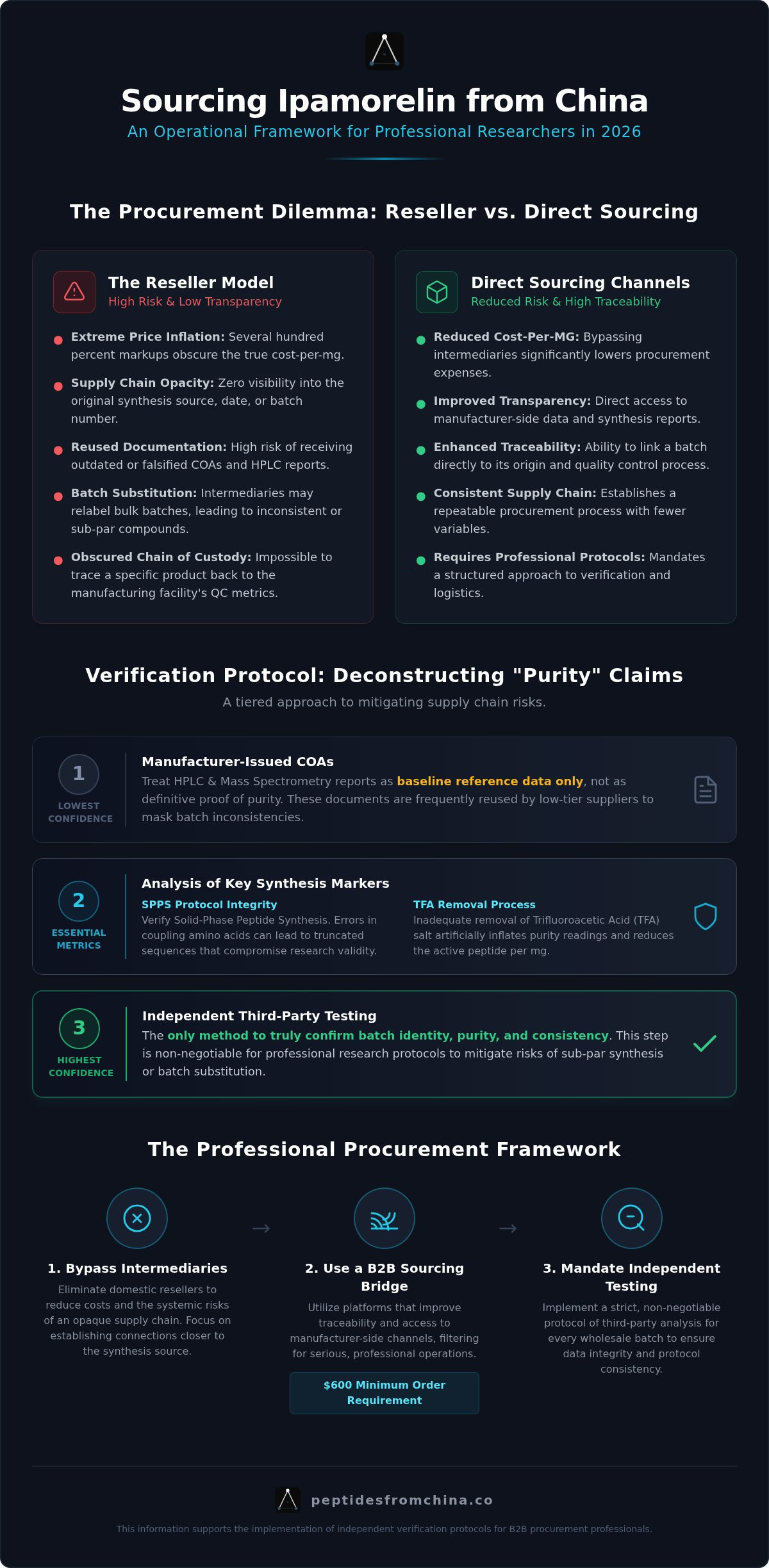
Most labs start their procurement journey by purchasing from domestic resellers. It's a choice driven by convenience, but that convenience carries a steep premium, often exceeding 400% of the original manufacturer's rate. When sourcing ipamorelin from China, the primary objective is to strip away these unnecessary financial and logistical layers. Every middleman added to the supply chain represents a potential point of documentation loss. Resellers rarely have a direct line to the synthesis chemist; they're simply moving inventory without a deep understanding of the batch's specific analytical history.
The "Domestic Warehouse" trap is a common hurdle for many procurement officers. Local shipping from a US or EU facility provides a superficial sense of security, but it often masks total supply chain ignorance. The reseller might not know which facility produced the vials or if the batch was part of a lot that barely met baseline purity standards. This lack of traceability is risky, especially since Ipamorelin is explicitly listed on the WADA Prohibited List. Researchers must maintain impeccable records and a clear chain of custody to ensure regulatory compliance and audit readiness.
Economic Logic of Bulk Procurement
High-volume research projects require a predictable and scalable budget. Purchasing individual retail vials is unsustainable for longitudinal studies. By shifting to wholesale peptides, labs can realize a significant ROI by drastically reducing the per-mg cost of the compound. Direct sourcing also facilitates better batch consistency. When you work closer to the source, you can track specific lot numbers, allowing you to request material from the same synthesis run if a previous batch performed well in your laboratory environment.
Transparency and Accountability
Direct communication with synthesis facilities is the only way to ensure that specific manufacturing requirements are met. Deciding whether to use a peptide sourcing agent vs platform is a strategic decision for any professional buyer. Peptides From China functions as a transparency-focused bridge, filtering out low-tier trading companies to connect you with verified synthesis facilities. We implement a $600 minimum order to ensure our operations are dedicated to professional labs and researchers who prioritize traceability and data integrity over retail-style convenience. Shortening the chain of custody is the most effective way to minimize points of failure and support independent verification protocols.
Verification Protocols: Mitigating Sourcing Risks
Accepting a Certificate of Analysis (COA) as absolute proof of quality is a fundamental error in B2B procurement. When sourcing ipamorelin from China, it's vital to recognize the "COA Fallacy." Many suppliers reuse analytical reports for years, applying the same 2024 data to a 2026 batch. These documents should be viewed as baseline technical reference material, not as a guarantee of purity. A professional protocol assumes that every manufacturer-provided paper needs independent validation before the material enters your laboratory workflow.
Implementing a "Trust but Verify" protocol helps reduce supply chain uncertainty. This approach doesn't rely on the manufacturer's internal quality control, which is often biased toward moving inventory. Instead, it relies on blind testing conducted by independent third-party laboratories. By sending random vials from a wholesale batch to an external facility, you establish a layer of accountability that most retail-focused buyers ignore. This process supports independent verification and ensures that your research isn't compromised by batch-to-batch variability.
The Independent Testing Workflow
Establishing a repeatable verification system is the only way to maintain operational consistency over time. The complexities of sourcing ipamorelin from China require a deep understanding of how synthesis facilities operate. Follow these steps for every new procurement cycle:
Step 1: For high-volume orders, request pre-shipment samples from the specific synthesis lot currently slated for fulfillment to establish a baseline.
Step 2: Upon receipt of the final wholesale batch, select random vials for blind testing at a qualified analytical facility to check for consistency.
Step 3: Compare the raw manufacturer HPLC data against your independent peptide testing results to identify any discrepancies in peak area or molecular weight.
Common Industry Pitfalls to Avoid
You must be able to spot red flags in analytical reports. Look for mismatched molecular weights on Mass Spectrometry reports; if the measured mass doesn't align with the theoretical mass of Ipamorelin, the compound is likely mislabeled or impure. Another risk is batch substitution, where a high-purity sample is provided initially, but the bulk order contains a different synthesis run with higher levels of baseline noise or truncated sequences. These practices are common in opaque supply chains where intermediaries have little control over the production facility. Professional procurement requires scrutinizing the chromatogram for abnormal peak integration or excessive baseline drift, which often indicates poor purification during the SPPS process.
Peptides From China acts as a transparency-first bridge, helping you avoid these pitfalls by connecting you directly to manufacturer-side channels. Because we focus on professional procurement, we require a $600 minimum order to ensure our resources are dedicated to labs that value data integrity. If you're ready to secure a more reliable research supply, connect with our sourcing team today to review our current batch-specific reference data.
Optimizing Ipamorelin Procurement with Peptides From China
PeptidesFromChina coordinates sourcing from established Chinese manufacturing facilities together with international logistics.
The $10 deposit initiates manual request processing and real-time stock verification and is credited toward the final invoice.
The PFC Sourcing Process
Our team meticulously vets peptide sourcing channels to ensure that every order follows a direct-to-manufacturer routing. This directness is essential for maintaining a clear chain of custody and reducing the likelihood of documentation errors. In the current 2026 regulatory environment, where China has implemented significant export control upgrades, having a direct line to the synthesis facility is critical. We provide batch-specific HPLC and Mass Spectrometry reports as baseline technical reference material. By removing hidden markups and intermediaries, we provide a transparent pricing structure that allows labs to optimize their research budgets without compromising on traceability.
Logistics and Customs Mitigation
Managing the international transit of research compounds requires an understanding of the expanded 2026 Catalogue of Dual-Use Items and increased customs scrutiny. We utilize neutral, non-descript packaging for all laboratory supplies to minimize unnecessary attention during the shipping process. This approach is a practical response to the stricter enforcement of pharmaceutical and chemical exports seen throughout the first half of 2026. Every shipment is tracked in real-time, providing global researchers with the visibility needed to manage laboratory timelines effectively. Our logistics protocol is designed to mitigate the typical anxieties of sourcing ipamorelin from China, offering a methodical and highly organized path from the production facility to your facility's receiving dock.
Establishing a Resilient Peptide Supply Chain
Procurement success in 2026 depends on your ability to bypass opaque intermediaries and verify every batch independently. You've learned that manufacturer-provided HPLC reports are merely baseline references, not definitive proof of purity. By prioritizing direct-to-manufacturer channels, you reduce the risks of batch substitution and excessive markups while gaining better control over your research variables. The complexities of sourcing ipamorelin from China require a methodical approach to both technical verification and international logistics.
Peptides From China supports this process by acting as a transparency-first bridge, connecting your lab to verified synthesis facilities while providing the tracking and neutral packaging necessary for global transit. Professional procurement isn't about finding the lowest retail price. It's about building a consistent, documented supply chain that withstands technical and regulatory scrutiny. We help you navigate these complexities through professional B2B sourcing protocols and direct-to-manufacturer access.
Begin your Ipamorelin sourcing request with a professional deposit at Peptides From China
Frequently Asked Questions
Is sourcing Ipamorelin from China safe for research purposes?
Safety in peptide procurement depends on the implementation of rigorous verification protocols rather than the country of origin. While China houses the world's largest synthesis infrastructure, the market contains variable quality levels. Sourcing ipamorelin from China is an exercise in risk management that requires independent laboratory testing to confirm the identity and purity of every batch before it enters a research environment. This step is essential to mitigate the risks of receiving mislabeled or impure compounds.
How can I verify if an Ipamorelin manufacturer is legitimate?
Legitimate manufacturers typically operate large scale facilities and provide batch specific reference analytical data rather than generic certificates. You can verify legitimacy by requesting specific documentation like HPLC and Mass Spectrometry reports for current lot numbers. Trading companies often fail to provide these or use outdated papers from previous years. Direct communication with the facility's technical staff regarding synthesis methods is a key indicator of a true manufacturer rather than a reseller.
What is the standard purity for research-grade Ipamorelin in 2026?
Research grade Ipamorelin typically targets a purity level of 98% or higher as measured by HPLC peak area percentage. However, purity is a variable metric that can fluctuate between synthesis runs. It's important to look at the net peptide content, which accounts for the presence of TFA salts and moisture. A high purity reading on a COA does not account for these factors, so independent salt exchange analysis is often necessary to confirm the actual peptide concentration.
Why do prices for Ipamorelin vary so much between Chinese suppliers?
Price variance usually reflects the number of intermediaries in the supply chain and the quality of the purification process. Large synthesis facilities offer lower per-mg rates for wholesale volumes, while trading companies add markups to cover their overhead. Lower prices may also indicate a lack of proper TFA removal or the use of older, less efficient synthesis methods that result in higher impurity profiles. Professional labs prioritize direct manufacturer access to eliminate these hidden costs.
Do I need to test every batch of Ipamorelin I receive from China?
Yes, independent testing is a non-negotiable requirement for professional research protocols. Manufacturer provided documents serve only as baseline technical reference material. Because batch substitution and the reuse of old analytical reports are common industry pitfalls, testing random vials from every new shipment helps reduce supply chain uncertainty. This practice ensures that the material in your lab matches the data provided by the supplier and supports independent verification of the compound's identity.
What happens if the Ipamorelin I source fails independent purity testing?
If a batch fails to meet your laboratory's required specifications, you should have a pre-negotiated resolution protocol with your sourcing bridge. Professional procurement involves documenting the discrepancy with your independent lab results and requesting a replacement from a different synthesis lot. Working through a B2B bridge like Peptides From China helps facilitate these manufacturing side corrections, as we prioritize long term reliability and batch traceability over one-off sales or retail convenience.
What are the typical lead times for custom synthesis of Ipamorelin?
In 2026, custom synthesis for wholesale batches typically requires a lead time of 10 to 15 business days. This period allows for the sequential Solid-Phase Peptide Synthesis process, purification, salt exchange, and lyophilization. International shipping and customs clearance generally add another 7 to 10 days depending on the destination. Planning for a three week procurement cycle helps ensure that your research timelines remain consistent despite the logistical variables inherent in manufacturer side supply channels.
How does Peptides From China handle customs and international shipping?
We manage international logistics by utilizing neutral, tracked shipping methods designed specifically for professional research labs. Our protocol includes using non-descript packaging to minimize scrutiny and providing real-time tracking data for every order. Because we focus on B2B procurement, we require a $600 minimum order, which allows us to dedicate the necessary resources to managing the complex documentation required for smooth border transit in the current regulatory landscape.