
A Certificate of Analysis in your inbox isn't a guarantee of quality; it's often just a digital file that's been recycled across dozens of batches and multiple resellers. For research institutions trying to secure wholesale peptides in 2026, the traditional domestic supply chain has become a minefield of high markups and opaque origins. You likely already know that relying on a middleman's word is a significant operational risk that can compromise months of laboratory work and yield inconsistent data.
PFC coordinates sourcing from established Chinese manufacturing facilities together with international logistics. You'll learn how to treat manufacturer documentation like HPLC and Mass Spectrometry reports as baseline data rather than final proof, and why independent verification remains the only viable path to consistency. PeptidesFromChina currently has a $600 total minimum order. Multiple catalog products can be combined to reach the minimum, with orders starting from one 10-vial kit per product. We'll outline a methodical strategy for improving batch traceability and reducing supply chain uncertainty in an increasingly complex regulatory environment.
Key Takeaways
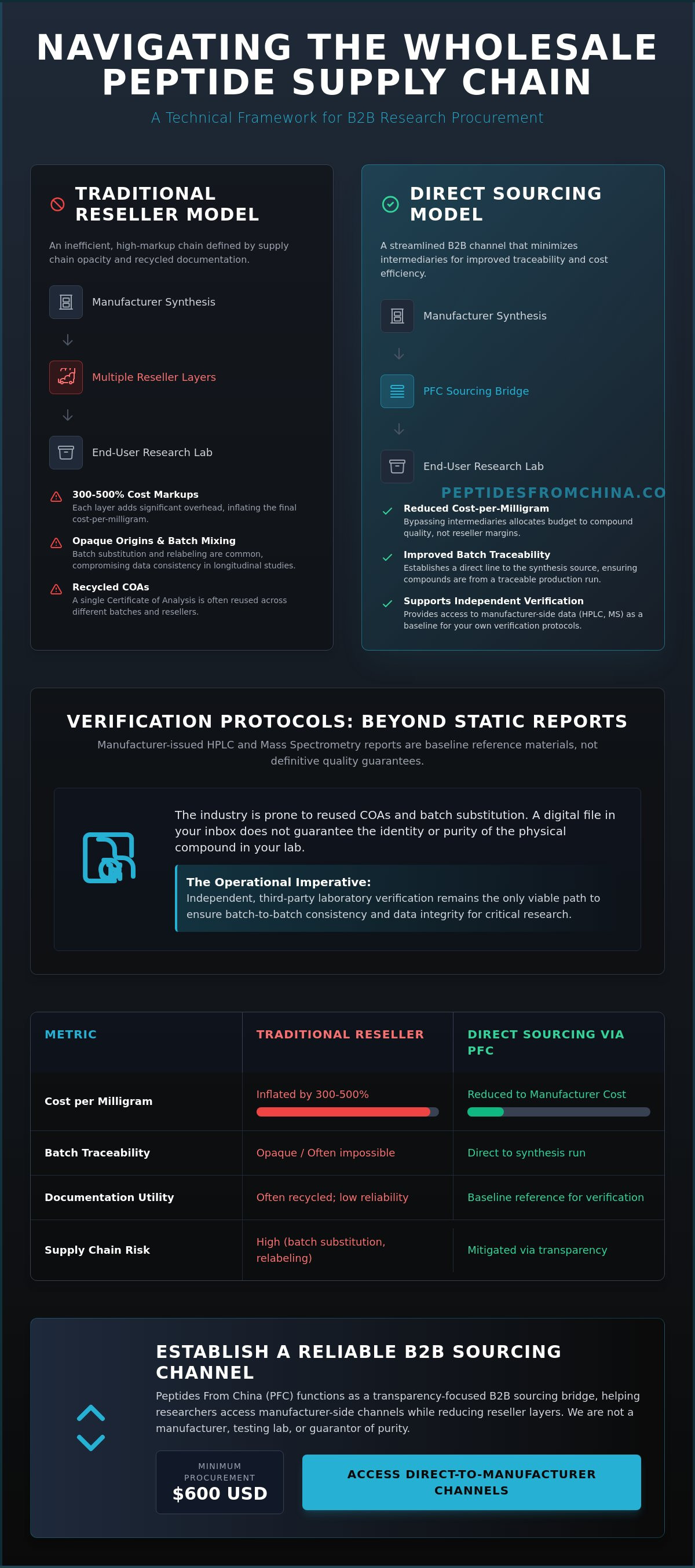
Identify the "reseller layer" where domestic brands inflate costs by 300-500% and learn how to bypass these intermediaries for direct-to-manufacturer access.
Understand the logistical workflow of sourcing wholesale peptides directly from synthesis facilities to significantly reduce cost-per-milligram for high-demand research compounds.
Learn why manufacturer-issued HPLC and Mass Spectrometry reports are baseline reference materials rather than definitive quality guarantees in a market prone to reused COAs.
Master the operational steps for managing large-scale research orders, including navigating international shipping hurdles and protocols for independent batch verification.
PeptidesFromChina currently has a $600 total minimum order. Multiple catalog products can be combined to reach the minimum, with orders starting from one 10-vial kit per product.
Table of Contents
Navigating the Wholesale Peptide Supply Chain in 2026
The Economics of Direct-to-Manufacturer Sourcing
Verification Protocols: Beyond Static HPLC Reports
Strategic Procurement: Managing Large-Scale Research Orders
Establishing a Reliable B2B Sourcing Channel with PFC
Navigating the Wholesale Peptide Supply Chain in 2026
Market pricing and availability can vary substantially by supplier, product, order size, and current conditions; exact comparisons require current, like-for-like data.
Modern research institutions are increasingly shifting toward direct-to-manufacturer sourcing models to regain control over their data integrity. This transition isn't without its challenges. The industry remains plagued by inherent risks such as batch substitution, relabeling, and variable synthesis quality. Acknowledging these flaws is the first step toward a realistic procurement strategy. Instead of looking for a vendor that promises perfection, sophisticated buyers look for a sourcing partner that provides a transparent view of the manufacturing pipeline and treats manufacturer documents as starting points for further verification.
Retail vs. B2B Sourcing: Understanding the Divide
Single-vial retail logic fails in large-scale laboratory environments because it prioritizes shelf-ready packaging over technical transparency. Institutional procurement requires a shift toward direct-to-manufacturer sourcing models. A sourcing bridge helps reduce supply chain uncertainty by acting as a professional filter between the lab and the factory. Unlike domestic warehouses that simply hold stock of unknown age, direct sourcing focuses on the chemical peptide synthesis timeline itself. This ensures that the compounds are part of a traceable production run rather than mixed inventory from multiple unidentified sources.
Common Pitfalls in Bulk Procurement
The most pervasive risk in the wholesale market is batch substitution and relabeling. Secondary distributors frequently mix batches to maintain inventory levels, which can lead to variable results in longitudinal studies. Many vendors use "domestic shipping" as a marketing shield to distract from a total lack of manufacturer-side control. They don't oversee the synthesis; they only manage the final parcel. Establishing a direct line to the synthesis source is the only way to improve traceability. This approach acknowledges the reality of the industry, such as reused COAs and variable purity, and replaces blind trust with a methodical verification protocol. Professional buyers shouldn't seek "guaranteed purity" from a website; they should seek a transparent channel that supports independent verification and provides reference analytical data for every $600 minimum procurement.
The Economics of Direct-to-Manufacturer Sourcing
Market pricing and availability can vary substantially by supplier, product, order size, and current conditions; exact comparisons require current, like-for-like data.
The synthesis-to-lab workflow for high-demand compounds like Semaglutide or BPC-157 involves several critical stages: initial chemical synthesis, purification via preparative HPLC, lyophilization, and international logistics. Each step requires specialized equipment and technical oversight. When you source through a transparency-focused bridge like Peptides From China, you move closer to the point of origin. This model prioritizes technical transparency, treating manufacturer-provided data as a baseline for your own independent verification protocols rather than a final guarantee of purity.
Cost Analysis: Reseller Markups vs. Direct Sourcing
Calculating the real cost of synthesis requires looking beyond the sticker price. A professional B2B sourcing strategy accounts for the base synthesis cost, international cold-chain logistics, and the necessary expense of third-party analytical testing. For most laboratories, a $600 minimum order serves as the standard threshold for operational efficiency. This amount balances the fixed costs of shipping and customs clearance against the volume of material received. Research institutions find a distinct strategic advantage in this model when procuring bulk tirzepatide powder, as it allows for larger batch sizes that improve longitudinal data consistency.
China's Role in Global Peptide Synthesis
China remains the global hub for large-scale peptide production due to its massive chemical infrastructure and specialized workforce. In 2026, the leading facilities have standardized synthesis protocols that rival Western pharmaceutical labs, yet they remain largely inaccessible to individual researchers due to language and logistical barriers. Understanding the direct-to-lab advantage is essential when evaluating glp 1 peptides for sale. Accessing these manufacturer-side channels helps reduce supply chain uncertainty by providing a clearer view of the production timeline and batch-specific reference data. This direct connection ensures that the compounds haven't sat in a domestic reseller's warehouse for months, potentially degrading under suboptimal storage conditions.
Verification Protocols: Beyond Static HPLC Reports
In the procurement of wholesale peptides, the most common mistake is treating a manufacturer-issued Certificate of Analysis (COA) as a definitive seal of quality. While High-Performance Liquid Chromatography (HPLC) and Mass Spectrometry (MS) are essential tools, they're baseline reference materials that capture a single moment in time for a specific sample. In a market where supply chain opacity is the norm, these documents are frequently reused, digitally altered, or applied to batches they don't actually represent. Relying solely on static reports from a seller creates a significant vulnerability for any research institution.
Direct-to-manufacturer sourcing significantly improves batch traceability by minimizing the number of hands a product passes through. When a domestic reseller relabels a product, the original synthesis data often gets lost or replaced by generic marketing claims. By using a transparency-focused bridge to access production-side channels, buyers receive the original manufacturer papers. This doesn't mean the data is infallible; it means you have a clearer starting point for your own internal verification. Reducing the reseller layers means you're far less likely to encounter batch substitution or the mixing of different synthesis runs into a single shipment.
Interpreting Manufacturer Documentation
A COA represents the manufacturer’s internal assessment, which may use different calibration standards than your own lab. Red flags in these reports include inconsistent fonts, missing timestamps, or chromatograms with suspiciously "clean" baselines that suggest digital smoothing. It's also critical to distinguish between purity and net peptide content. A report might show 99% purity, meaning 99% of the material is the target sequence, but it doesn't account for the residual moisture or counter-ions like TFA that can make up a significant portion of the vial's total weight.
Independent Verification Strategies
Professional B2B buyers don't accept manufacturer data at face value. Establishing a robust validation protocol is necessary to maintain research integrity. This involves implementing independent peptide testing for every new batch received. Blind testing, where the analytical lab is unaware of the stated purity or source, provides an unbiased check against the reference data. Prioritizing consistent batch-to-batch data over flashy marketing claims helps reduce supply chain uncertainty. When you operate with a $600 minimum procurement through a direct channel, the cost savings should be partially reinvested into this third-party verification to ensure your operational consistency remains grounded in factual accuracy.
Strategic Procurement: Managing Large-Scale Research Orders
Establishing a reliable pipeline for wholesale peptides involves more than simply identifying a manufacturer. It requires a methodical approach to logistics that accounts for the inherent risks of international transit and the variable nature of synthesis timelines. Professional procurement teams prioritize operational realism, recognizing that the domestic warehouse model often lacks the granular batch tracking necessary for high-fidelity research. Instead, they focus on securing a direct line to the synthesis source, ensuring that every shipment is part of a documented production run rather than a composite of aging inventory.
Securing a bulk supply chain requires a structured workflow that filters out the noise of the retail market. This process begins with identifying specific research requirements and compound specifications. Professional labs don't just ask for a product; they define the necessary purity thresholds and salt content. Managing these large-scale orders through a transparency-focused bridge helps reduce supply chain uncertainty by providing a clear view of the production pipeline from synthesis to delivery.
The B2B Sourcing Workflow
Step 1: Compound Specification. Define the exact parameters of your research needs, including sequence, quantity, and required reference analytical data.
Step 2: Verification Deposit. A $10 processing deposit is utilized to initiate manufacturer verification. This isn't a simple fee; it's a procedural step that secures current batch data and availability from the production facility.
Step 3: Procurement Fulfillment. Finalizing the $600 minimum wholesale order requirements ensures that international shipping and customs overhead don't disproportionately inflate your cost per milligram.
International Logistics and Customs Navigation
Managing inventory for high-volume research requires foresight. Labs often plan their procurement cycles months in advance to avoid synthesis bottlenecks for popular compounds. For instance, securing bulk retatrutide through manufacturer-side channels allows researchers to maintain a consistent supply of a single batch, which is critical for maintaining data integrity across long-term studies. If you're ready to bypass the reseller layer and secure your manufacturing-side access, following a disciplined procurement protocol is the only way to ensure operational consistency.
Establishing a Reliable B2B Sourcing Channel with PFC
PFC coordinates manufacturer-side sourcing and international logistics. Products are subject to the manufacturer’s applicable quality-control procedures and product-specific specifications. Manufacturer-side analytical documentation may be available depending on the product and batch, but PFC is not an independent analytical testing laboratory and does not guarantee a universal documentation package. Buyers requiring independent verification may arrange third-party analytical testing.
The core objective of the PFC protocol is to reduce the "reseller layer" that often obscures the origin and age of research compounds. When labs source through traditional domestic vendors, they're often several steps removed from the actual point of synthesis. This distance increases the risk of batch substitution and the reuse of outdated analytical reports. By facilitating a more direct connection to production facilities, PFC improves traceability and ensures that the reference documentation provided is specific to the current manufacturing run.
The Peptides From China Advantage
Operational consistency is the cornerstone of a successful research supply chain. PFC provides a structured environment where factual integrity takes precedence over marketing hype. Institutional buyers utilize the peptide sourcing platform to secure long-term supply stability, which is essential for multi-phase studies that require batch-to-batch uniformity. The platform functions as a professional interface, managing the technical communication with synthesis facilities to ensure that compound specifications meet the precise requirements of the laboratory. This approach doesn't replace the need for independent verification; rather, it provides a more reliable foundation for a buyer's validation protocols.
Getting Started with Bulk Procurement
Initiating a wholesale sourcing request through PFC begins with an inquiry describing the buyer’s research needs. The $10 deposit initiates manual request processing and real-time stock verification, places the request into the processing workflow, validates the payment wallet, and is credited toward the final invoice. Manufacturer-side analytical documentation may be available depending on the product and batch, but it is not released or guaranteed by the deposit.
Once the initial verification is complete and the pricing is confirmed, the procurement is finalized according to the $600 minimum order requirement. This threshold is maintained to ensure that the economics of international shipping, customs documentation, and neutral packaging remain efficient for the buyer. By following this disciplined sourcing model, institutional and commercial entities can move away from the uncertainties of the retail gray market and establish a grounded, operationally realistic supply chain for their wholesale peptides needs.
Refining Your Laboratory Procurement Standards
Securing a reliable supply of wholesale peptides in 2026 requires moving beyond the convenience of domestic resellers and adopting a transparency-first sourcing model. By bypassing the traditional middleman, institutions can eliminate arbitrary markups and gain direct access to manufacturer-side data. This shift allows for better batch traceability and ensures that your procurement budget is focused on compound quality rather than secondary marketing layers. It's about establishing a grounded, operationally realistic pipeline that prioritizes data integrity over retail-style promises.
Remember that manufacturer-issued COAs and HPLC reports serve only as baseline technical references; they don't replace the necessity of independent, buyer-side verification. Maintaining a professional $600 minimum for institutional-grade orders ensures that your logistics remain cost-effective while supporting a more rigorous validation protocol. Establishing this direct connection helps reduce supply chain uncertainty and provides the operational consistency needed for high-fidelity research. This methodical approach is the only way to navigate the complexities of the global market with confidence.
Start a manufacturer-side sourcing request with PFC. We look forward to supporting your institutional sourcing requirements.
Frequently Asked Questions
PeptidesFromChina currently has a $600 total minimum order. Multiple catalog products can be combined to reach the minimum, with orders starting from one 10-vial kit per product.
The minimum order requirement for wholesale peptides PeptidesFromChina currently has a $600 total minimum order. Multiple catalog products can be combined to reach the minimum, with orders starting from one 10-vial kit per product. This threshold is established to maintain the economic viability of international cold-chain logistics and customs documentation. By consolidating procurement at this level, research institutions can significantly reduce their cost per milligram while ensuring the shipment is large enough to justify the overhead of independent third-party verification upon arrival at the laboratory.
How do you verify the purity of wholesale peptide batches?
Purity is verified through a combination of manufacturer-issued data and independent, buyer-side analytical testing. We provide the original HPLC and Mass Spectrometry reports from the synthesis facility as baseline reference material. However, we emphasize that no single document guarantees product identity. Professional labs should implement their own validation protocols, including blind testing, to validate the reference data and ensure the batch meets their specific research thresholds.
Are the HPLC reports provided by manufacturers considered definitive proof of quality?
No, manufacturer-issued HPLC reports are baseline reference materials rather than definitive proof of quality. In the current market, these documents are frequently reused or digitally altered across different batches. While they provide necessary starting data for identity confirmation, they don't replace the requirement for independent testing. Professional buyers treat these papers as reference analytical data that must be validated through their own laboratory protocols.
Can you source specialized research peptides not listed on the main site?
Yes, we can facilitate the procurement of specialized research sequences that aren't listed on our standard product pages. Our role as a sourcing bridge allows us to query manufacturer-side channels for custom synthesis requirements. This service is particularly useful for institutions needing specific salt forms or modifications that aren't available through retail-focused vendors who only stock high-demand compounds like Semaglutide or BPC-157.
How does PFC handle international shipping and customs for bulk orders?
PFC manages international logistics by utilizing neutral packaging and specialized documentation to minimize administrative delays. We coordinate transit times to prioritize environmental stability for lyophilized powders during global shipping. This methodical approach helps mitigate the risks of customs hurdles that often plague bulk orders. We provide tracking data for every wholesale shipment, allowing procurement teams to monitor their supply chain from the production facility to the lab door.
What is the purpose of the $10 processing deposit?
The $10 processing deposit is a procedural step used to initiate manufacturer verification and secure current batch data. It filters out non-professional inquiries and allows us to obtain real-time availability and manufacturer-issued reference papers for your specific request. This deposit ensures that the information we provide is current and accurate before you commit to the $600 minimum order requirement, supporting a more transparent procurement process.
Do you offer domestic warehousing for wholesale orders in the US or EU?
We don't offer domestic warehousing in the US or EU because it adds an unnecessary layer of supply chain opacity. Storing material in local warehouses often masks the age and origin of the peptides, leading to potential degradation. By shipping directly from the synthesis source to your institution, we improve traceability and ensure you receive materials from the most recent production run without the markups associated with localized storage.
Why is direct-to-manufacturer sourcing more reliable than using domestic resellers?
Direct-to-manufacturer sourcing is more reliable because it eliminates the reseller layer where batch-mixing and relabeling frequently occur. When procuring wholesale peptides, bypassing domestic resellers ensures that materials are part of a single, documented synthesis run. This approach improves traceability and prevents the 300% to 500% price inflations common in the domestic market, allowing research budgets to be allocated toward higher-volume procurement and independent verification.