
The 2026 FDA proposal to prohibit 503B outsourcing facilities from compounding GLP-1s from bulk substances has effectively dismantled the traditional supply bridge for many clinical researchers. While retail resellers scramble to justify massive markups, professionals realize that finding glp 1 peptides for sale requires looking past polished storefronts and into raw manufacturing logistics. You've likely encountered the industry's darker side, including reused HPLC reports, supply chain opacity, and the persistent risk of batch-to-batch inconsistency that can derail months of laboratory data.
It's clear that relying on a middleman's "guaranteed" COA is no longer a viable strategy for high-stakes research. This guide provides the technical insight needed to navigate the complex sourcing landscape, helping you reduce supply chain uncertainty and lower procurement costs. We'll examine current synthesis standards, the reality of direct-to-manufacturer logistics, and how to implement a repeatable verification protocol. Whether you're accessing manufacturer-side channels through a B2B bridge like Peptides From China for $600 minimum wholesale orders or auditing your current providers, the focus remains on independent verification and operational consistency.
Key Takeaways
Analyze the technical challenges of Solid-Phase Peptide Synthesis (SPPS) for long-chain analogs to better predict and manage potential batch inconsistencies.
Reduce procurement costs by bypassing domestic reseller markups and accessing glp 1 peptides for sale through direct-to-manufacturer B2B channels.
Develop a repeatable verification protocol that treats manufacturer-provided HPLC and MS reports as baseline reference analytical data rather than definitive proof of purity.
Establish a consistent supply chain by leveraging a B2B sourcing bridge that facilitates manufacturer-side access with a professional $600 minimum order standard.
Table of Contents
The Landscape of GLP-1 Peptides for Sale in 2026
Synthesis Protocols and Batch Consistency in GLP-1 Analogs
Retail Resellers vs. Direct-to-Manufacturer Sourcing Channels
Critical Verification Steps for Professional Procurement
Navigating the Direct Sourcing Bridge with Peptides From China
The Landscape of GLP-1 Peptides for Sale in 2026
Research into Glucagon-like peptide-1 (GLP-1) analogs has reached a critical inflection point in 2026. The shift from small-scale exploratory studies to high-volume longitudinal trials has fundamentally changed how laboratories evaluate glp 1 peptides for sale. It's no longer sufficient to procure single vials from retail-facing websites that prioritize marketing over technical documentation. Professional procurement now requires a technical understanding of the international supply chain and the synthesis standards governing these specific compounds.
Market volatility remains high. This is largely due to the massive surge in global demand, which has incentivized the entry of numerous low-tier synthesis facilities. These entities often lack the rigorous quality control protocols required for consistent peptide production. Researchers are increasingly moving toward large-scale procurement to lock in batch consistency. It's a strategic move to avoid the variability inherent in purchasing small quantities from multiple resellers. These research-grade compounds are distinct from human-grade pharmaceuticals; they are intended strictly for laboratory use and independent analytical verification.
The Evolution of GLP-1 Research Compounds
While Semaglutide and Tirzepatide remain foundational, the focus has expanded to include more complex triple-agonists like Retatrutide. The synthesis of these longer chains is technically demanding. Many manufacturers struggle to maintain purity levels across large batches, leading to the proliferation of sub-standard material. B2B sourcing bridges like Peptides From China help researchers navigate this by providing access to manufacturer-side channels. By requiring a $600 minimum order, these platforms filter out the retail noise and focus on professional-grade volume, helping to improve traceability in a crowded market.
Sourcing Challenges: Transparency vs. Convenience
Domestic warehousing is often presented as a benefit, yet it frequently masks supply chain opacity. When a reseller holds stock domestically, the original batch documentation is often lost or obscured through relabeling. This practice makes it nearly impossible for a researcher to trace the material back to its synthesis origin. Choosing "fast shipping" usually means sacrificing traceability. A transparency-first model acknowledges these risks. It prioritizes manufacturer-side coordination and transparent international logistics over anonymous reseller supply chains. This approach supports independent verification and helps reduce supply chain uncertainty for institutional buyers, often starting with a $10 sourcing deposit to initiate the manufacturer-side search process.
Synthesis Protocols and Batch Consistency in GLP-1 Analogs
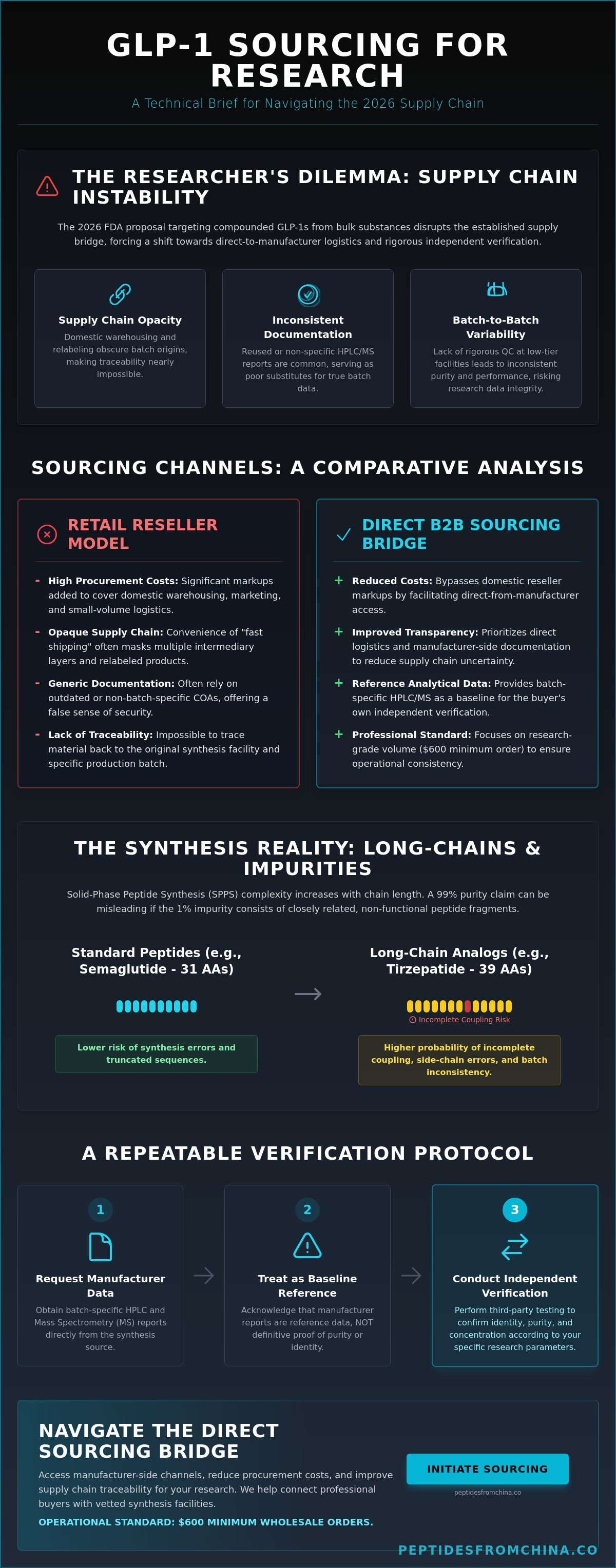
Solid-Phase Peptide Synthesis (SPPS) remains the primary method for producing GLP-1 chains, but its execution varies wildly across the global manufacturing sector. In this process, amino acids are added sequentially to a resin-bound peptide chain. For shorter peptides, this is relatively straightforward. However, as the sequence length increases, the risk of incomplete coupling and "truncated sequences" grows. When you evaluate glp 1 peptides for sale, you're often looking at a final purity percentage that doesn't account for these specific impurities. A 99% purity claim on a standard HPLC report can be misleading if the remaining 1% consists of closely related peptide fragments that mirror the target's molecular weight.
The challenge is magnified when synthesizing complex, long-chain analogs like Tirzepatide powder. This 39-amino acid sequence requires precise side-chain modifications and a specific fatty acid diacid moiety. Minor deviations in the synthesis environment or the quality of amino acid precursors can lead to significant batch-to-batch inconsistency. This is why professional researchers treat manufacturer-issued HPLC and Mass Spectrometry papers as baseline reference analytical data rather than absolute proof of quality. Independent verification is the only way to ensure the material matches your specific laboratory requirements.
Manufacturing Metrics for Semaglutide and Tirzepatide
Synthesis scale dictates the level of oversight possible. Small-batch laboratory runs often maintain high precision but struggle to meet the volume needs of large-scale longitudinal studies. Conversely, industrial-scale production can introduce "batch substitution" risks. During high-demand cycles, some facilities may fulfill orders using material from multiple synthesis runs to reach the required weight, leading to variable performance in your assays. Accessing a transparency-focused B2B sourcing bridge helps researchers identify manufacturers that prioritize batch traceability over sheer output volume.
Stability and Storage Protocols for Large-Scale Orders
Lyophilization is a non-negotiable standard for international logistics. This freeze-drying process removes moisture while preserving the peptide's structural integrity. Without proper lyophilization, peptides are highly susceptible to hydrolytic degradation during transit. Even with it, temperature sensitivity remains a factor. When managing 100+ vial research batches, maintaining a consistent cold chain from the synthesis facility to your laboratory is vital. Most researchers implement a protocol of immediate refrigeration at 2-8°C for short-term use or -20°C for long-term storage to mitigate any risk of degradation. Peptides From China facilitates these manufacturer-side channels for professional buyers, maintaining a strict $600 minimum order to ensure the logistics of bulk procurement remain efficient.
Retail Resellers vs. Direct-to-Manufacturer Sourcing Channels
The retail market for glp 1 peptides for sale is built on a high-margin, low-volume model that rarely suits institutional research. Most domestic resellers act as simple intermediaries. They procure bulk batches, apply a premium label, and mark up the price by 200% to 300%. While this provides the convenience of domestic shipping, it introduces significant supply chain uncertainty. When you buy from a reseller, you're often paying for their marketing and warehouse overhead rather than superior synthesis quality. Professional procurement requires a shift toward direct-to-manufacturer channels to ensure that your budget is allocated toward the material itself.
PFC coordinates manufacturer-side sourcing and international logistics. Products are subject to the manufacturer’s applicable quality-control procedures and product-specific specifications. Manufacturer-side analytical documentation may be available depending on the product and batch, but PFC is not an independent analytical testing laboratory and does not guarantee a universal documentation package. Buyers requiring independent verification may arrange third-party analytical testing.
The Intermediary Problem in the Peptide Industry
Intermediaries often obscure the origin of their stock to protect their margins. A common industry flaw involves the reuse of old HPLC reports; a reseller might present a certificate of analysis from a previous year for a completely different batch. Because domestic brands lack their own synthesis facilities, there's a distinct lack of accountability when a batch fails to meet specifications. Sourcing through a B2B bridge improves traceability by providing reference analytical data from the source, allowing for a clearer understanding of the batch's history.
Bulk Logistics: Managing Large-Scale Research Shipments
Direct sourcing from overseas requires a different logistical mindset. International shipments of laboratory supplies often utilize neutral packaging to minimize customs delays and ensure the privacy of the procurement process. This is a standard protocol for institutional budgets that prioritize security over brand aesthetics. The cost-benefit analysis of the $600 wholesale threshold is straightforward: it eliminates the reseller markup and provides access to bulk quantities necessary for longitudinal studies. The primary trade-off is lead time. While domestic retail offers fast shipping, direct channels involve international transit. For researchers, the gains in transparency and cost-efficiency far outweigh the wait.
Critical Verification Steps for Professional Procurement
Professional procurement begins with a fundamental level of skepticism regarding documentation. While many vendors offering glp 1 peptides for sale provide high-resolution certificates of analysis, relying on a single document as definitive proof of quality is an operational risk. A High-Performance Liquid Chromatography (HPLC) report or Mass Spectrometry (MS) analysis issued by a manufacturer should be viewed strictly as reference analytical data. These papers demonstrate what the facility produced during a specific run, but they don't account for potential batch substitution or degradation during subsequent handling and logistics.
Establishing a "Trust but Verify" protocol is the only way to ensure laboratory consistency. This means integrating independent peptide testing into your standard procurement workflow. By sending a random sample from a bulk shipment to a third-party laboratory, you confirm that the material in the vials matches the manufacturer’s claims. This step helps reduce supply chain uncertainty and protects your research data from the variables of international manufacturing.
Evaluating HPLC and Mass Spectrometry Reports
Identifying "recycled" or fraudulent reports is a critical skill for procurement officers. Digital COA files often show red flags such as blurred dates, inconsistent fonts, or missing integration tables. Manufacturer-side testing has inherent limitations; it’s often performed on the "best" part of a batch rather than a representative sample. Independent third-party analysis is the only method to support purity claims and identify truncated sequences that standard manufacturer reports might overlook. If the data doesn't align, it's a clear signal to re-evaluate the manufacturer relationship.
Risk Mitigation in International Sourcing
Reducing the impact of batch substitution requires a direct relationship with the synthesis facility. B2B bridges like Peptides From China facilitate this by bypassing domestic reseller layers that often obscure batch origins. You can initiate this process with a $10 deposit, which initiates manual request processing and real-time stock verification and is credited toward the final invoice. This methodical approach is essential when managing the $600 minimum wholesale requirement. When discrepancies arise between manufacturer data and your independent lab results, having a direct line of communication improves traceability and helps resolve the issue without the defensive posture typical of retail resellers. To begin manufacturer-side coordination and discuss any documentation that may be available for the product and batch, you can initiate a professional sourcing request here.
Navigating the Direct Sourcing Bridge with Peptides From China
Peptides From China (PFC) operates as a transparency-focused B2B sourcing bridge, specifically designed for researchers who have outgrown the limitations of retail-grade supply chains. Unlike domestic resellers that prioritize slick e-commerce interfaces and single-vial sales, PFC functions as a logistical filter between production facilities and professional laboratories. This model acknowledges that the search for glp 1 peptides for sale is often compromised by middleman opacity and reused analytical reports. By acting as a strategic partner, PFC helps reduce supply chain uncertainty by coordinating manufacturer-side sourcing and international logistics, ensuring that the material you receive hasn't been sitting in a domestic warehouse with an unknown chain of custody.
The operational framework at PFC is built on professional standards rather than retail convenience. The $600 minimum is an operational minimum for orders placed through the PFC sourcing platform. Multiple catalog products can be combined to reach the operational minimum. Every procurement cycle begins with a $10 sourcing deposit, a small processing fee used to initiate the manufacturer-side verification process. This step initiates manual request processing and real-time stock verification and is credited toward the final invoice.
The PFC Sourcing Model: Step-by-Step
The procurement process is methodical and thorough. The $10 deposit initiates manual request processing and real-time stock verification and is credited toward the final invoice. Products are subject to the manufacturer’s applicable quality-control procedures and specifications. Manufacturer-side analytical documentation may be available depending on the product and batch. PeptidesFromChina is not an independent analytical testing laboratory. You review this documentation before the final invoice is issued. This ensures you're aware of the baseline technical data before any funds are committed to the $600 minimum order. Logistics are handled with equal precision. Shipments are dispatched using tracked international methods in neutral, research-compliant packaging to ensure privacy and efficiency during the customs clearance process.
Why Direct Sourcing Beats Domestic Warehousing
Domestic warehousing introduces a layer of separation that often breaks the traceability of a peptide batch. When a reseller relabels a product for their own brand, the original manufacturing context is lost. Choosing a direct sourcing bridge eliminates this "reseller layer," ensuring that every vial can be traced back to its synthesis origin. In the current market, understanding the difference between a peptide sourcing agent vs platform is vital for establishing a consistent research supply chain. While a platform might offer a wider variety of unvetted options, a dedicated sourcing bridge like PFC focuses on manufacturer-side accountability. The final step in this supply chain is always independent laboratory verification, a practice that PFC supports by providing the direct access necessary for researchers to implement their own "Trust but Verify" protocols.
Securing Operational Consistency in GLP-1 Procurement
Transitioning from retail-grade sourcing to a professional B2B model is a necessary step for laboratories prioritizing data integrity. The current market for glp 1 peptides for sale is often defined by supply chain opacity and unreliable documentation. By bypassing domestic resellers and accessing manufacturer-side channels, you're able to eliminate unnecessary price markups and improve batch-to-manufacturer traceability. It's vital to remember that manufacturer-issued papers serve only as reference analytical data. Independent laboratory verification remains the gold standard for any serious research protocol.
Peptides From China acts as your strategic partner in this landscape, providing a transparency-focused bridge to vetted synthesis facilities. Our model supports buyer-led verification efforts through manufacturer-side sourcing transparency. Manufacturer-side analytical documentation may be available depending on the product and batch. With a professional $600 minimum order, you can secure wholesale pricing while maintaining the technical oversight your research requires. This methodical approach helps reduce supply chain uncertainty and ensures your procurement workflow is both repeatable and cost-effective. Access Manufacturer-Direct GLP-1 Sourcing Channels to begin optimizing your laboratory's supply chain today.
Frequently Asked Questions
Are GLP-1 peptides for sale intended for human consumption?
No, these compounds are strictly for laboratory research and are not intended for human consumption. Every vial of glp 1 peptides for sale through professional B2B channels is categorized as a research chemical for in vitro or animal studies. Using these materials in a clinical or pharmaceutical context is a violation of standard research protocols and safety guidelines.
What is the minimum order quantity for wholesale GLP-1 sourcing?
The minimum order requirement for wholesale procurement is $600. This specific threshold is established to maintain the economic viability of international logistics and customs clearance. It filters out retail-level noise and allows the sourcing bridge to focus on the high-volume needs of professional laboratories and institutional researchers who require bulk consistency.
How can I verify the purity of a bulk GLP-1 peptide batch?
Independent third-party analysis is the only reliable method for verifying batch purity. You should treat manufacturer-issued HPLC and Mass Spectrometry papers only as baseline reference analytical data. Sending a random sample from your bulk shipment to an accredited laboratory ensures the material matches your specific research requirements and helps identify potential truncated sequences that manufacturer reports might overlook.
Why do domestic resellers charge significantly more for GLP-1 analogs?
Domestic resellers apply high markups to cover the overhead of local warehousing, retail marketing, and the risk of holding stock. When you purchase glp 1 peptides for sale from these entities, you're paying a premium for fast shipping rather than synthesis quality. Direct sourcing through a B2B bridge helps reduce these costs by removing unnecessary intermediary layers and markups.
What documentation is provided with direct-to-manufacturer peptide orders?
Direct orders typically include HPLC (High-Performance Liquid Chromatography) and MS (Mass Spectrometry) reports. These documents provide a snapshot of the batch chemical profile and molecular weight at the time of synthesis. While they improve traceability, they don't replace the need for independent verification by the buyer once the shipment arrives at the laboratory.
How does Peptides From China handle international shipping and customs?
International shipments utilize neutral, research-compliant packaging to ensure efficient customs clearance. Every order is dispatched using tracked international methods, providing visibility throughout the transit process. This methodical approach to logistics helps reduce supply chain uncertainty and ensures that bulk shipments reach their destination without the typical delays associated with retail-branded packaging.
What happens if independent lab testing contradicts the manufacturer COA?
Discrepancies between manufacturer data and independent results should be addressed immediately through the direct B2B communication channel. Providing the manufacturer with your independent lab findings allows for a technical audit of the batch. This transparency-focused resolution process is a primary benefit of bypassing domestic resellers, who often lack the technical depth to handle such discrepancies effectively.
Is it possible to request specific synthesis requirements for large-scale orders?
Yes, large-scale institutional orders often allow for specific synthesis requirements or custom concentrations. You can initiate these requests through the B2B sourcing bridge starting with a $10 processing deposit. This deposit allows the bridge to verify manufacturer-side capabilities and coordinate technical specifications before you commit to the $600 minimum wholesale order requirement.