
A Certificate of Analysis is no longer a definitive guarantee of quality; in 2026, it is frequently a static document used to mask batch substitution and supply chain opacity. Following the closure of major industry players like PeptideSciences in March 2026, the market has become increasingly fragmented. You likely recognize the frustration of dealing with forged HPLC reports and hidden reseller markups that inflate costs without adding value. Understanding the operational mechanics of a peptide sourcing agent vs platform is now essential for any lab requiring consistent batch traceability.
This guide provides a technical breakdown of how these two procurement models function so you can establish a direct-to-manufacturer supply line. We'll examine how to reduce procurement overhead while navigating the upcoming July 2026 FDA Pharmacy Compounding Advisory Committee reviews. You will learn to implement a repeatable vetting protocol that prioritizes independent verification over manufacturer-issued papers. At Peptides From China (PFC), we facilitate this transition by acting as a transparency-focused B2B bridge for wholesale orders of $600 or more, helping you bypass unnecessary intermediaries and secure a more reliable research supply.
Key Takeaways
Identify the operational differences between manufacturers and marketing-heavy resellers to ensure your procurement budget reaches the synthesis lab rather than a middleman.
Compare the functional architecture of a peptide sourcing agent vs platform to choose between passive, high-volume marketplaces and active, transparency-focused oversight.
Uncover the technical reality behind domestic warehousing and how proximity is frequently used to obscure batch substitution and supply chain gaps.
Establish a rigorous due diligence framework that utilizes technical documentation as reference analytical data while prioritizing independent lab verification.
Streamline your supply chain by accessing manufacturer-side channels, helping you reduce costs on bulk research compounds like Tirzepatide or BPC-157.
Table of Contents
The Peptide Supply Chain Landscape: Resellers, Agents, and Platforms
Peptide Sourcing Agent vs. Platform: Understanding the Operational Architecture
The Domestic Warehouse Trap: Why Proximity Does Not Equal Purity
Due Diligence Protocols for Professional Peptide Procurement
Peptides From China (PFC): A Transparency-First Sourcing Bridge
The Peptide Supply Chain Landscape: Resellers, Agents, and Platforms
The global peptide market in 2026 is defined by a sharp divide between marketing visibility and manufacturing reality. Following the collapse of several high-profile retail vendors earlier this year, the supply chain has become increasingly fragmented. For procurement professionals, the primary challenge isn't finding a vendor; it's identifying who actually controls the Peptide synthesis process. Most "best peptide companies" found via search engines are sophisticated marketing fronts that don't own a single lyophilizer or HPLC system. They function as high-markup resellers, often layering domestic shipping costs on top of international production rates to create a false sense of security.
To secure a reliable supply line, you must distinguish between three primary actors. Manufacturers are the industrial facilities producing raw bulk powder. Resellers are retail entities that buy this bulk, vial it, and sell it to the end-user at a substantial markup. Sourcing intermediaries, including agents and platforms, act as the logistical bridge. In this environment, the choice between a peptide sourcing agent vs platform determines whether your lab receives active technical oversight or simply enters an automated transaction queue.
The Manufacturer-Direct Reality
Synthesis facility operations are fundamentally different from retail storefronts. Large-scale labs prioritize volume and technical consistency over flashy web design or 24/7 customer chat. They operate on production schedules, not retail inventory cycles. This is why professional labs are moving away from traditional resellers. By identifying the actual point of production, you eliminate the risk of "batch hopping," where a reseller fulfills your order from whatever cheap stock they can find on the open market. Direct-to-manufacturer models ensure that the reference analytical data you receive actually corresponds to the material in the vial.
The Intermediary Evolution
Intermediaries have evolved from simple brokers into technical partners. A sourcing agent provides active oversight, verifying manufacturer stock levels and logistical paths before a payment is ever made. They act as a protective filter, catching red flags like reused COAs or inconsistent batch numbers that automated systems often miss. Conversely, passive marketplaces or platforms prioritize transaction volume. They offer ease of use but frequently fail the "transparency test" because they don't provide the granular, batch-specific verification required for serious research.
Peptides From China (PFC) operates as a transparency-focused B2B sourcing bridge. We help research labs access manufacturer-side channels directly, reducing the layers of resellers that inflate costs and obscure traceability. For labs ready to move beyond retail single-vial purchases, we facilitate wholesale procurement with a minimum order requirement of $600. This model helps reduce supply chain uncertainty by rooting the procurement process in operational reality rather than marketing hype.
Peptide Sourcing Agent vs. Platform: Understanding the Operational Architecture
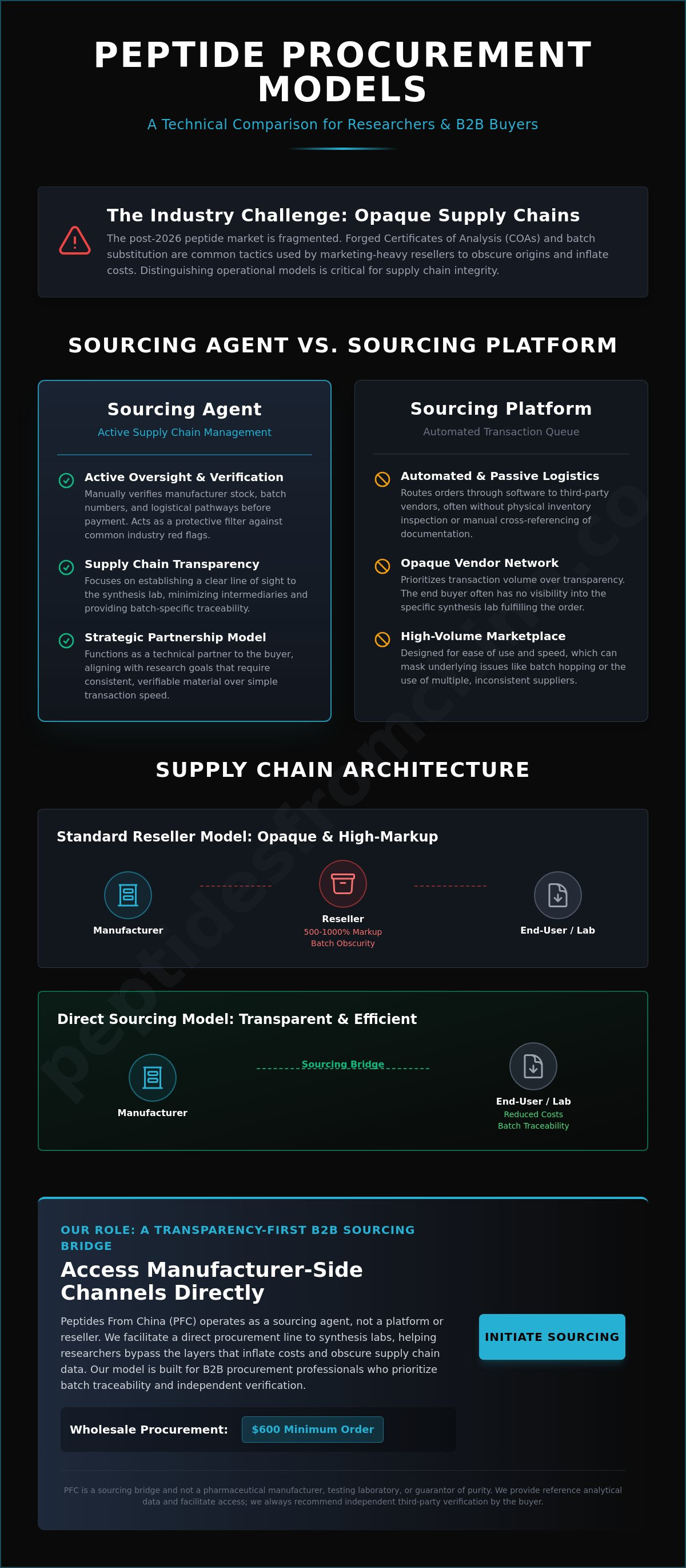
Choosing between a peptide sourcing agent vs platform is a decision between automated logistics and active supply chain management. Automated platforms prioritize transaction volume. They operate as software layers that route orders to a rotating list of third-party vendors, often without inspecting the physical inventory. Sourcing agents operate as strategic partners. They verify manufacturer stock levels and provide logistical transparency before funds are released. For a lab, the difference is found in the level of batch-specific oversight.
Platforms typically rely on automated workflows. Once an order is placed, it's routed to a fulfillment center. There is rarely a human step to cross-reference the batch number on the vial with the provided HPLC report. Agents engage in manual manufacturer verification. They check COAs against known production runs. This hands-on approach is critical when peptide testing discrepancies arise. If a third-party lab report shows a purity dip, an agent has the direct manufacturer contact to resolve the issue; a platform user is often stuck with a generic support ticket.
Operational Depth: What Happens After the Order?
Platform workflows are designed for speed, not scrutiny. The automated order routing system treats a vial of Tirzepatide the same way it treats a piece of lab equipment. Sourcing agents use a more methodical progression. They perform manufacturer verification and COA cross-referencing for every specific lot. This helps reduce supply chain uncertainty by ensuring that the reference analytical data provided matches the actual synthesis run being shipped. Without this layer of human intervention, you're essentially trusting an algorithm to manage your chemical purity.
Accountability and Traceability
Accountability remains the weakest link in automated models. Tracing a product back to a specific reactor on a generic peptide sourcing platform is difficult because the platform itself doesn't own the production line. To ensure consistency, a procurement model should follow rigorous standards similar to FDA guidance on bioanalytical method validation, treating every batch as a unique data point to be verified. Agents assume more responsibility because their business model depends on long-term manufacturer relationships and client retention. They don't hide behind listing fees or subscription models.
Cost structures also differ. Platforms favor monthly fees or small transaction percentages. Agents often work via transparent sourcing deposits or flat procurement fees. This aligns the agent's interests with the buyer's need for quality rather than the platform's need for volume. If you're managing a professional laboratory, accessing manufacturer-side channels helps reduce reseller layers. Peptides From China (PFC) provides this direct bridge for wholesale procurement, maintaining a $600 minimum order to ensure operational efficiency for serious researchers.
The Domestic Warehouse Trap: Why Proximity Does Not Equal Purity
Understanding the nuances of peptide sourcing and regulatory compliance is vital for long-term operational stability. When a product moves through multiple domestic intermediaries, the risk of batch substitution increases. Every time a compound is handled, repackaged, or relabeled outside of the synthesis facility, the chain of custody weakens. Direct sourcing helps reduce supply chain uncertainty by keeping the product as close to the manufacturer as possible.
The Relabeling Crisis in Peptide Retail
Traceability Over Speed
The 3-day domestic shipping window is attractive, but it's often a compromise on traceability. A 10-day direct-sourcing window allows for a cleaner chain-of-custody. This extra week of transit is a necessary trade-off for labs that require consistent batch-to-batch integrity. By routing orders directly to production facilities, you ensure that the material hasn't been sitting in an unmonitored domestic storage unit for months. Professional logistics and neutral packaging support global research efforts without the risks associated with retail-level handling.
Peptides From China (PFC) serves as a transparency-focused sourcing bridge for wholesale procurement. PFC coordinates manufacturer-side sourcing through established facilities together with international logistics without relying on anonymous retail-reseller supply chains. Buyers requiring independent verification may arrange third-party analytical testing. The $600 total minimum may combine multiple catalog products.
Due Diligence Protocols for Professional Peptide Procurement
Professional procurement requires moving beyond the surface-level marketing found on most vendor websites. A glossy "About Us" page or a collection of stock laboratory photos doesn't indicate synthesis capability. In the current market, verifying a manufacturer involves checking business licenses against physical synthesis locations and confirming their specific production capacity. When you evaluate a peptide sourcing agent vs platform, the primary differentiator is how they facilitate this vetting process. A platform typically hosts a directory of unverified entries; a sourcing agent should provide a filtered list of facilities where they have established operational history.
Technical documentation like HPLC reports and Mass Spectrometry (MS) data must be treated as baseline technical reference material rather than definitive proof of quality. These documents are easily manipulated, reused, or stolen from other reputable labs. Independent, third-party testing by the buyer remains a necessity for every batch. No single piece of paper fully guarantees product identity or purity. Relying solely on manufacturer-issued papers is a significant risk that often leads to batch-to-batch inconsistency.
Technical Reporting Standards
Legitimate HPLC reports include specific data points like retention times, clear baselines, and batch IDs that correspond to the physical product. Professional skepticism is required when a vendor presents a "perfect" 99.9% purity report. Real-world synthesis often contains minor, expected impurities; a recurring 99.9% rating across different compounds is a red flag for forged data. While HPLC measures purity, Mass Spectrometry is essential for confirming peptide identity. It ensures the compound is actually Tirzepatide or BPC-157 rather than a substituted sequence with a similar molecular weight.
Operational Red Flags
Identifying "ghost" manufacturers is a critical step in reducing supply chain uncertainty. These entities often act as shell companies for resellers, masking the true origin of the product. Another major risk is batch substitution during the re-shipping process, where a high-quality sample is replaced with lower-grade stock before final delivery. Reputable sourcing bridges often require a processing deposit to initiate the verification and manufacturer-contact process. This deposit covers the manual labor of auditing the synthesis facility and cross-referencing batch documentation, ensuring that only serious procurement requests are processed.
If your lab requires a direct-to-manufacturer supply line with active oversight, you can access manufacturer-side channels through Peptides From China. We prioritize batch traceability and help you bypass the reseller layers that compromise research integrity. Our model supports independent verification by providing a clear, uninterrupted path from verified synthesis facilities for wholesale orders of $600 or more.
Peptides From China (PFC): A Transparency-First Sourcing Bridge
Peptides From China (PFC) functions as a strategic bridge for laboratories that have outgrown the limitations of the retail model. PFC coordinates sourcing from established Chinese manufacturing facilities together with international logistics. Our model is built for professional procurement, requiring a $600 minimum order to maintain operational efficiency for wholesale synthesis. When evaluating a peptide sourcing agent vs platform, the distinction lies in active oversight. We don't simply host a directory of vendors; we actively verify the logistical path and documentation for every specific procurement request.
To initiate a manufacturer-side verification, we require a $10 processing deposit. This fee is a functional tool for accountability rather than a primary revenue source. It allows our team to dedicate the manual labor required to contact synthesis facilities, verify current stock levels, and review batch documentation before you pay a full invoice. This step ensures that your procurement budget is backed by actual inventory and reference analytical data, supporting independent verification efforts from the start.
The PFC Verification Process
The verification protocol begins well before a shipment is dispatched. We confirm that the manufacturer has the specific batch in stock and that the provided documentation matches the current production run. Receiving batches direct from the source ensures that the HPLC and MS reports haven't been separated from the physical product by a domestic reseller. For labs looking to secure high-demand compounds like bulk BPC-157 wholesale, this direct approach helps reduce supply chain uncertainty. It provides researchers with a clear understanding of the synthesis origin, which is essential for maintaining consistent experimental baselines.
Streamlining Laboratory Procurement
Moving from retail-style shopping to professional B2B sourcing is a necessary transition for labs managing large-scale research projects. Retail vendors often suffer from batch-to-batch variability because they source from a rotating list of suppliers to maintain their own margins. PFC helps labs maintain operational consistency by establishing a direct link to verified synthesis facilities. This shift allows procurement professionals to bypass the opaque layers of the middleman market and secure compounds like Tirzepatide, Retatrutide, or TB-500 with improved traceability.
Initiating a manufacturer-side verification request is the first step toward a more transparent supply chain. By prioritizing batch-specific data and direct manufacturer contact, you can reduce the risks of batch substitution and forged documentation. Labs ready to move beyond the retail "domestic warehouse" illusion can start by submitting a sourcing request for their specific research requirements, ensuring that every dollar spent contributes to higher traceability and verifiable synthesis quality.
Securing Your 2026 Peptide Supply Chain
Reliable procurement in the current market requires moving beyond the convenience of domestic resellers and the opacity of automated marketplaces. Success depends on establishing direct manufacturer links and treating all technical documentation as baseline reference material rather than absolute proof of quality. Choosing between a peptide sourcing agent vs platform is ultimately a decision between active oversight and automated uncertainty. It's essential to prioritize batch traceability over shipping speed to avoid the common pitfalls of relabeling and batch substitution that plague the retail market.
Peptides From China (PFC) operates as a dedicated bridge for labs that require professional, wholesale-scale consistency. We specialize in bulk B2B research procurement, providing direct-to-manufacturer routing and batch-specific COA verification for orders of $600 or more. Our model helps reduce supply chain uncertainty by keeping the product as close to the synthesis facility as possible. To move your laboratory toward a more transparent supply model, you can initiate a manufacturer verification request with Peptides From China today. With a methodical approach to vetting and independent verification, your team can maintain the operational integrity required for high-stakes research.
Frequently Asked Questions
What is the difference between a peptide sourcing agent and a reseller?
A sourcing agent facilitates a direct connection to the synthesis facility, while a reseller acts as a retail middleman. Agents provide visibility into the manufacturer's identity and batch-specific data. Resellers typically buy bulk powder, vial it domestically, and apply a significant markup, often obscuring the original point of production to protect their margins.
Can I trust the HPLC reports provided by Chinese peptide manufacturers?
You should treat manufacturer-issued HPLC reports as baseline technical reference material rather than definitive proof of quality. These documents are frequently reused or forged within the industry. While they provide a starting point for analysis, they don't replace the necessity of independent, third-party testing by the buyer for every batch received.
Why do some peptide companies have much lower prices than others?
Price discrepancies usually reflect the number of intermediaries in the supply chain or the quality of the synthesis process. Manufacturer-direct pricing is naturally lower because it eliminates reseller markups. However, extremely low prices can also signal batch substitution or lower purity levels, making the choice between a peptide sourcing agent vs platform critical for maintaining research standards.
What are the risks of buying peptides from a domestic warehouse?
Domestic warehouses often mask a complete lack of supply chain transparency and quality control. Most resellers operating these facilities don't perform independent testing on every import they receive. The process of domestic relabeling and repackaging also increases the risk of batch mixing and contamination, which can compromise the integrity of your laboratory results.
How does Peptides From China verify the quality of a batch?
PeptidesFromChina manually verifies current manufacturer-side availability during request processing. Products are subject to the manufacturer’s applicable quality-control procedures and specifications. Manufacturer-side analytical documentation may be available depending on the product and batch. PeptidesFromChina is not an independent analytical testing laboratory. We act as a transparency-focused bridge to ensure the batch number on your vials matches the synthesis run documentation. We emphasize that this process supports independent verification but doesn't replace the need for your lab to conduct its own analytical testing.
Is it legal to source research peptides directly from China for my lab?
Directly sourcing peptides for research purposes is a standard procurement practice for professional laboratories globally. It's your responsibility to ensure that all imported compounds are used strictly for research and comply with local regulatory requirements. Professional sourcing bridges help improve traceability during this process, though they don't act as legal or regulatory consultants.
What should I do if my independent test results differ from the manufacturer COA?
Your independent test results should always take precedence over manufacturer-issued papers. If a discrepancy occurs, it typically indicates batch substitution or synthesis errors at the factory level. You should immediately contact your sourcing bridge to initiate a resolution with the manufacturer, as verified data is the only reliable metric for professional research.
Why is there a minimum order requirement for wholesale peptide sourcing?
Wholesale synthesis facilities require a minimum volume to remain operationally efficient. Peptides From China maintains a $600 minimum order requirement to ensure that the procurement process is handled through manufacturer-side channels rather than retail resellers. This volume allows for the manual verification steps and technical oversight that a peptide sourcing agent vs platform provides to professional buyers.