A 99% purity certificate is no longer a definitive proof of quality; it's merely the baseline technical requirement for entering the 2026 peptide market. Most procurement professionals realize that relying on a single HPLC report is a significant operational risk, especially when supply chains remain intentionally opaque. If you've encountered reseller price gouging or inconsistent batch results, you know that finding a reliable peptide sourcing platform requires looking past marketing claims and into the actual mechanics of large-scale synthesis.
You're likely aware that documentation like Mass Spectrometry and HPLC reports are baseline references rather than absolute guarantees. This guide provides a technical deep-dive into the realities of peptide manufacturing, focusing on how to mitigate supply chain risks and move closer to the production source. You'll learn how to establish a direct-to-manufacturer pipeline for compounds like BPC-157 and Tirzepatide, reducing costs while maintaining a rigorous analytical baseline. We will cover the shift toward ISO-91721 standards, the dominance of solid-phase synthesis, and the necessary steps for independent verification. For those looking to utilize Peptides From China as a transparency-focused B2B bridge, we'll outline the operational requirements for wholesale procurement, including the $600 minimum order threshold.
Key Takeaways
Differentiate between research-grade synthesis and industrial-scale protocols to ensure batch consistency during the transition to wholesale volumes.
Analyze the limitations of technical documentation by treating HPLC and Mass Spectrometry reports as baseline references rather than definitive proof of purity.
Evaluate how a professional peptide sourcing platform helps reduce supply chain uncertainty by bypassing the mark-ups and opacity common among domestic resellers.
Optimize procurement by utilizing a B2B sourcing bridge to access manufacturer-side channels with a standardized $600 minimum for wholesale orders.
Table of Contents
The Fundamentals of Industrial Peptides Production in 2026
Scaling Peptide Manufacturing: From Lab Bench to Wholesale
Technical Reporting: Beyond the HPLC and Mass Spectrometry Baseline
Mitigating Supply Chain Uncertainty in Global Sourcing
Optimizing Procurement through Direct-to-Manufacturer Sourcing
The Fundamentals of Industrial Peptides Production in 2026
Market pricing and availability can vary substantially by supplier, product, order size, and current conditions; exact comparisons require current, like-for-like data.
Solid-Phase vs. Liquid-Phase Synthesis
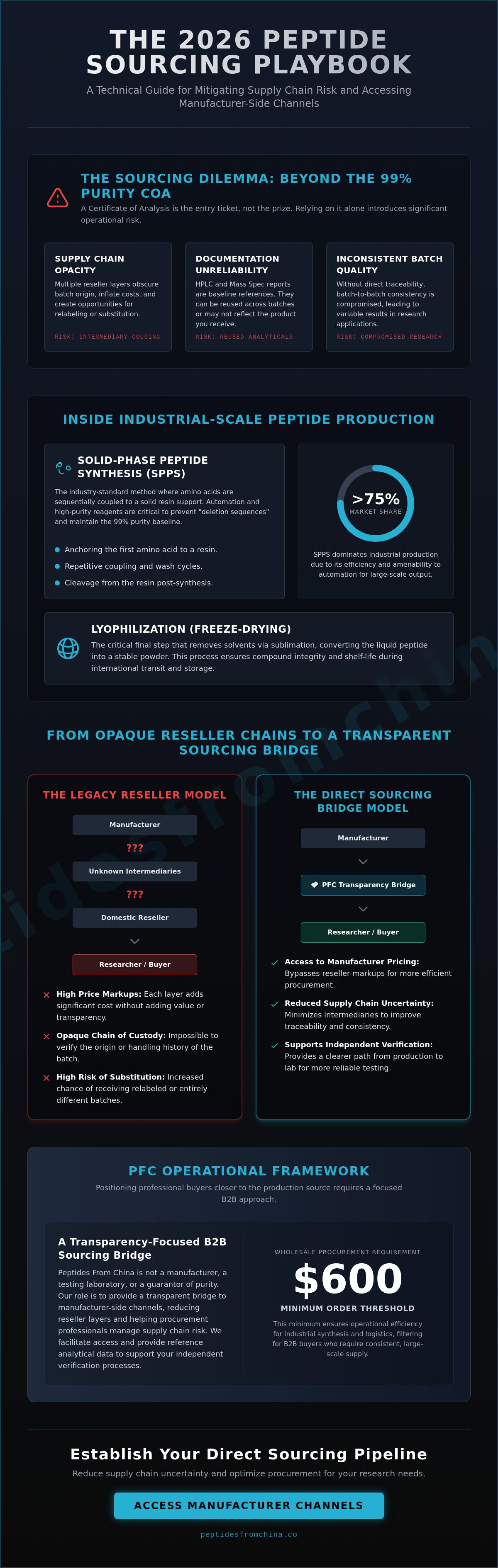
Solid-Phase Peptide Synthesis (SPPS) currently accounts for over 75% of the market share. This method involves anchoring the first amino acid to a solid resin and building the chain through repeated wash and coupling cycles. Using a Peptide synthesis approach that utilizes high-purity reagents is the only way to prevent batch contamination. If the reagents are sub-standard, the final yield contains truncated sequences that compromise the analytical profile. As sequences grow in length, the yield naturally decreases, making reagent quality and automated precision even more critical for maintaining a 99% purity standard.
The Role of Lyophilization in Stability
Scaling Peptide Manufacturing: From Lab Bench to Wholesale
Transitioning from custom small-batch synthesis to industrial-scale production requires a fundamental shift in operational logic. While university-based facilities, such as the Peptide and Peptoid Synthesis Core, focus on highly specialized, lower-volume research, the global wholesale market demands a different approach to consistency. In 2026, manufacturing facilities in China have achieved significant economies of scale by integrating automated synthesis with high-volume reagent procurement. This allows for the production of compounds like Tirzepatide and Semaglutide at a scale that domestic resellers cannot match. A professional peptide sourcing platform serves as the necessary bridge, ensuring that the transition from a lab-level order to a wholesale volume maintains a stable analytical baseline.
PeptidesFromChina currently has a $600 total minimum order. Multiple catalog products can be combined to reach the minimum, with orders starting from one 10-vial kit per product. These direct-to-manufacturer sourcing channels can significantly lower procurement costs while improving batch traceability.
Batch Size and Consistency Challenges
Scaling up synthesis isn't without technical risk. As batch sizes increase, the probability of sequence errors or incomplete couplings rises. In mass production, there's often an operational trade-off between speed and purity; faster cycles can lead to higher levels of truncated sequences. Reputable facilities mitigate this by running internal pilot protocols before committing to a full industrial run. These pilot runs help improve traceability and provide reference analytical data that informs the final production parameters. However, buyers should remember that these internal reports are baseline references and don't replace the need for independent batch verification.
Automation in Modern Synthesis Facilities
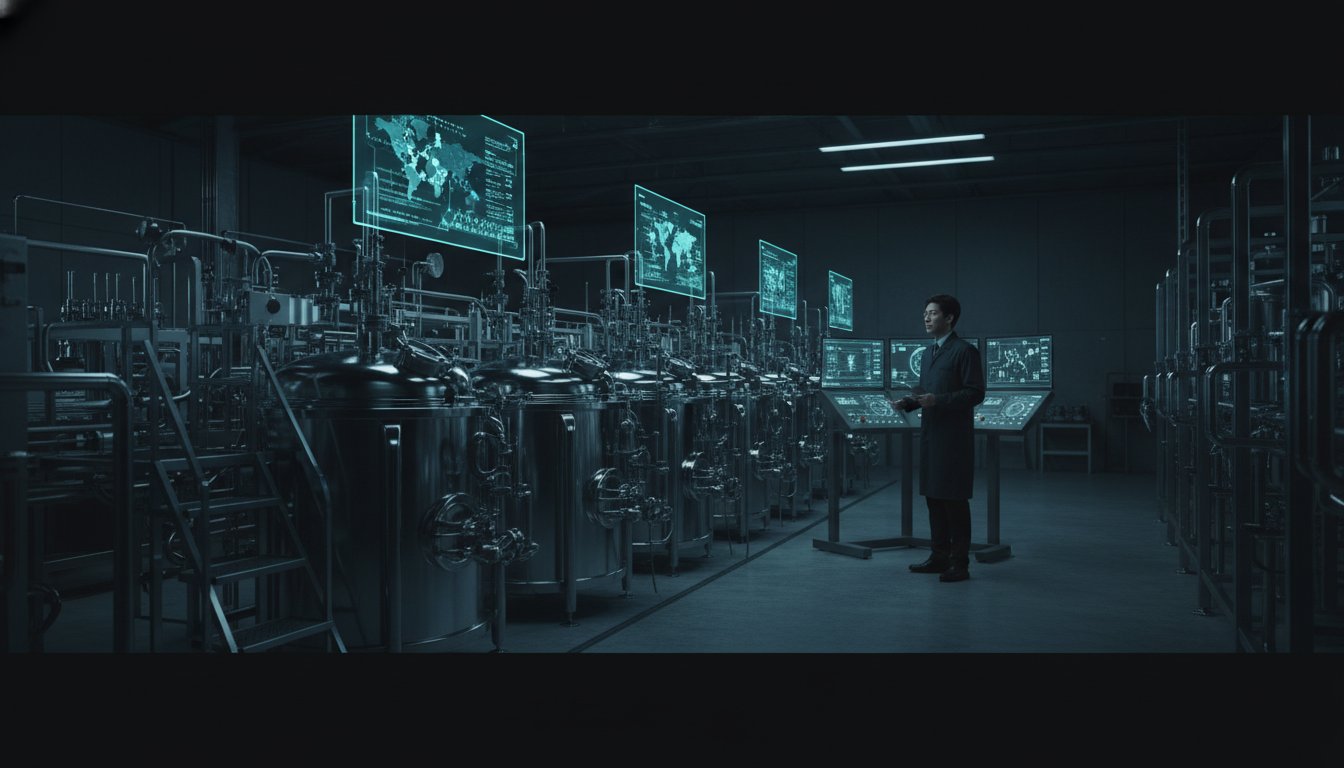
The shift toward large-scale synthesis is driven by sophisticated automation. By 2026, computer-controlled reagent delivery has become the standard, ensuring that each amino acid is introduced at the exact concentration and timing required. This minimizes the human error that frequently plagues smaller, manual operations. Facility-wide environmental controls also manage temperature and humidity to prevent atmospheric interference with the reaction kinetics. For those looking to optimize their supply chain, utilizing a peptide sourcing platform can help you access these advanced manufacturing channels while avoiding the opacity of traditional intermediaries.
Technical Reporting: Beyond the HPLC and Mass Spectrometry Baseline
High-performance liquid chromatography (HPLC) and Mass Spectrometry (MS) reports are often presented by resellers as absolute proof of quality. In reality, these documents should only be treated as baseline technical reference material. The 2026 peptide market is frequently compromised by reused or outright fraudulent Certificates of Analysis (COAs), where a single high-quality report is attached to multiple inferior batches. No single document, regardless of how official it appears, can fully guarantee product identity or purity. For procurement professionals, the goal isn't to find a "guaranteed" document but to utilize a peptide sourcing platform that improves traceability and supports independent verification.
Relying solely on manufacturer-issued papers is an operational risk that often leads to inconsistent research results. Reputable B2B sourcing bridges like Peptides From China help researchers access manufacturer-side data, but the responsibility for final quality verification remains with the buyer. Independent third-party testing is the only way to mitigate the risks of batch substitution or relabeling. When evaluating initial documentation, use a standardized peptides and proteins report sheet to cross-reference the following:
Batch numbers that match the physical vial labels exactly.
Synthesis dates that align logically with the procurement timeline.
Theoretical mass calculations compared against observed MS peaks.
Detailed HPLC chromatograms showing clear baseline resolution.
Establishing a direct-to-manufacturer sourcing pipeline helps reduce the interference of intermediaries who might obfuscate these details. While a peptide sourcing platform facilitates the flow of technical data, it's the buyer's independent analytical baseline that ensures operational consistency across large-scale synthesis projects.
Interpreting HPLC Chromatograms for Researchers
HPLC is used to determine the purity of the synthesized compound by separating the target peptide from impurities. When reviewing these reports, look closely at the baseline noise and any secondary peaks. The primary peak area represents the target peptide, and its ratio to the total area under the curve determines the purity percentage. However, it's possible for resellers to manipulate these graphs by adjusting the scale or truncation. Don't rely on manufacturer-provided HPLC data as definitive evidence; treat it as a reference point to decide if a batch warrants the cost of independent laboratory analysis.
Mass Spectrometry and Molecular Weight Verification
Mass Spectrometry confirms the identity of the synthesized peptide sequence by measuring its molecular weight. This measured value must match the theoretical mass of the target sequence. While MS is highly accurate, there's always a small margin of error in molecular weight readings for research compounds. If the MS report shows a significant deviation from the expected mass, it indicates an incorrect sequence or significant contamination. Manufacturer-side analytical documentation may be available depending on the product and batch, but it does not replace independent verification when a buyer requires it.
Mitigating Supply Chain Uncertainty in Global Sourcing
Domestic warehousing introduces additional operational risks that are often overlooked. While the promise of rapid shipping is attractive, it frequently means the peptides have been stored in substandard conditions for unknown periods. Peptides are sensitive to temperature fluctuations; domestic resellers rarely invest in the industrial-grade cold storage required for long-term stability. For organizations looking to upgrade their internal storage and handling capabilities, sourcing specialized equipment from a global wholesaler like IMT Medical Devices ensures access to high-quality medical supplies designed for sensitive materials. The age of the stock in these warehouses is also obscured because resellers rarely share original manufacturer-issued synthesis dates. For international logistics, neutral packaging is essential for security. It ensures that professional supplies reach their destination without attracting unnecessary attention or interference during the transit process.
Identifying the Reseller Layer
Distinguishing between a manufacturer and a reseller is critical for maintaining operational consistency. Use the following checklist to evaluate your current supply chain:
Does the supplier offer "instant shipping" on rare or custom sequences? This is a red flag indicating they are likely holding old stock or substituting batches.
Can they provide original manufacturer papers, or do they only offer their own branded COAs?
Is the pricing significantly higher than manufacturer-side benchmarks?
Direct-to-manufacturer sourcing helps reduce supply chain uncertainty by removing these layers of interference. By working through a transparent bridge, you can access manufacturer-side supply channels and establish a more direct line to the production floor.
Traceability and Independent Verification
Establishing a verifiable chain of custody requires more than just a batch number. While batch numbers are essential for tracking production history, they can be easily forged or reused by resellers. A robust procurement strategy involves selecting independent laboratories for periodic blind testing of your supplies. This creates an analytical baseline that is independent of the manufacturer's own data. By cross-referencing your independent results with the reference analytical data provided by the manufacturer, you create a dual-layer verification system. This methodical approach is the standard for researchers who prioritize factual integrity over the convenience of retail-style sourcing. A peptide sourcing platform can support manufacturer-side coordination, while buyers requiring independent verification may arrange third-party analytical testing.
Optimizing Procurement through Direct-to-Manufacturer Sourcing
Standard procurement often fails because it prioritizes shipping speed over batch traceability. Peptides From China (PFC) functions as a transparency-focused B2B sourcing bridge, allowing researchers to bypass the reseller layer and access manufacturer-side channels directly. By utilizing a peptide sourcing platform that emphasizes manufacturer-side sourcing, professional buyers can coordinate procurement through PFC. PFC is not a pharmaceutical manufacturer, a testing laboratory, or a guarantor of purity. Buyers requiring independent verification may arrange third-party analytical testing.
PeptidesFromChina currently has a $600 total minimum order. Multiple catalog products can be combined to reach the minimum, with orders starting from one 10-vial kit per product. Catalog inquiries may include bulk BPC-157 wholesale, Tirzepatide, or TB-500. To initiate the process, a $10 processing deposit is required. The deposit initiates manual request processing and real-time stock verification and is credited toward the final invoice.
The Economic Logic of Direct Sourcing
PeptidesFromChina currently has a $600 total minimum order. Multiple catalog products can be combined to reach the minimum, with orders starting from one 10-vial kit per product.
Navigating the PFC Sourcing Process
Establishing a direct-to-manufacturer pipeline through a peptide sourcing platform follows a methodical, multi-step protocol. First, researchers submit a request for specific compounds and quantities. Once the $10 deposit is confirmed, PFC begins manual request processing and real-time stock verification; the deposit is credited toward the final invoice. International shipping timelines typically reflect the reality of global logistics, with tracking protocols provided once the neutral-packaged shipment clears the initial export checks. This process prioritizes transparency and batch consistency over the marketing hype found in the retail gray market.
Establishing a Transparent Procurement Framework
Successful sourcing in 2026 depends on a methodical approach to technical data and supply chain logistics. By recognizing that HPLC and Mass Spectrometry reports are merely reference analytical data, you can build a more resilient verification protocol. Transitioning away from domestic resellers who obfuscate batch origins is the most effective way to improve traceability and reduce procurement costs. Utilizing a dedicated peptide sourcing platform allows you to bypass these intermediaries and engage directly with production facilities that prioritize factual integrity over marketing flair.
PFC coordinates sourcing from established Chinese manufacturing facilities together with international logistics. Products are subject to the manufacturer’s applicable quality-control procedures and specifications. Manufacturer-side analytical documentation may be available depending on the product and batch. PeptidesFromChina is not an independent analytical testing laboratory. For more information, Access Direct-to-Manufacturer Peptide Sourcing Channels.
Frequently Asked Questions
How long does the peptides production process take for bulk orders?
The synthesis of bulk peptide orders typically requires two to four weeks depending on sequence complexity and batch volume. Solid-Phase Peptide Synthesis involve repetitive coupling and washing cycles, followed by purification and a multi-day lyophilization process. Custom sequences or longer chains often extend this timeline because they require additional pilot runs to ensure the analytical baseline meets the 99% purity standard.
Why do different manufacturers provide varying HPLC reports for the same peptide?
Variations in HPLC reports occur because different laboratories utilize distinct column types, mobile phase gradients, and detection wavelengths. A chromatogram is a snapshot of a specific analytical environment; it isn't a universal constant. Discrepancies in baseline resolution or peak integration often reflect these methodological differences rather than a fundamental change in the peptide's identity or purity levels.
What is the standard minimum order for wholesale peptide sourcing?
For professional procurement through a peptide sourcing platform, PeptidesFromChina currently has a $600 total minimum order. Multiple catalog products can be combined to reach the minimum, with orders starting from one 10-vial kit per product.
Can a Certificate of Analysis (COA) be faked by resellers?
Document fraud is a persistent reality in the gray market where resellers frequently reuse or edit manufacturer-issued COAs. A single high-quality report may be attached to multiple inferior batches to hide inconsistent synthesis quality. This is why you should treat all manufacturer-issued papers as reference analytical data only and never as a definitive guarantee of product purity or identity.
What is the difference between research-grade and pharmaceutical-grade production?
How should lyophilized peptides be stored after production and shipping?
Lyophilized peptides should be stored in a freezer at -20°C to ensure long-term stability and prevent degradation. While they are relatively stable at room temperature during the shipping process, exposure to heat, light, and moisture will eventually break down the peptide bonds. Always keep vials vacuum-sealed until the point of use to avoid atmospheric contamination or moisture absorption.
Why is independent third-party testing necessary for research laboratories?
Independent testing is the only way to verify batch identity and purity independent of the manufacturer's own claims. Utilizing a peptide sourcing platform improves traceability, but blind testing by an external lab reduces supply chain uncertainty. This practice protects the integrity of your research by confirming that the compound in the vial matches the theoretical mass and purity standards required.
What happens if a batch does not meet the baseline analytical data provided?
If independent testing reveals a discrepancy with the manufacturer's reference data, the issue must be addressed through the sourcing bridge. A transparent platform facilitates communication with the production facility to resolve batch inconsistencies or arrange for replacements. This methodical resolution process is why minimizing intermediary layers is critical for maintaining operational consistency and protecting your procurement budget.