
Why is the quote from your current Bremelanotide wholesale supplier often 300% higher than the actual manufacturing cost? You likely suspect that the multiple layers of resellers between the synthesis floor and your lab are inflating costs while diluting accountability. It's a common frustration in an industry where reused COAs and batch substitution have become standard operating procedures. You've probably dealt with the anxiety of inconsistent batch purity or the rising risk of customs seizures that characterized the early 2026 shipping environment. It's a systemic issue that rewards middlemen at the expense of your research budget and operational consistency.
Products are subject to the manufacturer’s applicable quality-control procedures and specifications. Manufacturer-side analytical documentation may be available depending on the product and batch. PeptidesFromChina is not an independent analytical testing laboratory.
Key Takeaways
Market pricing and availability can vary substantially by supplier, product, order size, and current conditions; exact comparisons require current, like-for-like data.
Table of Contents
The Economics of Bremelanotide (PT-141) Wholesale Sourcing
Technical Standards for Research-Grade Bremelanotide Synthesis
Direct Chinese Sourcing vs. Domestic Reseller Warehousing
Strategic Procurement: Navigating MOQs and Batch Verification
Peptides From China: Your Transparency-Focused Sourcing Bridge
The Economics of Bremelanotide (PT-141) Wholesale Sourcing
Market pricing and availability can vary substantially by supplier, product, order size, and current conditions; exact comparisons require current, like-for-like data.
Understanding the PT-141 Market Structure
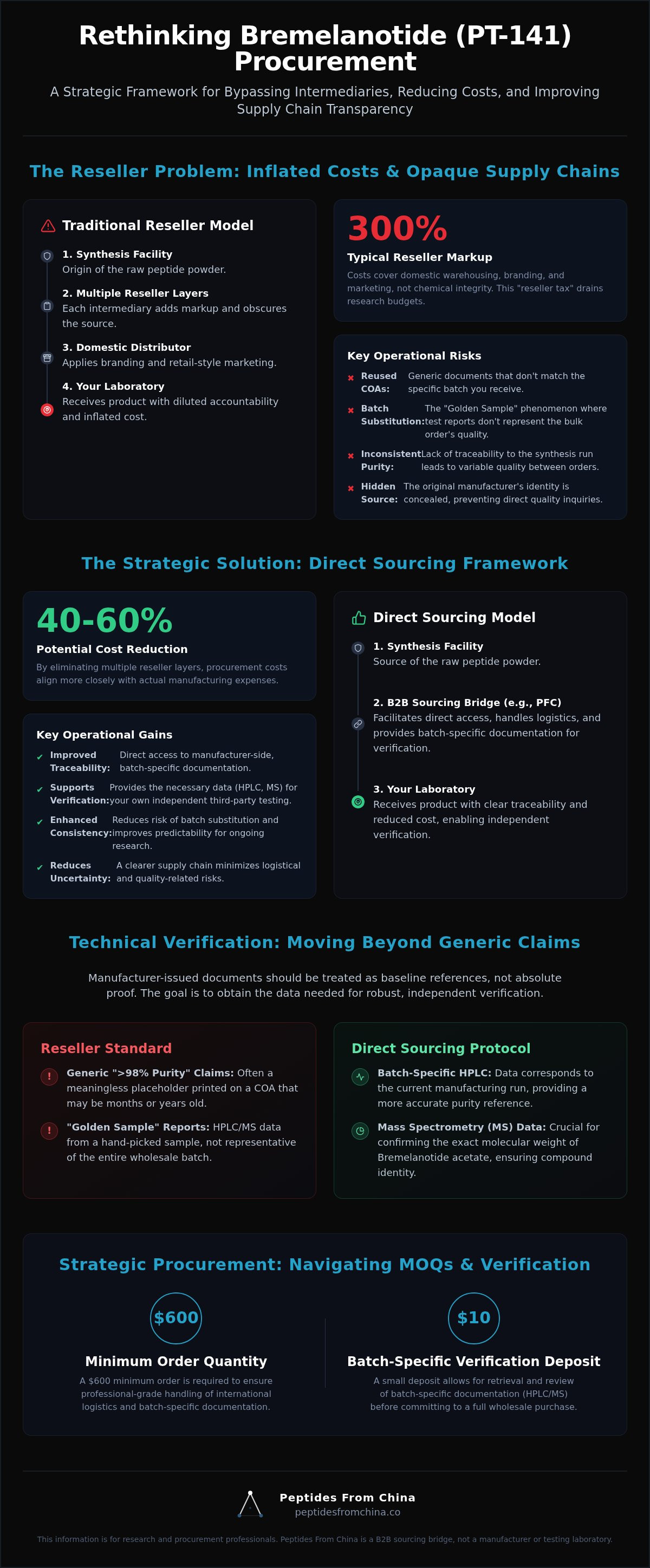
Chinese synthesis facilities dominate the global production landscape due to their specialized infrastructure and massive operational scale. Most 'US-based' suppliers don't manufacture their own stock; they're high-markup resellers of these same international batches. This creates a transparency deficit where the original manufacturer's identity is hidden behind a domestic label. Identifying a direct Bremelanotide wholesale supplier helps reduce supply chain uncertainty by providing a straight line to the synthesis lab. Bulk procurement of raw powder, rather than pre-filled vials, is the standard for professional laboratory efficiency. Powder synthesis minimizes the volume-based shipping costs and the fragility risks associated with glass vials, allowing for more streamlined international logistics.
Research-Grade vs. Pharmaceutical Grade: A Critical Distinction
Wholesale channels provide materials intended strictly for laboratory and research use. The 2026 regulatory landscape has seen increased scrutiny on peptide imports, making the distinction between research-grade and pharmaceutical-grade compounds more critical than ever. We avoid 'human-grade' marketing because it's often a red flag for retail-focused operations that lack rigorous technical standards. Professional B2B sourcing relies on technical reference material like HPLC and Mass Spectrometry data to support independent verification by the buyer. No single document guarantees purity, but direct access to manufacturer-side data improves traceability compared to the filtered information provided by resellers.
Peptides From China (PFC) serves as a B2B sourcing bridge to help researchers navigate these complexities. We maintain a $600 minimum order threshold for all wholesale procurement. This baseline is necessary to ensure that the logistics of neutral international shipping and batch-specific documentation are handled with professional-grade attention to detail. By eliminating the reseller layer, labs can often reduce their procurement costs by 40-60% while gaining better visibility into the manufacturing source. This model prioritizes factual accuracy and operational consistency over the hyperbolic claims found in the retail peptide market.
Technical Standards for Research-Grade Bremelanotide Synthesis
Evaluating a Bremelanotide wholesale supplier requires looking past the standard ">98% purity" claim printed on nearly every Certificate of Analysis (COA). In the current market, this figure has become a generic placeholder rather than a verified metric. High-quality research-grade Bremelanotide synthesis must be supported by High-Performance Liquid Chromatography (HPLC) and Mass Spectrometry (MS) data that corresponds specifically to the current manufacturing run. While HPLC measures purity levels, Mass Spectrometry is essential for confirming the exact molecular weight of the Bremelanotide acetate, ensuring the compound hasn't been substituted with a cheaper analog.
Professional buyers must also account for the "Golden Sample" phenomenon. This occurs when a supplier provides a high-quality report from a hand-picked vial that doesn't represent the consistency of a 500-vial wholesale batch. Direct manufacturer access is the only way to mitigate this risk, as it allows for batch-specific HPLC tracking and improves traceability throughout the production cycle. Relying on a generic Bremelanotide wholesale supplier often means receiving "recycled" documentation that may be months or even years out of date, increasing the likelihood of receiving under-dosed or degraded material.
Key Purity Indicators in PT-141 Batches
Beyond the peptide itself, the presence of Trifluoroacetic acid (TFA) content must be monitored, as high residual levels can impact research stability and cell culture viability. Professional synthesis facilities utilize advanced lyophilization (freeze-drying) techniques to ensure a moisture-free finished product, which is critical for maintaining a stable shelf life during international transit. HPLC purity should be viewed as a baseline technical reference for the specific batch analyzed rather than a permanent guarantee of product identity.
Documentation Requirements for B2B Buyers
A useful manufacturer-issued COA identifies the product and batch and presents enough method information and analytical data to be evaluated critically. Buyers should independently authenticate important documentation and may arrange third-party testing when independent verification is required. At PeptidesFromChina, the $10 deposit initiates manual request processing and real-time stock verification and is credited toward the final invoice; it does not purchase or release analytical documents.
Direct Chinese Sourcing vs. Domestic Reseller Warehousing
The choice between a domestic warehouse and a direct Bremelanotide wholesale supplier often comes down to a trade-off between convenience and transparency. Domestic warehousing creates a significant transparency deficit. When a lab buys from a local distributor, they're often purchasing a product that has changed hands three or four times before reaching the shelf. Each layer of the supply chain adds a markup and another opportunity for documentation to be separated from the physical batch. Sourcing directly from a synthesis facility in China eliminates these intermediaries, providing a straight line to the production source.
Manufacturer-side sourcing can reduce reliance on anonymous retail-reseller supply chains, but it does not guarantee that batch-specific analytical documents will be available. PeptidesFromChina coordinates sourcing and international logistics. Shipping methods, pricing, and estimated transit times vary by destination and are confirmed during order processing.
The Hidden Risks of Domestic 'Peptide Brands'
Many retail-facing entities engage in relabeling and batch mixing to maintain consistent stock levels. A single domestic brand might sell vials from multiple different manufacturers under one label. This practice makes it nearly impossible to track a purity issue or a synthesis error back to its source. Understanding the distinction between a peptide sourcing agent vs platform is critical for procurement officers who need to decide which model offers the best protection against these opaque practices. Direct platforms prioritize a transparent bridge to the lab, whereas resellers prioritize brand-level marketing over batch-level integrity.
Logistics and Neutral Packaging
Successful international B2B procurement requires clear order records and realistic logistics planning. PeptidesFromChina currently has a $600 total minimum order, and multiple catalog products can be combined to reach it, starting from one 10-vial kit per product. The $10 deposit initiates manual request processing and real-time stock verification and is credited toward the final invoice. Shipping options, pricing, and estimated transit times vary by destination and are confirmed during order processing.
Strategic Procurement: Navigating MOQs and Batch Verification
Professional procurement of research compounds requires a systematic approach that moves beyond the simple "add to cart" model used by retail resellers. When you're dealing with a Bremelanotide wholesale supplier, the goal is to establish a repeatable verification cycle that protects your research budget. This process isn't about finding the lowest sticker price; it's about securing the lowest cost-per-milligram of verified material. Following a structured protocol helps reduce supply chain uncertainty and ensures that your documentation matches the physical inventory you receive.
Identify Facility Capacity: Confirm that the manufacturing facility can handle the requested volume and specification. Initiate Processing: The $10 deposit starts manual request processing and real-time stock verification and is credited toward the final invoice. Technical Review: Evaluate any manufacturer-side analytical documentation that is available for the product and batch, without treating it as independent verification. Plan the $600 Minimum: Multiple catalog products may be combined to reach PFC’s operational minimum. Independent Receipt Testing: Buyers requiring independent verification may arrange third-party analysis after receipt.
Optimizing Your Wholesale Order
Volume tiers play a massive role in the economics of peptide synthesis. Pricing shifts dramatically as you move from 10g to 100g, and eventually to the 1kg manufacturing scale. To maximize shipping efficiency, many labs choose to combine their orders, sourcing Bremelanotide alongside bulk BPC-157 wholesale. This consolidation reduces the per-unit cost of international freight and documentation. It's also vital to manage lead times realistically. The highest quality wholesale peptides often aren't sitting on a domestic shelf; they're synthesized to order to ensure maximum stability and shelf life.
Independent Verification Protocols
A reliable Bremelanotide wholesale supplier will provide manufacturer-issued papers, but these should only be treated as baseline technical references. Professional B2B buyers must budget for independent third-party analysis as a standard part of their procurement SOP. Relying solely on supplier-provided reports is a significant operational risk. By establishing a long-term relationship with a verified synthesis lab, you can improve traceability and batch consistency over multiple years of research. If you are ready to move away from the high markups of domestic resellers, you can secure manufacturer-direct documentation through our transparency-focused sourcing bridge.
Peptides From China: Your Transparency-Focused Sourcing Bridge
Finding a reliable Bremelanotide wholesale supplier shouldn't involve navigating a maze of domestic resellers who obscure the origin of their stock. Peptides From China (PFC) functions as a specialized B2B sourcing platform designed to remove those unnecessary layers. We aren't a pharmaceutical manufacturer, a testing laboratory, or a guarantor of purity. Instead, we act as a transparent bridge that routes your orders directly to verified synthesis facilities. This operational model eliminates the reseller markups mentioned in previous sections, ensuring your research capital is spent on chemical mass rather than domestic branding or warehousing overhead.
The $10 deposit initiates manual request processing and real-time stock verification and is credited toward the final invoice.
The PFC Sourcing Advantage
The PFC sourcing advantage lies in providing direct access to manufacturing channels that are typically opaque to Western procurement officers. Many labs struggle to communicate directly with synthesis floors or navigate the specific logistics of neutral international shipping. Our platform provides a transparent pricing model that reflects actual peptide sourcing platform costs. We provide professional B2B support for large-scale research procurement, ensuring that operational consistency is maintained across multiple batches and long-term trials.
Getting Started with Your Wholesale Order
Initiating a wholesale order begins with a formal quote request for Bremelanotide (PT-141) or other compounds in our catalog. We maintain a $600 minimum order requirement for all wholesale procurement. This threshold is a baseline for professional efficiency, ensuring that the volume justifies the costs of secure international freight and the provision of batch-specific documentation. If your lab is ready to move away from the high markups and documentation gaps of local distributors, you can secure manufacturer-direct pricing for your next research batch. Our goal is to facilitate a realistic, transparent sourcing dynamic that helps you navigate the complexities of the global peptide supply chain.
Optimizing Your Laboratory's Bremelanotide Supply Chain
Market pricing and availability can vary substantially by supplier, product, order size, and current conditions; exact comparisons require current, like-for-like data.
PeptidesFromChina helps reduce supply-chain uncertainty by coordinating manufacturer-side sourcing and international logistics. The $10 deposit initiates manual request processing and real-time stock verification and is credited toward the final invoice. Request a Direct-to-Manufacturer Quote for Bremelanotide to discuss current availability and order requirements.
Frequently Asked Questions
What is the minimum order quantity for Bremelanotide wholesale?
The minimum order requirement for all wholesale procurement through our platform is $600. This threshold ensures that the order volume justifies the logistical overhead of neutral international shipping and the provision of batch-specific documentation. By maintaining this industry baseline, we focus on professional B2B efficiency rather than retail-level single-vial sales. This model helps reduce supply chain uncertainty for researchers requiring consistent access to large volumes.
How do I verify the purity of a bulk PT-141 shipment from China?
Verification requires a multi-step approach that begins with reviewing manufacturer-issued HPLC and Mass Spectrometry data as baseline technical references. However, professional labs shouldn't rely solely on these papers. We recommend arranging for independent third-party analysis upon receipt of the bulk shipment. This secondary verification step is the only way to confirm product identity and purity while protecting your research from the risks of batch substitution or outdated reports.
Does Peptides From China provide HPLC and Mass Spec reports?
The $10 deposit initiates manual request processing and real-time stock verification and is credited toward the final invoice.
Can I source Bremelanotide in raw powder form instead of vials?
Sourcing Bremelanotide in raw powder form is the standard for professional laboratory efficiency and large-scale procurement. Bulk powder synthesis minimizes volume-based shipping costs and the breakage risks associated with glass vials during international transit. This format is preferred by researchers who perform their own reconstitution or require specific concentrations for experimental protocols. Choosing a Bremelanotide wholesale supplier that offers raw powder helps reduce the unnecessary costs of domestic labeling and retail packaging.
What are the shipping lead times for direct-to-manufacturer peptide orders?
Shipping methods, pricing, and estimated transit times vary by destination and are confirmed during order processing. Availability may involve existing catalog stock or a separate custom-production request; standard catalog orders should not be described as universally synthesized to order.
What does the $10 processing deposit do?
The $10 deposit initiates manual request processing, checks current availability directly with the manufacturing side, places the request into the processing workflow, validates the payment wallet, and is credited toward the final invoice. It does not purchase or release a COA or other analytical documentation.
How does PFC handle customs and international logistics for research labs?
We manage international logistics by utilizing neutral, professional packaging and established shipping routes that help minimize regulatory friction. Our role as a Bremelanotide wholesale supplier bridge includes coordinating the chain of custody from the Chinese synthesis facility to your destination. We provide tracking protocols for all wholesale orders, ensuring that labs can monitor their shipments throughout the transit process. This methodical approach is designed to alleviate the typical anxieties associated with international sourcing.
Why is direct sourcing better than buying from a domestic US peptide company?
Market pricing and availability can vary substantially by supplier, product, order size, and current conditions; exact comparisons require current, like-for-like data.