
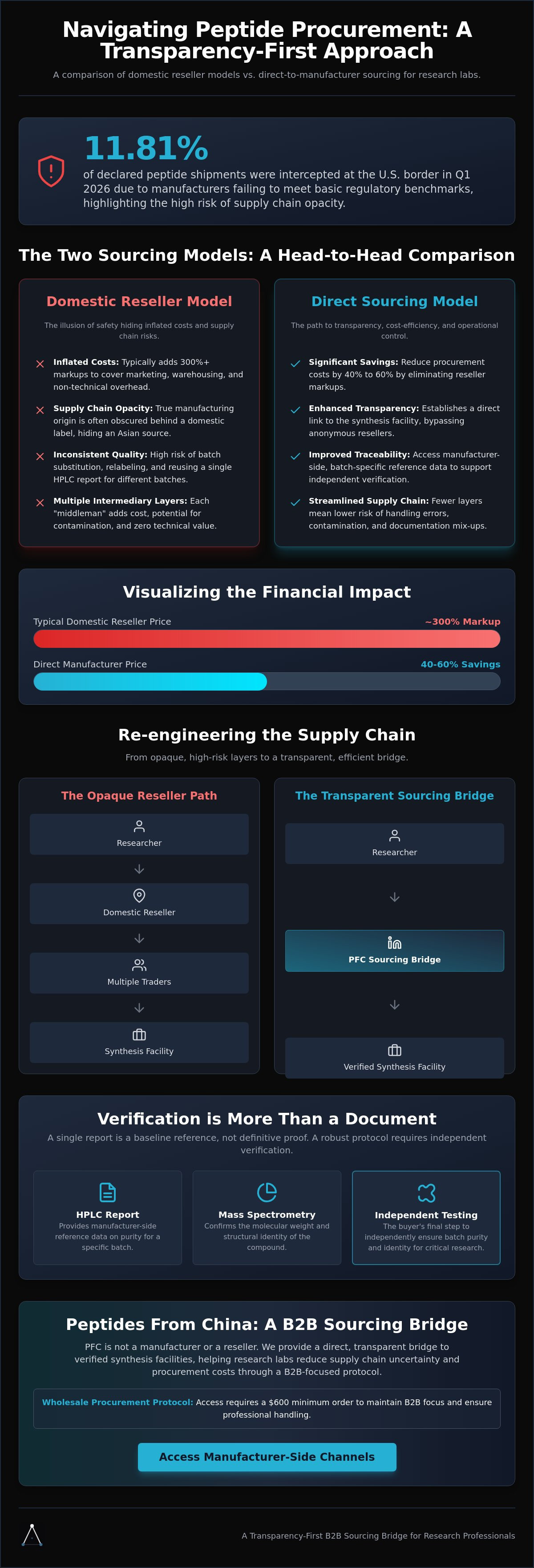
In the first quarter of 2026, 11.81% of declared peptide shipments were intercepted at the U.S. border because manufacturers failed to meet basic regulatory benchmarks. For most research labs, this statistic reinforces the primary anxiety of international procurement: the high risk of supply chain opacity. You've likely tolerated inflated domestic reseller prices and inconsistent batch purity because the alternative feels like a gamble with your lab's budget. While identifying trusted peptide alternatives asia is essential for operational efficiency, a standard HPLC report is no longer enough to guarantee transparency.
We'll show you how to manage these complexities by establishing a manufacturer-side supply line that can reduce your procurement costs by 40 to 60%. You'll learn to implement a repeatable verification protocol for every batch, moving beyond baseline paperwork to ensure consistent results. This guide explores the logistical realities of direct sourcing, including the $600 minimum wholesale requirements, to help you build a more resilient and transparent procurement strategy.
Key Takeaways
Learn why research labs are shifting toward trusted peptide alternatives asia to bypass domestic resellers and secure direct-from-source pricing.
Identify the logistical risks of domestic warehousing, including batch substitution and relabeling, that compromise supply chain integrity.
Understand why standard HPLC reports are only baseline technical references and how independent third-party analysis supports true batch traceability.
Professionalize your procurement by meeting the $600 wholesale minimum required to access manufacturer-side supply channels.
Implement a transparency-first sourcing model that reduces intermediary layers and coordinates sourcing with established Chinese manufacturing facilities and international logistics.
Table of Contents
The Landscape of Trusted Peptide Alternatives in Asia for 2026
Evaluating Trusted Peptide Alternatives: Direct Sourcing vs. Resellers
Verification Protocols: Moving Beyond HPLC Reports
Strategic Procurement: Navigating the Sourcing Process
Peptides From China: A Transparency-First Sourcing Bridge
The Landscape of Trusted Peptide Alternatives in Asia for 2026
The shift from domestic US/EU resellers to direct-from-source Asian manufacturing has accelerated as we move into 2026. This transition is driven by a need for greater supply chain transparency and the realization that most "domestic" stock is simply relabeled Asian production sold at a premium. Asia remains the primary hub for high-purity research compounds because of its massive infrastructure for Peptide synthesis. However, navigating this region requires distinguishing between actual synthesis facilities and trading companies. Trading companies often prioritize volume over batch traceability, adding layers of risk and cost without providing technical oversight or direct accountability.
Using trusted peptide alternatives asia allows research labs to bypass these intermediaries. Transparency-focused sourcing agents, like Peptides From China (PFC), act as a bridge to verified facilities. This approach helps reduce supply chain uncertainty by providing access to manufacturer-side channels. It's a strategic move for labs that value data over marketing hype. Finding trusted peptide alternatives asia isn't about finding a "perfect" vendor; it's about building a transparent, direct bridge that prioritizes independent verification over reused paperwork.
The Economic Drivers of Asian Sourcing
Market pricing and availability can vary substantially by supplier, product, order size, and current conditions; exact comparisons require current, like-for-like data.
The 2026 Research Market Reality
PFC coordinates manufacturer-side sourcing and international logistics. Products are subject to the manufacturer’s applicable quality-control procedures and product-specific specifications. Manufacturer-side analytical documentation may be available depending on the product and batch, but PFC is not an independent analytical testing laboratory and does not guarantee a universal documentation package. Buyers requiring independent verification may arrange third-party analytical testing.
Evaluating Trusted Peptide Alternatives: Direct Sourcing vs. Resellers
Most researchers assume a domestic reseller offers a safer procurement experience. In reality, you're often paying a significant "Middleman Tax" for a label and a local shipping address. These resellers rarely possess synthesis capabilities. They purchase in bulk from Asian facilities, relabel the vials, and add a heavy markup to cover their marketing overhead. Identifying trusted peptide alternatives asia requires looking past the domestic storefront to the actual point of production. This transparency is vital for maintaining the integrity of your research data.
Professional procurement officers use a sourcing bridge model to bypass these layers. This approach prioritizes data over brand recognition. By utilizing a bridge like Peptides From China, you can access manufacturer-side channels with a $600 minimum order. This protocol eliminates the reseller layer and establishes a direct link to synthesis facilities, ensuring your trusted peptide alternatives asia meet your laboratory's specific requirements for consistency and traceability.
The Reseller Model Pitfalls
Resellers frequently reuse a single HPLC report for multiple batches. This practice obscures the variable quality inherent in different synthesis runs. A domestic legal presence doesn't guarantee product identity; it only provides a local point of contact for a product that must be carefully sourced from overseas to meet research standards. White-labeling removes the chain of custody. You lose the ability to track the specific manufacturer-issued papers back to the reactor. This lack of traceability makes it nearly impossible to troubleshoot inconsistencies in your results.
The Direct-to-Manufacturer Advantage
Direct access allows labs to request batch-specific mass spectrometry data. This is vital for high-volume procurement of compounds like tb-500 peptide. Sourcing directly also helps eliminate the risk of degraded stock. Resellers often store peptides in residential-grade freezers with inconsistent temperature monitoring. Direct sourcing ensures the product moves through international logistics coordinated during order processing. Other advantages include:
Market pricing and availability can vary substantially by supplier, product, order size, and current conditions; exact comparisons require current, like-for-like data.
By shifting to a manufacturer-side model, you're not just saving money; you're gaining control over your supply chain. This control is the foundation of reliable, repeatable research.
Verification Protocols: Moving Beyond HPLC Reports
Accepting a manufacturer-issued HPLC report as definitive proof of quality is a common pitfall in research procurement. These documents serve only as baseline technical reference material. They represent a single point in the synthesis timeline and don't account for variables like post-processing degradation, batch substitution, or relabeling. When evaluating trusted peptide alternatives asia, your focus must shift from passive document review to active, independent verification. A report is a starting point, not a guarantee of product identity or purity.
Independent third-party peptide testing is the only method to confirm that the substance in the vial matches the data on the paper. This process helps reduce supply chain uncertainty by providing an unbiased analysis of the compound. You should also prioritize Mass Spectrometry (MS) alongside HPLC. While HPLC measures purity levels, MS confirms the molecular weight and sequence identity. Without MS data, a high purity percentage is meaningless because it doesn't verify the actual identity of the peptide.
Detecting red flags in manufacturer documentation requires a methodical eye. Look for inconsistent fonts, missing batch numbers, or dates that don't align with your order timeline. Generic headers or reports that lack specific manufacturer contact details often suggest a trading company is masking the true origin of the product. These discrepancies are frequently used to hide supply chain opacity and reused analytical data.
Reading Technical Analysis Data
A professional review of an HPLC chromatogram looks beyond the final purity percentage. You must examine the impurity profile, specifically the size and distribution of secondary peaks. These peaks represent synthesis byproducts that can interfere with sensitive research applications. Mass Spectrometry peaks should show a single, clear mass-to-charge ratio that aligns with the theoretical molecular weight of the peptide. Variations in synthesis conditions, reagent purity, and post-processing handling make batch-to-batch inconsistency an inherent operational risk in peptide manufacturing.
Independent Verification Strategies
Implementing a "blind testing" protocol is the most effective way to validate new trusted peptide alternatives asia. This involves sending samples to an independent laboratory without disclosing the manufacturer's claimed results. Choosing a peptide sourcing agent vs platform can significantly impact this process. A specialized agent often facilitates the movement of samples to third-party labs, ensuring that the reference analytical data is corroborated before the bulk of the order is processed.
Finally, physical inspection of the vials is a critical, often overlooked step. Verify the quality of the lyophilization; the "cake" should be uniform and free of moisture or discoloration. Check the vacuum seal integrity by observing the stopper behavior when the vial is opened. A failed vacuum seal often leads to rapid peptide degradation, regardless of the initial synthesis quality.
Strategic Procurement: Navigating the Sourcing Process
Transitioning to manufacturer-side procurement requires a shift from retail purchasing habits to professional laboratory protocols. Defining your requirements is the first step. You must establish specific parameters for purity, quantity, and your allocated budget before engaging with a synthesis facility. For research compounds like BPC-157 or Tirzepatide, professional sourcing operates at a wholesale scale. This is why Peptides From China (PFC) maintains a $600 minimum order requirement. This threshold filters out fragmented retail traffic, allowing the bridge to focus on the high-volume needs of eligible research-use buyers seeking trusted peptide alternatives asia.
Efficiency in B2B procurement also depends on managing the volume of inquiries. A $10 processing deposit is utilized as a secondary filter to ensure that manufacturer resources are dedicated to serious research inquiries. This small fee supports the logistical overhead of generating custom quotes and verifying manufacturer-side stock. It's a standard operational step that prioritizes transparency and ensures that technical staff can provide the necessary reference analytical data without the distractions of the non-professional market. If you are ready to initiate a professional inquiry, you can start the procurement process here.
The B2B Sourcing Roadmap
Navigating the path to trusted peptide alternatives asia follows a structured, three-step progression. First, you request a quote for specific sequences, such as Retatrutide or Ipamorelin, providing your required volume. Second, you review the manufacturer-side stock availability and baseline analytical documentation. Remember that these papers are technical references, not absolute proof of identity. Finally, after approving the batch details, you initiate the international shipment coordinated during order processing. This methodical approach improves traceability and helps reduce supply chain uncertainty by keeping the process focused on data and direct communication.
Logistics and Compliance
Managing international logistics for sensitive research compounds requires more than just a tracking number. Neutral packaging is a standard protocol used to ensure consistent delivery and minimize unnecessary scrutiny during customs clearance. Professional tracking protocols are implemented for all sensitive international freight, providing visibility throughout the transit process. It's important to recognize that wholesale peptides require more rigorous documentation than retail vials. This includes detailed shipping manifests and batch-specific papers that support independent verification once the shipment arrives at your facility. By adhering to these professional procurement protocols, you ensure that your laboratory maintains a consistent, reliable supply chain.
Peptides From China: A Transparency-First Sourcing Bridge
Peptides From China (PFC) operates as a dedicated B2B sourcing bridge, specifically designed to address the systemic flaws in the current peptide market. While traditional resellers prioritize marketing and domestic warehousing, our model focuses on supply chain transparency and the minimization of intermediaries. We don't act as a pharmaceutical manufacturer or a testing laboratory. Instead, we provide a direct link to verified synthesis facilities, helping researchers identify trusted peptide alternatives asia without the obfuscation common in retail channels. This structure allows your laboratory to move away from the "black box" of domestic reselling and toward a more accountable procurement model.
PFC coordinates sourcing from established Chinese manufacturing facilities together with international logistics, without relying on anonymous retail-reseller supply chains. Products are subject to the manufacturer’s applicable quality-control procedures and specifications. Manufacturer-side analytical documentation may be available depending on the product and batch. PeptidesFromChina is not an independent analytical testing laboratory.
Our Direct Sourcing Model
Eliminating reseller layers is the most effective way to reduce supply chain uncertainty. When you bypass the domestic middleman, you remove the risk of batch substitution and relabeling that often occurs during long-term domestic storage. Our role as a sourcing intermediary is to provide the logistical and technical bridge to trusted peptide alternatives asia. We support your independent verification by providing direct manufacturer data, which helps your lab establish a baseline for sequence verification and mass spectrometry analysis. This directness is the foundation of a modern, professional research supply chain.
Getting Started with Professional Sourcing
PeptidesFromChina currently has a $600 total minimum order. Multiple catalog products can be combined to reach the minimum, with orders starting from one 10-vial kit per product. The minimum is an operational ordering requirement.
The $10 deposit initiates manual request processing and real-time stock verification and is credited toward the final invoice. If the request concerns custom synthesis, project-specific requirements are confirmed during processing. Learn more: Initiate your direct sourcing request with Peptides From China.
Securing Your Laboratory Supply Chain
Professional procurement in 2026 demands a departure from the opaque reseller model. By establishing a direct link to synthesis facilities, your lab can eliminate the middleman tax and gain access to the raw data required for rigorous internal verification. It's important to remember that technical documentation like HPLC and Mass Spectrometry reports are baseline references; the integrity of your research depends on your own independent testing protocols. Shifting toward trusted peptide alternatives asia is a strategic decision to prioritize supply chain transparency over the convenience of domestic warehousing.
Products are subject to the manufacturer’s applicable quality-control procedures and specifications. Manufacturer-side analytical documentation may be available depending on the product and batch. PeptidesFromChina is not an independent analytical testing laboratory. PeptidesFromChina currently has a $600 total minimum order. Multiple catalog products can be combined to reach the minimum, with orders starting from one 10-vial kit per product. Shipping details vary by destination and are confirmed during order processing.
Start your manufacturer-side sourcing process with a $10 deposit. Establishing a more resilient and transparent procurement strategy is the best way to ensure the long-term reliability of your research results.
Frequently Asked Questions
Is it legal to source research peptides directly from Asia?
Sourcing peptides for laboratory research is generally legal provided they are strictly for "Research Use Only" and not human consumption. Compliance depends on your local jurisdiction and the specific compound's regulatory status. Researchers should verify that their intended use aligns with institutional guidelines and regional laws regarding chemical imports before initiating a procurement request.
How can I be sure the peptide purity matches the HPLC report?
You cannot rely solely on a manufacturer-issued report as definitive proof. To verify trusted peptide alternatives asia, you must implement buyer-arranged independent third-party testing when required. This includes both HPLC for purity and Mass Spectrometry for sequence identity. Manufacturer documentation should be treated as reference analytical data rather than a final guarantee of quality.
What is the typical lead time for direct-to-manufacturer orders from China?
Shipping options, pricing, and estimated transit times vary by destination and are confirmed during order processing.
Why do most peptide companies have such high markups on BPC-157?
Market pricing and availability can vary substantially by supplier, product, order size, and current conditions; exact comparisons require current, like-for-like data.
What happens if a batch fails independent laboratory testing?
If independent analysis reveals a significant discrepancy from the manufacturer's data, you should immediately halt the use of that batch. Establishing a transparent sourcing bridge allows for better communication with the facility to resolve the issue. Professional procurement protocols prioritize batch traceability to identify whether the failure occurred during synthesis or post-processing handling, helping to reduce future supply chain uncertainty.
Does Peptides From China provide single-vial retail sales?
No. PFC focuses on wholesale research-use sourcing, with a $600 total minimum order and at least one 10-vial kit per catalog product. Eligible buyers include private buyers, research groups, resellers, private brands, and laboratories.
How does neutral packaging help with international peptide shipping?
Neutral packaging helps ensure consistent delivery by minimizing unnecessary scrutiny from customs officials during the transit of trusted peptide alternatives asia. It protects the privacy of the research institution and reduces the likelihood of delays caused by non-technical administrative reviews. This practice is a standard logistical protocol for professional international chemical shipments to maintain operational consistency.
Can I request custom peptide synthesis through your platform?
Yes, you can request custom synthesis for specific sequences by providing your laboratory's technical requirements. Our role is to bridge the gap between your lab and verified synthesis facilities that can handle custom orders. This process requires a $10 processing deposit to ensure the request is a serious research inquiry before technical staff begin the quoting and stock verification process.