
Relying on domestic resellers for sourcing peptides for preclinical research often means paying for a brand name rather than chemical integrity. Many labs unknowingly accept opaque supply chains and reused COAs, which can directly compromise the reproducibility of their data. It's a systemic issue where high markups are mistaken for quality assurance, yet the underlying manufacturer remains a mystery.
You likely recognize that inconsistent batch purity is the primary threat to your research outcomes, especially as 2026 regulatory shifts toward New Approach Methodologies demand higher precision. This guide details how to navigate the manufacturer-side of the industry with an insider's view of verification and supply chain transparency. We'll examine the process of establishing a direct pipeline to verified synthesis facilities, reducing procurement costs for large-scale trials, and implementing rigorous batch-to-batch consistency protocols that meet professional laboratory standards.
Key Takeaways
Learn how to bypass the 300-500% "reseller tax" by establishing a direct-to-manufacturer procurement strategy that prioritizes supply chain transparency.
Master the technical requirements for sourcing peptides for preclinical research, focusing on facility scale, automation, and technical staff verification within the Chinese manufacturing sector.
Understand why a standard Certificate of Analysis (COA) is only a baseline and how to interpret HPLC data to ensure verifiable batch-to-batch consistency.
Navigate international logistics with professional protocols for neutral packaging and secure transit through the China-to-US/EU corridor.
Discover a methodical approach to manufacturer verification that utilizes small processing deposits to secure factual integrity and long-term supply reliability.
Table of Contents
The Preclinical Sourcing Landscape: Challenges and Realities
Navigating the Chinese Peptide Manufacturing Sector
Technical Verification: Beyond the Certificate of Analysis (COA)
Operational Logistics: Procurement and Supply Chain Integrity
PFC as a Strategic Sourcing Bridge for Research Institutions
The Preclinical Sourcing Landscape: Challenges and Realities
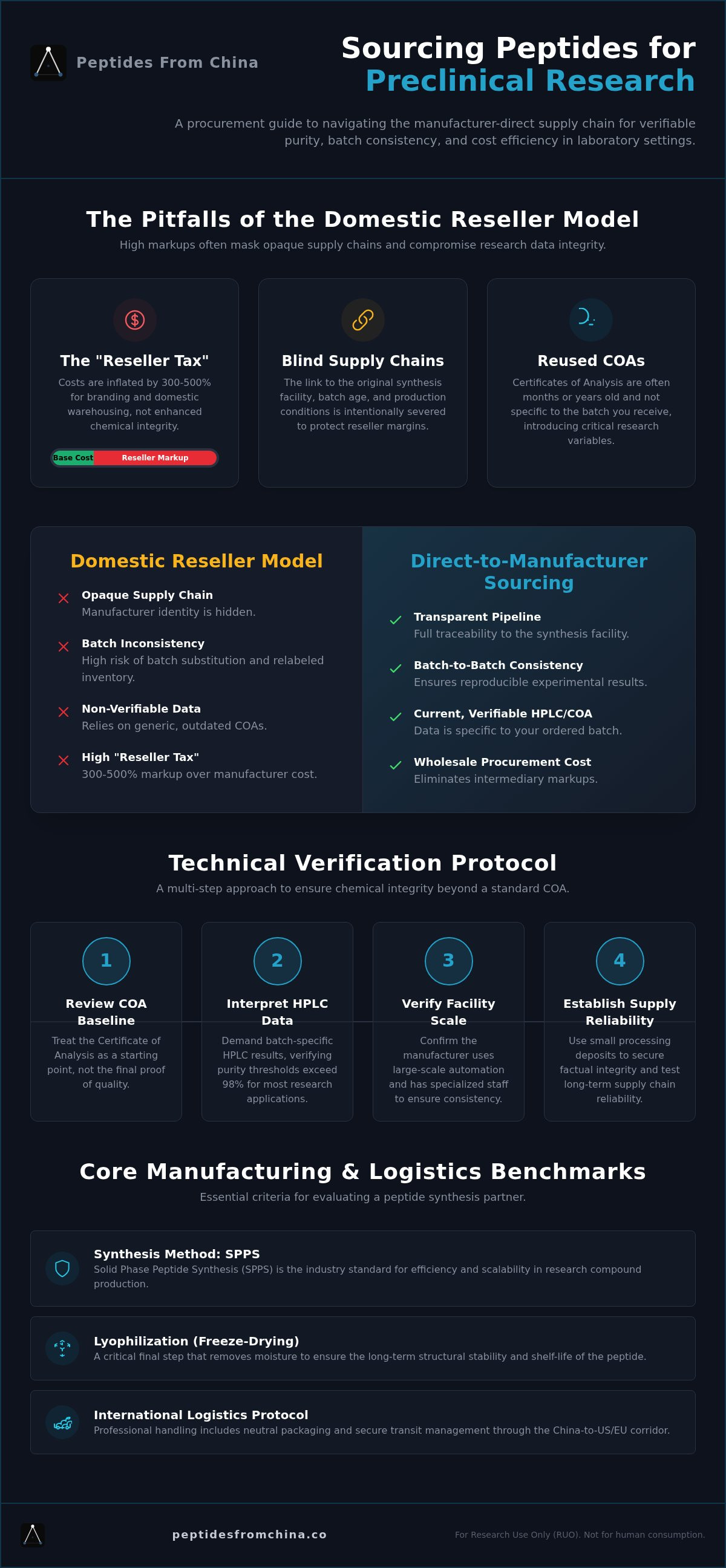
The current market for sourcing peptides for preclinical research is divided between high-cost domestic resellers and direct-to-manufacturer pipelines. For professional laboratories, the distinction between Research Use Only (RUO) compounds and clinical-grade pharmaceuticals is fundamental. RUO peptides are synthesized for in vitro and in vivo laboratory studies, yet many procurement departments fall into the trap of paying clinical-level prices to domestic intermediaries. This "reseller tax" frequently inflates costs by 300% to 500% without providing additional technical value or quality assurance.
Domestic warehousing often creates a "blind" supply chain. When a reseller stocks vials in a local warehouse, the link to the original synthesis facility is usually severed to protect their margins. This opacity makes it nearly impossible for researchers to verify the age of the batch or the specific conditions of its production. As a result, many institutions are shifting toward direct-to-manufacturer models to ensure they aren't just buying a label, but a documented chemical sequence.
The Hidden Pitfalls of the Peptide Market
The retail peptide sector is currently plagued by batch substitution and the frequent relabeling of older inventory. Because many resellers lack the technical infrastructure to perform independent verification, they often rely on reused Certificates of Analysis (COAs) provided by their suppliers months or even years prior. This practice introduces significant risks to study reproducibility. Domestic shipping is often marketed as a premium feature, yet it frequently masks a complete lack of quality control at the source. If a reseller doesn't know which facility produced a batch of BPC-157, they can't accurately vouch for its purity or salt content.
Establishing Baseline Requirements for Preclinical Trials
Reliable data requires strict purity thresholds, typically exceeding 98% for most research applications. High-quality Chemical peptide synthesis must be consistent across every batch to eliminate variables that could skew experimental results. When transitioning from small-scale retail buys to professional wholesale peptides, procurement teams must demand transparency. This involves moving past the "vial shop" mentality and establishing a pipeline where every batch is traceable to a specific production run. Consistency isn't just about the compound name; it's about the technical staff, the automation level of the facility, and the verifiable HPLC data accompanying the shipment.
Establishing these baseline requirements is the first step in sourcing peptides for preclinical research with high reliability. By prioritizing direct manufacturer data over reseller marketing, labs can secure the batch-to-batch consistency required for rigorous scientific inquiry.
Navigating the Chinese Peptide Manufacturing Sector
China operates as the primary global hub for Solid Phase Peptide Synthesis (SPPS), accounting for a significant portion of the international supply chain. For procurement professionals, identifying the right facility requires looking beyond a digital storefront and evaluating actual manufacturing scale. Large-scale synthesis plants utilize high-throughput automation and specialized technical staff to maintain narrow purity margins. In contrast, small-scale labs often lack the rigorous environmental controls needed for batch-to-batch consistency. Direct-to-manufacturer routing eliminates the uncertainty inherent in multi-tiered supply chains, ensuring that the material received is fresh from the lyophilization chamber.
Synthesis Methods and Quality Benchmarks
Choosing between Solid Phase and Liquid Phase synthesis depends on the specific sequence and volume required. SPPS is the industry standard for most research compounds, providing the efficiency needed for sourcing peptides for preclinical research at scale. Lyophilization, or freeze-drying, is a critical step in this process; it ensures long-term stability by removing moisture without damaging the peptide structure. Access to a professional peptide sourcing platform is essential for managing high-volume orders of compounds like Retatrutide or Selank, where manufacturing lead times must be synchronized with research schedules.
Manufacturer Verification Protocols
Verification begins with a technical audit of manufacturer-issued documentation. It's vital to distinguish between legitimate synthesis facilities and trading companies that simply relabel batches. Legitimate manufacturers can provide detailed HPLC and Mass Spectrometry data for specific production runs rather than generic templates. While researchers should consult the FDA guidance on peptide drugs to understand necessary quality standards, a sourcing agent provides the logistical layer of security. This includes conducting local facility spot-checks to verify that the equipment and staff match the claims on the technical papers. This methodical approach ensures that your laboratory is not exposed to the risks of batch substitution or degraded inventory.
If your institution requires verified manufacturing data for bulk procurement, you may request a technical consultation to discuss specific facility requirements.
Technical Verification: Beyond the Certificate of Analysis (COA)
In the context of sourcing peptides for preclinical research, a Certificate of Analysis (COA) is frequently treated as a definitive guarantee of quality. This is a mistake. A COA is a manufacturer's self-issued claim, and in the wholesale market, it represents a baseline technical reference rather than an objective truth. Fraudulent "dry-labbing"—the practice of generating analytical reports without performing the actual tests—remains a persistent risk. For professional procurement, verification must move beyond static paperwork and into the realm of raw data analysis.
High-Performance Liquid Chromatography (HPLC) remains the primary method for determining chemical purity, as it separates the target peptide from residual solvents and synthesis byproducts. While HPLC measures how much of the substance is the target compound, Mass Spectrometry (MS) confirms the identity of that compound by measuring its mass-to-charge ratio. Without both sets of data, there's no way to confirm that a batch of Tirzepatide or Semaglutide is chemically accurate. Relying on a reseller's word is a liability; relying on verifiable, batch-specific raw data is a necessity.
Interpreting HPLC and Mass Spec Reports
Reading a chromatogram requires looking for a single, sharp peak with minimal "noise" or secondary peaks. Secondary peaks often indicate contaminants like trifluoroacetic acid (TFA) or truncated sequences where the amino acid chain failed to complete. Mass Spec reports must align with the theoretical molecular weight of the peptide. If the mass-to-charge ratio is off by even a small margin, the sequence is likely incorrect. Because synthesis errors are common in high-volume production, professional institutions should conduct independent peptide testing upon receipt. This third-party audit ensures that the material in the vial matches the manufacturer's pre-shipment claims.
Batch Traceability and Continuity
Preclinical trials often span several months, making batch-to-batch variability a significant experimental variable. If a lab switches batches of IGF-1 LR3 or CJC-1295 without DAC mid-study, the data integrity may be compromised. Procurement strategies should prioritize securing large, single-lot quantities to ensure continuity. Every shipment must have a strict chain of custody and batch-specific reporting rather than generic catalog data. This methodical approach to sourcing peptides for preclinical research protects the reproducibility of your data by ensuring that the chemical baseline remains constant throughout the entire study duration.
Operational Logistics: Procurement and Supply Chain Integrity
Logistics in the B2B peptide sector demand a methodical approach that prioritizes reliability over speed. When sourcing peptides for preclinical research, the China-to-US/EU corridor represents the most efficient route for high-volume synthesis, yet it requires precise management of customs documentation. Professional procurement involves real-time tracking and a clear understanding of how neutral packaging functions to minimize logistical friction. Neutral packaging isn't about evasion; it's a standard industry practice for research-grade compounds to ensure they reach the laboratory without unnecessary transit delays or mishandling by intermediaries.
The $600 minimum is an operational minimum for orders placed through the PFC sourcing platform and may include multiple catalog products. It ensures that production facilities focus their resources on wholesale buyers who require technical documentation and batch consistency.
Optimizing Large-Scale Procurement
Structuring a preclinical budget requires an understanding of the economic logic behind bulk sourcing. By consolidating orders for compounds like tb-500 peptide or BPC-157, labs can significantly reduce the per-vial cost while securing a single production lot. Managing lead times is equally critical. You must account for the synthesis queue, which can vary based on facility capacity, and the subsequent international transit window. To understand the specific steps from payment to delivery, review the details on how it works.
Risk Mitigation in International Transit
International transit involves inherent variables that must be addressed through robust B2B contracts. A reliable sourcing partner provides insurance and clear reshipment policies to protect the institution's investment. Direct shipping from the synthesis facility in China actually improves traceability when sourcing peptides for preclinical research. Unlike domestic reshipping, where a batch might sit in an unverified warehouse for months, direct transit ensures you receive the most recent lyophilized batch. For more information on handling and storage protocols, consult our peptide quality standards and our FAQ.
To secure a logistical plan tailored to your laboratory's specific timeline and volume requirements, request a wholesale quote today.
PFC as a Strategic Sourcing Bridge for Research Institutions
PFC serves as a specialized sourcing desk designed to provide clarity for institutions sourcing peptides for preclinical research. We don't function as a retail vial shop or a domestic warehouse. PFC coordinates sourcing from established Chinese manufacturing facilities together with international logistics. By removing the domestic middleman, we eliminate the artificial price inflation that often drains research budgets. PFC coordinates each order with the manufacturing side and international logistics, ensuring that the compounds received, such as Tirzepatide or Semaglutide, are fresh and accompanied by batch-specific analytical reference data.
Our role is to facilitate a direct pipeline that prioritizes factual integrity over marketing flair. We understand the skepticism surrounding international procurement, which is why our model is built on methodical verification rather than superficial promises. We provide the technical and logistical bridge necessary to access the Chinese manufacturing sector without the typical anxieties of supply chain opacity.
The PFC Sourcing Process
Our procurement protocol is built on a methodical sequence to protect the buyer's interests. The $10 deposit initiates manual request processing and real-time stock verification and is credited toward the final invoice. The $600 minimum is an operational minimum for orders placed through the PFC sourcing platform and may include multiple catalog products. This step prevents the common industry issue of ordering compounds that aren't actually in stock or don't meet the required purity thresholds. Once stock is approved, we move to the final invoicing and logistical phase, providing a streamlined path from the synthesis queue to your lab. You can review the full details on how it works to align our timeline with your study schedule.
Supporting Independent Laboratory Verification
PFC coordinates manufacturer-side sourcing and international logistics. Products are subject to the manufacturer’s applicable quality-control procedures and specifications. Manufacturer-side analytical documentation may be available depending on the product and batch. PeptidesFromChina is not an independent analytical testing laboratory. Buyers requiring independent verification may arrange third-party analytical testing. Browse BPC-157 and TB-500, view the full catalog, or request a quote.
Securing Technical Integrity for Your Research Pipeline
Establishing a transparent supply chain is a technical necessity for any institution focused on data reproducibility. By moving past domestic resellers, labs can eliminate opaque markups and secure a direct line to verified synthesis facilities. Successfully sourcing peptides for preclinical research requires a shift from trusting marketing labels to auditing raw HPLC and Mass Spectrometry data. This methodical approach ensures that every batch meets the strict purity thresholds required for valid experimental outcomes.
Logistical integrity is equally vital. Utilizing professional protocols like neutral packaging and coordinated manufacturer-side sourcing and international logistics minimizes transit risks and preserves the stability of lyophilized compounds. PFC coordinates sourcing from established Chinese manufacturing facilities together with international logistics. Products are subject to the manufacturer’s applicable quality-control procedures and specifications. Manufacturer-side analytical documentation may be available depending on the product and batch. PeptidesFromChina is not an independent analytical testing laboratory. We're committed to helping your procurement department transition from inconsistent retail buys to a reliable wholesale pipeline.
Request a Manufacturer Verification and Quote from Peptides From China to secure your next research batch. We look forward to supporting your institutional goals through factual integrity and supply chain transparency.
Frequently Asked Questions
Is a Certificate of Analysis (COA) enough to guarantee peptide purity?
No. A COA is a self-issued manufacturer claim. While it's a baseline, it doesn't account for batch substitution or dry-labbing risks. Labs should treat it as a preliminary reference and perform independent HPLC/MS verification to ensure the data reflects the actual material in the vial. This is critical for maintaining experimental integrity and avoiding reproducibility issues caused by inaccurate documentation provided by resellers.
The $600 minimum is an operational minimum for orders placed through the PFC sourcing platform and may include multiple catalog products.
The $600 minimum is an operational minimum for orders placed through the PFC sourcing platform and may include multiple catalog products, starting from one 10-vial kit per product. The standard catalog is available to adult eligible research buyers, including private buyers, research groups, resellers, and private brands.
How can researchers verify that peptides are coming directly from a manufacturer?
Verification involves auditing the raw analytical data and tracking the shipping origin. Sourcing arrangements should be confirmed with the supplier; international logistics may involve a forwarder or logistics partner. Researchers should request batch-specific HPLC and Mass Spectrometry reports that match the current production lot. Additionally, utilizing a sourcing agency to perform local facility spot-checks ensures the manufacturer has the technical infrastructure claimed in their official documentation.
What is the difference between RUO peptides and pharmaceutical-grade peptides?
Research Use Only (RUO) peptides are synthesized for laboratory experiments and are not intended for human consumption or clinical diagnostic procedures. Pharmaceutical-grade peptides require strict adherence to cGMP standards and extensive regulatory filings for human use. For the purpose of sourcing peptides for preclinical research, RUO compounds provide the necessary chemical sequence and purity for in vitro or in vivo studies without the clinical-grade pharmaceutical price inflation.
Can HPLC reports be faked, and how can labs protect themselves?
Yes, "dry-labbing" or reusing old reports is a documented risk in the global supply chain. Labs can protect themselves by demanding raw data files rather than static PDF summaries and by performing their own third-party testing upon receipt. Comparing the manufacturer's pre-shipment data with independent laboratory results is the most effective way to identify fraudulent analytical reports and ensure the chemical sequence is accurate for your study.
What are the typical lead times for direct-from-China peptide sourcing?
Lead times generally range from 10 to 15 business days for in-stock compounds, though custom synthesis sequences take longer. This window accounts for the synthesis queue, lyophilization, and international transit via the China-to-US/EU corridor. Factors such as facility capacity and neutral packaging protocols can influence the timeline. We recommend synchronizing procurement with your research schedule to account for these logistical variables and ensure batch continuity for long-term trials.
Why is neutral packaging used for international peptide shipping?
Neutral packaging is a standard B2B logistical protocol used to minimize transit friction and ensure safe delivery. It reduces the likelihood of mishandling by international carriers or unnecessary delays during the customs clearance process. This approach is specifically designed for research-grade compounds moving through the wholesale supply chain. PFC coordinates sourcing from established Chinese manufacturing facilities together with international logistics. Shipping options, pricing, and estimated transit times vary by destination and are confirmed during order processing.
The $10 deposit initiates manual request processing and real-time stock verification and is credited toward the final invoice.
The $10 deposit initiates manual request processing and real-time stock verification and is credited toward the final invoice. It allows us to confirm that the specific lot meets your requirements for sourcing peptides for preclinical research The $600 minimum is an operational minimum for orders placed through the PFC sourcing platform and may include multiple catalog products. This process prevents payment for out-of-stock items and ensures analytical data is available before bulk funds are committed.