
The lowest quote on a wholesale peptide price list often signals a compromised supply chain rather than a genuine logistical advantage. Most procurement professionals recognize that domestic "warehousing" companies frequently act as high-margin resellers, inflating costs while offering little more than a reused COA as a proxy for quality. You've likely encountered the frustrations of variable batch consistency and the persistent opacity that defines the China-to-US supply route.
This article serves as a technical reference for laboratories and researchers looking to bypass these intermediaries and access manufacturer-direct channels. We provide a transparent analysis of 2026 pricing structures, including the logistical realities of bulk procurement and the limitations of standard analytical data. You'll learn how to navigate the current regulatory landscape, such as the July 2026 FDA advisory committee reviews of compounds like BPC-157 and TB-500, while maintaining rigorous internal standards. By focusing on a $600 minimum order threshold, we move past retail-level distractions to focus on professional-grade sourcing protocols, batch traceability, and the necessity of independent buyer-side testing.
Key Takeaways
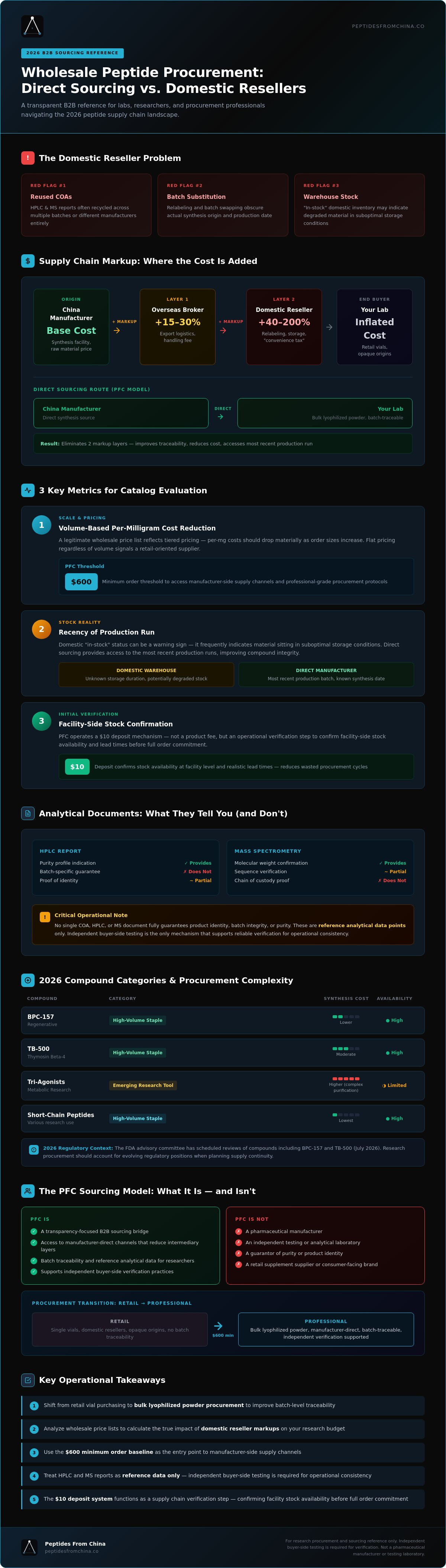
Identify the transition from retail vial purchasing to bulk lyophilized powder procurement to improve batch-level traceability.
Analyze the 2026 wholesale peptide price list to calculate the impact of domestic reseller markups on your research budget.
Establish a $600 minimum order baseline to shift from retail-grade sourcing to professional manufacturer-side supply channels.
Learn to treat HPLC and Mass Spectrometry reports as reference analytical data that requires independent buyer-side verification for operational consistency.
Understand how the PFC $10 deposit system serves as a verification mechanism for facility-side stock availability and supply chain transparency.
Table of Contents
Navigating the 2026 Research Peptide Catalog Landscape
Essential Compounds and Pricing Structures
Economic Analysis: Direct Sourcing vs. Domestic Intermediaries
Verification Protocols for Bulk Procurement
The PFC Model: Bridging the Manufacturer-Researcher Gap
Navigating the 2026 Research Peptide Catalog Landscape
The 2026 procurement environment is defined by a fundamental move toward raw material transparency. For years, researchers relied on domestic resellers that marketed single vials at retail prices, often masking the origin of the compounds. Today, professional labs are shifting toward bulk lyophilized powder procurement. This change isn't just about cost; it's about controlling the supply chain. When you request a wholesale peptide price list, you aren't just looking for the lowest number. You're looking for a direct line to the synthesis facilities that actually produce the material.
Most entities calling themselves a "peptide company" are actually high-margin middlemen. They don't own the labs. They purchase from overseas, relabel the vials, and add a significant "convenience tax" for domestic shipping. Understanding the technical nuances of Peptide synthesis is essential for researchers who want to audit these sources effectively. A professional catalog must prioritize batch traceability over marketing claims, acknowledging that a fancy label doesn't equate to synthesis quality.
The Evolution of Wholesale Sourcing
The domestic "re-labeler" model is losing ground as researchers demand better batch traceability. In the past, a simple HPLC report was enough to satisfy a buyer. In 2026, we know that these documents are often reused across multiple batches or even different manufacturers. Sourcing has become more methodical. Researchers now prioritize direct-to-manufacturer routing, accepting the logistical complexities of international shipping to ensure they aren't receiving old, degraded stock from a domestic warehouse. This shift helps reduce supply chain uncertainty by removing unnecessary layers of handling.
Key Metrics for Catalog Evaluation
Evaluating a professional research peptide catalog requires looking past "guaranteed purity" claims. Purity is a baseline requirement, not a marketing feature. Professional buyers focus on three specific metrics:
Scale and Pricing: Wholesale dynamics depend heavily on volume. A wholesale peptide price list should reflect how per-milligram costs drop as order sizes increase. At Peptides From China (PFC), we establish a $600 minimum to ensure we are serving professional-grade procurement needs rather than the retail market.
Stock Reality: "In-stock" status in a domestic warehouse can be a red flag. It often indicates that the material has been sitting in suboptimal conditions. Direct sourcing ensures you're accessing the most recent production run.
Initial Verification: We utilize a $10 deposit system for initial verification. This isn't a product fee; it's an operational step to confirm facility-side stock availability and lead times before a full order is committed.
Essential Compounds and Pricing Structures
Analyzing a wholesale peptide price list requires an understanding of synthesis complexity and production scale. Not all compounds are equal in the manufacturing pipeline. While simple short-chain peptides are relatively inexpensive to produce in high volumes, newer tri-agonists require sophisticated purification steps that keep costs elevated. The global market for research-use compounds is currently split between high-volume staples and emerging metabolic research tools. Each category has distinct logistical requirements. For example, while the FDA has raised safety concerns about peptides in clinical settings, the demand in the research sector continues to drive manufacturing innovation in China.
High-Volume Regenerative Peptides
Regenerative research often centers on compounds like BPC-157 and TB-500. These peptides are characterized by their stability and relatively high synthesis yields. For labs looking to optimize their budgets, accessing bulk BPC-157 wholesale channels allows for significant per-unit reductions. Similarly, TB-500 peptide sourcing requires careful attention to the specific sequence being produced, as Thymosin Beta-4 synthesis standards vary between facilities. Longevity-focused research also involves GHK-Cu and Epithalon, which are often procured in multi-gram quantities to support long-term studies. Consistency across these batches is managed through direct-to-manufacturer routing, which helps reduce supply chain uncertainty by minimizing the risk of receiving degraded material from domestic resellers.
Metabolic and GLP-1 Research Compounds
The 2026 metabolic research landscape is dominated by GLP-1 and GIP agonists. Semaglutide and Tirzepatide have reached industrial-scale production levels, which has stabilized their pricing on most wholesale catalogs. However, the emergence of Retatrutide introduces new complexity. As a tri-agonist, its synthesis involves more intricate amino acid coupling, making it more expensive than earlier generations. These compounds are highly sensitive to environmental factors. Professional procurement protocols ensure they are shipped in vacuum-sealed vials, often requiring specific logistics to maintain structural integrity during transit. If you're preparing a large-scale study, you can view our current catalog to see how volume affects the pricing of these metabolic tools.
Economic Analysis: Direct Sourcing vs. Domestic Intermediaries
Domestic warehousing is often marketed as a safety feature. In reality, it's a value-added service that carries a heavy "Intermediary Tax." When you review a domestic wholesale peptide price list, you're paying for the reseller's overhead, domestic labor, and aggressive marketing campaigns. These markups frequently reach substantially over the manufacturer's base price. By sourcing directly, you shorten the chain of custody significantly. This helps reduce supply chain uncertainty. You aren't just saving capital; you're ensuring the material hasn't been sitting in a non-climate-controlled storage unit for months before reaching your lab.
The primary trade-off involves lead times. Domestic shipping takes days, while direct sourcing involves international logistics and customs clearance. However, for a professional laboratory, the cost-benefit analysis usually favors the manufacturer. The substantial savings can be redirected to fund independent verification. Adhering to Regulatory Guidelines for Peptide Analysis requires significant investment in third-party testing. If you reduce your procurement costs by 60%, you have the necessary capital to run your own HPLC and Mass Spectrometry tests on every batch you receive.
The Logic of the $600 Minimum
Direct synthesis facilities don't operate like retail shops. Small orders are economically unviable for large-scale reactors. We maintain a $600 minimum order requirement to align with these manufacturing realities. This threshold ensures the logistics remain efficient for the facility and the buyer. It moves the focus away from "vial price" and toward a professional "project budget" model. Labs that plan their procurement on a quarterly basis find this baseline more sustainable. It allows for more rigorous independent testing budgets because the per-unit cost is drastically lower than retail equivalents.
Transparency as a Cost-Saving Measure
Opacity in the supply chain represents a major financial risk. Batch substitution and relabeling are common when multiple intermediaries are involved in the transaction. Using a peptide sourcing platform helps audit these facilities directly. You receive reference analytical data from the source rather than a photocopied report from a reseller. Transparent pricing models lead to better long-term laboratory budget management. When you understand the floor price of a compound, your research funding goes further. It removes the guesswork and helps you avoid the "warehousing" markups that provide no technical benefit to the research itself.
Verification Protocols for Bulk Procurement
A wholesale peptide price list often comes bundled with Certificates of Analysis (COAs), but professional procurement requires a deeper level of scrutiny. In the 2026 market, documentation like HPLC and Mass Spectrometry reports must be viewed as reference analytical data rather than definitive proof of quality. The industry continues to struggle with supply chain opacity, where less scrupulous resellers frequently reuse outdated or fraudulent documentation across multiple production cycles. This makes a "Trust but Verify" protocol essential for any laboratory receiving bulk lyophilized powder.
Relying solely on manufacturer-issued papers is a significant operational risk. While these documents provide a baseline for identification, they don't account for degradation during transit or batch substitution at the intermediary level. Implementing independent peptide testing is the only way to confirm that the material meets your specific research requirements. By bypasssing domestic resellers and using the capital saved to fund your own third-party analysis, you improve traceability and significantly reduce supply chain uncertainty.
Reading Analytical Reports
Identifying red flags in manufacturer-issued COAs is a critical skill for procurement officers. Common discrepancies include batch numbers that don't align with synthesis dates or HPLC chromatograms with suspiciously "clean" baselines that suggest digital manipulation. It's also vital to distinguish between purity and concentration. A sample might show 99% purity on an HPLC report, yet the actual concentration of the peptide in the bulk powder could be lower due to residual salts or moisture content. Verifying these metrics through independent labs ensures your research data remains consistent across different study phases.
Traceability and Batch Consistency
Large-scale synthesis naturally involves batch-to-batch variation. Managing this requires a methodical approach to documentation. We recommend maintaining a technical reference library for every compound you source, archiving both the manufacturer's reference data and your own independent test results. This practice allows you to track the performance of specific synthesis facilities over time. Direct communication with these facilities is the most effective way to improve traceability. When you move away from the "black box" model of domestic warehousing, you gain a clearer understanding of the production timeline and the specific protocols used during the lyophilization process.
Establishing these rigorous standards is the primary reason we enforce a $600 minimum for our clients. It ensures that the scale of the order justifies the logistical and analytical effort required for professional-grade verification. If you're ready to move beyond the limitations of retail-style sourcing, you can access our manufacturer-direct sourcing channels to begin a more transparent procurement process.
The PFC Model: Bridging the Manufacturer-Researcher Gap
Peptides From China (PFC) operates as a transparency-focused B2B sourcing bridge, specifically designed to help researchers access manufacturer-side channels. We don't position ourselves as a pharmaceutical manufacturer or a testing laboratory. Instead, our role is to reduce the layers of resellers that typically sit between a synthesis facility and the end buyer. The traditional procurement model relies on a static wholesale peptide price list that often masks the reality of facility-side stock levels. We counter this by providing direct-to-manufacturer routing, ensuring that the compounds you receive haven't been sitting in a domestic warehouse for an indeterminate period.
Our model is built for professional-grade procurement, which is why we maintain a $600 minimum order requirement. This threshold ensures that the logistical complexities and verification steps involved in international sourcing remain viable for all parties. To start the process, we utilize a $10 deposit system. This isn't a product fee; it's a mechanism for initial verification and stock approval. It allows us to confirm current lead times and facility-side availability before you commit to a full wholesale order, helping to reduce supply chain uncertainty from the outset.
The Sourcing Process Step-by-Step
The $10 deposit initiates manual request processing and real-time stock verification and is credited toward the final invoice. PFC checks current availability directly with the manufacturing side and places the request into the processing workflow. Manufacturer-side analytical documentation may be available depending on the product and batch.
International Logistics and Tracking
PFC coordinates international logistics. Shipping methods, pricing, and estimated transit times vary by destination and are confirmed during order processing. Learn more: wholesale peptides.
Optimizing Your Laboratory Procurement Strategy for 2026
Sourcing in 2026 requires a fundamental shift from retail convenience toward manufacturer-side transparency. By eliminating domestic reseller markups and adopting direct-to-manufacturer routing, laboratories can allocate significantly more capital toward independent verification. This approach doesn't just lower costs. It improves traceability and allows for a more methodical audit of synthesis facilities, ensuring that your research data remains consistent across every study phase. Moving past the "warehousing" model helps reduce supply chain uncertainty by shortening the chain of custody for every compound.
PeptidesFromChina currently has a $600 total minimum order. Multiple catalog products can be combined to reach the minimum, with orders starting from one 10-vial kit per product. Manufacturer-side analytical documentation may be available depending on the product and batch. Learn more: Request a 2026 Wholesale Price List and Sourcing Audit.
Frequently Asked Questions
How do I access a wholesale peptide price list for 2026?
You can request a current wholesale peptide price list directly through the PFC platform. This list is dynamic and reflects real-time manufacturer-side pricing and availability rather than static retail figures. Because we bridge the gap to synthesis facilities, these prices are subject to raw material costs and current production throughput in the 2026 market. This ensures you access the most recent pricing data available from the source.
What is the minimum order requirement for direct-from-China peptide sourcing?
PeptidesFromChina currently has a $600 total minimum order. Multiple catalog products can be combined to reach the minimum, with orders starting from one 10-vial kit per product. The $600 minimum is an operational minimum for orders through the PFC sourcing platform.
How can I be sure of the purity of bulk research peptides?
You shouldn't rely on any single document as definitive proof of purity. While manufacturer-side analytical documentation may be available depending on the product and batch, these are provided as reference analytical data. We strongly advocate for independent, third-party testing by the buyer to confirm product identity and purity before starting any research project. This practice is the only way to truly reduce supply chain uncertainty and ensure your research remains consistent.
Why is there a $10 deposit for sourcing requests?
The $10 deposit initiates manual request processing and real-time stock verification and is credited toward the final invoice. The deposit is not payment for analytical documents or testing.
What compounds are available in the Peptides From China catalog?
Our catalog includes high-demand research compounds such as BPC-157, Semaglutide, Tirzepatide, and Retatrutide. We also facilitate sourcing for TB-500 (Thymosin Beta-4), Selank, Semax, Epithalon, and GHK-Cu. Other available technical compounds include IGF-1 LR3, HGH Fragment 176-191, CJC-1295 without DAC, Ipamorelin, Melanotan II, PT-141, and Thymosin Alpha-1. Every compound is sourced through direct-to-manufacturer routing to ensure you aren't receiving old stock from a domestic reseller.
How does PFC differ from a domestic peptide reseller?
PFC is a B2B sourcing bridge that provides direct-to-manufacturer routing, whereas domestic resellers are typically high-margin "warehousing" companies. We don't relabel vials or add domestic convenience markups. Instead, we focus on improving traceability by connecting you directly to synthesis facilities and removing unnecessary layers from the chain of custody. This model prioritizes supply chain transparency and manufacturer-direct pricing over the convenience of domestic shipping speeds.
What is the typical lead time for wholesale peptide synthesis and shipping?
Lead times vary based on the specific compound and current facility throughput. For high-demand metabolic research tools, we confirm current lead times during the initial $10 deposit phase. This timeline includes the synthesis window and the logistical protocols required for international shipping in neutral, tracked packaging. By confirming these details at the start, we help you manage your research timelines without the uncertainty often found in the retail market.
Do you provide HPLC and Mass Spectrometry reports for every batch?
Products are subject to the manufacturer’s applicable quality-control procedures and specifications. Manufacturer-side analytical documentation may be available depending on the product and batch. PeptidesFromChina is not an independent analytical testing laboratory. Buyers requiring independent verification may arrange third-party analytical testing.