
Market pricing and availability can vary substantially by supplier, product, order size, and current conditions; exact comparisons require current, like-for-like data.
The $600 minimum is an operational minimum for orders placed through the PFC sourcing platform and may include multiple catalog products. Multiple catalog products can be combined to reach the minimum, with orders starting from one 10-vial kit per product.
Key Takeaways
PFC coordinates manufacturer-side sourcing and international logistics. Products are subject to the manufacturer’s applicable quality-control procedures and product-specific specifications. Manufacturer-side analytical documentation may be available depending on the product and batch, but PFC is not an independent analytical testing laboratory and does not guarantee a universal documentation package. Buyers requiring independent verification may arrange third-party analytical testing.
Table of Contents
The Evolution of B2B Peptide Sourcing Platforms in 2026
Technical Verification Standards: HPLC, MS, and COA Authenticity
The Economics of Sourcing: Direct-to-Manufacturer vs. Domestic Resellers
Operational Logistics for International Laboratory Procurement
The $600 minimum is an operational minimum for orders placed through the PFC sourcing platform and may include multiple catalog products. Multiple catalog products can be combined to reach the minimum, with orders starting from one 10-vial kit per product.
The Evolution of B2B Peptide Sourcing Platforms in 2026
Market pricing and availability can vary substantially by supplier, product, order size, and current conditions; exact comparisons require current, like-for-like data.
Institutional Procurement vs. Retail Vial Shops
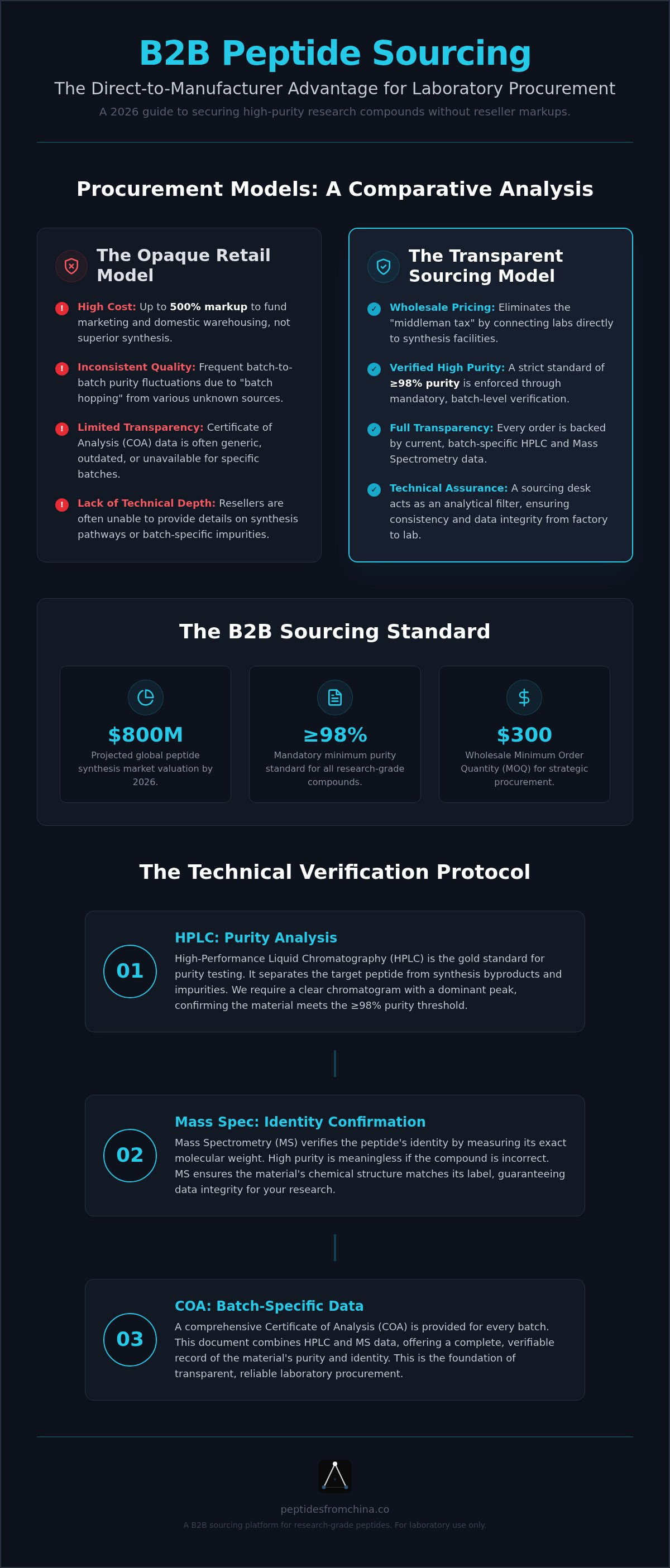
Retail vial shops operate on a high-margin model designed for convenience rather than scale. These businesses typically source bulk material, divide it into single-use vials, and add significant markups to cover domestic warehousing, labor, and aggressive marketing. For a laboratory, this model is inefficient. Institutional procurement requires bulk raw powders and comprehensive data sets that retail shops can't provide. Retailers often lack the technical depth to answer complex inquiries about batch-specific impurities or synthesis pathways. By cutting out these domestic hubs, labs can reallocate their budgets toward more extensive testing and higher sample volumes. The shift toward wholesale procurement reflects a maturing industry where data integrity is more valuable than retail packaging.
Manufacturer-Side QC and Buyer-Arranged Verification
PFC coordinates manufacturer-side sourcing and international logistics. Products are subject to the manufacturer’s applicable quality-control procedures and product-specific specifications. Manufacturer-side analytical documentation may be available depending on the product and batch, but PFC is not an independent analytical testing laboratory and does not guarantee a universal documentation package. Buyers requiring independent verification may arrange third-party analytical testing.
Technical Verification Standards: HPLC, MS, and COA Authenticity
High-purity research peptides require more than a manufacturer's promise. Within a professional b2b peptide sourcing platform, technical verification is the primary safeguard against batch variability. For institutions, the standard for "high-purity" is strictly defined as ≥98% purity. Achieving this requires rigorous analytical methods to ensure the chemical integrity of compounds like Tirzepatide or Selank. Relying on outdated data is a risk researchers can't afford. Data must be batch-specific and verifiable to maintain the integrity of laboratory results.
Interpreting HPLC Purity and Mass Spectrometry Identity
High-Performance Liquid Chromatography (HPLC) is the industry benchmark for determining purity. It works by separating the peptide from any residual solvents or synthesis byproducts. When you examine an HPLC report, you're looking at the "area under the curve" on the chromatogram. A single, sharp peak indicates a homogeneous sample; smaller "shoulders" or secondary peaks signal impurities. While purity is vital, it doesn't confirm identity. That's the role of Mass Spectrometry (MS). MS measures the precise molecular weight of the sample. If the detected mass doesn't match the theoretical sequence of the peptide, the purity percentage is irrelevant. You can find detailed breakdowns of these protocols in our guide to Peptide Testing and Analysis.
Verifying COA Authenticity for Wholesale Batches
The $600 minimum is an operational minimum for orders placed through the PFC sourcing platform and may include multiple catalog products. Multiple catalog products can be combined to reach the minimum, with orders starting from one 10-vial kit per product.
Laboratory Credentials: Ensure the testing facility is an independent third party or a verified internal QC department with a traceable history.
Batch Matching: The batch number on the vial must correspond exactly to the report.
Timestamp Integrity: Reports should be dated within a reasonable window of the synthesis completion.
Data Resolution: High-resolution chromatograms should be clear enough to identify baseline noise and potential contaminants.
Consistency across large-scale orders depends on these verification steps. If you're unsure about the data provided by a manufacturer, requesting a specific batch analysis through our sourcing desk can provide the clarity needed for your project. Products are subject to the manufacturer’s applicable quality-control procedures and specifications. Manufacturer-side analytical documentation may be available depending on the product and batch. PeptidesFromChina is not an independent analytical testing laboratory.
The Economics of Sourcing: Direct-to-Manufacturer vs. Domestic Resellers
Products are subject to the manufacturer’s applicable quality-control procedures and specifications. Manufacturer-side analytical documentation may be available depending on the product and batch. PeptidesFromChina is not an independent analytical testing laboratory.
PFC coordinates manufacturer-side sourcing and international logistics. Products are subject to the manufacturer’s applicable quality-control procedures and product-specific specifications. Manufacturer-side analytical documentation may be available depending on the product and batch, but PFC is not an independent analytical testing laboratory and does not guarantee a universal documentation package. Buyers requiring independent verification may arrange third-party analytical testing.
Eliminating the "Middleman Tax" and Warehousing Markups
Moving material through domestic warehouses often results in significant price inflation. These markups are necessary for retailers to maintain "ready-to-ship" inventory, but they provide zero analytical value to the researcher. Direct routing from the manufacturer preserves the research budget by ensuring every dollar spent goes toward the synthesis of compounds like Retatrutide or Ipamorelin. Institutional buyers should consult our Wholesale Peptides Guide to understand the granular economic differences between retail vial pricing and bulk powder procurement.
Transparency in Sourcing Deposits and Verification Fees
The $10 deposit initiates manual request processing and real-time stock verification and is credited toward the final invoice.
The $600 minimum is an operational minimum for orders placed through the PFC sourcing platform and may include multiple catalog products. Multiple catalog products can be combined to reach the minimum, with orders starting from one 10-vial kit per product.
Operational Logistics for International Laboratory Procurement
Efficient laboratory operations in 2026 require a methodical approach to supply chain management. Procurement officers must distinguish between ready-to-ship inventory and custom synthesis requirements to maintain research timelines. Standard catalog items, such as BPC-157 or TB-500, typically move from manufacturer verification to dispatch within 3 to 5 business days. However, custom synthesis for specialized sequences or high-volume bulk powder orders often requires a 14 to 21-day production window. A professional b2b peptide sourcing platform streamlines this process by providing a single point of contact for tracking these distinct lead times across multiple synthesis facilities.
Managing large-scale orders, such as 100+ vial kits or multi-gram bulk powder shipments, demands rigorous logistical coordination. Unlike retail environments that focus on single-vial sales, our sourcing desk prioritizes the consistency of the entire batch. This involves ensuring that the synthesis facility can meet the volume requirements without compromising the analytical standards established in previous sections. For institutional buyers, the goal is a predictable pipeline that supports ongoing research without the interruptions common in fragmented retail supply chains.
Navigating Global Transit and Neutral Packaging
International transit for research chemicals relies on precision and discretion. We utilize neutral packaging protocols to ensure that shipments move through global logistics hubs without unnecessary administrative delays. This approach focuses on factual documentation and professional handling rather than superficial branding. Every shipment is assigned a global tracking number, allowing procurement teams to monitor the progress of their material from the synthesis facility to the laboratory. Domestic warehousing is not a prerequisite for reliable delivery; in fact, direct routing reduces the number of touchpoints and the risk of temperature fluctuations. You can review the step-by-step fulfillment process on our Direct Sourcing Logistics page.
Secure B2B Payment Protocols for International Sourcing
Professional B2B transactions require secure, traceable payment methods that protect the laboratory's capital. The $10 deposit initiates manual request processing and real-time stock verification and is credited toward the final invoice. The $600 minimum is an operational minimum for orders placed through the PFC sourcing platform and may include multiple catalog products. Current payment methods are listed in the live PFC payment instructions and are confirmed during processing. This structured invoicing process ensures that no significant funds are committed until the manufacturer's stock has been physically confirmed and analytically vetted. For a detailed breakdown of our transaction security, visit our guide on How to Pay for Wholesale Peptides.
Successful procurement depends on matching your laboratory's specific timeline and volume requirements with the right synthesis facility. If you are planning a large-scale research project and require a custom logistical framework, request a comprehensive procurement quote to begin the verification process.
The $600 minimum is an operational minimum for orders placed through the PFC sourcing platform and may include multiple catalog products.
The $10 deposit initiates manual request processing and real-time stock verification and is credited toward the final invoice.
Selecting High-Demand Compounds from the Research Catalog
The $600 minimum is an operational minimum for orders placed through the PFC sourcing platform and may include multiple catalog products. Many laboratories focus their procurement on high-demand compounds such as BPC-157, Tirzepatide, and Semaglutide. However, the wholesale model also supports specialized sequences like Selank or GHK-Cu. For longitudinal studies, batch-matching is critical. Procuring a larger single batch rather than multiple smaller orders from different synthesis cycles ensures consistency in experimental variables. This strategy prevents the "batch hopping" common in retail supply chains, where purity levels can fluctuate significantly between small orders. By consolidating requirements, procurement officers can secure factory-direct pricing while maintaining a rigorous data trail for every compound in the study.
The Final Batch Inspection and Release Cycle
Once order details are confirmed, PFC coordinates manufacturer-side sourcing and international logistics. Products are subject to the manufacturer’s applicable quality-control procedures and specifications. Manufacturer-side analytical documentation may be available depending on the product and batch. PeptidesFromChina is not an independent analytical testing laboratory. Shipping options, pricing, and estimated transit times vary by destination and are confirmed during order processing. See the peptide sourcing agent guide for more on sourcing roles.
Securing Your Laboratory Supply Chain for 2026
Transitioning to a direct-to-manufacturer model is a strategic necessity for institutional data integrity. By removing the domestic reseller markup, laboratories can reallocate significant portions of their budget toward higher sample volumes and more exhaustive analytical testing. Utilizing a dedicated b2b peptide sourcing platform provides infrastructure to coordinate international logistics while buyers evaluate manufacturer specifications against their project-specific requirements.
Success in the modern procurement landscape depends on transparency and factual verification. Products are subject to the manufacturer’s applicable quality-control procedures and specifications. Manufacturer-side analytical documentation may be available depending on the product and batch. PeptidesFromChina is not an independent analytical testing laboratory. We're committed to ensuring your laboratory receives only the highest quality materials. We invite you to request a wholesale quote for research-grade peptides to secure your next batch of high-purity compounds. With our international logistics expertise and commitment to batch consistency, your laboratory can focus on scientific discovery with complete confidence in your material supply. We look forward to facilitating your institutional research goals.
Frequently Asked Questions
What is the minimum order quantity for wholesale research peptides?
The $600 minimum is an operational minimum for orders placed through the PFC sourcing platform and may include multiple catalog products. Multiple catalog products can be combined to reach the minimum, with orders starting from one 10-vial kit per product.
How do you verify the purity of peptides sourced from China?
Products are subject to the manufacturer’s applicable quality-control procedures and specifications. Manufacturer-side analytical documentation may be available depending on the product and batch. PeptidesFromChina is not an independent analytical testing laboratory.
The $10 deposit initiates manual request processing and real-time stock verification and is credited toward the final invoice.
The $10 deposit initiates manual request processing and real-time stock verification and is credited toward the final invoice.
What is the typical lead time for bulk peptide synthesis in 2026?
Lead times depend on whether the compound is ready-to-ship or requires custom synthesis. For catalog items like BPC-157 or Semaglutide, dispatch usually occurs within 3 to 5 business days following invoice settlement. Custom synthesis for specialized sequences or high-volume bulk powder typically requires a 14 to 21-day production window. These timelines reflect the rigorous synthesis and analytical verification protocols necessary to meet 2026 laboratory standards for high-purity research materials and consistent batch quality.
Do you provide domestic US or EU warehousing for faster shipping?
PFC coordinates sourcing from established Chinese manufacturing facilities together with international logistics.
Can I request a custom synthesis for a compound not in the catalog?
Yes, you can request custom synthesis for sequences not currently listed in our catalog. Our b2b peptide sourcing platform connects labs directly with specialized synthesis facilities capable of producing a wide array of research-grade compounds. Custom requests involve the same rigorous verification standards as our catalog items, including HPLC and MS analysis. Please provide the sequence and required quantity through our contact desk to receive a technical feasibility assessment and a formal wholesale procurement quote.
How are wholesale peptides packaged for international shipping?
PFC coordinates sourcing from established Chinese manufacturing facilities together with international logistics.
What documents are included with a wholesale peptide order?
Products are subject to the manufacturer’s applicable quality-control procedures and specifications. Manufacturer-side analytical documentation may be available depending on the product and batch. PeptidesFromChina is not an independent analytical testing laboratory.