Klotho has almost everything the longevity world loves: a mythological name, striking animal data, links to the kidney and brain, and a protein level that tends to be lower in older and less healthy populations.
That combination has produced an irresistible headline: Klotho vanishes after 40.
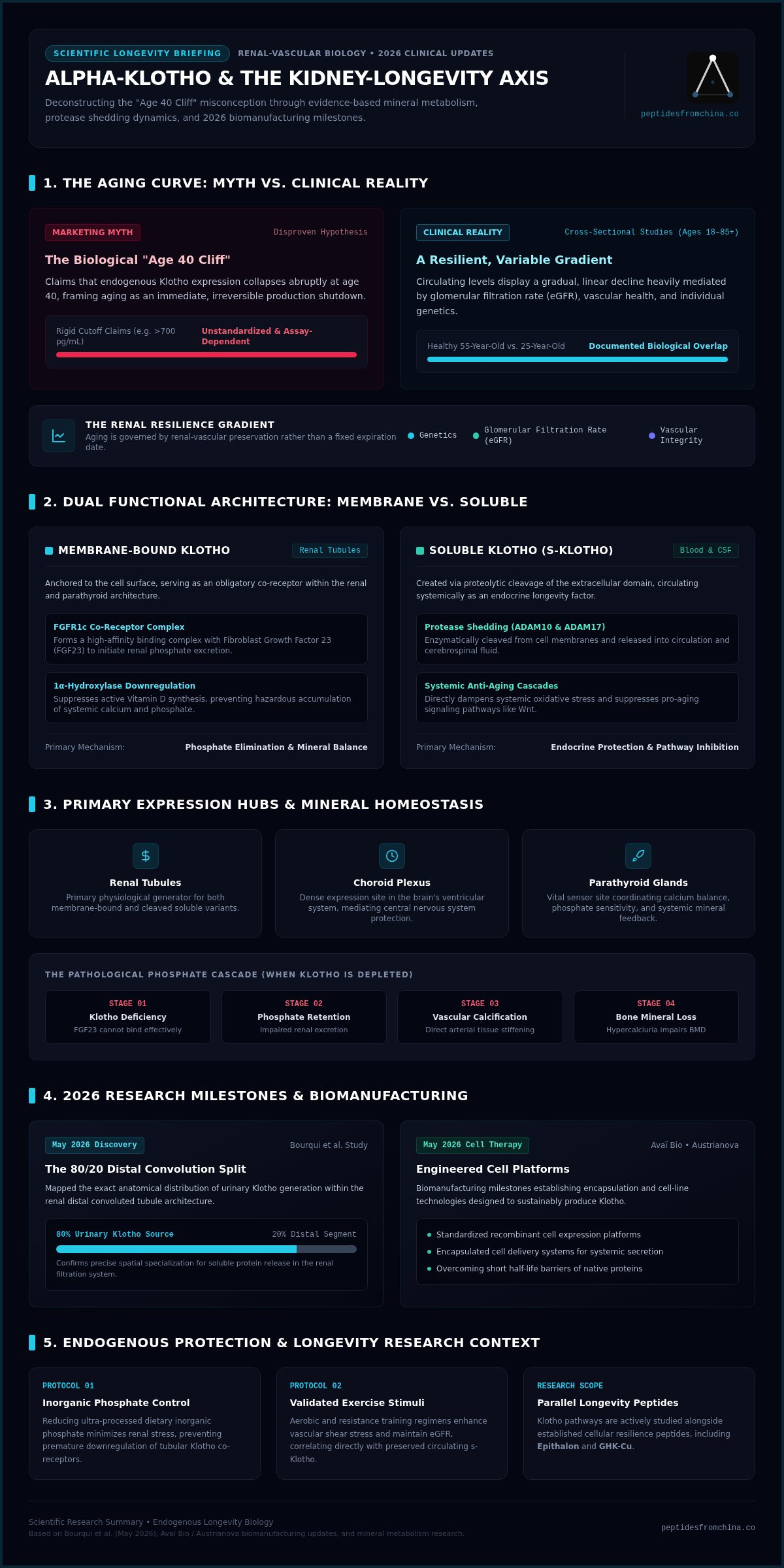
The real science is more interesting—and more useful. Klotho does not appear to fall off a biological cliff on your 40th birthday. Human studies show broad age-related patterns, but also major differences between people, diseases and laboratory assays. A healthy 55-year-old can overlap with a 35-year-old, while chronic kidney disease may push the system in the wrong direction much earlier.
What changed in 2026 was not the discovery of a precise age cutoff. Researchers clarified where different forms of kidney Klotho come from and what those compartments actually control. At the same time, a biotechnology program moved an encapsulated Klotho-producing cell line toward manufacturing readiness.
Neither development created an available anti-aging treatment. Together, however, they moved Klotho from a vague longevity slogan toward a more testable biological system.
What Klotho actually is
The Klotho family includes several related proteins. The one at the center of longevity research is alpha-Klotho, usually written α-Klotho.
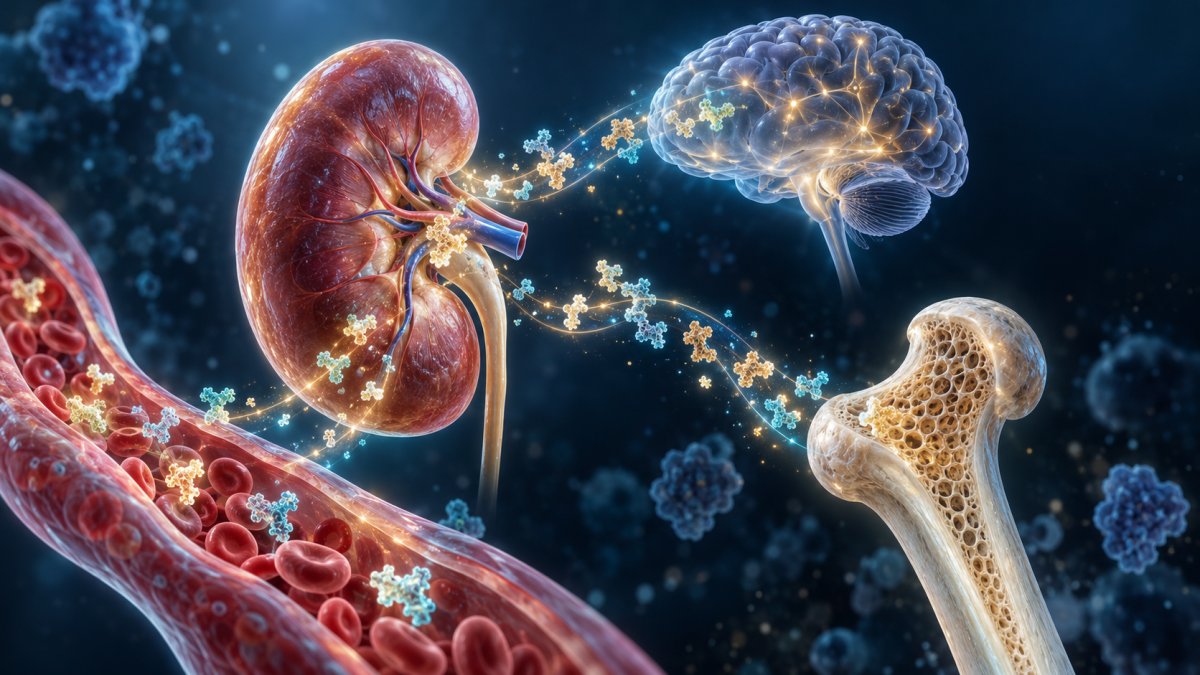
The kidney is its dominant expression site, although Klotho is also produced in tissues including the brain’s choroid plexus and the parathyroid glands. Alpha-Klotho appears in two functionally related forms:
Membrane-bound Klotho sits on the surface of selected cells and acts as an essential co-receptor for fibroblast growth factor 23, or FGF23.
Soluble Klotho is released into blood, urine and cerebrospinal fluid through cleavage of the extracellular portion of the membrane protein and potentially through other processing routes.
The membrane form is central to mineral metabolism. FGF23 is produced mainly by bone and signals the kidney to reduce phosphate reabsorption and active vitamin D production. Klotho helps make the kidney responsive to that signal.
This is why Klotho biology cannot be reduced to “more is younger.” It is embedded in a tightly regulated kidney–bone–parathyroid network involving phosphate, calcium, vitamin D, parathyroid hormone and FGF23.
Soluble Klotho is more difficult to summarize. Experimental studies associate it with regulation of ion channels, inflammatory signaling, oxidative stress responses, fibrosis and cellular pathways including Wnt and insulin/IGF-1 signaling. Many of the most exciting effects come from cells and animals rather than controlled human intervention trials.
That distinction matters. A protein can be biologically important without already being a validated treatment or a stand-alone diagnostic.
Does Klotho really disappear after 40?
No credible evidence establishes age 40 as a universal switch.
Across observational studies, circulating soluble α-Klotho often trends lower with age and is associated with measures of frailty, kidney function and other aging-related outcomes. But the distributions overlap, and study results vary with population, health status, sample handling and assay.
The phrase “after 40” is best understood as a communication shortcut: midlife is when accumulated metabolic, vascular and renal stress may become more visible. It is not a laboratory threshold at which Klotho-producing cells suddenly vanish.
Three points are more defensible:
Kidney health and Klotho are closely connected. Reduced renal Klotho expression is repeatedly observed in experimental kidney injury and chronic kidney disease.
Lower circulating Klotho is associated with several adverse aging phenotypes. Association does not prove that low Klotho caused them.
Aging is not the only variable. Kidney function, inflammation, metabolic health, medications, physical activity and analytical method can all influence the number reported by a test.
This turns the story from a countdown into a systems problem. The useful question is not “At what birthday does Klotho disappear?” It is “Which kidney and metabolic processes maintain the Klotho system, and can changing that system improve meaningful human outcomes?”
The 2026 kidney study: a better map, not an age-40 cliff
A 2026 study in Kidney International used single-cell RNA sequencing and targeted mouse knockout models to separate the roles of Klotho across the nephron.
The findings challenged a simple version of the story.
Researchers reported that approximately 80% of urinary soluble Klotho came from the late distal convolution and about 20% from the early distal convolution. Removing Klotho from the distal convolution greatly reduced urinary Klotho and disturbed calcium handling, producing hypercalciuria and lower bone mineral density in the model.
Yet distal-convolution deletion did not reproduce the full systemic phosphate disorder. Broader tubular deletion produced severe phosphate retention, high FGF23 and undetectable serum and urinary soluble Klotho. The results support distinct jobs for different kidney segments: distal Klotho contributes strongly to urinary Klotho and calcium reabsorption, while proximal-tubule Klotho is important for phosphate homeostasis and circulating Klotho biology.
This is a meaningful advance because it replaces “the kidney makes Klotho” with a more precise map of which renal compartments contribute to which functions.
It does not show that human DCT1 or DCT2 cells suddenly die after age 40. Nor was it a longitudinal human study proving a midlife collapse. Those claims are stronger than the paper.
Why Klotho attracts brain-aging researchers
Klotho is not only a kidney story. Experimental work has connected higher Klotho activity with synaptic function, cognition and resilience to neurological stress. Klotho is expressed in the choroid plexus, and soluble forms are detected in cerebrospinal fluid. That makes it part of a much broader field of peptide and protein signaling research in neuroscience.
Animal studies and human observational genetics have made the brain connection especially compelling. Certain KLOTHO variants and higher measured protein levels have been associated with cognitive performance in some cohorts, while experimental elevation of Klotho or Klotho fragments has improved cognition in animal models.
But several leaps remain:
an association with cognition does not establish a treatment;
an effect in mice does not define a human dose or delivery method;
circulating blood levels may not cleanly represent Klotho activity inside the central nervous system;
a longevity biomarker is not automatically a causal driver of longevity.
Klotho may become a target for neurodegeneration research. It is not currently a clinically validated cognitive-enhancement therapy.
Bone and vascular aging: where phosphate enters the picture
Phosphate is essential. Excess phosphate exposure and impaired phosphate handling, however, can become damaging—particularly when kidney function declines.
The Klotho–FGF23 system helps regulate how much phosphate the kidney retains, how much active vitamin D is produced and how calcium is handled. Severe disruption of this network can contribute to abnormal mineral metabolism, bone disease and vascular calcification.
This makes Klotho relevant to both skeletal and cardiovascular aging, but again the direction is not as simple as maximizing one protein. FGF23 can rise as a compensatory response, kidney function can fall for many reasons, and calcium, phosphate, vitamin D and parathyroid hormone interact.
A single Klotho result without renal and mineral context can therefore be more confusing than informative.
Can Klotho be measured today?
Soluble α-Klotho can be measured in serum, plasma, urine and cerebrospinal fluid in research settings. Commercial ELISA kits are available, and some specialty longevity services offer blood testing. Researchers evaluating emerging markers may also find our overview of biomarker research design and assay validation useful.
The limitation is standardization.
For a broader look at analytical methods and documentation, see our guide to peptide testing.
Different assays can produce meaningfully different absolute values. Sample type, collection timing, storage, freeze–thaw cycles and antibody specificity may affect results. Published studies do not establish one universal “optimal” range that can be transferred across every platform.
If Klotho testing is used as an exploratory trend marker, the most defensible approach is to:
use the same laboratory and assay over time;
interpret the result alongside kidney function rather than alone;
avoid treating an internet reference range as a diagnosis;
pair the result, where clinically appropriate, with established measurements such as eGFR, creatinine, urine albumin, phosphate, calcium, vitamin D, parathyroid hormone and possibly FGF23.
The last point is important: established renal and mineral markers currently carry far more clinical validation than a stand-alone soluble Klotho number.
What appears to support endogenous Klotho?
The strongest practical case is not for a secret Klotho supplement. It is for protecting the systems that express and regulate it.
Exercise
Exercise is the most consistently studied lifestyle intervention in this area. Meta-analyses report that regular training can increase circulating soluble α-Klotho, although the studies are heterogeneous and the size of the effect depends on exercise mode, duration, participant age and assay method.
This is encouraging, but it does not mean that every workout produces a durable anti-aging hormone surge. The better interpretation is that physical activity and Klotho tend to move in a favorable direction together, with longer training programs providing the more relevant signal.
Kidney and cardiometabolic health
Blood-pressure control, glucose management, avoidance of smoking, appropriate hydration and medical management of kidney disease protect the organ responsible for most Klotho expression. These interventions have established health value even if their individual Klotho effects are not measured.
Dietary phosphate quality
Phosphate is present naturally in many nutritious foods, so indiscriminate restriction is not sensible. The more relevant concern is highly absorbable inorganic phosphate additives used in some processed foods and beverages, particularly for people with impaired kidney function.
Klotho does not justify a universal low-phosphate diet. It reinforces the value of understanding renal function and reducing unnecessary exposure to heavily processed sources when appropriate.
Sleep and inflammation
Sleep, metabolic health and chronic inflammatory states are often discussed as Klotho modifiers. The direction is biologically plausible and supported by observational or experimental signals, but direct human causal evidence is less mature than the promotional language suggests.
Protecting sleep and metabolic health is still worthwhile. It simply should not be sold as a proven method to “restore youthful Klotho.”
The encapsulated-cell idea: a biological Klotho factory
Recombinant proteins can be difficult therapeutics. They may clear quickly, require repeated administration and struggle to reproduce continuous physiological secretion.
An alternative is to implant living engineered cells that secrete the desired protein. The cells are enclosed in a semipermeable capsule designed to let nutrients in and Klotho out while isolating the cells from the host immune system.
In May 2026, Avaï Bio and Austrianova announced completion of a GMP master cell bank for cells engineered to overexpress α-Klotho, followed by viral testing and plans for a working cell bank. Austrianova’s platform encapsulates living cells in porous protective capsules, allowing secreted biological molecules to diffuse outward.
This is a real development milestone. It is not the same as demonstrating that an implant rejuvenated humans—or even establishing clinical efficacy in a published animal trial.
The key unanswered questions include:
how much biologically active Klotho the cells produce in vivo;
whether output remains stable for months;
whether the capsules remain localized, viable and retrievable;
whether immune isolation is sufficient over long periods;
whether raising circulating Klotho improves a defined disease outcome;
what happens if secretion is excessive or poorly controlled.
The platform is worth watching precisely because it addresses a hard delivery problem. Calling it an available anti-aging therapy would erase the most important part of the story: it still has to prove that the biological concept works safely in living subjects and then in humans.
What would count as a true Klotho breakthrough?
The field does not need another association between low Klotho and poor health. It needs intervention data.
A genuine breakthrough would include:
a standardized, reproducible assay tied to meaningful reference data;
a delivery method that produces predictable exposure;
randomized human evidence showing improvement in a defined clinical outcome;
a clear safety window;
proof that the benefit comes from changing Klotho biology rather than merely tracking healthier kidneys.
Until then, Klotho occupies an unusual position. It is more than longevity marketing: its role in mineral metabolism and kidney biology is firmly real. But it is less than a finished longevity intervention: most therapeutic claims remain preclinical or hypothetical.
That gap is exactly what makes it worth following.
The bottom line
Klotho is not literally vanishing the moment people turn 40. The evidence supports a broader pattern in which age, kidney function and cardiometabolic stress influence a complex protein system with consequences for mineral metabolism and potentially for brain and tissue resilience.
The major 2026 kidney study provided a better functional map. The encapsulated-cell program provided a credible engineering direction. Neither has yet produced a clinically available Klotho therapy.
For now, the practical strategy is refreshingly unexotic: protect kidney and cardiometabolic health, exercise consistently, interpret experimental testing cautiously and watch for intervention trials rather than viral promises.
Klotho may become one of longevity medicine’s important targets. The science will become stronger by resisting the temptation to declare victory too early.
Frequently asked questions
What is alpha-Klotho?
Alpha-Klotho is a protein expressed predominantly in the kidney. Its membrane form helps FGF23 regulate phosphate and vitamin D metabolism, while soluble Klotho is being studied for broader signaling roles in kidney, brain, vascular and metabolic biology.
Does Klotho disappear after age 40?
No. Human studies often find lower average soluble Klotho with aging, but there is no validated universal cutoff at age 40 and considerable overlap exists between age groups.
Can I get a Klotho blood test?
Some specialty laboratories offer soluble α-Klotho testing. Results are assay-dependent, and there is no universally accepted optimal range. The test is best viewed as exploratory rather than diagnostic.
Does exercise increase Klotho?
Systematic reviews and meta-analyses suggest that regular exercise can increase circulating soluble α-Klotho. Studies vary considerably, so the exact magnitude and the best exercise prescription are not settled.
Is Klotho available as an anti-aging treatment?
No Klotho treatment is currently established as an approved anti-aging therapy. Recombinant proteins, gene approaches and engineered cell delivery remain research strategies.
What happened with the Klotho cell therapy in 2026?
Avaï Bio and Austrianova reported completing a GMP master cell bank for engineered α-Klotho-producing cells. This supports future development but is not evidence of clinical efficacy or an available implanted therapy.
Sources
Bourqui L, et al. Klotho in the kidney distal convolution regulates urinary Klotho excretion and kidney calcium reabsorption, but not phosphate homeostasis. Kidney International. 2026.
Guldan M, et al. Circulating α-Klotho and multidimensional aging and frailty: a systematic review and meta-analysis. Calcified Tissue International. 2026.
Corrêa HL, et al. Exercise training and circulating Klotho: systematic review and meta-analysis. Scientific Reports. 2022.
Abduldayeva A, et al. Physical exercise and circulating α-Klotho in humans: systematic review and meta-analysis. 2026.
Austrianova. Avaï Bio and Austrianova complete GMP master cell bank for cell-based Klotho program. May 21, 2026.
Avaï Bio. α-Klotho development program. Accessed September 2026.