Peptides in Neuroscience Research: A 2026 Explainer

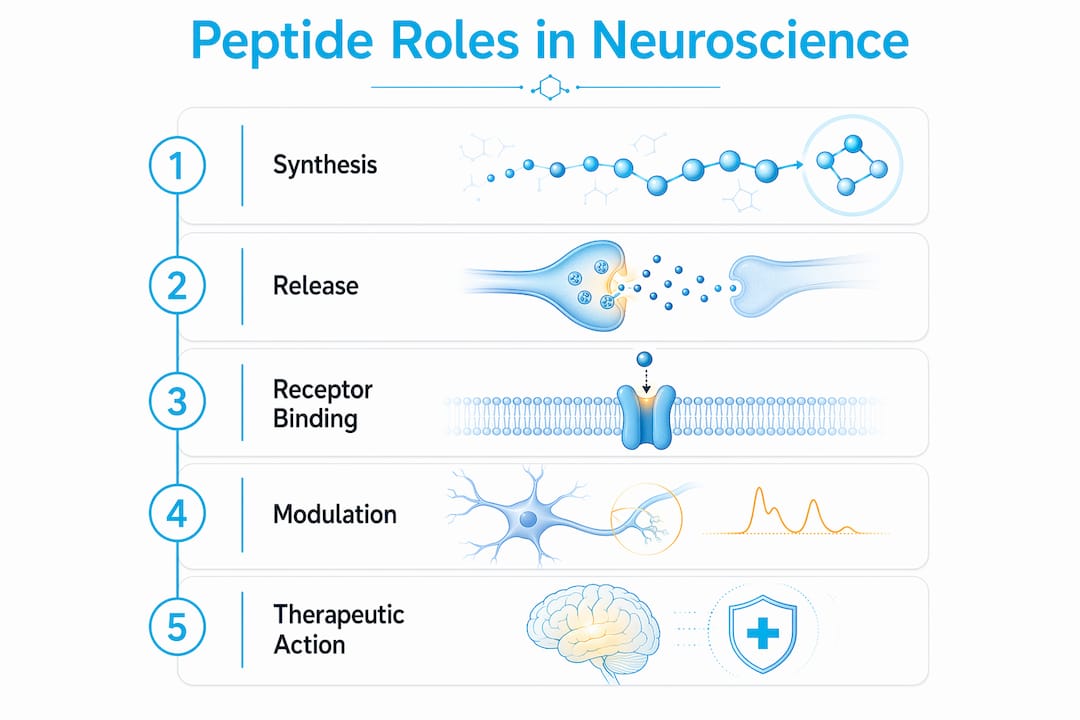
Peptides are short chains of amino acids that function as critical signaling molecules in the brain, regulating communication, cognition, and neuroimmune processes. The role of peptides in neuroscience research, formally studied under the term neuropeptide signaling, has expanded well beyond classical neurotransmitter models. Neuropeptides such as corticotropin-releasing factor (CRF), pituitary adenylate cyclase-activating polypeptide (PACAP), and neuropeptide S (NPS) each regulate distinct brain circuits. Understanding how these molecules act, where they act, and what happens when they malfunction is now central to research on Alzheimer’s disease, psychiatric disorders, and brain infection defense.
What is the role of peptides in neuroscience research?
Neuropeptides are defined as peptides synthesized and released by neurons to modulate brain activity. They differ from classical neurotransmitters like glutamate or dopamine in several important ways. Neuropeptides are typically larger, act on G protein-coupled receptors, and produce effects that last seconds to minutes rather than milliseconds. Their functional specificity depends on release site geometry and receptor distribution across brain regions, not just molecular identity.
The brain uses neuropeptides to regulate a wide range of physiological states. These include mood, appetite, fear, wakefulness, and long-term memory consolidation. CRF coordinates stress responses across the hypothalamus and amygdala. NPS modulates arousal and anxiety simultaneously. PACAP links neural activity to immune defense. Each of these peptides acts within specific circuits, but their effects ripple across interconnected systems.

Co-transmission adds another layer of complexity. Many neurons release both a classical neurotransmitter and one or more neuropeptides from the same terminal. This means observed behavioral or physiological effects cannot be attributed to the peptide alone without additional experimental controls. The co-transmission challenge is one of the central methodological problems in the neuroscience of peptides today.
How do peptides regulate brain communication and behavior?
Neuropeptides use at least three distinct modes of action to influence brain circuits. Understanding these modes is necessary for interpreting experimental results correctly.
Volume transmission: The peptide diffuses broadly through cerebrospinal fluid (CSF) or extracellular space, reaching receptors far from the release site. This mode is evolutionarily ancient and allows one neuron to modulate large populations of cells simultaneously.
Focal axonal or dendritic release: The peptide is released at or near a synapse, producing localized effects. This mode enables circuit-specific modulation and is more analogous to classical neurotransmission.
Co-release with classical neurotransmitters: The peptide is packaged in dense-core vesicles and released alongside fast-acting neurotransmitters. The peptide typically requires higher-frequency firing to be released, creating a frequency-dependent signaling layer on top of classical transmission.
A 2026 review contrasts volume transmission with circuit-specific modulation, arguing that both modes are complementary rather than competing. Early metazoan nervous systems relied almost entirely on diffusion-based peptide signaling. Later evolution added focal release mechanisms, enabling finer temporal and spatial control. The evolutionary success of peptides stems from their ability to combine these modes across diverse receptor types.
Receptor distribution determines functional output as much as the peptide itself. The same neuropeptide can produce opposing effects in different brain regions depending on which receptor subtype is expressed locally. This makes receptor mapping a prerequisite for interpreting any peptide manipulation experiment.
Pro Tip: When designing peptide manipulation studies, map receptor expression in your target region before selecting pharmacological tools. Assuming uniform receptor distribution across brain areas is a common source of conflicting results in the literature.
How do peptides influence brain physiology and disease?
Neuropeptides regulate cognition, immune defense, and neurodegeneration through mechanisms that extend well beyond classical neurotransmission. Their roles in brain physiology fall into several overlapping categories.
Cognition and behavior: NPS modulates learning, memory, and anxiety in mammalian brain circuits, producing distinct cognitive and affective phenotypes depending on receptor activation patterns. Fear extinction, wakefulness, and stress reactivity all involve neuropeptide signaling at the circuit level.
Neuroprotection: Several neuropeptides reduce excitotoxicity and oxidative stress in neurons under metabolic challenge. This neuroprotective capacity makes them candidates for therapeutic development in neurodegenerative contexts.
Neuroimmune defense: PACAP is upregulated during systemic infection and acts as an antimicrobial neuropeptide in the brain, modulating immune responses while minimizing neuroinflammation. This finding shifts the conceptual model of neuropeptides beyond purely neuronal roles.
Microglial function: Peptides regulate microglial activation states, influencing whether these resident immune cells adopt neuroprotective or neurotoxic phenotypes. This has direct implications for Alzheimer’s disease and other neuroinflammatory conditions.
“Peptides link neural and immune functions, with endogenous antimicrobial peptides like PACAP modulating both brain defense and neuropsychiatric health, shifting paradigms beyond purely neuronal models.” — PNAS, 2026
The neuroimmune dimension of peptide biology is particularly significant for researchers studying psychiatric disorders. Neuroinflammation is now recognized as a contributing factor in depression, schizophrenia, and post-traumatic stress disorder. Peptides that regulate microglial phenotype or CSF cytokine levels are therefore relevant to both neurology and psychiatry. Researchers working on peptide immune interactions will find this intersection increasingly productive.
What are the therapeutic applications of peptides in neuroscience?
Peptide-based therapeutics represent one of the most active areas in translational neuroscience. The primary targets include amyloid-β aggregation in Alzheimer’s disease, neuroinflammation, and synaptic loss. Several candidates have reached early clinical evaluation.
Peptide Mechanism Target Condition Status GV1001 Activates microglial B1R–mTORC2 pathway; promotes plaque clearance Alzheimer’s disease Preclinical/early clinical NPS analogs Modulates arousal and fear circuits via NPSR1 receptor Anxiety, PTSD Preclinical PACAP analogs Antimicrobial and anti-inflammatory neuromodulation Brain infection, neuroinflammation Preclinical Amyloid-disrupting peptides Inhibit β-sheet aggregation of amyloid-β Alzheimer’s disease Early clinical trials
GV1001 is among the most mechanistically detailed candidates. It reduces amyloid plaque burden and rescues synaptic loss in Alzheimer’s mouse models by activating the bradykinin receptor 1 and mTORC2 signaling pathway in microglia. This drives microglial migration toward plaques and accelerates clearance. The mechanism is notable because it targets glial biology rather than neurons directly, representing a shift in therapeutic strategy.
Blood-brain barrier (BBB) penetration remains the primary obstacle for CNS peptide delivery. Most peptides are too large and hydrophilic to cross the BBB by passive diffusion. Receptor-mediated transcytosis via transporters such as TfR1 and LRP1 offers a viable route, but engineering delivery systems to exploit these pathways requires precise control of molecular parameters. A 2026 review confirms that BBB transport complexity is a key gating factor for realizing therapeutic benefits in brain disorders.
Nanotechnology approaches are addressing this problem directly. Peptide-functionalized polymersomes can be engineered to cross the BBB, but their fate depends on nanoscale formulation details. Research shows that ligand insertion depth in polymersome membranes determines whether the carrier undergoes transcytosis into brain parenchyma or is retained in endothelial cells. Subtle changes in the δ parameter shift the outcome entirely. This finding underscores that peptide presence alone is insufficient for CNS delivery. The delivery architecture matters as much as the peptide itself.
Pro Tip: When evaluating peptide delivery studies, check whether the reported BBB crossing was measured in brain parenchyma or only in endothelial cell models. Many studies conflate endothelial uptake with actual brain penetration, which leads to overestimated delivery efficiency.
What research methods advance peptide neuroscience investigation?
Studying peptide function in the brain requires a combination of methods. No single approach is sufficient given the co-transmission problem and the spatial complexity of neuropeptide release.
Genetic manipulation: Conditional knockout and knock-in models allow researchers to eliminate or overexpress specific peptides or their receptors in defined cell populations. This establishes causal relationships that pharmacological tools alone cannot confirm.
Receptor expression mapping: In situ hybridization and single-cell RNA sequencing (scRNA-seq) reveal which cell types express which receptor subtypes. This is a prerequisite for interpreting region-specific peptide effects and for identifying microglial phenotype shifts in neuroinflammation models.
Pharmacological tools: Selective agonists, antagonists, and receptor ligands allow acute manipulation of peptide signaling. These tools are most informative when combined with genetic controls to confirm receptor specificity.
Optogenetics: Light-controlled activation of specific neuron populations enables researchers to trigger peptide release with millisecond precision. This spatiotemporal control is critical for separating peptide effects from co-released classical neurotransmitters.
Imaging and biosensors: Fluorescent peptide sensors and two-photon microscopy allow real-time visualization of peptide release and receptor activation in living tissue. These approaches are beginning to resolve the spatial dynamics of volume transmission in intact circuits.
Effective peptide neuroscience research combines pharmacological manipulations with receptor expression imaging and optogenetic control. Relying on a single intervention type produces results that are difficult to interpret and rarely replicate. The field has moved toward multi-modal experimental designs precisely because co-transmission complexity demands convergent evidence from multiple independent approaches. Researchers sourcing peptides for these studies should prioritize batch-verified material with documented purity, since variability in peptide quality directly undermines reproducibility across experimental replicates.
Key takeaways
Neuropeptides regulate brain function through multiple signaling modes, and translating this biology into therapeutics requires solving both mechanistic and delivery challenges simultaneously.
Point Details Peptide signaling modes Neuropeptides act via volume transmission, focal release, and co-release, each producing distinct functional outcomes. Co-transmission problem Attributing effects to peptides alone requires genetic, pharmacological, and imaging evidence converging on the same conclusion. Neuroimmune roles PACAP and related peptides link neural activity to immune defense, expanding peptide biology beyond purely neuronal models. Therapeutic delivery BBB penetration depends on receptor-mediated transcytosis and nanoscale formulation parameters, not peptide identity alone. Research methodology Multi-modal approaches combining optogenetics, scRNA-seq, and pharmacology are the current standard for causal peptide research.
Where peptide neuroscience research is actually heading
The field is more complex than most review articles suggest. Co-transmission is not a minor technical complication. It is a fundamental feature of how peptidergic neurons operate, and it means that a large portion of published peptide research is likely confounded by uncontrolled neurotransmitter co-release. I have seen this problem repeatedly in studies that use systemic peptide administration and then attribute behavioral changes to receptor-specific peptide action without ruling out off-target effects.
The most credible work right now combines conditional genetics with spatially resolved imaging and acute optogenetic control. That combination is expensive and technically demanding, but it is the only way to make causal claims about peptide function in intact circuits. Researchers who skip these controls tend to produce results that do not replicate across labs or species.
On the therapeutic side, I am genuinely optimistic about the GV1001 mechanism. Targeting microglial biology through peptide signaling is a more tractable approach than trying to block amyloid production directly. The microglial clearance mechanism is specific, the pathway is druggable, and the preclinical data are mechanistically coherent. The BBB delivery problem is real, but the polymersome avidity work shows that it is solvable with the right formulation engineering.
What the field needs most is not more peptide candidates. It needs better experimental standards, more rigorous delivery validation, and cross-disciplinary teams that include synthetic chemists, cell biologists, and clinical neuroscientists working from the same data. The peptides are there. The biology is there. The gap is in translational rigor.
— Sam Levin
Research-grade peptides for neuroscience studies
Neuroscience researchers working with neuropeptides need material that holds up across experimental replicates. Batch-to-batch variability in peptide purity directly affects receptor binding assays, behavioral outcomes, and in vitro cell models. A single contaminated lot can invalidate weeks of data.

Products are subject to the manufacturer’s applicable quality-control procedures and specifications. Manufacturer-side analytical documentation may be available depending on the product and batch. PeptidesFromChina is not an independent analytical testing laboratory. The peptide catalog includes CNS-relevant compounds such as Epithalon, VIP, Pinealon, and KPV. Learn more: peptide catalog. Learn more: Epithalon. Learn more: VIP. Learn more: KPV.
FAQ
What are neuropeptides and how do they differ from neurotransmitters?
Neuropeptides are short amino acid chains synthesized by neurons that act on G protein-coupled receptors to modulate brain activity over longer timescales than classical neurotransmitters. Unlike glutamate or GABA, neuropeptides typically require high-frequency neuronal firing for release and produce effects lasting seconds to minutes.
How do peptides affect brain function in cognitive disorders?
Peptides such as NPS regulate learning, memory, and anxiety through receptor-specific circuit modulation, while others like GV1001 target microglial pathways to reduce amyloid plaque burden in Alzheimer’s models. Their effects depend on receptor subtype expression and release geometry within specific brain regions.
What is the biggest challenge in peptide neuroscience research?
Co-transmission is the primary challenge. Most peptidergic neurons release classical neurotransmitters alongside neuropeptides, making it difficult to isolate peptide-specific effects without multi-modal experimental controls including genetics, pharmacology, and optogenetics.
Can peptides cross the blood-brain barrier for therapeutic use?
Most peptides cannot cross the BBB by passive diffusion. Receptor-mediated transcytosis via TfR1 and LRP1 transporters provides a viable route, and engineered delivery systems such as peptide-functionalized polymersomes can exploit these pathways when formulated with the correct nanoscale ligand parameters.
What experimental methods are used to study peptide signaling in the brain?
Current best-practice approaches combine conditional genetic knockouts, receptor expression mapping with scRNA-seq, selective pharmacological tools, and optogenetic stimulation to establish causal relationships between peptide release and behavioral or physiological outcomes.