
The standard domestic COA you receive with your peptide order is often little more than a high-priced photocopy of a manufacturer's baseline report. If you're looking to ghk cu buy at a professional scale, you've likely realized that the current retail market is built on opaque supply chains and significant markups for the exact same material synthesized in a handful of overseas facilities. You know that a single PDF doesn't guarantee purity, yet the industry continues to rely on these easily falsified documents as definitive proof.
This article provides a technical roadmap for procurement professionals who need to move beyond retail "brands" and engage directly with synthesis labs. You'll learn how to establish a transparent sourcing channel that helps reduce supply chain uncertainty and supports rigorous independent verification. We'll detail the logistical requirements for manufacturer-side access, including the $600 minimum order threshold, and explain how to interpret HPLC and Mass Spectrometry data as baseline reference material rather than absolute guarantees.
Key Takeaways
Establish 98% purity as the baseline laboratory standard and understand why the copper-to-peptide ratio is a critical indicator of synthesis quality.
Evaluate the cost-efficiency of direct manufacturing channels compared to the high markups and supply chain opacity of domestic retail intermediaries.
Implement verification protocols to ghk cu buy with improved traceability, focusing on batch-specific HPLC/MS data rather than reused documentation.
Navigate the logistical requirements of wholesale procurement, including the $600 minimum order threshold necessary to access manufacturer-side pricing.
Table of Contents
Understanding GHK-Cu Sourcing for Research Applications
Technical Benchmarks for High-Purity GHK-Cu
Direct Manufacturing vs. Retail Intermediaries
Verification Protocols: How to Buy GHK-Cu Safely
Executing Wholesale GHK-Cu Orders with Peptides From China
Understanding GHK-Cu Sourcing for Research Applications
GHK-Cu is a naturally occurring tripeptide complex that has gained significant traction in laboratory settings due to its high affinity for divalent copper ions. In a professional research context, the Copper peptide GHK-Cu (Glycyl-L-histidyl-L-lysine copper) is studied primarily for its role in signaling pathways related to tissue remodeling, DNA repair, and anti-inflammatory responses. As of mid-2026, the regulatory landscape has shifted. On May 14, 2026, non-injectable GHK-Cu was restored to Category 1 of the FDA's 503A bulk drug substances list, which has increased the demand for high-purity material in laboratory and compounding environments. For those looking to ghk cu buy for large-scale studies, understanding the difference between professional sourcing and retail-level acquisition is the first step in ensuring data integrity.
The Role of GHK-Cu in Modern Research
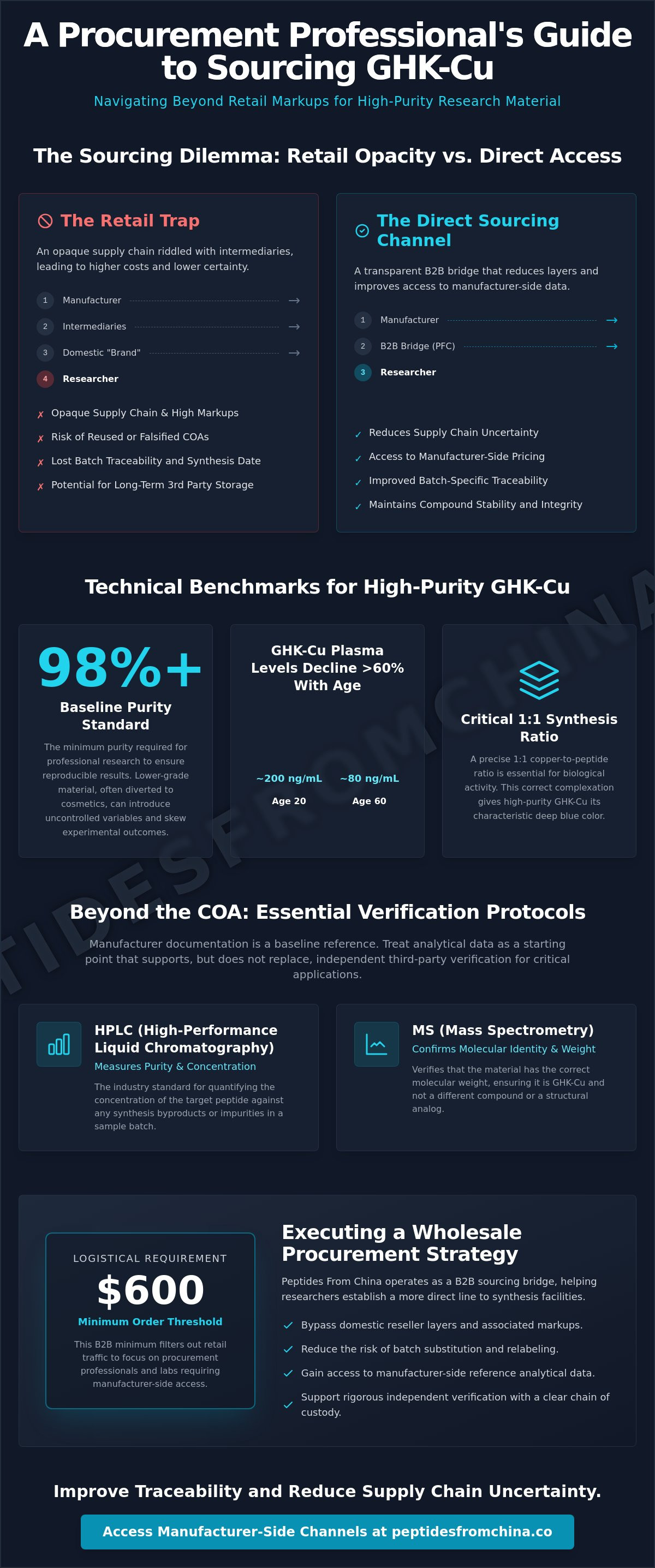
Research labs focus on GHK-Cu because of its documented biological activity, including its ability to modulate the expression of genes involved in wound healing and antioxidant defense. Clinical data shows that plasma levels of this peptide decline by over 60% as humans age, dropping from roughly 200 ng/mL at age 20 to 80 ng/mL by age 60. This decline makes it a primary target for age-related biological research. To achieve reproducible results, researchers require high-purity material, typically 98% or higher by HPLC. Anything less introduces uncontrolled variables that can compromise the validity of an entire study. This necessity for precision is why technical buyers are shifting away from retail vials toward wholesale procurement models that offer better batch traceability.
Market Challenges: Resellers and Relabeling
The peptide industry is currently saturated with domestic resellers who position themselves as manufacturers. In reality, the vast majority of GHK-Cu is synthesized in specialized facilities in China. Domestic "brands" often purchase this material, relabel it, and apply significant markups without performing additional purification or quality control. This "retail trap" creates an opaque supply chain where the buyer pays more for less transparency. Multiple layers of intermediaries increase the risk of receiving material with reused or fraudulent COAs. By the time a vial reaches a domestic warehouse, the link to the original synthesis date and batch number is often lost.
Direct sourcing helps reduce supply chain uncertainty by establishing a straight line to the synthesis facility. When you bypass the reseller, you gain access to manufacturer-side documentation and reduce the risk of batch substitution. Peptides From China (PFC) operates as a B2B bridge for this exact purpose. By maintaining a $600 minimum order requirement, PFC filters out the retail market to focus on procurement professionals who need direct manufacturer access. This model ensures that the material hasn't been sitting in a third-party warehouse for months, maintaining the stability and integrity of the compound for your research needs.
Technical Benchmarks for High-Purity GHK-Cu
When you prepare to ghk cu buy for laboratory applications, the primary technical metric you must evaluate is purity. Professional research environments consider 98% purity the absolute baseline for meaningful data. This high concentration is necessary to accurately observe the Regenerative and Protective Actions of the GHK-Cu Peptide without interference from synthesis byproducts. Impurities in lower-grade material, which is often diverted into the cosmetic market, can trigger inflammatory responses or secondary chemical reactions that skew experimental results. For researchers, the "blue" color of the compound isn't just an aesthetic trait; it's a result of the 1:1 copper-to-peptide ratio that must be precisely maintained during synthesis.
Analytical Verification Methods
High-Performance Liquid Chromatography (HPLC) is the industry standard for determining the purity of a batch. It measures the concentration of the target peptide against any remaining impurities. However, HPLC alone isn't enough. Mass Spectrometry (MS) is required to confirm the molecular weight and identity of the compound, ensuring that the material is indeed GHK-Cu and not a structural analog. Because documentation can be easily manipulated in the retail market, peptide testing and analysis is a non-negotiable step for any serious procurement officer. You should treat manufacturer-issued COAs as baseline reference material that requires independent verification.
Synthesis Standards in 2026
Most high-purity GHK-Cu is produced through solid-phase peptide synthesis (SPPS). This method allows for greater control over the amino acid sequence compared to liquid-phase alternatives. During this process, peptide labs must implement rigorous washing cycles to remove residual solvents and trifluoroacetic acid (TFA), which is used to cleave the peptide from its resin support. High TFA levels can be toxic in many biological assays, making efficient salt exchange and lyophilization critical for batch-to-batch consistency.
The physical characteristics of the final product should be a fine, deep blue lyophilized powder. If the powder appears pale or clumpy, it may indicate moisture infiltration or an incorrect copper-chelation ratio. For bulk research batches, stability is maintained by storing the lyophilized powder at -20°C. Once reconstituted, the peptide's shelf life drops significantly, so researchers should only prepare what is needed for immediate use. Accessing these technical standards requires moving toward manufacturer-side channels. If you're managing a lab budget, sourcing through a B2B bridge like PFC helps you bypass retail markups while maintaining a $600 minimum order threshold for wholesale consistency.
Direct Manufacturing vs. Retail Intermediaries
The decision to ghk cu buy through a domestic reseller often stems from a desire for convenience, yet this choice introduces significant operational risks. Retail intermediaries act as a buffer between the lab and the synthesis facility, frequently obscuring the origin and age of the material. While the price per vial is higher, the actual value is lower due to the loss of batch traceability and the common industry practice of using "reused COAs"—analytical reports from a single batch applied to multiple subsequent shipments. Bypassing these domestic warehouses allows procurement officers to establish a direct line to the production source, which helps reduce supply chain uncertainty for longitudinal studies.
The Problem with Domestic Warehousing
Domestic warehouses often lack the specialized climate controls required for long-term peptide stability. While a reseller might promise 48-hour shipping, the material may have spent months in an unverified environment before reaching their inventory. This creates an illusion of speed at the expense of batch age and potential degradation. Once a product enters a reseller’s stockpile, the chain of custody is effectively broken. It becomes nearly impossible to verify the synthesis date or the specific conditions of its manufacture, leaving the researcher with no way to account for environmental variables that could impact the scientific overview of GHK-Cu mechanisms they are investigating.
B2B Sourcing Advantages
Transitioning to a B2B model provides direct access to manufacturer-issued papers and reference analytical data. This transparency is vital because biological outcomes are highly dependent on chemical identity and the removal of synthesis byproducts. Utilizing a professional peptide sourcing platform like PFC serves as a bridge, helping labs access large-scale synthesis facilities without the overhead of retail branding. Direct sourcing also allows labs to request specific salt forms, such as acetate over trifluoroacetate, which can be critical for certain cell culture assays where residual TFA might prove toxic.
Managing the transition from retail to wholesale requires a shift in procurement logic. Labs must move from single-vial, "just-in-time" ordering to batch-based procurement that supports independent verification. At PFC, this shift is facilitated by a $600 minimum order requirement. This threshold ensures that resources are focused on professional-grade logistics and batch consistency rather than the high-volume, low-transparency retail fulfillment model. By cutting out the middleman, you aren't just reducing costs; you're securing a more consistent supply chain that improves traceability for your entire research program.
Verification Protocols: How to Buy GHK-Cu Safely
Safe procurement in the peptide industry requires a departure from retail-level trust. When you prepare to ghk cu buy for a professional lab, your protocol must start with technical skepticism. The first step is requesting manufacturer-side HPLC and MS reports that are specific to the current batch. You should never accept a generic PDF that lacks a clear synthesis date or batch number. Cross-referencing these details is essential; if a batch number appears on a report dated more than six months ago, the material may have been sitting in a reseller's inventory, increasing the risk of degradation.
For large-scale orders, independent third-party testing is the only way to confirm that the material matches the provided documentation. You should treat manufacturer papers as baseline reference material rather than definitive proof of identity. A reliable sourcing intermediary will facilitate this process by providing direct access to the facility's data. Finally, verify that the material is shipped in neutral, professional packaging. Flashy retail branding is often a red flag for customs and suggests the seller is prioritizing marketing over technical integrity. If you are looking for a transparent sourcing bridge that bypasses these retail risks, Peptides From China offers a B2B model with a $600 minimum order to ensure professional-grade logistics.
Reading a Certificate of Analysis (COA)
A COA is a snapshot of a specific moment in the synthesis process. When you review an HPLC chromatogram, look for a flat, clean baseline. Significant noise or "ghost peaks" often indicate residual solvents like acetonitrile or TFA, which can interfere with sensitive biological assays. Researchers must understand that documentation supports independent verification but does not replace it. In professional research, the goal is to use reference analytical data to build a profile of the batch before it ever reaches your bench.
Operational Realistic Sourcing
You should avoid any supplier using absolute claims like "guaranteed purity" or "perfect chain of custody." These terms are hallmarks of retail marketing hype and rarely reflect the realities of chemical synthesis. Instead, focus on suppliers who use nuanced language and prioritize batch traceability. In the 2026 market, researchers must lead with skepticism to avoid the "retail trap" of relabeled material. By focusing on supply chain transparency and reducing the number of intermediaries, you can significantly improve the consistency of your research material and reduce the variables in your data.
Executing Wholesale GHK-Cu Orders with Peptides From China
To ghk cu buy at wholesale scale, you must move beyond the limitations of domestic retail inventories. Peptides From China (PFC) provides a structured B2B bridge that connects procurement professionals directly with verified synthesis facilities. This model is designed specifically for researchers who require batch consistency and reduced intermediary layers. By maintaining a $600 minimum order requirement, PFC ensures that the supply chain remains focused on professional-grade laboratory volumes rather than the high-overhead retail market. This threshold allows for the allocation of resources toward rigorous logistics and manufacturer-side verification that retail resellers cannot provide.
The PFC Procurement Workflow
The process begins with a $10 processing deposit. This initial fee triggers a manufacturer verification workflow where we confirm current stock availability and review the latest batch-specific documentation from the synthesis facility. Once the manufacturer-issued papers are reviewed as baseline technical references, the $10 deposit is credited back to your final invoice. This system filters the procurement process to focus on serious laboratory buyers while ensuring that the material is routed straight from the synthesis lab to your facility, effectively eliminating multiple layers of domestic markups.
Our workflow includes a multi-step approval process for quality documentation. Before an order is finalized, we ensure that the manufacturer provides HPLC and Mass Spectrometry reports that correspond to the specific batch number in question. While these documents are treated as reference analytical data rather than a guarantee of purity, they provide the necessary starting point for a lab's own independent verification. This direct routing model helps improve traceability and ensures that the material has not been sitting in an unverified third-party warehouse for an extended period.
Commitment to Transparency
PFC explicitly operates as a sourcing intermediary and not a pharmaceutical manufacturer or testing laboratory. Our role is to act as a protective filter, helping researchers access manufacturer-side channels while avoiding the common pitfalls of the retail peptide market. We prioritize COA-verified batches and provide a streamlined path for large-scale procurement that supports operational consistency. By positioning ourselves as a bridge, we help labs reduce supply chain uncertainty and maintain a clearer chain of custody for their research materials.
Professional procurement also requires secure logistics. PFC manages the complexities of international shipping by utilizing neutral packaging designed for efficient transit. Every wholesale order includes tracking information, allowing for precise monitoring of the batch as it moves from the synthesis facility. This focus on professional, non-branded packaging reduces the risk of transit delays and ensures that the material arrives in a stable, lyophilized state. By cutting out the reseller, you gain a more direct, operationally realistic way to ghk cu buy for your ongoing research requirements.
Optimizing Your Research Supply Chain
Navigating the 2026 peptide market requires a strategic shift from trust-based retail buying to a data-driven procurement model. By prioritizing direct-to-manufacturer sourcing, you effectively eliminate the high domestic markups and supply chain opacity common among resellers. It's essential to remember that while COA-verified batches provide a baseline, they should be treated as reference analytical data rather than a final guarantee of purity. The most reliable path to operational consistency involves maintaining rigorous independent verification protocols alongside a transparent sourcing bridge.
When you prepare to ghk cu buy for large-scale laboratory applications, the $600 minimum wholesale threshold ensures that your material is handled through professional-grade logistics rather than retail-level stock. This approach helps reduce supply chain uncertainty and improves traceability across your entire research program. If you're ready to bypass the retail middleman and access manufacturer-side channels, you can take the first step toward a more transparent supply chain today.
Secure Your GHK-Cu Batch: Start the Verification Process with a $10 Deposit
Establishing a reliable, direct sourcing channel is a foundational step in ensuring the long-term integrity and reproducibility of your laboratory data.
Frequently Asked Questions
Where can I buy GHK-Cu for professional research?
Professional procurement requires accessing manufacturer-side channels rather than retail supplement shops. You can ghk cu buy through sourcing platforms like Peptides From China, which connect researchers directly to synthesis facilities. This approach ensures batch consistency and helps bypass the significant markups and opaque supply chains typical of domestic resellers.
What is the minimum order amount for wholesale GHK-Cu sourcing?
The minimum wholesale requirement for procurement through Peptides From China is $600. This threshold is established to filter out retail traffic and focus operational resources on professional-grade logistics. It ensures that the sourcing process remains dedicated to the rigorous documentation and batch traceability standards required for laboratory research applications.
How do I verify the purity of GHK-Cu powder from China?
Verification requires a systematic analytical process, starting with the review of manufacturer-issued HPLC and Mass Spectrometry reports. These documents provide baseline reference analytical data for each batch. For high-stakes research, independent third-party testing by a qualified laboratory is the only way to confirm chemical identity and purity levels before experimental use.
What is the difference between GHK-Cu and copper tripeptide-1?
Why is direct-to-manufacturer sourcing cheaper than domestic resellers?
Sourcing directly from synthesis facilities eliminates multiple layers of domestic intermediaries who add significant markups for warehousing and retail branding. By bypassing these resellers, you gain access to factory-direct pricing. This model also improves traceability, as the material doesn't sit in unverified third-party warehouses where environmental controls and batch age are often unknown.
What documentation should accompany a GHK-Cu batch?
Every batch should include a Certificate of Analysis (COA) containing HPLC chromatograms for purity and Mass Spectrometry for identity confirmation. These manufacturer-issued papers must include specific batch numbers and synthesis dates. This documentation serves as a critical starting point for researchers to verify the origin of the material before conducting their own independent verification.
How is GHK-Cu shipped internationally to ensure stability?
GHK-Cu is shipped in its lyophilized powder form, which is highly stable at room temperature during international transit. Professional sourcing partners use neutral, professional packaging and secure logistics to minimize delays. This ensures the material arrives in a consistent state, ready for long-term laboratory storage at -20°C to maintain its integrity for future assays.