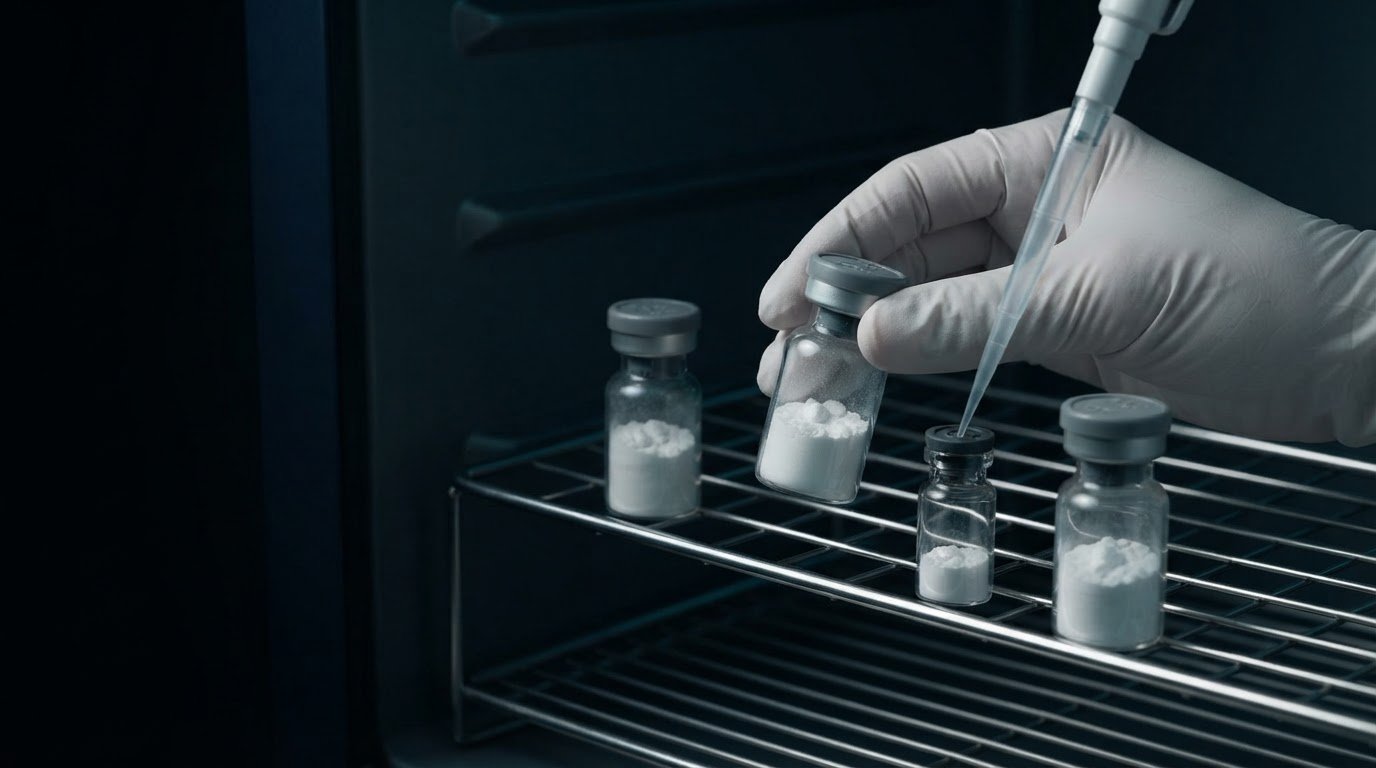
"CJC-1295 without DAC" is commercial and research-market terminology. Market labeling for this peptide is applied inconsistently, so the name alone does not establish molecular identity. The literature documents modified GRF(1-29) analogs, and a published analytical study identified modified GRF(1-29) as distinct from secretagogues. For a specific batch, identity depends on documentation of the exact sequence and form.
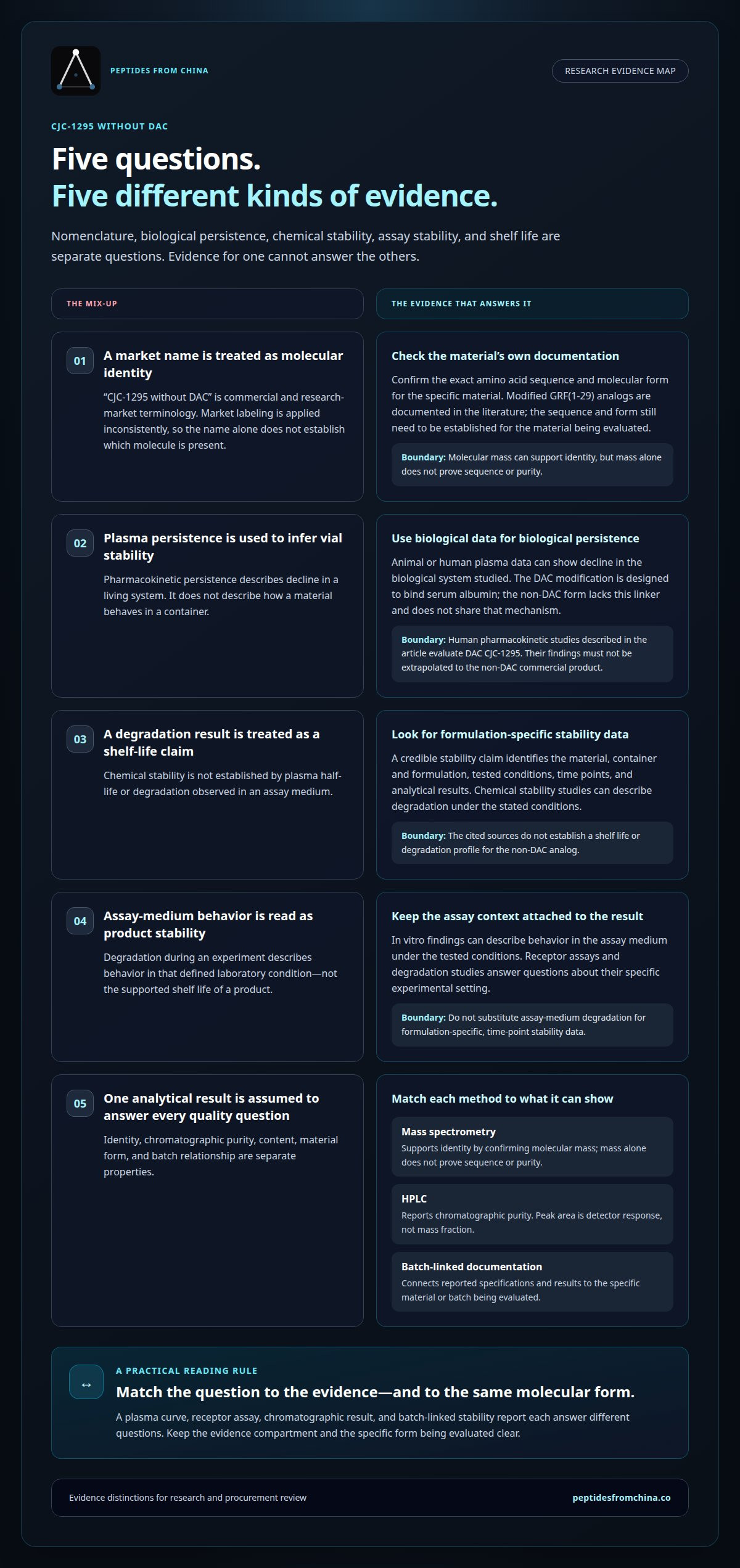
This review separates five questions that are often merged: nomenclature, biological pharmacokinetics, chemical stability, assay stability, and product shelf life. Each answers something different, and none can be derived from another.
Key Takeaways
Naming is not identity: confirm sequence and form against documentation for the specific batch.
Pharmacokinetic persistence describes decline in a biological system, not chemical stability in a vial.
Assay-medium degradation does not establish shelf life, and plasma half-life does not either.
The human pharmacokinetic studies evaluate DAC CJC-1295, and their findings must not be extrapolated to the non-DAC commercial product.
Animal, in vitro, human pharmacology, and safety data are kept separate below.
Table of Contents
Nomenclature and Molecular Identity
Two peptides share the CJC-1295 name in the market. One carries the Drug Affinity Complex (DAC), a reactive linker designed to bind serum albumin; its albumin bioconjugation and preclinical receptor and pharmacokinetic evidence are described in a primary publication. The other lacks the linker and is sold as a 29-amino-acid analog. The foundational design work on modified GRF(1-29) analogs is in an earlier primary study. Because the market name is applied inconsistently, the sequence and form of any given material must be confirmed from its own documentation.
For procurement, identity is established by several separate properties: amino acid sequence, chromatographic purity, content, material form, and the relationship between a document and the specific batch. Mass spectrometry supports identity by confirming molecular mass, but mass alone does not prove sequence or purity. HPLC reports on chromatographic purity, which is a different question again, and peak area is detector response rather than mass fraction.
Manufacturer-side specifications and quality documentation vary by product, manufacturer, and batch. Review the documentation supplied for the specific material you intend to order. Our peptide quality page and the certificate of analysis guide explain how to read these documents.
Pharmacokinetic Persistence: What Differs With and Without DAC
Pharmacokinetic persistence describes how long a compound remains detectable or active in a living system. It depends on clearance, enzymatic degradation, and protein binding. It says little about how a material behaves in a container.
Albumin Binding and Peptide Half-Life
The DAC modification is designed to form a covalent bond with serum albumin, which circulates far longer than a small peptide, as described in the albumin bioconjugation study. This binding is the mechanism proposed for the extended persistence of the DAC conjugate. The non-DAC form lacks this linker, so it does not share that mechanism, and persistence data from the conjugate cannot be applied to it.
Evidence Compartments
Evidence in this area comes from distinct settings, which should be read separately.
Human pharmacology: The published human pharmacokinetic and pharmacodynamic study evaluates DAC CJC-1295, as does a human study of growth hormone pulsatility during DAC CJC-1295 exposure. Their findings must not be extrapolated to the non-DAC commercial product.
Animal data: Preclinical observations relate to the conjugate or to the specific peptide tested, in a different species and matrix. They are not human measurements.
In vitro findings: Receptor assays and degradation in assay medium describe behavior under defined laboratory conditions only.
QuestionEvidence typeWhat it can showWhat it cannot show NomenclatureSequence and mass documentationWhich molecule is describedPurity or activity by itself Pharmacokinetic persistenceAnimal or human plasma dataDecline in a biological systemVial stability or shelf life Chemical stabilityStress and storage studies with HPLC/MSDegradation under stated conditionsBiological activity Assay stabilityDegradation in assay mediumBehavior during the experimentProduct shelf life Shelf lifeFormulation-specific, time-point stability dataSupported retention period for that materialResults for other formulations
To choose between sources, match the question you need answered to the evidence type in the first column, then ask whether the data concern the same molecular form you are evaluating. A plasma curve from one species, a receptor assay, and a batch-linked stability report each answer a different question, so none of them should be quoted in place of another. Keep a record of which compartment each cited result belongs to.
Chemical Stability, Assay Stability, and Shelf Life
The sources cited here do not establish a shelf life or degradation profile for the non-DAC analog, so this article does not state one. Vendor stability claims should be treated as unverified until supported by formulation-specific data.
Stability Evidence and Testing
A credible stability claim identifies the material, the container and formulation, the conditions tested, the time points, and the analytical results. Plasma half-life and assay-medium degradation do not substitute for such a study.
Stability-indicating methods should be evaluated for what they can resolve:
HPLC: Separates the main peak from related substances and degradation products. Check that the method resolves known impurities and that peak purity was assessed.
Mass spectrometry: Confirms molecular mass and helps identify degradants. It does not by itself quantify purity or prove sequence.
Batch linkage: A report is informative only if it ties to the batch you receive.
Buyers can commission independent testing through a qualified laboratory under their own protocol. Our guide on stability and storage inference applies the same reasoning to another peptide.
Mechanism of Action of the Non-DAC Analog
Modified GRF(1-29) analogs are studied as growth hormone-releasing hormone (GHRH) receptor agonists. Activity is evaluated through receptor-based assays and downstream hormone measurements, which answer different questions.
Modified GHRH Sequence
These analogs are built on the first 29 amino acids of GHRH with substitutions, as described in the foundational design study. Sequence describes structure only. It does not establish potency, duration, or in vivo outcome.
GHRH Receptor Interaction
The analogs act on the GHRH receptor on pituitary somatotrophs, stimulating signaling that leads to growth hormone release. Receptor assays show activation under defined in vitro conditions. They do not show how an intact organism responds.
Pulsatile Versus Sustained Signaling
Growth hormone is naturally secreted in pulses. A human study examined whether pulsatility is preserved during DAC CJC-1295 exposure. That work concerns the DAC conjugate and is not transferable to the non-DAC form.
Growth hormone and IGF-1 are separate endpoints: the first is the released hormone, the second a downstream marker. Differences in design, sampling schedule, and endpoint prevent ranking studies against each other.
Non-DAC Analog and Ipamorelin Kinetics
Ipamorelin is a different class of molecule, a ghrelin receptor agonist, not a GHRH analog. The two act on different receptors and are often studied side by side for that reason. Any comparison of their kinetics must keep several points in view:
Their persistence figures come from different species, assays, and sampling schedules.
Persistence of a peptide concentration is not the same as persistence of a hormone response.
The sources cited here do not support a ranking of the two.
A practical framework separates three questions: how fast the peptide concentration declines, how long a receptor signal is measurable, and how long downstream hormone changes last. Each requires its own measurement. If you plan combined work, see the growth hormone peptides procurement guide.
Safety Data and Regulatory Context
Long-Term Safety Data Gaps
The human studies cited above concern the DAC conjugate, and no comparable human dataset is cited here for the non-DAC form. Conjugate findings must not be carried over to it.
Safety Concerns and Considerations
The U.S. Food and Drug Administration maintains a page on bulk drug substances that may present significant safety risks, and the agency's December 2024 PCAC review document covers CJC-1295-related material. Read both directly from the FDA, with their date and context, rather than through secondary summaries. They should not be read as establishing incidence or causality, and stability results should not be read as safety findings in either direction.
Research Use Only Sourcing
Peptides From China is a B2B sourcing platform that coordinates manufacturer sourcing, availability confirmation, specifications, order processing, and international logistics and support for laboratory buyers. Its catalog includes CJC-1295 without DAC, listed under the market name discussed above. All catalog products are for laboratory research use only, not for human or veterinary use.
Manufacturer-side specifications and QC documentation vary by product, manufacturer, and batch, so request the documents for your specific order and compare them with the criteria in this article. Availability and commercial terms are confirmed after the processing deposit and before the final invoice. The How It Works page sets out the process, and you can contact Peptides From China with questions about specifications.
Evidence Summary
The market name does not prove identity, so batch documentation of sequence and form is the starting point. The human pharmacokinetic studies evaluate DAC CJC-1295 and do not transfer to the non-DAC product. Persistence data, assay observations, and shelf-life evidence answer separate questions, and the first two cannot supply the third.
Frequently Asked Questions
What does DAC mean?
DAC stands for Drug Affinity Complex, a linker designed to bind serum albumin, as described in the primary study. It is a structural modification, not a separate receptor target.
Is "CJC-1295 without DAC" the same as modified GRF(1-29)?
The terminology is applied inconsistently. Confirm the exact sequence and form in the documentation for your specific batch.
Which form suits which study?
Choose by the question. State the molecule, system, endpoint, and observation window in the design, and keep DAC and non-DAC evidence separate.
Does half-life tell me how long the product keeps?
No. Biological half-life describes decline in a living system. Product retention requires formulation-specific stability data.
For laboratory research use only, not for human or veterinary use.