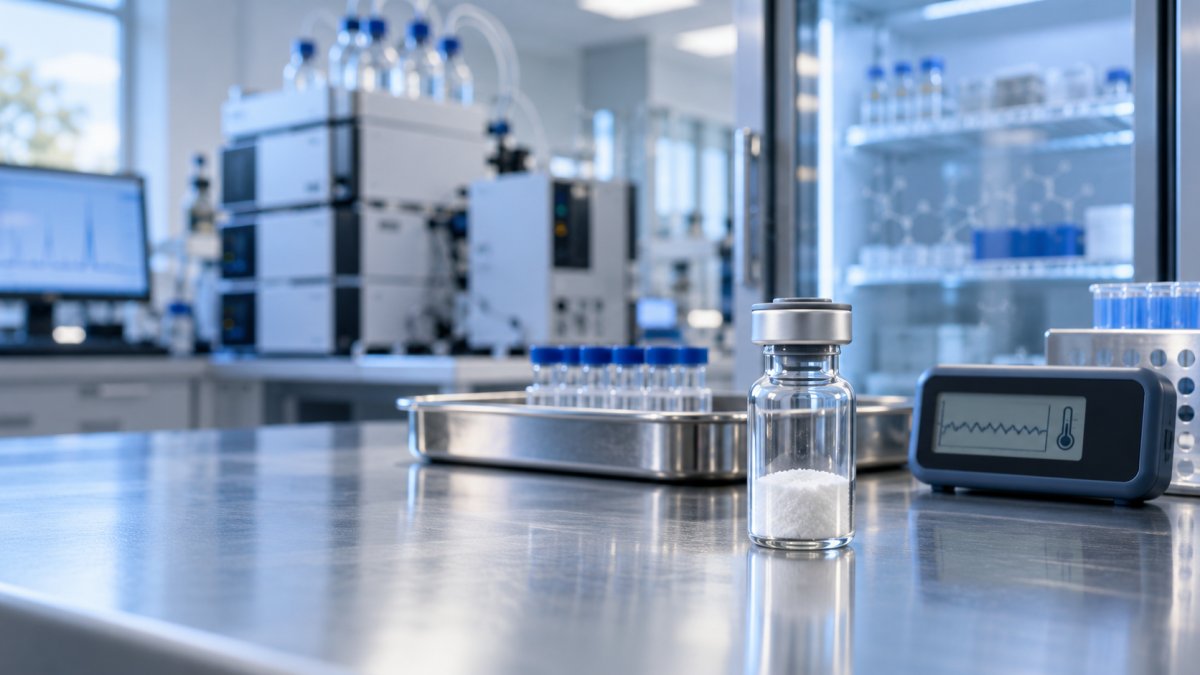
Retatrutide is attracting intense research interest, but storage advice online has raced far ahead of the evidence. Search long enough and you will find confident claims that the peptide remains stable for a precise number of days in a refrigerator, survives shipping at room temperature, or can be repeatedly frozen and thawed without consequence. The problem is simple: those claims are usually presented without the formulation, container, analytical method, acceptance criteria, or batch data needed to support them.
For a research laboratory, the useful question is not “What storage rule is repeated most often?” It is: What conditions were actually validated for this material, in this presentation, using stability-indicating tests?
This guide separates what is known about retatrutide from what must be established through product-specific data. It also explains how lyophilized material differs from a prepared solution, where degradation can occur, and what evidence procurement teams should request before relying on a stability claim.
Retatrutide is still an investigational molecule
Retatrutide, also known as LY3437943, is a single peptide engineered to activate the GIP, GLP-1, and glucagon receptors. Eli Lilly describes it as an investigational once-weekly triple hormone receptor agonist. The published phase 2 obesity trial established clinical activity and safety findings under a controlled development program, but it did not create a public, universal storage specification for third-party research material.
That distinction matters. There is no FDA-approved retatrutide product label that independent laboratories can use as a substitute for supplier-specific stability data. Storage instructions associated with semaglutide, tirzepatide, or another approved peptide product cannot simply be transferred to retatrutide. Different sequences, lipid modifications, excipients, pH values, concentrations, containers, and manufacturing processes can produce different degradation profiles.
The correct starting point is therefore conservative but practical: treat every storage claim as formulation-specific until the supporting data show otherwise.
Stability is more than whether a vial still looks clear
A peptide can appear unchanged while its analytical profile moves outside specification. Stability has several dimensions:
Chemical stability: whether the intended molecular structure remains intact rather than undergoing oxidation, deamidation, hydrolysis, isomerization, or other modification.
Physical stability: whether the material remains properly dispersed without unacceptable aggregation, precipitation, adsorption, or particle formation.
Potency or content: whether the measured amount of intact peptide remains within the laboratory’s acceptance range.
Microbiological quality: whether the prepared material remains suitable for its intended laboratory system from a bioburden or sterility perspective.
Container compatibility: whether the vial, closure, headspace, and contact surfaces preserve the material rather than introducing loss or contamination.
These categories overlap, but they are not interchangeable. A clear solution does not prove chemical integrity. A strong HPLC purity result does not by itself establish peptide content, identity, sterility, or biological activity. A correct molecular mass does not show that every relevant impurity is absent.
Lyophilized material and prepared solution are different stability problems
Lyophilized retatrutide
Removing water can slow many degradation pathways, which is why peptides are often supplied as a freeze-dried cake or powder. That does not make lyophilized material indestructible. Residual moisture, oxygen, light, elevated temperature, formulation composition, and the quality of the lyophilization cycle can still influence stability.
Research buyers should look beyond the word “lyophilized.” Useful supporting information includes the assigned storage condition, shelf-life or retest period, packaging configuration, batch date, and the analytical results used to justify the claim. A visually elegant cake is not a substitute for identity and purity data.
Prepared research solution
Once a peptide is placed in solution, molecular mobility increases and water-dependent reactions become more relevant. The result can depend on solvent composition, pH, concentration, excipients, dissolved oxygen, light exposure, contact surfaces, temperature, and agitation. Preparation also introduces a new microbiological and handling history.
This is why a supplier’s data for sealed lyophilized vials cannot automatically establish the lifetime of a prepared solution. The two presentations require separate evidence. A precise post-preparation claim should identify the exact formulation, temperature, container, sampling schedule, analytical method, and pass/fail criteria behind it.
The main pathways that can change a peptide sample
Chemical modification
Peptides can undergo reactions including oxidation, deamidation, hydrolysis, and isomerization. Which pathway dominates depends on the sequence and formulation environment. Temperature generally accelerates chemical reactions, while pH can shift both reaction rate and dominant degradation route. Light and oxygen may also matter for susceptible residues or formulation components.
Because degradation can create closely related species, a stability study needs a method capable of separating the intact peptide from relevant products. A single assay number without chromatograms, method details, or time points provides limited insight.
Aggregation and particles
Peptide molecules can associate with one another, particularly when solution conditions reduce physical stability. Aggregation may be promoted by temperature excursions, agitation, repeated freeze-thaw cycles, interfaces, concentration, or incompatible formulation conditions. Some changes are visible; others require analytical detection.
A sample that develops persistent haze, precipitate, unusual particles, or a major change in appearance should be quarantined for investigation rather than “rescued” by vigorous shaking. Appearance is a useful screening observation, not a complete stability test.
Surface adsorption
At low concentrations, apparent loss can occur when peptide adsorbs to vial walls, closures, pipette tips, filters, or tubing. This can reduce measured recovery even when the molecule has not chemically degraded. Container material, contact time, concentration, formulation, and surface-area-to-volume ratio all influence the risk.
That is one reason stability and recovery work should use the intended container-closure system rather than an unrelated vessel chosen only for convenience.
Mechanical stress
Shipping and laboratory handling add vibration, impacts, air-liquid interfaces, and temperature changes. “Kept cold” is not a complete shipping qualification. A defensible cold-chain program defines the shipping configuration, acceptable excursion range, duration, monitoring method, and what happens when a shipment falls outside the approved limits.
Why universal online timelines are unreliable
Claims such as “stable for 30 days after mixing” often omit nearly everything needed to evaluate them. At minimum, ask:
Which retatrutide material and batch were tested?
What was the peptide concentration and solution composition?
What were the pH and container-closure system?
Was the sample protected from light?
What temperatures and excursions were recorded?
How many freeze-thaw cycles or handling events occurred?
Which analytical methods were used?
What change was considered acceptable?
Without those details, the timeline is not a transferable specification. It may be an anecdote, an extrapolation from another peptide, or a supplier convention rather than a stability study.
A practical storage framework for research organizations
The most reliable workflow begins before the shipment arrives.
1. Define the intended research presentation
Specify whether the laboratory needs sealed lyophilized material, a prepared analytical solution, or a formulated research sample. Define the expected duration of storage, anticipated shipping route, working concentration, and analytical endpoint. A vague request produces vague stability expectations.
2. Request the product-specific storage basis
Ask the supplier for the assigned storage condition and the evidence supporting it. For long-term programs, request real-time data where available rather than relying only on accelerated conditions. ICH Q1A explains the basic regulatory principle: shelf life and retest periods should be supported by stability studies, while temperature excursions require their own assessment.
3. Record receipt condition
Log arrival date, lot, vial condition, packaging condition, and any available temperature record. Photograph damage or unusual appearance before moving the material into controlled storage. Do not discard shipping evidence until the receiving review is complete.
4. Separate long-term inventory from working material
Repeatedly removing the full inventory from controlled storage creates avoidable excursions. Laboratories can reduce handling by planning appropriate working units, provided that any aliquoting process has been validated for recovery, compatibility, and contamination control. More transfers are not automatically better; each transfer also creates a new surface and handling event.
5. Control light, temperature, and handling
Use monitored equipment appropriate to the supplier’s validated condition. Track excursions rather than relying on the refrigerator or freezer set point alone. Avoid unnecessary agitation and repeated temperature cycling. If an excursion occurs, quarantine the affected material until its impact can be assessed against available data or analytical testing.
6. Maintain traceability
Every working unit should remain connected to its original lot, receipt record, preparation record, storage history, and test results. Good traceability turns a suspected problem into an investigable event instead of a guess.
How to verify whether storage changed the material
A fit-for-purpose stability program uses orthogonal methods: different tests that answer different questions.
Reversed-phase HPLC or UPLC: tracks changes in the chromatographic impurity profile and intact-peptide peak under a stability-indicating method.
LC-MS: supports identity and can reveal mass changes consistent with certain degradation products.
Peptide content or assay: measures how much target material is present rather than reporting only area-percent purity.
Appearance and pH: provide quick indicators of physical or formulation change.
Aggregate or particle methods: may be appropriate when the formulation and risk assessment indicate a physical-stability concern.
Biological or functional assay: may be required when the research question depends on retained receptor activity rather than chemical identity alone.
Method suitability matters as much as the instrument name. “Tested by HPLC” is not enough unless the method can detect the changes the stability study is meant to find.
What procurement teams should ask a retatrutide supplier
A strong supplier conversation is specific and easy to audit:
What is the exact material presentation and lot?
What storage condition is assigned before preparation?
What real-time or accelerated data support that condition?
Are post-preparation data available for the exact formulation and concentration?
Which stability-indicating methods and acceptance criteria were used?
How are shipping excursions monitored and investigated?
Can the supplier provide traceable identity, purity, content, and lot documentation?
Peptides From China helps B2B research buyers compare sourcing options, review available batch documentation, and coordinate orders across suitable manufacturing partners. Explore the research compound catalog, read our overview of peptide quality and verification, or contact the PFC team with the target specification and project scale.
The bottom line
Retatrutide stability cannot be reduced to one temperature and one number of days. The defensible answer depends on the material, formulation, container, storage history, and analytical acceptance criteria. Lyophilized material and prepared solution should be treated as separate stability questions, and instructions borrowed from another peptide are not evidence.
For research buyers, this is good news: the quality of a storage claim can be evaluated. Ask for the formulation, test design, time points, methods, and pass/fail limits. When those elements are present, storage becomes a controlled part of the research program rather than a matter of internet folklore.
Frequently asked questions
Does retatrutide have an official FDA storage label?
No. Retatrutide remains investigational, so there is no FDA-approved commercial product label that establishes a universal storage specification for third-party research material.
Can semaglutide or tirzepatide storage instructions be used for retatrutide?
No. Storage specifications are product- and formulation-specific. Similar therapeutic classes do not make the formulations interchangeable.
Is lyophilized retatrutide automatically stable at room temperature?
Not automatically. Lyophilization can slow water-dependent degradation, but the justified storage condition still depends on formulation, residual moisture, packaging, temperature, light, and supporting stability data.
How long is retatrutide stable after preparation?
There is no defensible universal period for all third-party material. A valid claim must refer to the exact formulation, concentration, container, temperature, handling pattern, test method, and acceptance criteria.
Does a clear solution prove that the peptide is intact?
No. Visual inspection can detect some physical changes, but chemical degradation or content loss may occur without visible haze, particles, or color change.
Which tests are most useful after a storage study?
A combination is usually stronger than one result: a stability-indicating chromatographic method, mass spectrometry for identity or mass changes, content assay, appearance and pH, plus additional physical or functional testing when relevant to the research use.
Primary and authoritative sources
Jastreboff AM, et al. Triple-Hormone-Receptor Agonist Retatrutide for Obesity. New England Journal of Medicine. 2023.
Eli Lilly and Company. What to know about retatrutide. Updated July 2026.
U.S. Food and Drug Administration. Q1A(R2) Stability Testing of New Drug Substances and Products.
International Council for Harmonisation. ICH Q1A(R2) Guideline.
Mant CT, et al. HPLC analysis and purification of peptides. Methods in Molecular Biology. 2007.
Urva S, et al. The novel GIP, GLP-1 and glucagon receptor agonist retatrutide delays gastric emptying. Diabetes, Obesity and Metabolism. 2023.
For laboratory research use only. This article addresses material handling and analytical quality; it is not a clinical-use or dosing guide.