
Can you differentiate between a legitimate laboratory verification and a digitally altered peptide certificate of analysis before you commit to a $300 wholesale order? For procurement professionals, the reality of international sourcing often involves a high degree of skepticism toward standard market practices. You likely understand that a batch of research-grade material is only as reliable as the data backing it, yet the risk of batch-to-batch inconsistency remains a constant concern in large-scale procurement. It's frustrating to manage technical documentation that feels intentionally opaque or difficult to verify against actual synthesis standards.
This guide will provide you with a reliable framework for interpreting these documents to confirm the purity and identity of your research materials. You'll learn how to analyze HPLC and MS chromatograms for compounds such as BPC-157 and Semaglutide with professional confidence. We'll examine the critical differences between in-house manufacturer reports and independent third-party verification. By the end of this article, you'll have the technical tools necessary to audit supplier documentation and secure high-purity batches for your laboratory requirements.
Key Takeaways
Establish a rigorous "chain of quality" by prioritizing batch-specific reports over generic catalog specifications during large-scale procurement.
Decode technical HPLC and MS chromatograms to confirm that research-grade materials like Tirzepatide meet exact purity and molecular weight standards.
Protect your laboratory operations by learning to identify red flags in a peptide certificate of analysis that isn't current or authentic.
Adopt a structured verification workflow that bridges the transparency gap between international synthesis facilities and professional wholesale buyers.
Understand how direct-to-manufacturer sourcing models maintain high-integrity verification while removing logistical complexities that aren't necessary for professional labs.
Table of Contents
Why a Certificate of Analysis (COA) is Critical for Wholesale Procurement
Decoding Technical Data: HPLC and Mass Spectrometry (MS)
Identifying Red Flags in Peptide Lab Reports
The Professional Verification Workflow for Bulk Orders
Direct Sourcing: How Peptides From China Ensures Batch Purity
Why a Certificate of Analysis (COA) is Critical for Wholesale Procurement
Establishing a professional chain of quality begins with the synthesis facility and ends in your laboratory. In wholesale procurement, the peptide certificate of analysis serves as the primary instrument of verification. Unlike retail environments where buyers might rely on marketing claims, professional B2B buyers require raw data to mitigate the economic risk of large scale orders. A single contaminated or under-dosed batch can derail research timelines and lead to significant financial loss, especially when procuring high value compounds like Tirzepatide or Retatrutide. Standardized reporting provides the only objective method for establishing trust with international manufacturers.
Bridging the Transparency Gap with Chinese Facilities
Direct sourcing from Chinese synthesis facilities requires a rigorous auditing process to ensure consistency across batches. We use a peptide certificate of analysis to verify that the manufacturer's output aligns with the required specifications before the product leaves the facility. This approach is central to our model at Peptides From China; we prioritize manufacturing transparency over the convenience of domestic warehousing. Local stock in the US or EU often lacks recent, lot-matched data, making it difficult to verify the exact age or purity of the material. By focusing on direct routing, we ensure that every wholesale order is backed by current documentation that matches the specific batch being shipped. You can learn more about our verification standards on our peptide quality page.
COA vs. Specification Sheets: Understanding the Difference
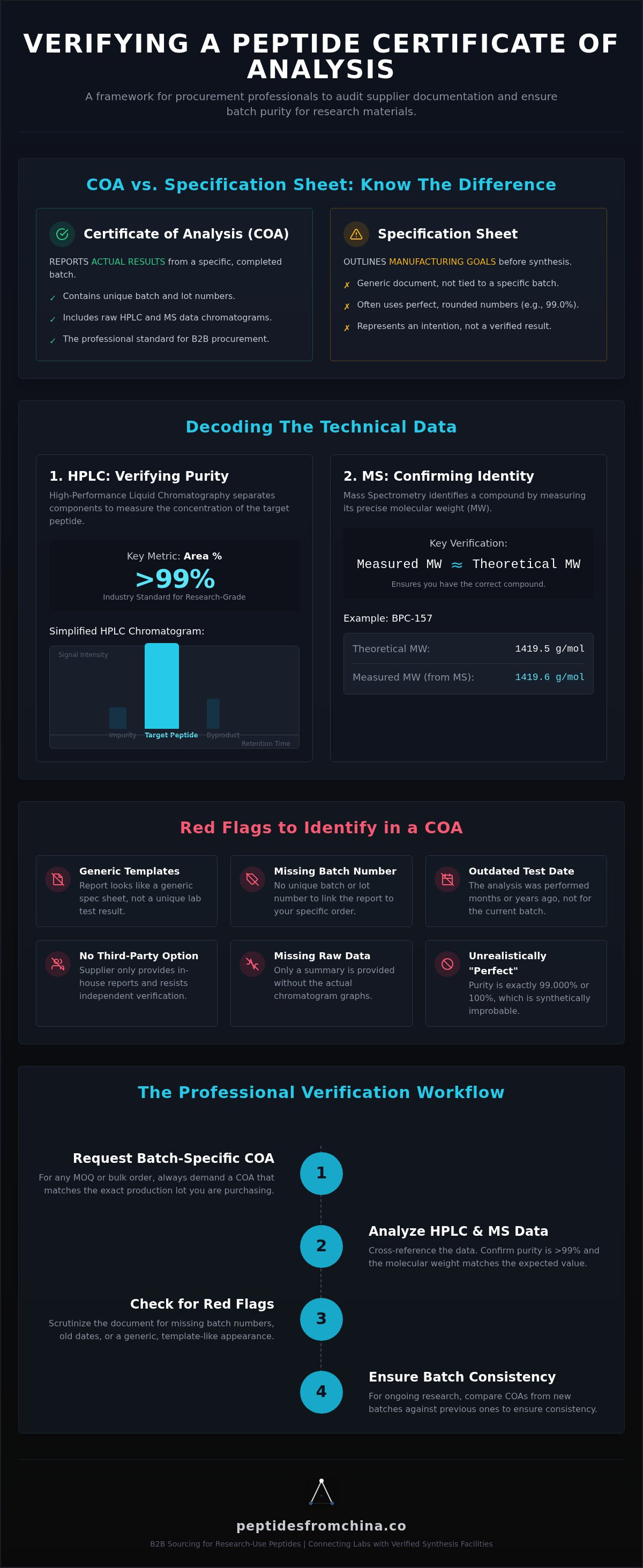
It's vital to distinguish between a specification sheet and a COA during the procurement process. A specification sheet outlines the manufacturing goals, such as a target purity of 99%. It represents what the lab intends to produce. In contrast, a COA reports the actual performance and measured purity of a specific batch after synthesis is complete. Professional laboratory procurement requires the latter. If a supplier provides a document that looks like a template with perfectly rounded numbers and no unique batch identifiers, it's likely a specification sheet rather than a genuine test result. A legitimate report must include raw HPLC and MS data to prove that the "actual" matches the "goal." Relying on generic templates increases the risk of receiving sub-standard material that doesn't meet your research requirements.
Decoding Technical Data: HPLC and Mass Spectrometry (MS)
A professional peptide certificate of analysis relies on two primary analytical techniques to validate a batch. HPLC is a process that separates components in a mixture to measure the concentration of the target peptide. While HPLC determines how much of the substance is the desired compound, Mass Spectrometry (MS) confirms exactly what that compound is. For research-grade materials like BPC-157, a purity level of 99% is the established industry standard. Achieving this threshold ensures that the presence of residual solvents, salts, or truncated sequences is minimized, providing a stable foundation for laboratory experimentation.
High-Performance Liquid Chromatography (HPLC) for Purity
The HPLC chromatogram provides a visual representation of the peptide's chemical profile. When you review the report, the primary peak should be tall, narrow, and clearly defined. This peak represents the target peptide. Any secondary peaks appearing along the baseline indicate impurities, degradation products, or synthesis byproducts. The "Area %" listed in the report summary is the critical metric for procurement officers. It calculates the proportion of the target peak area relative to the total area of all detected peaks. High-volume buyers must ensure these results remain consistent across multiple orders. Batch-to-batch stability is vital for longitudinal research studies where minor variations in purity could compromise the integrity of long-term data sets. If a batch falls below the 99% threshold, it may contain unwanted artifacts that interfere with sensitive assays.
Mass Spectrometry (MS) for Molecular Identity
Purity data isn't sufficient without identity verification. Mass Spectrometry confirms the molecular weight of the synthesized compound by measuring the mass-to-charge ratio of its ions. A standard report will list a "Theoretical Mass," which is the calculated weight based on the peptide's specific amino acid sequence. This must align with the "Found Mass" detected during the test. MS analysis prevents the misidentification of similar structures, which is particularly important for complex sequences like Tirzepatide. Because many peptides share similar physical properties, the precise molecular weight measurement provided by MS is the only way to guarantee you haven't received a look-alike compound or an incorrectly synthesized sequence. If you need assistance reviewing a specific peptide certificate of analysis before placing a wholesale order, you can request a technical consultation with our sourcing desk to verify manufacturer documentation.
Identifying Red Flags in Peptide Lab Reports
A professional procurement strategy requires a high degree of skepticism toward standard market documentation. While a peptide certificate of analysis is meant to provide assurance, it's often the primary site of manipulation in the wholesale market. Forged or outdated reports are common tools used by unreliable suppliers to move sub-standard material. Recognizing these red flags before finalizing a transaction is essential for protecting your laboratory's budget and research integrity. If the report lacks clear, high-resolution chromatogram images or shows signs of digital alteration around the date and batch number, you should consider the documentation invalid.
One frequent tactic is the 'Superseded' trap. Suppliers often use a single, high-quality report from a previous batch to represent subsequent production runs. This practice ignores the reality of batch-to-batch inconsistency in large-scale synthesis. You must verify that the lot number on the report matches the physical packaging of your shipment exactly. Discrepancies here indicate that the testing data doesn't correspond to the material you received. Check for consistency in the font and alignment of the data fields; mismatched text often suggests that a template has been edited to reflect a higher purity than actually achieved.
Spotting In-House vs. Third-Party Verification
Manufacturer-only testing presents an inherent conflict of interest. While in-house reports are necessary for initial production checks, they shouldn't be the sole basis for a wholesale order exceeding $300. Independent verification by an external laboratory provides an objective layer of security. We act as a sourcing agent to facilitate these audits, ensuring that the data comes from a facility with no financial stake in the synthesis outcome. You can review our standard verification protocols on our peptide quality page to understand how we filter manufacturer claims.
Batch vs. Catalog-Level Documentation
A 'typical' or 'representative' report is functionally useless for professional procurement. These catalog-level documents only show what a facility is capable of producing, not what they've actually synthesized for your specific order. When dealing with compounds like Semaglutide or BPC-157 in bulk, you must demand real-time testing results for the current lot. This is particularly critical for custom synthesis projects involving multiple kilograms of material. Relying on generic documentation increases the risk of receiving batches with significant purity variances that can compromise your experimental results.
The Professional Verification Workflow for Bulk Orders
Managing wholesale procurement requires a methodical approach to verification. The process begins with a pre-synthesis specification agreement. You must define the target purity, salt content, and peptide identity before the manufacturer initiates production. This agreement sets the benchmark for the entire project. Once synthesis is complete, the facility generates an initial peptide certificate of analysis. This post-production review acts as the first filter to ensure the batch meets the agreed-upon specs. For high-value batches exceeding the $300 minimum order, coordinating independent verification is the next logical step. Final batch approval and the release of funds should only occur once the independent data confirms the manufacturer's claims. This structured workflow eliminates the typical anxieties of international sourcing by prioritizing factual data over verbal promises.
Pre-Shipment Sample Testing Protocols
Professional labs often utilize a $10 processing deposit to initiate manufacturer verification. This small entry fee allows us to coordinate the logistics of blind testing before you commit to a full wholesale invoice. In a blind test, the sample is sent to an independent facility without identifying the manufacturer or the expected purity. This ensures the results are completely unbiased and based solely on the chemical reality of the sample. You can follow our full sequence of operations on our How It Works page. This protocol is essential when procuring large quantities of compounds like Tirzepatide or Semaglutide. It provides a low-risk entry point to verify a manufacturer's consistency before scaling up your order volume.
Managing Lot Consistency in Large-Scale Synthesis
Maintaining purity across a large MOQ order requires constant monitoring. When dealing with multi-kilogram projects, the risk of batch variance increases significantly. If a discrepancy arises between the manufacturer's peptide certificate of analysis and your independent lab results, you must have a clear resolution protocol in place. This usually involves a re-test or a batch rejection clause. Neutral, tracked shipping is equally important for batch integrity. It prevents external contamination and ensures the material arriving at your lab is the exact lot that was tested. We prioritize these logistical details to bridge the gap between production and delivery. If you're ready to secure a verified batch for your next project, you can request a wholesale quote today to begin the verification process.
Direct Sourcing: How Peptides From China Ensures Batch Purity
We function as a strategic B2B intermediary, bridging the gap between professional laboratories and high-capacity synthesis facilities. Our model bypasses the traditional retail layers that inflate costs without adding technical value. By connecting labs directly to the source, we ensure that the peptide certificate of analysis you receive is batch-specific and generated at the point of production. This direct routing is essential for high-demand research compounds like Semaglutide and Retatrutide. Our $300 minimum order quantity is designed to serve the needs of institutional and commercial research entities that require consistency and scale rather than single-vial retail convenience. We eliminate the retail markup while maintaining the professional verification standards your research requires.
Our Direct-to-Manufacturer Verification Model
We prioritize direct relationships with Chinese synthesis facilities because domestic warehousing often compromises data integrity. When a product sits in a US or EU warehouse, it's frequently disconnected from its original peptide certificate of analysis, making it impossible to verify the exact synthesis date or lot number. Our vetting protocol involves auditing facility capacity and historical batch consistency before any manufacturer enters our network. We act as your analytical filter, ensuring that every order is backed by current, lot-matched documentation. This approach removes the uncertainty of "old stock" and replaces it with real-time data. You can find more detail on our rigorous vetting standards on our peptide quality page.
Initiating a Verified Sourcing Request
Starting a wholesale inquiry for research-grade peptides is a straightforward logistical process. Procurement officers can begin by submitting a request for a custom quote. We require a $10 processing deposit to initiate the manufacturer verification and current batch testing. This deposit is not an additional fee; it is fully credited toward your final wholesale invoice once you approve the batch data. This mechanism ensures that only serious procurement inquiries are processed, allowing us to maintain high service standards for professional labs. To begin your inquiry and receive a specific batch report, visit our contact page. Our desk will provide a detailed breakdown of lead times, shipping logistics, and payment options tailored to your institutional requirements.
Securing Data-Driven Integrity in Wholesale Sourcing
Professional procurement requires moving beyond catalog specifications to verify the chemical reality of every lot. By mastering the interpretation of HPLC and MS data, you protect your research from the risks of batch inconsistency and documentation forgery. A valid peptide certificate of analysis is the only objective bridge between a manufacturer's claims and your laboratory's standards.
Our direct-to-manufacturer model ensures that your documentation remains lot-matched and authentic. We eliminate unnecessary reseller markups while providing the technical transparency needed for high-volume research. With a $300 wholesale MOQ and direct synthesis facility access, your procurement process becomes methodical and reliable. This systematic approach allows you to scale your operations without compromising on the quality of your research materials.
Ready to secure your next batch? You can request a verified wholesale quote for your research lab to begin the verification protocol. We look forward to supporting your institutional research with COA-verified batches and transparent pricing.
Frequently Asked Questions
What is a peptide Certificate of Analysis (COA)?
A peptide certificate of analysis is a technical document that validates the purity and molecular identity of a specific synthesized batch. Unlike a specification sheet, which outlines a manufacturer's goals, the COA reports actual measured performance using HPLC and Mass Spectrometry. For wholesale buyers, this document is the primary tool for establishing a chain of quality. It ensures that the material received in a $300+ order meets the precise requirements of your laboratory's research protocols.
How can I verify if an HPLC report is authentic?
Authenticity verification requires a methodical review of the raw data. You must look for high-resolution chromatogram images rather than generic text summaries. Check for signs of digital manipulation around the date, batch number, and purity percentages. A legitimate report will include specific testing parameters, such as the column type and mobile phase used during HPLC. We recommend cross-referencing the lot number with the manufacturer's internal database or utilizing our independent verification services to confirm the data's integrity.
Why is 99% purity important for research peptides?
A purity level of 99% is the established industry standard for research-grade compounds like BPC-157. This high threshold is necessary to minimize the presence of synthesis byproducts, residual solvents, and salts. In sensitive laboratory environments, even minor impurities can interfere with experimental results or lead to batch-to-batch inconsistency. Maintaining this standard ensures that your longitudinal studies are based on stable, high-integrity materials that provide predictable and reproducible data.
Does Peptides From China provide third-party testing?
We function as a quality control intermediary between synthesis facilities and professional labs. While facilities provide in-house reports, we coordinate independent third-party verification for high-value wholesale batches. This process eliminates the inherent conflict of interest in manufacturer-only testing. By routing samples to unbiased laboratories, we provide an objective layer of security. Our $10 processing deposit allows you to initiate this verification protocol before committing to a full wholesale order, ensuring batch-specific transparency.
What is the difference between HPLC and Mass Spectrometry?
HPLC and Mass Spectrometry serve distinct analytical purposes in a peptide certificate of analysis. HPLC, or High-Performance Liquid Chromatography, measures chemical purity by separating the components of a mixture to determine the concentration of the target peptide. Mass Spectrometry (MS) verifies the molecular identity by measuring the mass-to-charge ratio. While HPLC tells you how much of the substance is present, MS confirms exactly what the substance is, preventing the misidentification of similar chemical sequences.
Can I request a COA before placing a wholesale order?
Yes, we provide batch-specific documentation as part of our sourcing workflow. You can initiate a request for a current batch report by submitting a $10 processing deposit. This small fee covers the logistics of retrieving and verifying the latest lab results from the synthesis facility. Once you review the data and approve the batch for your $300+ wholesale order, this deposit is credited toward your final invoice, providing a low-risk entry to manufacturer verification.
Why do some COAs show lower purity for certain compounds?
Lower purity readings often indicate degradation or synthesis errors during production. While some complex sequences like Tirzepatide are harder to synthesize, they must still meet the 99% research standard. If a report shows lower purity, it typically means the batch contains more impurities or truncated sequences. We reject any batches that fall below our agreed-upon specifications, ensuring that our clients only receive high-integrity materials that align with professional laboratory requirements and research standards.
How do I match a COA lot number to my shipment?
Matching the lot number is a critical step in the verification process. The unique identifier listed on the lab report must correspond exactly to the lot number printed on the physical packaging of your shipment. This alignment proves that the analytical data you've reviewed belongs to the specific material you received. Any discrepancy between the report and the packaging is a significant red flag, suggesting that the documentation may be outdated or superseded by a different production run.