
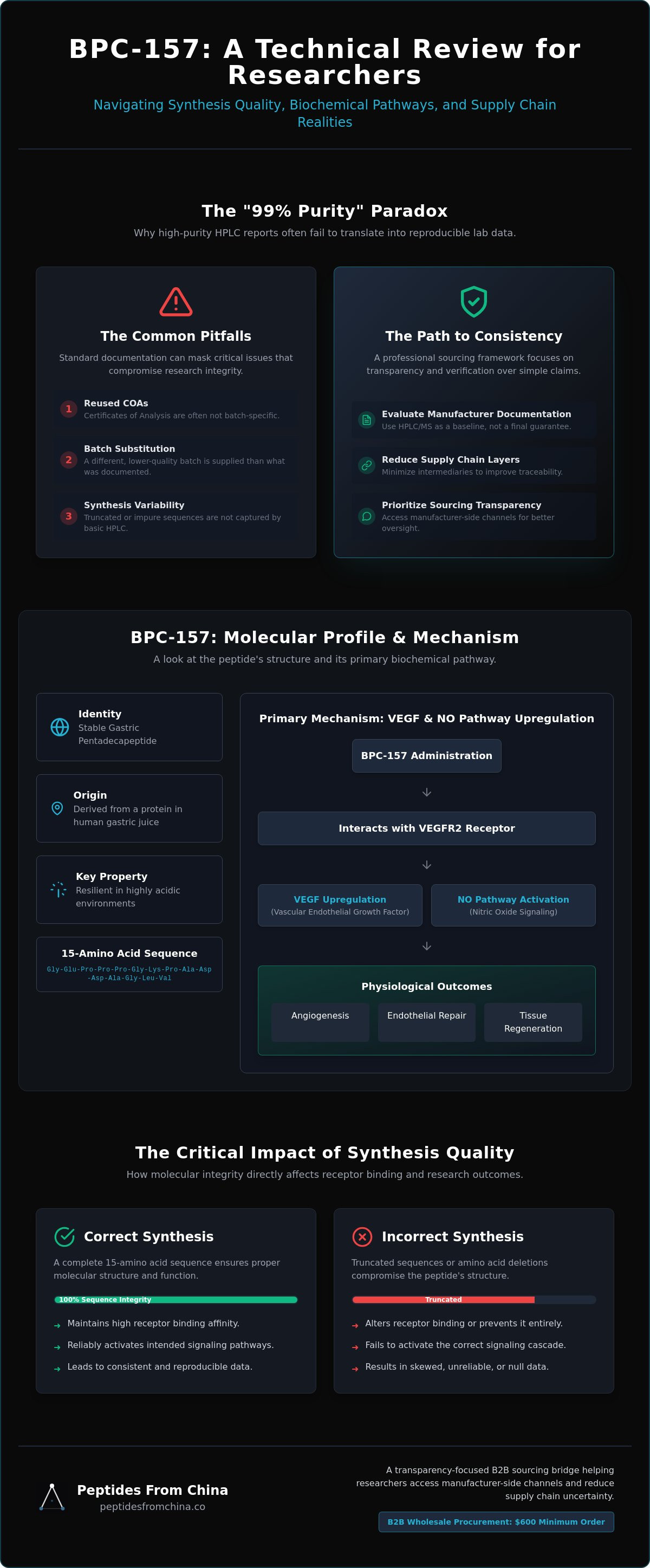
Why does a "99% pure" HPLC report so often fail to translate into reproducible data in the laboratory? Most BPC-157 mechanism of action studies focus on the activation of the Vascular Endothelial Growth Factor (VEGF) and nitric oxide (NO) pathways, yet researchers frequently encounter frustrating variability between batches. This inconsistency usually stems from synthesis-driven differences that a standard, often-reused COA cannot capture. If you're managing high-volume procurement, you've likely realized that marketing claims about "perfect purity" don't account for the realities of peptide manufacturing or the risks of batch substitution. With the FDA's removal of BPC-157 from the Category 2 list in April 2026, technical scrutiny of these substances has never been more critical for professional labs.
We understand the difficulty of distinguishing actual pharmacological data from retail-tier hype. This technical review provides a deep dive into the biochemical pathways of BPC-157 while establishing clear criteria for evaluating research-grade materials. We'll examine how synthesis quality directly impacts binding affinity and provide a framework for more reliable sourcing. By focusing on manufacturer-side transparency and reducing intermediary layers, you can help reduce supply chain uncertainty. We'll also outline how Peptides From China (PFC) acts as a B2B sourcing bridge for those meeting the $600 minimum order requirement, helping you move beyond baseline documentation toward more consistent research outcomes.
Key Takeaways
Understand why the 15-amino acid sequence's stability in acidic environments makes it a unique subject for gastric and systemic research.
Examine how BPC-157 mechanism of action studies highlight the up-regulation of VEGF and NO signaling to promote angiogenesis and endothelial repair.
Learn how synthesis-driven variability, like truncated sequences, can skew your data by altering receptor binding affinity in molecular signaling models.
Identify the technical criteria for evaluating manufacturer-side documentation beyond baseline HPLC reports to help reduce supply chain uncertainty.
Discover how to access manufacturer-side sourcing channels through Peptides From China to improve traceability, provided you meet the $600 minimum order requirement.
Table of Contents
Core Mechanisms of BPC-157: A Review of Current Literature
Angiogenesis and the VEGF Pathway: The Foundation of BPC-157 Research
Neurological and Cytoprotective Mechanisms in Advanced Studies
The Impact of Synthesis Impurities on Mechanism of Action Studies
Sourcing High-Purity BPC-157 for Reliable Research Protocols
Core Mechanisms of BPC-157: A Review of Current Literature
BPC-157 is a 15-amino acid sequence derived from a protective protein naturally occurring in human gastric juice. In the context of BPC-157 mechanism of action studies, it's often defined as a "stable gastric pentadecapeptide." This nomenclature, "Body Protective Compound," reflects its unique ability to induce cytoprotection across various tissues in preclinical models. Unlike many regulatory peptides that suffer from rapid degradation, BPC-157 is characterized by its resilience in highly acidic environments. This stability is a primary reason why it remains a central focus for researchers investigating gastrointestinal repair and systemic tissue regeneration.
Molecular Structure and Stability Factors
The specific amino acid sequence, Gly-Pro-Pro-Glu-Pro-Ser-Val-Ala-Phe-Cys-Ser-Asp-Val-Ala-Met, is the foundation of its pharmacological profile. Structural integrity is paramount for maintaining high binding affinity in laboratory protocols. If the peptide sequence is compromised by truncation or amino acid deletions during synthesis, the resulting molecule may fail to activate the intended signaling pathways. This is a common pitfall in the peptide industry, where supply chain opacity and reused COAs often mask variable synthesis quality. The peptide's inherent resistance to hydrolysis and proteolysis allows it to remain bioactive longer than comparable compounds, provided the manufacturing process maintains the exact molecular weight and sequence purity required for reliable research.
The Brain-Gut Axis and Systemic Distribution
While its origins are gastric, BPC-157 demonstrates a remarkable capacity to cross biological barriers and exert systemic effects. Research in rodent and in-vitro models suggests it facilitates organoprotection far beyond the digestive tract. This includes interactions with the central nervous system, specifically influencing the dopaminergic and serotonergic systems through the brain-gut axis. Studies often compare localized administration with systemic delivery, finding that the peptide's distribution is widespread regardless of the entry point. However, achieving these results in a lab setting requires a consistent supply of research-grade material that hasn't been degraded by improper handling or poor synthesis.
For procurement professionals, the challenge lies in navigating a market prone to batch substitution and relabeling. Peptides From China (PFC) acts as a transparency-focused B2B sourcing bridge, helping researchers bypass the layers of resellers that contribute to supply chain uncertainty. By facilitating access to manufacturer-side channels, PFC supports more rigorous independent verification for those meeting the $600 minimum order requirement. This methodical approach is necessary because a single HPLC report is merely a baseline reference, not a definitive guarantee of product identity or long-term operational consistency.
Angiogenesis and the VEGF Pathway: The Foundation of BPC-157 Research
The most documented physiological effect of this pentadecapeptide is its role in vascular repair and new vessel formation. In the context of BPC-157 mechanism of action studies, the up-regulation of Vascular Endothelial Growth Factor (VEGF) stands as a primary driver of its regenerative profile. This process isn't merely about stimulating growth; it's about coordinating the complex transition from tissue necrosis to granulation tissue formation and systematic collagen reorganization. For researchers, replicating these results depends heavily on the structural integrity of the peptide, as even minor synthesis errors can disrupt the signaling cascade required for vascular modeling.
VEGF Expression and Vascular Modeling
In various ischemic models, BPC-157 has demonstrated a capacity to promote angiogenesis by interacting with the VEGFR2 receptor. This interaction triggers the activation of internal signaling pathways that lead to the formation of new blood vessels, which is critical for studies involving chronic wound healing and limb ischemia. However, many laboratories struggle with inconsistent outcomes because they rely on resellers with opaque supply chains. If the peptide batch contains synthesis by-products or residual solvents, the binding affinity for VEGFR2 may be significantly reduced, leading to a failure in vascular expression that contradicts established literature.
Nitric Oxide (NO) Synthesis and Endothelial Integrity
Another vital component of the BPC-157 pathway is the modulation of endothelial nitric oxide synthase (eNOS). By maintaining consistent NO production, the peptide helps preserve endothelial integrity and regulates vascular tone. Comparative metrics in treated versus control groups often show a marked improvement in NO-mediated vasodilation. This specific mechanism is why synthesis quality is so important; the bio-activity required to stimulate eNOS is sensitive to the presence of truncated sequences. Accessing reliable sourcing channels helps reduce supply chain uncertainty, ensuring that the material used in your vascular studies matches the reference analytical data found in high-impact journals.
Beyond the vascular system, BPC-157 influences the FAK-paxillin pathway, which is essential for tendon-to-bone healing research. This pathway facilitates the migration of fibroblasts, allowing for more effective tissue repair in musculoskeletal models. Much of the preclinical data on BPC-157 suggests that its cytoprotective effects are systemic, yet these results are only reproducible when the peptide's 15-amino acid sequence is perfectly maintained. At Peptides From China (PFC), we act as a B2B sourcing bridge to help researchers access manufacturer-side production, bypassing the inconsistent quality often found with domestic resellers. For those meeting our $600 minimum order requirement, we provide a more direct path to obtaining research-grade material that supports rigorous independent verification and operational consistency.
Neurological and Cytoprotective Mechanisms in Advanced Studies
The systemic influence of BPC-157 extends into complex neurological pathways, challenging the traditional view of it as a localized gastric agent. In BPC-157 mechanism of action studies, researchers have observed a significant interaction with the dopaminergic and serotonergic systems. This cross-system signaling is a primary reason why the peptide is a focal point for studies involving central nervous system (CNS) homeostasis. However, the reliability of these advanced studies is often threatened by supply chain opacity and the prevalence of relabeled batches that don't match their accompanying HPLC reports.
Neuro-Regenerative Pathways and CNS Protection
Current research investigates how BPC-157 attenuates neurotoxicity and oxidative stress in various laboratory models. The peptide appears to influence the expression of growth factor receptors in the brain, which may support the survival of neurons under toxic insult. While many focus on BPC-157 for Musculoskeletal Healing, its neuro-regenerative potential is equally compelling to researchers exploring GABAergic system modulation. The brain-gut axis MOA involves the modulation of the dopaminergic system to maintain homeostasis between central nervous system signaling and peripheral gastrointestinal function. This interaction suggests a protective role against the behavioral and physiological disturbances typically seen in models of dopamine dysfunction.
Counteracting Chemical and Biological Insult
Beyond the CNS, BPC-157 demonstrates broad-spectrum cytoprotection against a variety of chemical and biological stressors. It has been shown to counteract NSAID-induced damage, which is a common benchmark in organoprotection research. Its protective reach includes the following areas in animal and in-vitro models:
Liver and Pancreas: Mitigation of lesions and inflammatory responses during toxic insult.
Cardiovascular System: Protection of heart tissue from oxidative damage and electrolyte imbalances.
Gut-Brain-Lung Axis: Stabilization of multiple organ systems through systemic signaling pathways.
Gastric Integrity: Protection against alcohol-induced gastric lesions by maintaining mucosal blood flow.
These protective mechanisms support the necessity of independent verification in professional research environments. If a peptide batch contains synthesis by-products or residual solvents, the delicate molecular signaling required for organoprotection can be easily disrupted. At Peptides From China (PFC), we serve as a transparency-first B2B sourcing bridge to help labs move past the risks of reused COAs and batch substitution. By facilitating direct access to manufacturer-side production for those meeting our $600 minimum order requirement, we help improve traceability and operational consistency. This methodical approach supports buyer-led verification against the manufacturer-side reference analytical data when available.
The Impact of Synthesis Impurities on Mechanism of Action Studies
A common misconception in procurement is that a Certificate of Analysis (COA) showing 99% purity is a definitive guarantee of product performance. In reality, a standard HPLC report is merely a baseline technical reference material. It doesn't always account for the specific synthesis-driven variability that can derail BPC-157 mechanism of action studies. If a peptide batch contains truncated sequences or amino acid deletions, the resulting molecule's receptor binding affinity is fundamentally altered. When your research relies on precise molecular signaling, even a minor structural deviation can lead to non-reproducible data that contradicts established literature.
Synthesis-Driven Variability in Research Outcomes
While HPLC measures the quantity of the main peak, it often fails to identify sequence errors that only Mass Spectrometry can reveal. These impurities aren't just inert fillers; they can trigger non-specific immune responses in laboratory models, masking the actual cytoprotective effects of the peptide. For those conducting long-term trials, batch-to-batch variability is a significant risk factor. Ensuring you receive high quality peptides requires a sourcing strategy that prioritizes batch traceability and manufacturer-side accountability over the lowest possible price point.
Evaluating Manufacturer-Side Documentation
Professional researchers must look beyond the generic documents provided by resellers. The industry is plagued by reused COAs, relabeling, and supply chain opacity. Identifying "red flag" patterns, such as identical HPLC chromatograms for different batches, is a critical skill for procurement officers. A more robust approach involves implementing independent verification protocols rather than taking middleman claims at face value. Navigating the complexities of peptide sourcing means understanding that documentation is only as reliable as the transparency of the supply channel it came from.
At Peptides From China (PFC), we act as a transparency-focused B2B sourcing bridge, helping you minimize intermediary layers and access manufacturer-side channels. We don't claim to be a testing laboratory or a guarantor of absolute purity; instead, we provide the traceability needed for your own independent verification. For laboratories and institutions meeting our $600 minimum order requirement, we offer a methodical way to reduce supply chain uncertainty and maintain operational consistency. If you're ready to move beyond the limitations of generic resellers, you can explore our manufacturer-side procurement options today.
Sourcing High-Purity BPC-157 for Reliable Research Protocols
Ensuring that BPC-157 mechanism of action studies remain reproducible requires more than just high-level scientific protocols; it demands a procurement strategy that prioritizes supply chain transparency. Most researchers fail to account for the logistical risks inherent in the international peptide market, where reseller layers often obscure the origin of the material. By moving toward a manufacturer-side sourcing model, institutions can significantly improve traceability and reduce the likelihood of receiving batches that deviate from reference analytical data. This methodical approach is the only way to maintain the integrity of long-term laboratory investigations.
The B2B Sourcing Model: Reducing Reseller Layers
Eliminating unnecessary intermediaries helps reduce supply chain uncertainty. When you buy from a domestic reseller, you're often receiving material that has passed through multiple hands, each adding a layer of opacity regarding storage conditions and batch identity. Peptides From China (PFC) acts as a transparency-focused B2B sourcing bridge, connecting professional buyers directly with manufacturer-side production. This model supports independent verification by providing clearer batch history, which is essential for maintaining consistent bio-activity across multi-phase studies. For organizations looking for a structured approach to procurement, our guide on wholesale peptides outlines the necessary steps to secure consistent supply channels while bypassing the typical pitfalls of the retail market.
Procurement Standards for Research Institutions
Retail-grade suppliers may not meet every buyer’s operational needs. Products are subject to the manufacturer’s applicable quality-control procedures and specifications. Manufacturer-side analytical documentation may be available depending on the product and batch. PeptidesFromChina is not an independent analytical testing laboratory. PFC coordinates international logistics; shipping details vary by destination and are confirmed during order processing. Learn more: bulk BPC-157 wholesale.
To maintain the integrity of your BPC-157 mechanism of action studies, your sourcing must be as methodical as your science. We cater specifically to high-volume users who understand that the lowest price often indicates the highest risk of batch substitution or synthesis errors. If your laboratory or institution meets our $600 minimum order requirement, you can request a quote for research-grade compounds at Peptides From China. This direct path helps you bypass the "gray market" retail traps and establish a reliable, transparent supply line for your ongoing research protocols.
Optimizing Research Outcomes Through Strategic Sourcing
Reliable data in BPC-157 mechanism of action studies depends on a supply chain that values technical precision over marketing flair. We've examined how the up-regulation of VEGF and NO pathways can be compromised by synthesis impurities like truncated sequences. Because the peptide industry often suffers from reused COAs and relabeled batches, professional laboratories must move beyond surface-level documentation. Implementing independent verification protocols is the only methodical way to ensure your reference analytical data matches the physical compound in your vials.
By choosing a sourcing model that reduces unnecessary reseller layers, buyers can improve traceability. Products are subject to the manufacturer’s applicable quality-control procedures and specifications. Manufacturer-side analytical documentation may be available depending on the product and batch. PeptidesFromChina is not an independent analytical testing laboratory. PeptidesFromChina currently has a $600 total minimum order. Multiple catalog products can be combined to reach the minimum, with orders starting from one 10-vial kit per product. Learn more: secure high-purity BPC-157 for your research via Peptides From China.
Comparative scope for BPC-157 research
Comparative studies should distinguish BPC-157 from TB-500 rather than treat the materials as interchangeable: BPC-157 is a 15-amino-acid peptide, while TB-500 refers to a research material associated with thymosin beta-4. Findings for one material do not establish findings for the other.
Technical Research and Sourcing FAQs
What is the primary mechanism of action for BPC-157 in wound healing?
BPC-157 facilitates wound healing primarily through the up-regulation of Vascular Endothelial Growth Factor (VEGF) and the modulation of nitric oxide signaling. This process coordinates angiogenesis and the formation of granulation tissue in ischemic models. It also influences the FAK-paxillin pathway, which is essential for fibroblast migration in musculoskeletal healing. These systemic effects are why the peptide is a central focus for studies involving tendon-to-bone repair and gastric mucosal protection.
How does BPC-157 influence the VEGF pathway in laboratory models?
The peptide promotes new blood vessel growth by interacting with the VEGFR2 receptor and triggering an internal signaling cascade. This activation is critical for tissue regeneration and the reversal of ischemic damage in animal models. However, the effectiveness of this pathway in a lab setting is highly dependent on the peptide's structural integrity. Even minor synthesis errors can prevent the molecule from properly binding to the receptor, leading to inconsistent research outcomes.
Can BPC-157's mechanism be affected by peptide synthesis methods?
Yes, the synthesis method directly impacts the peptide's bio-activity and its performance in BPC-157 mechanism of action studies. Truncated sequences or amino acid deletions during the manufacturing process can fundamentally alter the 15-amino acid chain. If the sequence is compromised, the peptide may fail to trigger the intended VEGF or nitric oxide pathways. This is why researchers shouldn't rely solely on baseline documentation like an HPLC report, which may not identify sequence errors.
Is there human clinical data supporting the MOA of BPC-157?
Human clinical data remains very limited as of July 2026. While three small human pilot studies conducted before 2025 reported no adverse effects for specific conditions like knee pain, there is still a near-total lack of large-scale, robust clinical trials. The vast majority of existing data comes from preclinical rodent models. Researchers should treat its use in humans as investigational, especially with the FDA's Pharmacy Compounding Advisory Committee scheduled to review its status on July 23, 2026.
How do impurities in BPC-157 impact receptor binding in research?
Synthesis by-products and residual solvents can physically block or competitively inhibit receptor sites, skewing your laboratory data. These impurities often trigger non-specific immune responses in research models, which can mask the peptide's actual cytoprotective effects. When a batch contains high levels of synthesis-driven variability, the resulting binding affinity is significantly reduced. This makes independent verification a necessity for any professional lab aiming for reproducible results in molecular signaling studies.
What is the role of Nitric Oxide in BPC-157's cytoprotective effects?
BPC-157 modulates endothelial nitric oxide synthase (eNOS) to maintain vascular integrity and regulate blood flow. This modulation helps protect organs from toxic insult and oxidative stress by ensuring consistent nitric oxide production. In treated laboratory models, this mechanism has been shown to counteract damage from stressors like alcohol or NSAIDs. Maintaining the peptide's exact molecular weight is essential for this bio-activity, as degraded batches won't interact with the eNOS pathway effectively.
Why is independent verification necessary for BPC-157 mechanism studies?
Independent verification is the only way to ensure that a peptide batch actually matches the reference analytical data required for your study. The peptide industry is prone to supply chain opacity, reused COAs, and batch substitution by resellers. A single manufacturer-issued HPLC report doesn't guarantee product identity or purity. By conducting your own testing, you help reduce supply chain uncertainty and ensure that synthesis-driven variability doesn't derail your research outcomes or lead to non-reproducible data.
How does Peptides From China facilitate BPC-157 research sourcing?
Peptides From China (PFC) acts as a transparency-focused B2B bridge that helps researchers access manufacturer-side channels. We reduce intermediary layers to improve traceability for labs and institutions meeting our $600 minimum order requirement. Our model focuses on providing the batch traceability needed for your own independent verification. This methodical approach helps procurement professionals avoid the risks of relabeling and middleman markups while ensuring operational consistency for long-term BPC-157 mechanism of action studies.