
A Certificate of Analysis in the peptide industry is often treated as a definitive shield, yet it's frequently little more than a recycled document that fails to reflect the current batch in your hands. If you're relying on domestic resellers who simply relabel imported vials, you're paying a significant markup for an illusion of security rather than actual supply chain traceability. Moving into 2026, the landscape is shifting with the FDA's recent reclassification of Category 2 peptides and new EMA manufacturing guidelines, making a transparent peptide sourcing platform more critical than ever for professional procurement.
We understand that managing these opaque channels is a source of constant frustration for B2B buyers who require consistency and factual integrity. This guide explains how to dismantle the middleman structure to establish a more reliable, cost-effective supply chain. We'll outline the logistical differences between resellers and direct manufacturing channels, specifically focusing on how Peptides From China (PFC) acts as a transparency-focused bridge for wholesale orders starting at a $600 minimum. You'll learn to move beyond baseline technical references and implement a rigorous protocol for independent batch verification to ensure operational consistency.
Key Takeaways
Distinguish between domestic resellers who relabel stock and sourcing platforms that facilitate direct access to synthesis facilities.
Learn why HPLC and Mass Spectrometry reports are baseline reference materials rather than definitive proof of quality in a market prone to reused documentation.
Identify critical red flags such as opaque sourcing and inconsistent pricing that signal broken chains of custody or unverified surplus stock.
Understand how a professional peptide sourcing platform like PFC helps reduce intermediary risks for B2B procurement with a $600 minimum order requirement.
Develop a realistic sourcing framework that prioritizes independent batch testing and direct manufacturer-side transparency over reseller marketing claims.
Table of Contents
Defining the Landscape of Peptide Distributors in 2026
Resellers vs. Sourcing Platforms: Decoding the Supply Chain
The Documentation Trap: HPLC Reports and COA Opacity
Evaluating Peptide Research Supply: 4 Red Flags to Monitor
Direct Sourcing: Reducing Intermediary Risk with PFC
Defining the Landscape of Peptide Distributors in 2026
A peptide distributor acts as the logistical bridge between synthesis facilities and research laboratories. In the current market, this role has evolved from simple domestic catalog companies to sophisticated peptide sourcing platform models that prioritize transparency over stock-on-hand. Understanding this landscape requires looking past the surface-level branding of most suppliers. Many entities that present themselves as manufacturers are actually secondary or tertiary resellers that add layers of cost without adding verified value. This distinction is critical for procurement professionals who need to manage both budget and batch consistency.
The evolution of the market into 2026 reflects a growing demand for direct-to-manufacturer access. Traditional distributors often rely on a complex web of intermediaries, where a single batch of a compound like Tirzepatide may change hands three times before reaching a domestic warehouse. Each hand-off introduces potential for batch substitution, relabeling, and documentation decay. A modern peptide sourcing platform helps reduce supply chain uncertainty by minimizing these steps, connecting labs more directly to the source of production.
The Intermediary Problem: Why Costs Escalate
Market pricing and availability can vary substantially by supplier, product, order size, and current conditions; exact comparisons require current, like-for-like data.
Research vs. Clinical Supply Chains
Establishing a reliable supply requires a clear understanding of the methods used in chemical peptide synthesis. For laboratory-grade compounds, the 2026 standard remains a purity of 98 percent or higher, verified by HPLC and Mass Spectrometry. However, many distributors misuse the term "GMP" to imply pharmaceutical-grade quality for products intended strictly for research. In reality, true cGMP (Current Good Manufacturing Practice) compliance is a rigorous regulatory standard that most domestic resellers don't meet. Professional buyers should focus on identifying the original synthesis site and obtaining batch-specific reference analytical data. Peptides From China (PFC) operates as a B2B sourcing bridge for those looking to bypass these reseller layers, facilitating wholesale procurement with a $600 minimum order requirement to ensure operational efficiency and direct manufacturer-side access.
Resellers vs. Sourcing Platforms: Decoding the Supply Chain
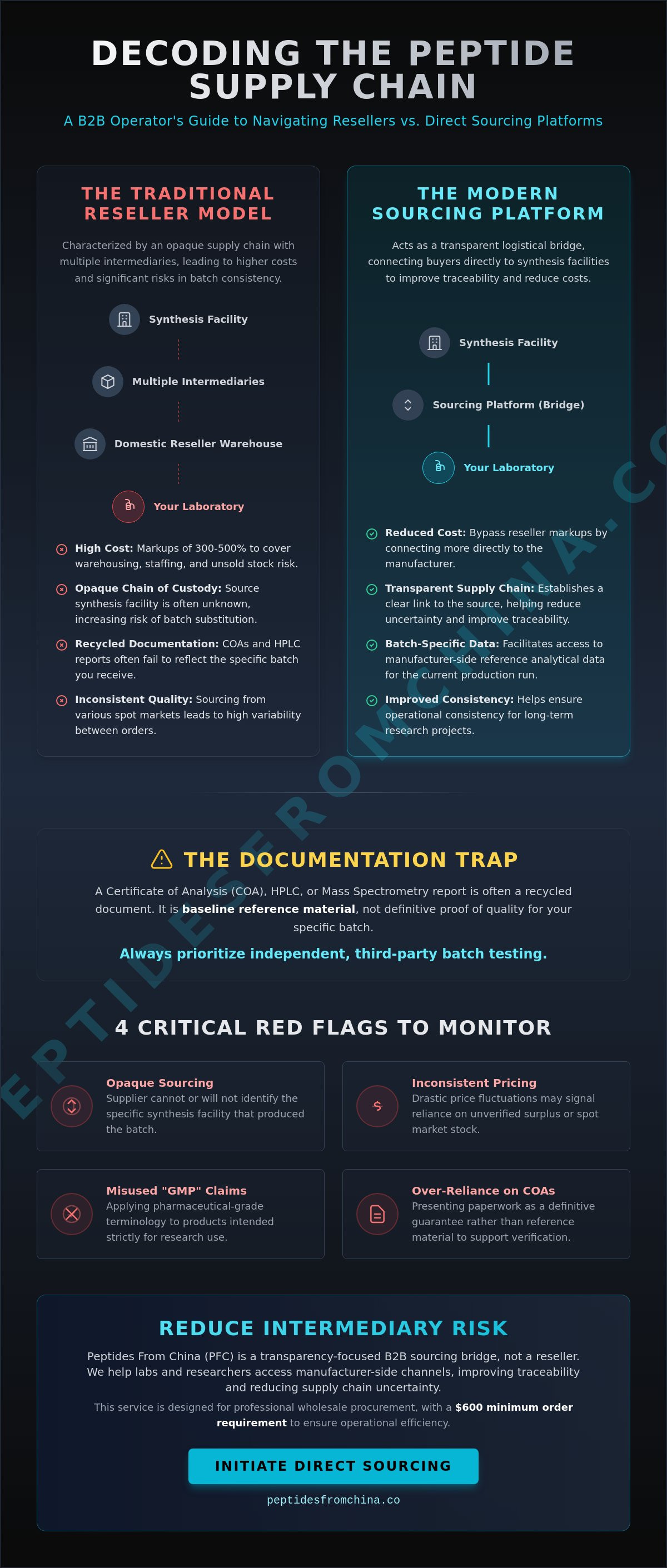
Resellers and sourcing platforms serve two distinct operational needs. Traditional resellers follow a retail-focused model where they purchase bulk quantities from overseas, apply their own branding, and store the vials in domestic warehouses. This provides the benefit of rapid shipping, but it creates a significant barrier between the buyer and the production source. Because these resellers often buy from multiple spot markets to maintain stock levels, the consistency of synthesis can vary significantly between orders. The markup paid to a reseller isn't for product quality; it's a premium for domestic logistics and immediate availability.
In contrast, a peptide sourcing platform operates as a methodical logistical conduit. Instead of selling from pre-purchased inventory, these platforms facilitate a direct link to verified synthesis facilities. This model prioritizes traceability over speed. By removing the reseller layer, buyers can access manufacturer-side documentation and reduce the risk of receiving relabeled or substituted batches. For those managing long-term research projects, reducing these intermediary layers is the most effective way to ensure operational consistency and lower procurement costs.
The role of a sourcing agent within this framework is to act as a technical filter. They navigate the complexities of international manufacturing standards, ensuring that the facility's internal protocols align with laboratory requirements. While documentation like HPLC reports are provided, an effective agent treats these as a FDA peptide quality assessment baseline rather than absolute proof. They understand that true verification requires independent testing by the buyer once the material arrives, as no single document can fully guarantee product identity or purity.
Operational Mechanics of a Sourcing Platform
Verified synthesis facilities in China typically require a structured B2B approach. The process often begins with a deposit to initiate manufacturer-side stock verification or custom synthesis. This ensures the batch is allocated specifically for the order rather than pulled from generic, aged surplus. Logistics are handled through neutral packaging and specialized tracking protocols designed for international research materials. This methodical approach helps reduce supply chain uncertainty by maintaining a clear record of the compound's journey from the synthesis bench to the laboratory.
The Economic Logic of Direct Sourcing
Direct sourcing requires a shift in procurement strategy. Most professional platforms, including Peptides From China, implement a $600 minimum order requirement. This threshold is necessary to offset the costs of international logistics and to ensure the manufacturer's synthesis schedule is prioritized. While shipping costs from China are higher than domestic rates, the savings on the compounds themselves make bulk sourcing the only viable path for sustained laboratory work. It's an investment in transparency and cost-efficiency that single-vial retail purchases simply cannot match. By committing to wholesale volumes, researchers can establish a consistent supply of compounds like BPC-157 or Tirzepatide without the inflated margins of domestic middlemen.
The Documentation Trap: HPLC Reports and COA Opacity
In the 2026 market, High-Performance Liquid Chromatography (HPLC) and Mass Spectrometry (MS) reports are often presented as definitive proof of quality. However, professional buyers understand that these documents are frequently the weakest link in the supply chain. A common industry practice involves using a single high-quality report for multiple different batches, some synthesized months apart. This creates a false sense of security that doesn't reflect the actual material in the vials. A credible peptide sourcing platform doesn't present manufacturer-issued papers as an absolute guarantee; it positions them as baseline reference analytical data that requires further validation by the end-user.
Red Flags in Analytical Reporting
Identifying deceptive reporting requires a technical eye for detail. One major red flag is the "template" COA. These documents often lack batch-specific identifiers, such as unique lot numbers that match the physical labeling on the vials. If a distributor provides a report that looks identical to one issued six months ago for a different order, the integrity of that data is compromised. There's also a significant difference between a manufacturer's internal report and a third-party audit. Internal reports are useful for initial screening, but they shouldn't be the final word. Claims of "99% Purity" are particularly suspect if they aren't accompanied by a high-resolution chromatogram showing clear peak integration and baseline stability. Without the raw data, a percentage is just a number on a page.
The Role of Independent Verification
Professional laboratories never rely solely on distributor-provided documentation. They establish a rigorous protocol for independent peptide testing on a percentage of every wholesale batch received. This is the only way to verify product identity and purity with certainty. Transparency-focused platforms like Peptides From China support this level of scrutiny. By acting as a B2B sourcing bridge rather than a stock-holding reseller, PFC helps reduce supply chain uncertainty. This model allows researchers to access manufacturer-side channels while maintaining the autonomy to perform their own analytical verification. For wholesale orders meeting the $600 minimum, this approach ensures that the cost savings of direct sourcing aren't negated by the risks of unverified material. It's about building a supply chain based on data, not marketing claims.
Evaluating Peptide Research Supply: 4 Red Flags to Monitor
Identifying a reliable supply of research compounds requires moving beyond surface-level marketing claims and examining the operational reality of the distributor. The most significant red flag is opaque sourcing. If a distributor can't name the specific synthesis facility or provide a verifiable chain of custody, the integrity of the compound is fundamentally broken. Professional procurement requires knowing exactly where the synthesis occurs to ensure that the material isn't being pulled from unverified surplus stock or secondary markets. A transparent peptide sourcing platform acts as a clear window into the manufacturing process, not a wall that hides it.
Inconsistent pricing is another critical indicator of supply chain instability. Extreme fluctuations in the cost of compounds like Tirzepatide or Retatrutide often suggest that a vendor is buying from whichever factory has the lowest priced excess inventory at that moment. This practice makes it impossible to establish batch-to-batch consistency. Domestic warehousing claims in the US or EU for high-volume stock of restricted compounds usually signal a reseller model. These entities often prioritize rapid retail turnover over technical verification, adding significant markups while obscuring the product's origin. Poor batch traceability remains a systemic issue. If a distributor can't link a specific vial to a unique manufacturing run, any provided analytical data is effectively useless for laboratory verification.
Audit Checklist for B2B Procurement
Before committing to a wholesale order, it's essential to verify the distributor’s manufacturing ties and facility audit history. Technical support should be able to answer specific questions regarding synthesis methods and purification protocols without using generic scripts. We recommend utilizing a structured protocol for evaluating peptide research supply to ensure every procurement requirement is met. If you're ready to bypass the risks of domestic middlemen, you can access manufacturer-side channels through Peptides From China, where we facilitate direct sourcing for professional wholesale requirements starting at $600.
Assessing Logistics and Packaging
Logistical standards are just as important as the synthesis itself. For international research compounds, neutral packaging is the industry standard to ensure smooth transit through global customs. A dedicated peptide sourcing platform implements rigorous tracking and lost shipment policies to protect high-value wholesale orders. It's also vital to assess whether the distributor understands the necessity of cold-chain logistics for specific sequences. While many lyophilized peptides are stable at room temperature for short durations, certain compounds require specific handling to maintain their integrity during the final stages of delivery. A provider that ignores these logistical details is likely cutting corners in other areas of quality assurance.
Direct Sourcing: Reducing Intermediary Risk with PFC
Peptides From China (PFC) functions strictly as a transparency-focused B2B sourcing bridge. We don't claim to be a pharmaceutical manufacturer, a testing laboratory, or a guarantor of final purity. Instead, we provide a methodical conduit for researchers to access manufacturer-side channels directly. This model helps reduce supply chain uncertainty by removing the opaque layers associated with domestic resellers. By using a peptide sourcing platform that prioritizes logistical clarity, professional buyers can establish a more direct line to the synthesis facilities responsible for their compounds. This approach shifts the focus from marketing hype to operational reality, allowing for better management of batch consistency and procurement costs.
Manufacturer-side analytical documentation may be available depending on the product and batch. It is not guaranteed with every order and is not independent verification by PFC. Buyers may arrange third-party analytical testing when required.
The PFC Sourcing Workflow
The process begins with a specific request for compounds such as BPC-157 or Tirzepatide. The $10 deposit initiates manual request processing and real-time stock verification and is credited toward the final invoice. Products are subject to the manufacturer’s applicable quality-control procedures and specifications. Manufacturer-side analytical documentation may be available depending on the product and batch. Shipping methods, pricing, and estimated transit times vary by destination and are confirmed during order processing.
Transitioning to a Direct Model
PFC coordinates manufacturer-side sourcing and international logistics. Products are subject to the manufacturer’s applicable quality-control procedures and product-specific specifications. Manufacturer-side analytical documentation may be available depending on the product and batch, but PFC is not an independent analytical testing laboratory and does not guarantee a universal documentation package. Buyers requiring independent verification may arrange third-party analytical testing.
Securing Your Research Supply Chain for 2026
Navigating the global peptide market requires a shift from passive procurement to active supply chain management. It's clear that relying on domestic resellers often leads to inflated costs and a total loss of batch traceability. Professional laboratories must prioritize direct manufacturer-side access and treat all provided analytical data as baseline reference material that requires independent verification. By removing the middleman, you don't just reduce costs; you gain a clearer understanding of the compound's origin and synthesis history.
Manufacturer-side analytical documentation may be available depending on the product and batch. It is not guaranteed with every order and is not independent verification by PFC. Buyers may arrange third-party analytical testing when required.
Access Factory-Direct Peptide Sourcing with PFC
Frequently Asked Questions
What is the difference between a peptide distributor and a manufacturer?
A manufacturer operates the physical synthesis facility where chemical peptide synthesis occurs. A distributor acts as a logistical intermediary that manages the movement of these compounds to the end-user. Many entities that appear to be manufacturers are actually resellers who add branding and significant markups without owning the production equipment or controlling the synthesis environment.
Why do peptide distributors in the US and EU charge so much more than Chinese sources?
Market pricing and availability can vary substantially by supplier, product, order size, and current conditions; exact comparisons require current, like-for-like data.
Can I trust the HPLC reports provided by peptide distributors?
You should treat any provided HPLC or Mass Spectrometry report as baseline reference analytical data only. Reused or outdated documentation is a common issue in the reseller market. Because a report is not a definitive guarantee of the specific batch in your hands, professional buyers always prioritize independent verification after the material arrives.
What are the risks of buying peptides from a reseller with domestic warehousing?
The main risk is a broken chain of custody. Resellers often "spot buy" from various surplus stocks to maintain inventory levels, which makes batch-to-batch consistency impossible to maintain. This model prioritizes rapid retail turnover, often obscuring the original synthesis site and increasing the likelihood of receiving substituted or relabeled material.
How do I verify the purity of a wholesale peptide batch independently?
Professional laboratories verify purity by submitting a percentage of every wholesale batch to a third-party analytical facility for HPLC and Mass Spectrometry. This process confirms the molecular identity and purity level of the compound. You should compare these independent results against the manufacturer’s reference data to ensure the batch meets your specific research requirements.
What is the standard minimum order for professional peptide sourcing?
While retail vendors offer single-vial sales, professional procurement requires higher volumes to ensure manufacturer-side priority. For a peptide sourcing platform like PFC, the minimum order for wholesale procurement is $600. This threshold is necessary to manage the complexities of international logistics and to provide the cost-efficiency required for long-term laboratory research.
How does a sourcing platform like PFC help reduce supply chain risks?
PFC acts as a transparency-focused sourcing bridge. It coordinates manufacturer-side sourcing through a limited network of verified facilities without relying on anonymous retail-reseller supply chains. Products are subject to the manufacturer’s applicable quality-control procedures and specifications, while analytical documentation may be available depending on the product and batch.
Why is neutral packaging important for international peptide shipments?
Neutral packaging is a logistical standard that ensures the efficient transit of research compounds through global customs. It minimizes unnecessary delays and scrutiny by using discreet, professional labeling. This approach is essential for maintaining a consistent supply chain and ensuring that high-value wholesale orders reach their destination without logistical interference.