
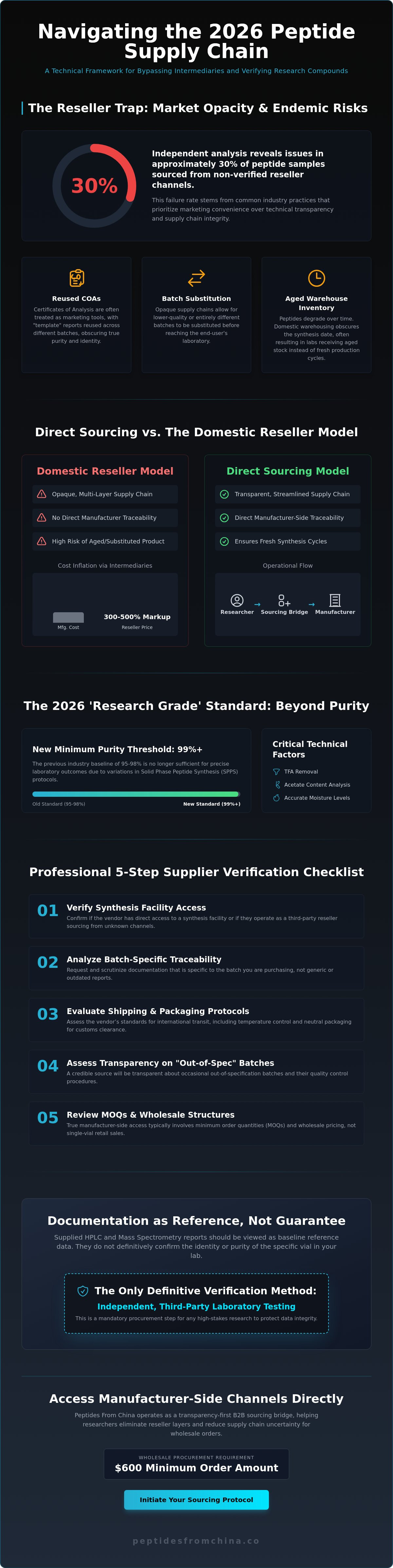
Independent analysis has found issues in approximately 30% of peptide samples sourced from non-verified channels. For procurement professionals, it's clear that a standard Certificate of Analysis often functions as a marketing tool rather than a technical guarantee. You've likely realized that batch-to-batch inconsistency and opaque supply chains are the standard risks when securing a peptide research supply in 2026. Relying on a domestic reseller's word or a re-labeled HPLC report is no longer a viable strategy for high-stakes laboratory work.
This article provides a technical framework to help you move beyond surface-level paperwork and establish direct manufacturer-side channels. We'll show you how to reduce procurement costs by eliminating middlemen and why independent verification is the only way to truly confirm product identity. By understanding the role of a transparency-focused B2B sourcing bridge like Peptides From China, which facilitates wholesale orders starting at $600, you can navigate the complexities of international synthesis facilities with greater operational confidence. We will examine how to verify supply chains and implement verification protocols that protect your lab's data integrity.
Key Takeaways
Identify the technical distinctions between true research-grade compounds and the standard domestic reseller model to reveal hidden supply chain risks.
Learn a systematic checklist for verifying direct synthesis facility access, moving beyond the baseline reference data found in standard HPLC reports.
Understand why direct-to-manufacturer sourcing helps reduce the risk of batch substitution and ensures you receive fresh production cycles instead of aged warehouse inventory.
Establish a robust operational SOP for your peptide research supply that integrates manufacturer-side verification and independent laboratory testing as mandatory procurement steps.
Discover how a transparency-first B2B sourcing bridge can eliminate unnecessary reseller layers and provide a direct path to verified manufacturing channels.
Table of Contents
The 2026 Peptide Research Supply Landscape: Navigating Market Opacity
A Professional Checklist for Evaluating Peptide Suppliers
Direct-to-Manufacturer Sourcing vs. Domestic Warehousing
Operational Procurement Protocols for Research Laboratories
Peptides From China: A Transparency-First Sourcing Bridge
The 2026 Peptide Research Supply Landscape: Navigating Market Opacity
In 2026, the definition of "research grade" has evolved beyond simple purity percentages. It now requires a rigorous technical framework that accounts for trifluoroacetic acid (TFA) removal, acetate content, and moisture levels. A professional peptide research supply must meet a minimum purity standard of 99%, as the previous 95-98% industry baseline is no longer sufficient for precise laboratory outcomes. This shift is largely driven by the increasing complexity of Peptide synthesis, where small variations in Solid Phase Peptide Synthesis (SPPS) protocols can lead to significant batch-to-batch inconsistencies. Managing a reliable peptide research supply in 2026 requires a shift from retail-style buying to professional procurement that prioritizes supply chain transparency over marketing claims.
The current market is characterized by extreme opacity. Most buyers interact with domestic resellers who present themselves as manufacturers but actually operate as logistical intermediaries. This model prioritizes retail-style convenience over technical transparency. It leads to common pitfalls that can compromise research data, including:
Reused Certificates of Analysis (COAs) across multiple batches.
Batch skimming or substitution with lower-quality material.
A total lack of manufacturer-side traceability and direct synthesis records.
For a professional procurement officer, the goal is to bypass these layers and establish a direct connection to the synthesis source. Resellers add cost without adding technical value.
Identifying Reseller Mark-ups and Intermediary Layers
Spotting a domestic reseller often starts with analyzing their inventory and shipping locations. If a vendor offers hundreds of different compounds with "same-day domestic shipping" but cannot provide a specific synthesis date for a current batch, they're likely a reseller. These intermediary layers significantly inflate laboratory budgets. Each middleman adds a mark-up that can increase the final price by 300% to 500% compared to manufacturer-side pricing. Beyond cost, domestic warehousing often obscures the age of the product. Peptides are sensitive to temperature and time; receiving "fresh" synthesis cycles is always preferable to stock that has sat in a third-party warehouse for months.
The Limits of Standard Analytical Documentation
Relying solely on provided HPLC and Mass Spectrometry reports is a common mistake in procurement. You should view these documents as baseline reference data rather than definitive proof of quality. The industry frequently sees "template" COAs that are reused across multiple batches or even different vendors. These documents don't always correspond to the actual vial in your hand. Independent third-party testing is the only definitive verification method to confirm identity and purity levels. Without it, you're essentially trusting a marketing document over empirical evidence. Establishing a direct line to facilities, such as through a B2B sourcing bridge like Peptides From China—where wholesale orders start at $600—helps reduce supply chain uncertainty by providing better visibility into the documentation's origin.
A Professional Checklist for Evaluating Peptide Suppliers
Evaluating a potential peptide research supply requires a systematic approach that looks beyond the polished interface of a website. You've got to verify the operational reality of the vendor's supply chain to avoid the risks of batch substitution and relabeling. A professional procurement checklist for 2026 should prioritize manufacturer-side transparency over retail-style convenience. Use the following five steps to audit your sourcing channels.
Step 1: Verification of direct synthesis facility access vs. third-party sourcing.
Step 2: Analysis of batch-specific traceability and manufacturer-issued documentation.
Step 3: Evaluation of shipping protocols and "neutral" packaging standards for international transit.
Step 4: Assessment of the provider’s transparency regarding "out-of-spec" batches.
Step 5: Review of minimum order quantities (MOQs) and wholesale pricing structures.
Verification of Synthesis Facilities
Ask your supplier specific questions about their manufacturing partner in China. You need to know the facility's current capacity for synthesizing compounds like Tirzepatide or BPC-157. Red flags include vague answers about "partner labs" or an inability to provide facility-specific audit documents. Verifying the actual peptide production environment is essential to ensure the compounds aren't being sourced from secondary "gray" markets where quality control is non-existent. Establishing a protocol for direct manufacturer-side sourcing helps reduce these logistical risks.
Analytical Data Integrity
A professional peptide research supply should support independent verification as a standard practice. Don't just accept the provided HPLC report as definitive proof. You should have an internal SOP for conducting peptide testing on a per-order basis via an independent third-party lab. When reviewing manufacturer data, cross-reference HPLC peaks with the reported purity percentage. If the chromatogram looks identical to a report from six months ago, or if they only provide stock photos of vials, you're likely dealing with a reseller who doesn't have eyes on the current batch.
International shipping protocols are a critical part of the checklist. Reliable suppliers use neutral packaging standards that facilitate smoother transit through customs by avoiding provocative labeling. You should also gauge a supplier’s transparency regarding "out-of-spec" batches. If a supplier claims they've never had a synthesis failure, they're likely hiding data. Finally, compare pricing structures. Wholesale procurement, such as the $600 minimum required by Peptides From China, typically indicates a direct-to-manufacturer bridge rather than a retail model with heavy mark-ups. This structure ensures you're paying for synthesis quality rather than domestic warehousing overhead.
Direct-to-Manufacturer Sourcing vs. Domestic Warehousing
Choosing a peptide research supply involves a fundamental trade-off between the immediate availability of domestic stock and the verifiable chain of custody offered by direct-to-manufacturer channels. While domestic resellers offer the convenience of three-day shipping, this speed often comes at the expense of batch transparency. Domestic warehousing models frequently rely on stock that has been sitting in uncontrolled environments for months. Peptides are inherently sensitive to temperature fluctuations and time; receiving a "fresh" synthesis batch directly from the facility helps reduce the risk of degradation that occurs in aged warehouse inventory. Direct channels also facilitate custom synthesis for specific research sequences that domestic resellers simply do not carry in their standardized catalogs.
Navigating the logistics of international shipping is often cited as a barrier to direct sourcing. However, professional sourcing bridges use established "neutral" packaging standards and sophisticated routing to manage customs risks effectively. These protocols are designed to ensure that research compounds reach their destination without the unnecessary scrutiny that follows poorly labeled retail packages. By moving the point of procurement closer to the synthesis reactor, laboratories can improve traceability and ensure that the reference analytical data actually matches the physical product in the shipment.
The Risk of Batch Substitution in Domestic Supply
Domestic resellers often struggle with inventory management, leading to the common practice of mixing batches to fulfill larger orders. When a reseller runs low on a specific lot of Tirzepatide or BPC-157, they may substitute vials from a different synthesis cycle without updating the associated documentation. This lack of manufacturer-side accountability makes it nearly impossible for a researcher to maintain consistency across a long-term project. Direct sourcing improves traceability back to the original synthesis reactor, ensuring that every vial in a $600 wholesale order belongs to the same production run. This consistency is vital for laboratories that require reproducible data and want to avoid the "batch-to-batch" variance typical of multi-layered supply chains.
Economic Logic of Wholesale Procurement
The price disparity between retail single-vial sales and professional wholesale orders is significant. Retailers must bake the costs of domestic warehousing, marketing, and high-risk payment processing into their vial prices, often resulting in a 300% mark-up. Shifting to a wholesale model allows laboratories to allocate more of their budget toward actual compound quality and independent testing. A $600 minimum order threshold, such as that required by Peptides From China, ensures access to higher-tier manufacturing channels that don't participate in the retail "gray" market. This bulk procurement strategy allows for better long-term budgeting, especially for projects that require a consistent supply of compounds over several months. By eliminating the reseller mark-up, procurement professionals can secure a higher volume of research material while maintaining a direct line to the synthesis facility.
Operational Procurement Protocols for Research Laboratories
Establishing a standard operating procedure (SOP) for incoming peptide batches is a mandatory step for any laboratory prioritizing data integrity. A reliable peptide research supply isn't just about the purchase; it's about the verification cycle that follows. Your SOP should begin with a $10 sourcing deposit, which initiates the process of manufacturer-side verification through a sourcing bridge. This small initial step helps filter out unverified agents and ensures that the communication channel leads directly to the synthesis facility rather than a generic reseller's inbox.
Once the material arrives, the protocol must include independent HPLC and Mass Spectrometry verification. You should never rely on the manufacturer-issued papers as definitive proof of purity. Instead, treat them as reference analytical data to be compared against your own third-party results. Budgeting for this independent analysis is a necessary procurement cost that helps reduce supply chain uncertainty. For long-term stability, lyophilized peptide powders should be stored at -20°C or -80°C in a desiccated environment. Improper storage can lead to peptide degradation, rendering even the highest-quality synthesis useless for sensitive research applications.
Managing Logistics and Lead Times
Procuring a peptide research supply from international facilities requires realistic planning regarding lead times. International transit from China to US or EU laboratories typically takes between 10 and 15 business days. Neutral packaging is essential here; it maintains supply chain security and reduces the likelihood of unnecessary customs delays. To avoid research downtime, laboratories should coordinate large-scale orders at least three weeks before current stock is exhausted. This buffer accounts for potential logistical bottlenecks and the time required for independent lab verification before the batch enters active use.
Minimum Order Requirements and Batch Consistency
Professional synthesis facilities operate on different economic scales than retail vendors. This is why manufacturer-side sourcing through Peptides From China requires a $600 minimum order. This threshold ensures you're accessing high-tier manufacturing channels rather than the sub-standard batches often found in the retail "gray" market. There's a direct correlation between order volume and your ability to influence manufacturing quality; larger orders often receive more rigorous attention during the final quality control stages at the facility. To verify consistency across multiple high-volume orders, you should cross-reference the retention times and mass-to-charge ratios from your independent tests against previous batch records.
If you're ready to move away from unreliable resellers and establish a more transparent procurement cycle, you can explore our direct-to-manufacturer sourcing protocols to secure your next research batch.
Peptides From China: A Transparency-First Sourcing Bridge
Peptides From China (PFC) operates as a B2B sourcing agency, explicitly functioning as a bridge between production facilities and professional buyers. Unlike traditional vendors, PFC doesn't manufacture compounds or maintain a retail storefront. Instead, it addresses the transparency gap in the global peptide research supply by routing orders directly to verified synthesis facilities. This model eliminates the multiple mark-up layers added by domestic resellers, ensuring that procurement budgets are spent on compound quality rather than intermediary logistics. By positioning itself as a sourcing partner rather than a manufacturer, PFC maintains the objective distance necessary to filter out facilities that don't meet technical documentation standards.
Facilitating international shipping with tracked, discreet logistics is a core component of the PFC model. Professional labs require a predictable delivery schedule and packaging that minimizes customs interference. PFC manages these logistical complexities, allowing researchers to focus on their data rather than transit hurdles. This approach helps reduce supply chain uncertainty by providing a streamlined, reliable path from the synthesis reactor to the laboratory door.
The PFC Verification and Sourcing Process
The process begins with a $10 sourcing deposit. This step is designed to secure current manufacturer stock and initiate the release of batch-specific documentation for buyer review. PFC acts as a protective analytical filter, providing HPLC and Mass Spectrometry reports as baseline reference data for approval. It's important to remember that these documents are technical reference material; they don't replace the need for independent laboratory testing. PFC prioritizes factual accuracy and supply chain traceability, helping researchers navigate the risks of relabeling and batch substitution described earlier in this guide. This commitment to transparency ensures that you're making procurement decisions based on verifiable data rather than marketing hype.
Accessing Large-Scale Synthesis Channels
For laboratories requiring high-volume compounds like BPC-157, Semaglutide, or Tirzepatide, PFC provides a direct path to industrial-scale synthesis channels. There's a significant operational difference between using a peptide sourcing agent vs platform. While platforms often prioritize retail-style automation and lack accountability, a sourcing agent provides the human-led verification necessary for professional procurement. This ensures that your specific research requirements are communicated directly to the facility managers.
Initiating a professional sourcing request through the PFC platform requires a minimum order of $600 for wholesale procurement. This threshold ensures that the synthesis facilities can allocate the necessary resources for high-purity production cycles. By facilitating access to these manufacturer-side channels, PFC helps professional labs maintain a consistent peptide research supply while minimizing the typical anxieties associated with international sourcing. You can initiate a request through the platform to start the verification process for your next research batch.
Strengthening Your Procurement Pipeline for 2026
Securing a reliable peptide research supply in 2026 demands a departure from the standard retail-reseller model. You've seen how domestic warehousing often obscures batch identity and limits your access to fresh synthesis cycles. By implementing a rigorous procurement checklist, you move beyond surface-level HPLC reports and establish a technical framework based on manufacturer-side transparency. Independent third-party testing remains the only definitive way to confirm purity and identity for your specific research requirements.
Peptides From China acts as your professional sourcing bridge, facilitating direct-to-manufacturer sourcing and tracked international shipping. This methodical approach ensures your laboratory receives COA-verified batches while eliminating the inflated costs associated with domestic intermediaries. When you're ready to optimize your supply chain, you can Request a Professional Sourcing Quote from Peptides From China to begin the verification process. Establishing a direct line to the synthesis reactor is the most effective way to protect your data integrity and ensure long-term operational consistency.
Frequently Asked Questions
How do I know if a peptide research supply is actually a direct manufacturer?
You can identify a direct source by their focus on bulk synthesis and their lack of retail-style convenience. Manufacturers rarely maintain domestic storefronts or offer single-vial sales. If a supplier cannot provide specific synthesis dates or facility-level documentation, they're likely a reseller. Direct channels prioritize technical transparency over marketing flair and usually require higher order minimums to justify the synthesis cycle costs.
Why do most peptide companies have the same HPLC reports?
Many companies utilize the same HPLC reports because they're sourcing from the same high-volume synthesis lots. Resellers often relabel these products and reuse the original manufacturer's documentation as their own. This practice makes it difficult to verify the actual chain of custody. It's why you should view provided reports as baseline reference material rather than definitive proof of the specific vials you receive.
What is the standard minimum order for wholesale peptide sourcing?
Wholesale minimums in the professional sector generally range between $500 and $1,000 depending on the synthesis facility's requirements. These thresholds are necessary to cover the operational costs of large-scale production runs. Lower minimums often indicate a retail model where the product has already passed through multiple intermediary layers, significantly increasing the final price per vial for your peptide research supply.
Can I trust a Certificate of Analysis (COA) provided by a supplier?
You shouldn't view a provided COA as a final guarantee of product quality. While these documents offer reference analytical data, they are frequently reused across different batches or forged by intermediaries. Independent third-party verification is the only methodical way to confirm identity and purity. A professional procurement strategy treats supplier paperwork as a starting point for internal verification protocols rather than absolute proof.
What are the risks of buying peptides from domestic US or EU warehouses?
The primary risks include batch substitution and the receipt of aged warehouse stock. Domestic resellers often mix vials from different synthesis cycles to maintain inventory levels, which compromises research consistency. Additionally, domestic storage conditions may not be as strictly controlled as the original manufacturing facility. This can lead to potential peptide degradation over time before the product ever reaches your laboratory.
How should a research lab verify the purity of a new peptide batch?
A research lab should verify every new peptide research supply batch by conducting independent HPLC and Mass Spectrometry analysis. This internal protocol ensures that the purity levels and molecular weight align with expected standards. Relying on your own data helps reduce supply chain uncertainty and protects the integrity of your research outcomes by catching inconsistencies before they affect your laboratory work.
What is the typical lead time for direct-from-China peptide shipping?
Typical lead times for direct international transit from China generally fall between 10 and 15 business days. This duration accounts for the time needed to coordinate with synthesis facilities and execute sophisticated routing through customs. Professional sourcing bridges use neutral packaging and tracked logistics to ensure that research compounds arrive securely while minimizing the risks of unnecessary transit delays or package seizures.
Why does Peptides From China require a $600 minimum order?
The $600 minimum order allows Peptides From China to facilitate direct manufacturer-side sourcing for professional buyers. This wholesale threshold is required to access higher-tier manufacturing channels that focus on industrial-scale synthesis rather than retail sales. It ensures that procurement budgets are spent on manufacturing quality and batch consistency instead of the mark-ups and overhead associated with domestic reseller models.