
A Certificate of Analysis is often treated as a final guarantee, but in the current 2026 landscape, it's actually just a baseline technical reference that doesn't account for batch substitution or supply chain opacity. You've likely encountered the frustration of varying purity levels and high reseller markups that make consistent research nearly impossible. Sourcing CJC-1295 from China requires moving beyond retail-style trust and adopting a methodical, B2B verification strategy that prioritizes raw data over marketing claims.
We'll show you how to navigate the complexities of direct-to-manufacturer procurement while managing the risks of the 2026 NMPA export regulations. You’ll learn how Peptides From China (PFC) acts as a transparency-focused bridge to help you access manufacturer-side channels and bypass the "middleman" noise. By implementing a $10 manufacturer verification deposit and adhering to a $600 minimum wholesale order, you can filter out unreliable layers that inflate costs. This guide outlines the logistical protocols and independent testing requirements necessary to help reduce supply chain uncertainty and support your laboratory’s operational consistency.
Key Takeaways
Understand the manufacturing landscape for CJC-1295 and current export considerations. Learn to evaluate HPLC and MS data as baseline analytical references while arranging independent testing when needed. Compare the procurement impact of DAC versus No DAC modifications. For PeptidesFromChina requests, the $10 deposit initiates manual request processing and real-time stock verification and is credited toward the final invoice. The platform has a $600 total minimum order that may combine multiple catalog products.
Table of Contents
The Landscape of CJC-1295 Manufacturing in China
Evaluating Synthesis Purity: HPLC and MS Realities
DAC vs. No DAC: Sourcing and Stability Considerations
How to Verify Large-Scale CJC-1295 Orders
Direct Sourcing with Peptides From China (PFC)
The Landscape of CJC-1295 Manufacturing in China
CJC-1295 is a synthetic growth hormone-releasing hormone (GHRH) analog that researchers utilize for its ability to increase plasma growth hormone levels. It’s produced primarily through Solid-Phase Peptide Synthesis (SPPS). This chemical process is preferred for its ability to produce high-purity sequences at scale, though it requires precise control over amino acid coupling and purification stages. China has solidified its position as the global hub for this type of high-volume peptide synthesis. Most of the world’s supply originates from specialized industrial clusters that have the infrastructure to support large-scale reactors and sophisticated purification equipment.
For procurement professionals, sourcing CJC-1295 from China is a strategic move to maintain research budget efficiency. By bypassing the layers of international resellers, laboratories can access pricing that reflects the actual cost of synthesis. However, the market is saturated with intermediaries who present themselves as factories. True manufacturing efficiency comes from identifying the primary source, where the chain of custody is shortest and the technical oversight is most direct.
Identifying Real Synthesis Facilities vs. Resellers
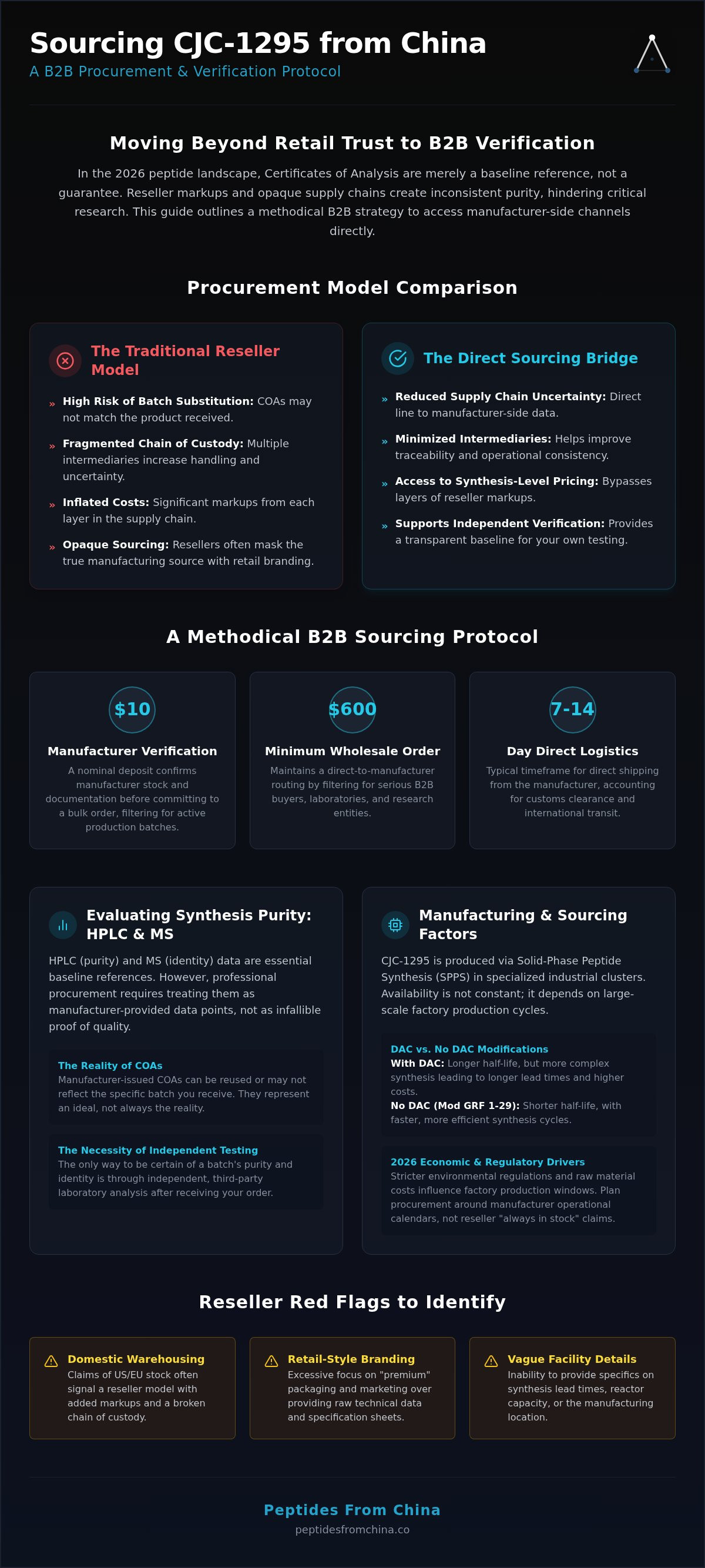
Distinguishing between a primary synthesis facility and a secondary reseller is a critical step in professional procurement. Real manufacturers typically operate out of established industrial zones in cities like Shijiazhuang and Wuhan. These facilities focus on bulk chemical production and maintain high-capacity manufacturing logs. Resellers, by contrast, often rely on flashy marketing and "expert" branding to mask a lack of technical infrastructure. Red flags that indicate a reseller include:
Domestic Warehousing: Claims of US or EU-based stock often signal a significant markup and a fragmented chain of custody.
Retail-Style Branding: Excessive focus on "premium" packaging rather than technical specification sheets.
Vague Facility Details: An inability to provide specific details about reactor capacity or synthesis lead times.
At Peptides From China (PFC), we serve as a transparency-focused bridge to these verified facilities. We implement a $600 minimum wholesale order requirement specifically to filter for serious research entities and maintain a direct-to-manufacturer routing that eliminates the reseller layer.
Economic Drivers of the 2026 Peptide Market
Wholesale pricing for CJC-1295 is dictated by the availability of raw amino acid precursors and the specific synthesis cycles of the factory. In 2026, the market is heavily influenced by stricter environmental regulations in China, which can impact production windows and raw material costs. Batch availability isn't constant; it follows large-scale manufacturing schedules. If a facility isn't currently running a CJC-1295 cycle, lead times will naturally increase as the factory waits to reach a cost-effective production volume.
When sourcing CJC-1295 from China, account for international logistics as well as current availability. Shipping options, pricing, and estimated transit times vary by destination and are confirmed during order processing.
Evaluating Synthesis Purity: HPLC and MS Realities
High-Performance Liquid Chromatography (HPLC) serves as the primary technical baseline for assessing the purity of synthetic peptides. HPLC is a method for separating and quantifying peptide components based on their chemical properties, allowing researchers to determine the ratio of the target peptide to its synthesis byproducts. While HPLC measures purity, Mass Spectrometry (MS) is required to verify the molecular identity of the CJC-1295 sequence by confirming its molecular mass. When sourcing CJC-1295 from China, these documents are standard inclusions in manufacturer documentation. However, professional procurement protocols dictate that these reports be treated as reference analytical data rather than definitive proof of batch quality.
The Limitations of Manufacturer COAs
Manufacturer-issued Certificates of Analysis (COAs) often present an idealized version of a product that may not reflect the actual batch received. A common practice in the high-volume peptide market is the reuse of "golden" HPLC reports, where a factory uses a single high-quality test result to represent multiple subsequent synthesis runs. A COA is a snapshot in time; it doesn't account for batch inconsistencies, degradation during storage, or the presence of truncated sequences. GHRH analogs are particularly susceptible to these variations, which can lead to significant safety risks if the material is not correctly characterized. Relying on manufacturer paperwork without secondary verification introduces unnecessary supply chain uncertainty into your research environment.
Professional Verification Standards for Labs
To maintain rigorous research standards, laboratories must implement independent third-party testing for every wholesale order. This process moves beyond accepting a static percentage and involves a deep analysis of the chromatogram. A professional review focuses on identifying the following:
Chromatographic Resolution: A clean, singular peak indicates high purity, while "shoulders" or secondary peaks suggest the presence of closely related impurities.
Peptide Content vs. Purity: Purity refers to the percentage of the target peptide within the total peptide mass, but peptide content measures the actual weight of the peptide in the vial. Low peptide content often indicates high levels of residual moisture or salts.
Sequence Accuracy: MS data must align perfectly with the theoretical mass of the CJC-1295 sequence to confirm that no amino acid substitutions occurred during synthesis.
Establishing a direct-to-manufacturer sourcing bridge helps reduce the risks of relabeling and batch substitution often found in the reseller market. By bypassing intermediaries, you gain better visibility into the manufacturer's specific synthesis cycles and can more effectively coordinate independent batch testing. This methodical approach ensures that the reference analytical data provided by the factory serves as a starting point for your own internal quality control rather than the final word on product integrity.
DAC vs. No DAC: Sourcing and Stability Considerations
Sourcing CJC-1295 from China involves a choice between the standard peptide and the version modified with the Drug Affinity Complex (DAC). The primary structural difference is that the DAC version includes a chemical group that allows for a prolonged stimulation of growth hormone by bonding to serum albumin. From a procurement standpoint, this modification adds several steps to the synthesis process, which typically increases both the wholesale price and the manufacturer's lead time. While Mod GRF 1-29 is a standard 29-amino acid chain, the DAC version requires an additional lysine linker and a maleimidoproprionic acid group. This added complexity means that sourcing CJC-1295 from China with DAC often carries a 30% to 50% premium over the No DAC version at the wholesale level.
Logistical Stability in International Shipping
International transit from China can expose batches to fluctuating temperatures and humidity. Lyophilized powder is the industry standard for stability, but it's not invincible. Batch integrity relies on professional vacuum sealing and neutral packaging to prevent atmospheric exposure during customs inspections. Customs delays are an inherent risk in the 2026 supply chain; therefore, the quality of the lyophilization process itself becomes a critical factor in whether the peptide arrives with its secondary structure intact. We prioritize facilities that utilize industrial-grade freeze-drying equipment, as poor lyophilization can leave residual moisture that accelerates peptide degradation when temperatures rise during transit.
Strategic Sourcing: Which Variant Fits Your Research?
Market pricing and availability can vary substantially by supplier, product, order size, and current conditions; exact comparisons require current, like-for-like data.
PeptidesFromChina coordinates sourcing from established Chinese manufacturing facilities together with international logistics.
How to Verify Large-Scale CJC-1295 Orders
Verification is a procedural necessity that separates professional procurement from retail-style speculation. When sourcing CJC-1295 from China in bulk, the first step involves requesting manufacturer-issued technical papers. These documents shouldn't be viewed as a definitive guarantee, but as a baseline for comparison against your own independent analysis. Batch traceability is the objective here. You must ensure that the material moves from the synthesis reactor to the final vial without the interference of unverified third parties or relabelers who often obscure the chain of custody.
The $10 deposit initiates manual request processing and real-time stock verification and is credited toward the final invoice.
Step-by-Step Sourcing Protocol
Standardizing your procurement process improves traceability and helps you avoid common industry pitfalls. You should start by initiating contact through a B2B platform that handles manufacturer filtering. It's helpful to review established peptide testing protocols early in the conversation to set technical expectations with the factory representative. This ensures the manufacturer knows you'll be conducting independent HPLC/MS analysis upon receipt.
Once the manufacturer provides their quality documentation, analyze it for consistency. If the HPLC reports lack batch-specific timestamps or appear to be reused templates, it's a clear signal to pause the transaction. Final invoice payment should only occur after you've approved the preliminary documentation and confirmed that the factory can meet your specific synthesis lead times.
Managing the $600 Minimum Wholesale Requirement
PeptidesFromChina currently has a $600 total minimum order. Multiple catalog products can be combined to reach the minimum, with orders starting from one 10-vial kit per product.
When combining items in a bulk order, you must verify that all vials in a specific set originate from the same synthesis cycle. This consistency is vital for maintaining the integrity of your research data across long-term studies. By consolidating your procurement, you reduce the per-vial cost of international logistics and customs clearance. If you're ready to bypass reseller layers and access manufacturer-side channels, you can start the manufacturer verification process today to secure your next research batch.
Direct Sourcing with Peptides From China (PFC)
PFC coordinates manufacturer-side sourcing and international logistics. Products are subject to the manufacturer’s applicable quality-control procedures and product-specific specifications. Manufacturer-side analytical documentation may be available depending on the product and batch, but PFC is not an independent analytical testing laboratory and does not guarantee a universal documentation package. Buyers requiring independent verification may arrange third-party analytical testing.
The PFC Advantage for Research Institutions
PeptidesFromChina coordinates sourcing through a limited network of verified manufacturing facilities for eligible adult buyers, including private buyers, research groups, resellers, private brands, and laboratories. Products are subject to manufacturer QC. Manufacturer-side analytical documentation may be available depending on the product and batch and is not independent verification.
Operational Logistics and Support
Our peptide sourcing platform coordinates manufacturer-side sourcing and international logistics. The $10 deposit initiates manual request processing and real-time stock verification and is credited toward the final invoice. This gives buyers current availability information before they decide whether to proceed with the $600 total minimum order.
Global logistics are handled with a focus on batch integrity and professional transparency. Every shipment utilizes neutral packaging and includes global tracking, allowing you to monitor the transit from the facility to your laboratory. We understand the technical requirements of international shipping, ensuring that lyophilized powders are properly vacuum-sealed to withstand the delays often associated with customs clearance. This transparency-first model provides a reliable, direct-to-manufacturer bridge for professional buyers who value efficiency, data, and long-term supply chain consistency over marketing flair.
Optimizing Your CJC-1295 Procurement Strategy
Professional sourcing CJC-1295 from China in 2026 requires a departure from retail-style trust. It's a logistical exercise where HPLC and MS reports serve as reference analytical data, not final guarantees. By prioritizing direct-to-manufacturer routing, you eliminate the opacity and markups inherent in reseller networks while improving the traceability of your research batches. Consistency in your laboratory results depends on these methodical verification protocols and a commitment to independent testing of every wholesale shipment.
PeptidesFromChina provides a specialized sourcing channel to a limited network of verified manufacturing facilities and coordinates international logistics. The platform has a $600 total minimum order, which may combine multiple catalog products. The $10 deposit begins manual request processing and real-time stock verification and is credited toward the final invoice.
Frequently Asked Questions
What is the difference between CJC-1295 with DAC and without DAC?
The primary difference is the presence of the Drug Affinity Complex (DAC), which extends the peptide's half-life by bonding to serum albumin. Mod GRF 1-29, or CJC-1295 without DAC, has a significantly shorter duration of action. When sourcing CJC-1295 from China, the DAC version is typically more expensive and requires a longer synthesis lead time due to the increased complexity of the chemical modification process.
How can I verify the purity of CJC-1295 sourced from China?
You should use manufacturer-provided HPLC and Mass Spectrometry reports as baseline reference material while conducting independent third-party testing on every batch. A professional analysis involves reviewing the chromatogram for clean, singular peaks and ensuring the molecular mass aligns with the theoretical sequence. This secondary verification helps reduce supply chain uncertainty and confirms that the material meets your laboratory's specific purity thresholds.
Why is there a $600 minimum order for wholesale peptide sourcing?
The $600 minimum wholesale requirement acts as a strategic filter for professional research entities and covers the logistical overhead of direct-to-manufacturer routing. It ensures that your shipment is handled as a professional cargo unit rather than a small retail parcel, which improves tracking reliability and customs efficiency. This threshold allows us to maintain a transparency-focused B2B model that bypasses high-markup reseller layers.
Is it safe to source research peptides directly from Chinese manufacturers?
Direct sourcing is a standard industry practice for laboratories that implement rigorous verification protocols. While removing intermediaries improves traceability and reduces costs, it doesn't eliminate the need for independent batch testing. Safety in this context refers to the reliability of the supply chain; therefore, sourcing CJC-1295 from China is safest when you treat all manufacturer documentation as reference data that requires secondary confirmation.
What does the $10 processing deposit cover at Peptides From China?
The $10 deposit initiates manual request processing and real-time stock verification and is credited toward the final invoice.
How long does international shipping from China to a research lab typically take?
Shipping options, pricing, and estimated transit times vary by destination and are confirmed during order processing.
Can I request custom synthesis for bulk CJC-1295 orders?
Many primary synthesis facilities in China offer custom sequences for bulk procurement, though this typically involves longer lead times. The factory must schedule a specific production cycle to accommodate the custom synthesis and purification requirements. If your research requires a specific modification or a unique sequence, we can facilitate the communication with the facility to confirm their current reactor capacity and technical capabilities.
Why are manufacturer-provided COAs not considered definitive proof of quality?
Manufacturer-issued Certificates of Analysis (COAs) are snapshots of a specific moment in time and are often reused across multiple synthesis runs. In the high-volume peptide market, these reports are baseline technical references rather than permanent guarantees of batch quality. Independent testing is the only way to confirm that the material in the vial matches the data on the paper, protecting your research from batch substitution or degradation.