Semax and N-Acetyl Semax Amidate are often presented as two versions of the same research peptide, with the modified analogue described as longer-lasting, more potent, or better able to reach neural tissue. The chemistry is easy to explain. The evidence is not.
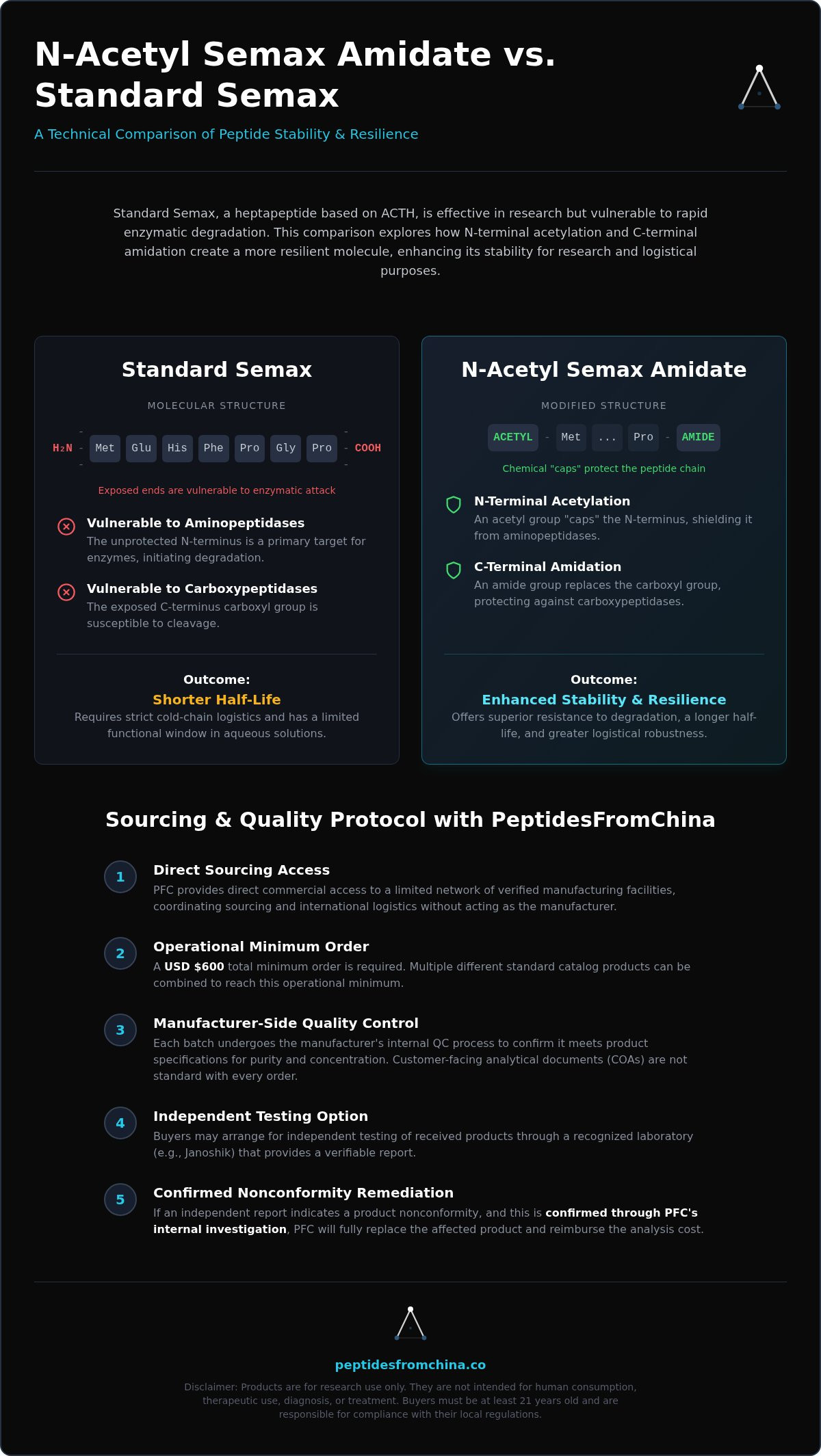
Semax is the heptapeptide Met-Glu-His-Phe-Pro-Gly-Pro. N-Acetyl Semax Amidate keeps that seven-residue core but caps both ends: an acetyl group is added at the N-terminus and the C-terminus is converted to an amide. Those changes can alter how a peptide behaves around exopeptidases. What they do not automatically establish is a longer half-life in vivo, greater brain exposure, stronger biological activity, or clinical superiority.
This comparison separates the well-documented chemistry from the claims that still need direct experimental proof. It is written for laboratory and procurement teams choosing between Semax research material and N-Acetyl Semax Amidate, not as a human-use protocol.
Semax vs N-Acetyl Semax Amidate at a glance
QuestionSemaxN-Acetyl Semax Amidate Core sequenceMet-Glu-His-Phe-Pro-Gly-ProThe same seven-residue core Terminal groupsUncapped N- and C-terminiN-terminal acetyl group and C-terminal amide Direct published literatureAnimal, molecular, and limited regional clinical literatureVery limited; direct comparative studies are not established Proteolysis evidenceSemax metabolism and fragments have been studiedA 2013 paper studied acetyl-Semax, but it does not by itself validate the doubly capped amidate Human comparative trialNo credible head-to-head trial was identified Best research useExperiments that need continuity with the published Semax literatureExplicit analogue-comparison or terminal-capping experiments
What Semax is—and what has actually been studied
Semax was designed from the ACTH(4–7) sequence with a Pro-Gly-Pro tail. Its sequence is short enough that enzymatic processing is an important part of the research story rather than a minor formulation detail.
Published work has explored Semax in several experimental contexts. In rats, researchers reported changes in cortical gene expression after focal cerebral ischemia. Other animal work reported increased BDNF expression in brain regions and detected radiolabeled peptide-related material in the brain and eye after administration. These findings make Semax a legitimate subject for mechanistic research, but they should be described at the level at which they were observed: predominantly animal and molecular studies.
The literature does not support collapsing every finding into a simple claim that Semax is a universally proven “cognitive enhancer.” Different papers used different models, endpoints, analytical methods, and exposure conditions. A transcriptional response in rat cortex is not the same outcome as a validated clinical benefit.
What N-Acetyl Semax Amidate changes
N-Acetyl Semax Amidate is commonly represented as Ac-Met-Glu-His-Phe-Pro-Gly-Pro-NH2. The two terminal modifications are chemically meaningful:
N-terminal acetylation masks the free amino group at the beginning of the chain.
C-terminal amidation replaces the terminal carboxyl group with an amide.
Because many exopeptidases recognize a free terminus, capping can be a rational strategy for changing susceptibility to enzymatic cleavage. It can also change charge, solubility, chromatographic behavior, receptor interaction, and the pattern of metabolites produced. The net result depends on the exact peptide and the biological matrix.
That last point is essential. Terminal capping is not a universal multiplier. It does not allow a supplier—or a researcher—to calculate potency, brain exposure, or duration from structure alone.
What the acetyl-Semax stability paper shows
A frequently cited 2013 paper examined the proteolytic stability of acetyl-Semax in biological media. That study is relevant because it tests an N-terminally modified Semax analogue rather than relying only on a general chemistry assumption.
But “acetyl-Semax” and “N-Acetyl Semax Amidate” are not interchangeable names. The commercially discussed amidate includes a second modification at the C-terminus. Evidence for the N-acetylated molecule cannot be silently upgraded into a complete pharmacokinetic profile for the doubly capped analogue.
The paper therefore supports a narrower conclusion: N-terminal modification can be investigated as a way to change proteolysis. It does not establish a specific in-vivo half-life for N-Acetyl Semax Amidate, a dose conversion, superior neural distribution, or a longer duration of effect.
Four popular claims and their evidence status
1. “The amidate has a much longer half-life”
Status: plausible, but not quantified by direct comparative evidence. Protecting both termini may reduce some routes of exopeptidase cleavage. A defensible half-life claim still requires measurement of intact peptide over time in a defined matrix or organism. Supplier comparisons that publish a precise duration without a traceable pharmacokinetic study are not evidence.
2. “It is more potent”
Status: unproven as a general statement. Potency is endpoint-specific. A peptide can be more stable yet less active at a target, or produce different metabolites with their own activity. Demonstrating potency requires a defined assay, a concentration-response curve, an appropriate comparator, and replicated results.
3. “It crosses the blood-brain barrier better”
Status: not established by the terminal modifications alone. Acetylation and amidation change charge, but brain exposure depends on far more than nominal lipophilicity. Direct evidence would require validated measurements of intact compound in plasma and brain, ideally with time-course data and controls that distinguish parent peptide from labeled fragments.
4. “It has the same effects as Semax, only stronger”
Status: unsupported shortcut. The shared core makes comparison scientifically interesting, not predetermined. Terminal changes can affect degradation, conformation, binding, distribution, and fragment formation. Until a study measures both materials under the same conditions, the modified analogue should be treated as a distinct research object.
How to design a useful laboratory comparison
A strong comparison starts with identity and analytical equivalence, not assumptions about the label. Both materials should be characterized with methods appropriate to the research question.
Confirm molecular identity
Mass spectrometry should distinguish the parent sequence from its capped analogue. The expected mass shift and the reported molecular form must match the material actually supplied. Counterions, hydration state, and salt form should be documented because they affect mass calculations and gravimetric comparisons.
Separate identity, purity, and content
An HPLC area percentage is not a complete identity test and does not necessarily equal peptide content by weight. A sound peptide testing and analysis plan distinguishes:
identity by mass or orthogonal structural analysis;
chromatographic purity and the impurity profile;
net peptide content where quantitative comparison matters;
residual water, solvent, and counterion contributions;
lot-specific stability under the conditions used by the study.
Measure intact peptide, not only a downstream signal
If the hypothesis concerns stability, the assay should measure disappearance of intact parent material and emergence of identifiable fragments over time. A downstream biological signal can be useful, but it cannot reveal whether a difference arose from parent-peptide exposure, an active metabolite, or assay variability.
Use matched conditions
The comparison should use the same matrix, temperature, sampling schedule, analytical platform, and molar concentration. Comparing equal milligram amounts can be misleading when molecular forms or net peptide content differ.
Which material fits the research question?
Choose Semax when continuity with the published literature is the priority. Its main advantage is not that every mechanism is settled; it is that researchers can anchor the experiment to a recognizable sequence and a larger body of prior work.
Choose N-Acetyl Semax Amidate when terminal modification is itself part of the hypothesis. It is appropriate for studies designed to test proteolysis, chromatographic behavior, metabolite formation, or biological differences created by capping.
Use both when the goal is a true analogue comparison. The strongest design includes the parent sequence and modified analogue in the same experiment, alongside vehicle controls, a predefined endpoint, and analytical confirmation that the intended compound remains present.
For procurement teams, the same principle applies: buy the molecular form the protocol specifies. Switching from Semax to the amidate because a product page calls it “more potent” changes the experimental material and can break comparability with earlier work.
A practical procurement checklist
Does the documentation state the complete sequence and both terminal groups?
Does the observed mass support that exact structure?
Is the reported purity tied to the supplied lot?
Are salt form, counterion, and net peptide content described?
Can the supplier provide chromatographic and mass-spectral data rather than only a summary value?
Will future lots use comparable analytical methods?
Is the material explicitly supplied for research use only?
Researchers planning recurring work should also consider direct-to-manufacturer sourcing so that sequence specifications, terminal modifications, and lot documentation remain consistent across study phases.
The bottom line
Semax and N-Acetyl Semax Amidate share a seven-residue core, but they should not be treated as interchangeable products. Semax has the deeper published record. The capped analogue has a clear chemical rationale for comparative research, while the strongest commercial claims about its half-life, brain exposure, potency, and duration remain ahead of the direct evidence.
That evidence gap is not a reason to ignore the analogue. It is the experiment. A well-designed head-to-head study can test whether terminal capping improves stability, changes the metabolite profile, or alters a defined biological endpoint. Until then, structure should guide the hypothesis—not substitute for the result.
Frequently asked questions
Are Semax and N-Acetyl Semax Amidate the same peptide?
No. They share the same seven-amino-acid core, but N-Acetyl Semax Amidate has an acetylated N-terminus and an amidated C-terminus. Those changes create a distinct molecular form.
Is N-Acetyl Semax Amidate proven to be more stable?
Terminal capping provides a reasonable stability hypothesis, and acetyl-Semax has been studied in proteolysis experiments. Direct, quantitative head-to-head stability data for the doubly capped amidate remain limited.
Is the amidate proven to be more potent than Semax?
No general potency advantage has been established. Potency must be measured for a defined assay and endpoint under matched conditions.
Which form is better for research?
Semax is the stronger choice for continuity with published Semax studies. N-Acetyl Semax Amidate is useful when terminal modification, proteolytic stability, or analogue comparison is the research question.
How can a laboratory confirm the correct form?
Use lot-specific analytical documentation, including mass spectrometry that supports the stated molecular form and chromatography that characterizes purity and impurities. Where quantitative comparison matters, also assess net peptide content and relevant counterions.
Primary research sources
Shevchenko KV, et al. Stability of Semax acetyl to proteolysis in various biological media. Doklady Biological Sciences. 2013.
Medvedeva EV, et al. The peptide Semax affects the expression of genes related to the immune and vascular systems in rat brain focal ischemia. BMC Genomics. 2014.
Dolotov OV, et al. The heptapeptide Semax stimulates BDNF expression in different areas of the rat brain in vivo. Doklady Biological Sciences. 2003.
Potaman VN, et al. Evenly tritium-labeled peptides and their in vivo and in vitro degradation. Bioorganic Chemistry. 2006.
Kaplan AY, et al. Experimental substantiation for using Semax in optic nerve disease. 2004.