A third-party HPLC report is a baseline reference, not a permanent shield against the inherent risks of batch substitution or relabeling. By mid-2026, the choice between selank vs semax for research often hinges less on theoretical pharmacology and more on the integrity of the synthesis facility. You've likely encountered the frustrations of the domestic reseller market: opalescent supply chains, reused COAs, and markups that don't reflect the actual manufacturing cost. We understand that for professional laboratories and technical researchers, the priority isn't marketing hype, but rather establishing a repeatable, transparent pipeline for high-purity neuro-active compounds.
This guide provides a technical comparison of Selank and Semax, focusing on their distinct mechanisms as synthetic analogs of Tuftsin and ACTH(4-10). Beyond the science, we'll detail a realistic B2B procurement protocol for sourcing direct from China, helping you reduce costs and improve traceability. The $600 minimum is an operational minimum for orders placed through the PFC sourcing platform and may include multiple catalog products. Our goal is to move past the "guaranteed purity" myths and provide the operational data you need for independent verification and consistent batch procurement.
Key Takeaways
Differentiate between the ACTH-derived mechanism of Semax and the Tuftsin-based pathway of Selank to ensure alignment with specific neuro-research protocols.
Identify the specific synthesis risks associated with neuro-active compounds and why standard reseller COAs often fail to provide adequate quality assurance.
Utilize reference analytical data, including specific molecular weights, to conduct a more accurate comparison of selank vs semax for research during the verification process.
Implement a direct sourcing strategy that bypasses domestic markups and leverages manufacturer-side channels to improve batch traceability and operational consistency.
The $600 minimum is an operational minimum for orders placed through the PFC sourcing platform and may include multiple catalog products.
Table of Contents
Pharmacological Foundations: Understanding Selank and Semax Mechanisms
Research Metrics: Comparative Analysis of Cognitive and Anxiolytic Profiles
Sourcing Challenges: Synthesis Risks and Purity Variability
Verification Protocols: Evaluating HPLC and Mass Spec Documentation
Strategic Procurement: Direct Manufacturer Sourcing for Research Institutions
Pharmacological Foundations: Understanding Selank and Semax Mechanisms
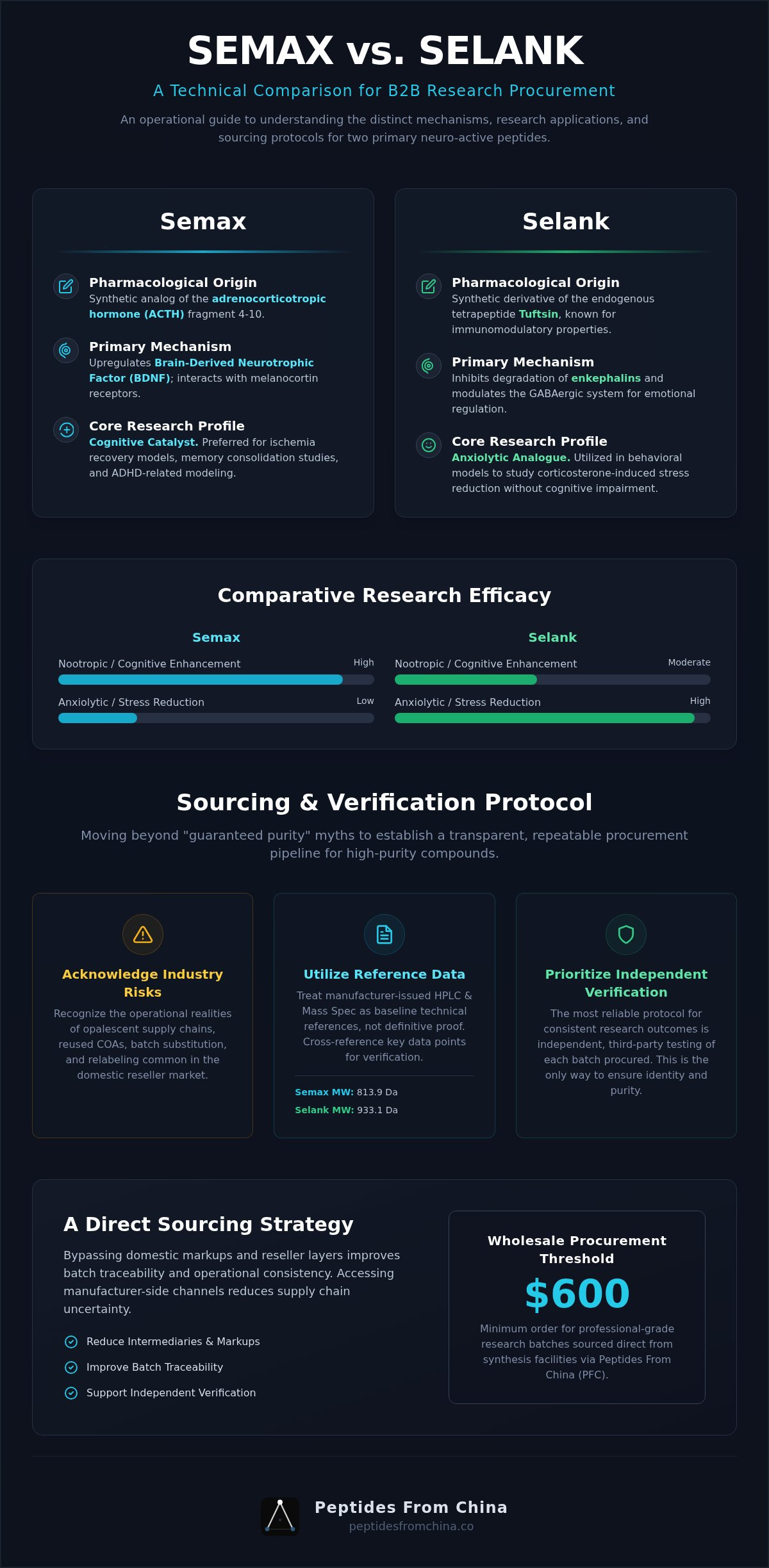
The structural divergence of these two peptides defines their specific utility in laboratory settings. While both were developed by the Institute of Molecular Genetics, they stem from entirely different biological precursors. Semax is an analog of the adrenocorticotropic hormone (ACTH) fragment 4-10, whereas Selank is a synthetic derivative of the naturally occurring tetrapeptide Tuftsin. When evaluating selank vs semax for research, the primary distinction lies in their metabolic targets; Semax interacts with melanocortin receptors, while Selank functions primarily by inhibiting the degradation of enkephalins. These differing pathways dictate whether a protocol focuses on cognitive stimulation or emotional regulation.
Semax: The ACTH-Derived Cognitive Catalyst
Semax functions through the upregulation of Brain-Derived Neurotrophic Factor (BDNF) within the hippocampus. This mechanism makes it a preferred candidate for ischemia recovery models and memory consolidation studies. In the 2026 regulatory environment, its status has shifted significantly. Following the FDA decision on April 15, 2026, to remove Semax from the Category 2 list, it underwent a Pharmacy Compounding Advisory Committee review in July. This move highlights a transition in how the compound is viewed for potential stroke and headache research protocols. It's often used in ADHD-related modeling due to its influence on dopamine and serotonin systems.
Selank: The Synthetic Anxiolytic Analogue
Selank provides a different experimental pathway. It modulates the GABAergic system and stabilizes blood enkephalins, offering anxiolytic-like effects without the sedative-hypnotic profile associated with traditional benzodiazepines. For a detailed Selank Overview, researchers can examine its history as a peptide designed to mirror the immunomodulatory properties of Tuftsin. It's frequently utilized in behavioral models to study the reduction of corticosterone-induced stress. Unlike many anxiolytics, it doesn't appear to impair cognitive function, making it a unique tool for studying emotional stability in complex task environments.
Both peptides exhibit rapid systemic clearance, which often requires specific delivery methods to observe sustained neuro-modulatory effects. From a procurement standpoint, the complexity of synthesizing these neuro-active sequences is higher than standard GLP-1 analogs. We treat manufacturer-issued HPLC reports as baseline technical references rather than absolute proof of identity. Reliable research requires independent verification of the molecular weights: 933.1 Da for Selank and 813.9 Da for Semax. Eliminating reseller layers helps reduce supply chain uncertainty, especially when dealing with the variable synthesis quality inherent in international markets. Accessing manufacturer-side channels through a bridge like Peptides From China (PFC) supports better batch traceability for high-volume needs.
Research Metrics: Comparative Analysis of Cognitive and Anxiolytic Profiles
Empirical data from a comparative fMRI analysis of Selank and Semax reveals distinct activation patterns that researchers must account for when designing neuro-restoration protocols. Semax demonstrates clear dominance in ischemia models, showing significant efficacy in neuroprotection by modulating the serotonergic and dopaminergic systems. Conversely, Selank shows superiority in reducing corticosterone-induced stress, acting as a potent tool for emotional regulation research. The neuro-optimization threshold for both compounds is reached when the peptide concentration achieves steady-state modulation of hippocampal BDNF or enkephalin levels without triggering receptor downregulation. While their primary indications differ, their structural stability allows for precision in laboratory observation.
Direct Comparison: Nootropic vs. Anxiolytic Efficacy
Semax acts as a dedicated cognitive catalyst by influencing the dopaminergic system to enhance memory consolidation. It's particularly effective in models requiring high-speed information processing or recovery from hypoxic events. Selank's profile is more complex, as it influences interleukin-6 (IL-6) and the broader immune response. This makes it valuable for immunomodulatory research alongside its primary anxiolytic applications. In rodent models, quantifiable metrics for selank vs semax for research include maze navigation speed for Semax and open-field exploration frequency for Selank. These metrics provide a clear baseline for evaluating the compounds' distinct impacts on the central nervous system.
The 2026 Regulatory Landscape for Neuro-Peptides
The regulatory environment in 2026 has introduced new complexities for procurement. The FDA's removal of Semax from the Category 2 list and the subsequent Pharmacy Compounding Advisory Committee review on July 24, 2026, has significantly impacted domestic 503A compounding availability. While pharmacies are restricted, research-grade sourcing remains the primary channel for non-clinical studies. Navigating these international standards requires a focus on laboratory-only reagents that bypass the "not for human consumption" retail labels found in the supplement market. Accessing manufacturer-side supply chains helps researchers bypass the uncertainty of domestic reseller inventories and ensures better chain of custody.
Some protocols utilize both peptides to achieve comprehensive neuro-restoration. This synergy targets both the cognitive deficits and the emotional instability often found in neuro-degenerative models. When these compounds are combined, the research focus shifts to the balance between alertness and stress mitigation. The $600 minimum is an operational minimum for orders placed through the PFC sourcing platform and may include multiple catalog products. This approach supports independent verification and allows for more robust, long-term experimental designs without the risk of batch substitution.
Sourcing Challenges: Synthesis Risks and Purity Variability
Domestic resellers often operate within opalescent supply chains, where high markups serve to obscure batch origin rather than guarantee quality. This "Reseller Trap" is a significant hurdle when procuring selank vs semax for research. Many retail vendors reuse outdated Certificates of Analysis (COAs) or relabel batches from unverified sources. Because these neuro-peptides require higher precision than standard sequences like Semaglutide, synthesis errors are common. Impurities such as acetate salts, residual solvents, and truncated sequences frequently contaminate low-purity batches. These truncated fragments are particularly deceptive; they can pass a basic HPLC test by appearing as a clean peak while lacking the necessary biological activity.
Synthesis Pitfalls for Selank and Semax
The peptide bonds in these compounds are notably fragile during large-scale lyophilization. If the freeze-drying process isn't calibrated correctly, the resulting powder may contain degraded material that won't perform in a laboratory setting. Shipping logistics add another layer of risk. Improper temperature control during international transit can degrade neuro-active efficacy before the product even reaches the lab. Both peptides rely on an inhibitory effect on enkephalin-degrading enzymes to function. If the sequence is compromised by heat or synthesis errors, this enzymatic interaction is lost. Identifying these failures requires more than just a cursory glance at a PDF report provided by a middleman.
The Transparency Crisis in 2026
In the current market, an HPLC report should be viewed as baseline technical reference material, not definitive proof of purity. A "clean" chromatogram doesn't always guarantee product identity or the absence of specific impurities. Mass Spectrometry (MS) is essential for confirming the molecular weight and ensuring the sequence matches the intended target. When identifying reputable peptide companies, researchers should prioritize those who facilitate direct-to-manufacturer access. Peptides From China (PFC) acts as this bridge, helping reduce supply chain uncertainty by connecting labs directly to synthesis facilities. This model supports independent verification and improves traceability. For professional procurement, the $600 minimum is an operational minimum for orders placed through the PFC sourcing platform and may include multiple catalog products.
Verification Protocols: Evaluating HPLC and Mass Spec Documentation
Verification protocols for selank vs semax for research must extend beyond a cursory review of a PDF. A single peak on an HPLC chromatogram only suggests that the sample is homogenous at a specific UV wavelength; it doesn't verify that the substance is actually Selank or Semax. Mass Spectrometry (MS) is the necessary secondary step to confirm the molecular weight: 933.1 Da for Selank and 813.9 Da for Semax. Without these dual data points, a researcher cannot distinguish between the target peptide and a truncated sequence that elutes at a similar time. Acceptance criteria for a research-grade peptide batch require a minimum of 98% purity by HPLC and a mass spectrometry variance of less than 0.1% from the theoretical molecular weight.
Independent, third-party testing remains the only way to mitigate the risks of batch substitution. While manufacturer-provided data is a helpful starting point, professional procurement involves sending random vials from a large-scale order to an ISO-certified lab. This step confirms that the synthesis facility hasn't substituted a cheaper analog or relabeled an older batch. For high-volume buyers, this verification process is an operational necessity rather than an optional expense.
Deconstructing the Certificate of Analysis (COA)
Analyzing the COA requires a skeptical eye for generic or "photoshopped" reports. Generic reports often lack batch-specific dates or clear manufacturer stamps, which are non-negotiable for professional traceability. If a reseller provides a report where the date has been obscured or the font appears inconsistent, the batch's integrity is compromised. For a deeper understanding of these technical requirements, consult our guide on peptide testing and analysis. Reliable documentation should always include the raw data files, not just a summary table.
Logistical Verification: Tracking and Packaging
Logistics play a critical role in maintaining the stability of neuro-active compounds. International laboratory supplies must be shipped in neutral packaging to reduce the risk of customs delays or transit interference. Because peptides like Selank and Semax are sensitive to thermal degradation, your sourcing agent must understand cold-chain requirements for long-distance transit. The $10 deposit initiates manual request processing and real-time stock verification and is credited toward the final invoice. The $600 minimum is an operational minimum for orders placed through the PFC sourcing platform and may include multiple catalog products. To secure your research pipeline and reduce reseller layers, you can access manufacturer-side channels through our transparent B2B bridge.
Strategic Procurement: Direct Manufacturer Sourcing for Research Institutions
When coordinating high-volume protocols for selank vs semax for research, the primary operational goal is the elimination of intermediary volatility. Domestic resellers often lack a direct chain of custody, leading to the batch inconsistency and "reused COA" issues discussed previously. PFC coordinates sourcing from established Chinese manufacturing facilities together with international logistics. This direct-to-manufacturer routing helps reduce supply chain uncertainty by ensuring that the material you receive hasn't been sitting in a reseller's unmonitored warehouse for months. By bypassing these layers, researchers can access manufacturer-side channels that prioritize factual integrity over retail marketing tactics.
The Direct Sourcing Workflow
The $10 deposit initiates manual request processing and real-time stock verification and is credited toward the final invoice. The deposit initiates manual request processing and real-time stock verification and is credited toward the final invoice. Products are subject to the manufacturer’s applicable quality-control procedures and specifications. Manufacturer-side analytical documentation may be available depending on the product and batch. PeptidesFromChina is not an independent analytical testing laboratory. Shipping options, pricing, and estimated transit times vary by destination and are confirmed during order processing. Our wholesale peptides sourcing guide explains the broader sourcing process.
Scaling Research with Bulk Procurement
Longitudinal studies require a high degree of consistency that single-vial retail sourcing cannot provide. If you're conducting a multi-month study, securing a single, large batch of Semax or Selank is essential to prevent inter-batch variability from skewing your data. The economic logic of bulk procurement is clear; direct manufacturer pricing allows for significantly higher volumes at a lower cost per milligram. The $600 minimum is an operational minimum for orders placed through the PFC sourcing platform and may include multiple catalog products. This threshold ensures that every shipment receives the necessary attention to detail, from neutral packaging to batch-specific traceability. Scaling your research through these direct channels provides a more stable foundation for independent verification and long-term project success.
If you're ready to bypass the reseller markups and secure a direct line to verified synthesis facilities, we can help you navigate the complexities of international logistics. Contact PFC to initiate your direct sourcing request and establish a more transparent pipeline for your laboratory's neuro-peptide requirements.
Implementing a Transparent Sourcing Protocol for Neuro-Peptides
Selecting between selank vs semax for research requires a precise understanding of their distinct molecular pathways and the logistical risks inherent in the current peptide market. Semax provides a targeted pathway for cognitive and neuroprotective studies, while Selank serves as a tool for exploring emotional regulation and immunomodulatory responses. Relying on reseller documentation is no longer sufficient in 2026. Professional laboratories must prioritize independent verification of molecular weights and purity levels to ensure long term study consistency. This methodical approach helps reduce supply chain uncertainty and protects the integrity of your experimental data.
Peptides From China (PFC) provides the necessary B2B bridge to navigate these technical and logistical complexities. By utilizing direct-to-manufacturer routing, we help you eliminate middleman markups and improve batch traceability. Products are subject to the manufacturer’s applicable quality-control procedures and specifications. Manufacturer-side analytical documentation may be available depending on the product and batch. PeptidesFromChina is not an independent analytical testing laboratory. Shipping options, pricing, and estimated transit times vary by destination and are confirmed during order processing. The $600 minimum is an operational minimum for orders placed through the PFC sourcing platform and may include multiple catalog products. Secure your direct-to-manufacturer sourcing bridge with Peptides From China and establish a more reliable pipeline for your neuro-active research materials. We look forward to supporting your laboratory's procurement goals with factual integrity and transparent logistics.
Frequently Asked Questions
Is Selank or Semax more effective for cognitive enhancement research?
Semax is typically more effective for cognitive enhancement research because it functions as an ACTH(4-10) analog that upregulates Brain-Derived Neurotrophic Factor (BDNF). While Selank is a Tuftsin derivative focused on anxiolytic pathways, Semax targets the dopaminergic and serotonergic systems. Researchers choosing selank vs semax for research should select Semax for models involving memory consolidation, ischemia recovery, or ADHD-related cognitive processing.
Can Selank and Semax be used together in a single research protocol?
Yes, researchers frequently combine both peptides in a single protocol to achieve comprehensive neuro-restoration. This synergistic approach allows the researcher to observe simultaneous modulation of the GABAergic system via Selank and the melanocortin receptors via Semax. Using both compounds helps address the cognitive deficits and emotional instability often found in neuro-degenerative models, provided that the batch consistency is independently verified through manufacturer-side channels.
What is the molecular weight of research-grade Semax and Selank?
The theoretical molecular weight for Selank is 933.1 Da and for Semax is 813.9 Da. Confirming these weights via Mass Spectrometry (MS) is the only way to ensure product identity and the absence of truncated sequences. While an HPLC report shows purity, only MS data verifies that the synthesized peptide matches the intended sequence. These values serve as the baseline technical reference for all laboratory verification protocols.
Why is there such high price variability among peptide suppliers in 2026?
Price variability in 2026 is primarily driven by the number of intermediaries in the supply chain and the precision of the synthesis process. Domestic resellers often apply significant markups to cover marketing and domestic warehousing costs. By utilizing a direct-to-manufacturer bridge like Peptides From China, labs can reduce these costs. This model bypasses the reseller trap where high prices don't necessarily correlate with higher batch purity or traceability.
How do I verify if an HPLC report is actually batch-specific?
A batch-specific HPLC report must include a unique batch number, a current synthesis date, and a clear manufacturer stamp. You should also look for inconsistencies in font or layout that suggest a report has been altered. If a supplier cannot provide the raw data files or a chromatogram with a specific date, the document is likely a generic reference rather than a verification of the actual material in the vial.
What is the shelf-life of lyophilized Selank and Semax during storage?
Lyophilized Selank and Semax generally remain stable for 24 months when stored at -20°C. If kept at a standard refrigeration temperature of 2-8°C, the shelf-life is approximately 90 days. Exposure to room temperature should be minimized during transit, as heat can lead to the degradation of the fragile peptide bonds. Once reconstituted, the peptides degrade much faster and should be used within 7 to 14 days for optimal efficacy.
Does Peptides From China provide third-party testing for their batches?
PFC coordinates sourcing from established Chinese manufacturing facilities together with international logistics. Products are subject to the manufacturer’s applicable quality-control procedures and specifications. Manufacturer-side analytical documentation may be available depending on the product and batch. PeptidesFromChina is not an independent analytical testing laboratory. We don't operate as an independent testing laboratory or a pharmaceutical manufacturer. Instead, we help researchers access manufacturer-side channels and reduce reseller layers. We encourage all professional buyers to conduct their own independent verification to ensure the highest levels of traceability and operational consistency for their specific research needs.
What are the shipping requirements for neuro-peptides coming from China?
Shipping research materials internationally requires destination-specific planning. Shipping options, pricing, and estimated transit times vary by destination and are confirmed during order processing. The $600 minimum is an operational minimum for orders placed through the PFC sourcing platform and may include multiple catalog products.