
A PDF report from a manufacturer isn't a guarantee of quality; it's merely a baseline reference for your own verification protocol. In the current market for research peptides, relying on a reseller's word or a recycled HPLC report often leads to batch substitution and high markups on bulk orders. You've likely experienced the frustration of paying a premium for domestic "transparency" only to encounter the same supply chain opacity you were trying to avoid.
This guide outlines a methodical approach to B2B procurement that prioritizes factual integrity over marketing flair. We'll show you how to establish a repeatable protocol to reduce supply chain uncertainty and navigate the 2026 regulatory landscape, including the recent FDA reclassifications. By moving closer to the manufacturer and utilizing a transparency-focused bridge like Peptides From China, you can lower your cost-per-mg while maintaining rigorous standards. We'll detail the operational realities of sourcing, from managing the Foreign Supplier Verification Program to meeting the $600 wholesale minimums required for direct access.
Key Takeaways
Learn to evaluate HPLC and Mass Spectrometry reports as technical reference material rather than definitive proof of identity or purity.
Identify the operational risks of domestic resellers, including stock degradation from improper temperature control and the lack of batch-specific transparency.
Establish a multi-layered verification protocol for research peptides that incorporates independent testing and pilot batches to reduce sourcing uncertainty.
Navigate the logistical requirements of international procurement, including the $600 minimum order threshold for accessing manufacturer-direct wholesale channels.
Leverage a transparency-focused B2B bridge to streamline manufacturer oversight and minimize the cost-per-mg for long-term laboratory requirements.
Table of Contents
Understanding the Research Peptide Landscape: Beyond Retail Marketing
The Technical Foundation: Peptide Synthesis and Analytical Documentation
Intermediary Risks: Resellers vs. Direct-to-Manufacturer Sourcing
Professional Procurement Protocols: Verifying High-Purity Compounds
Optimizing Laboratory Supply Chains with Peptides From China (PFC)
Understanding the Research Peptide Landscape: Beyond Retail Marketing
Research peptides are short chains of amino acids synthesized specifically for laboratory experimentation. These compounds function as chemical reagents and are distinct from human-grade pharmaceuticals, which undergo different regulatory and manufacturing oversight. For the modern laboratory, the most significant hurdle isn't just finding a supplier; it's managing supply chain uncertainty. This uncertainty stems from a lack of transparency regarding where a compound was synthesized, how it was handled, and whether the analytical data provided actually matches the vial in hand.
The "99% Purity" claim is a common marketing trope used by retail vendors to simplify complex analytical data. In reality, this number is often statistically misleading. It typically refers to a single peak on a chromatogram from a "representative" sample, which may not account for trifluoroacetic acid (TFA) salts, residual solvents, or moisture content. Professional researchers understand that purity is a batch-specific variable, not a permanent attribute. Relying on a static claim without recent, independent verification introduces unnecessary risk into the experimental process.
The Role of Peptides in Modern Laboratory Research
By 2026, signaling molecules like BPC-157 and various GLP-1 analogs have become central to metabolic and regenerative research. For these studies to produce reproducible results, batch-to-batch consistency is vital. A single high-purity report is useless if the next shipment contains a different peptide isoform or a lower concentration of the active compound. This realization is driving a shift from small-scale retail purchasing to professional B2B sourcing. Researchers are no longer looking for the flashiest website; they're looking for a repeatable procurement protocol that minimizes variables.
Market Realities: Relabeling and Reseller Layers
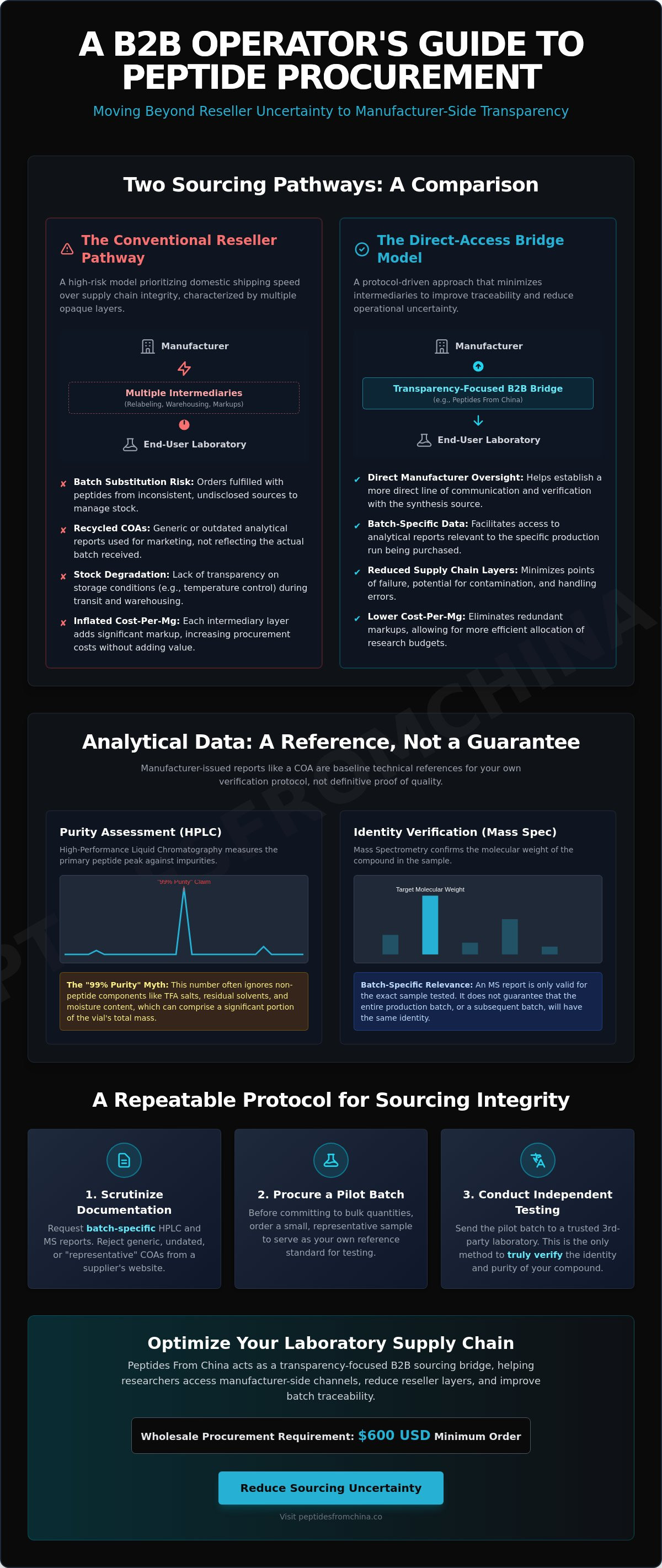
Many domestic vendors operate on a "domestic warehouse" model that prioritizes shipping speed over transparency. These resellers often mask the true origin of their research peptides through relabeling and private branding. This creates multiple layers of intermediaries, each adding a markup and a potential point of failure in the chain of custody. If a vendor doesn't disclose their synthesis source, you have no way to verify the manufacturing standards or the storage conditions of the compound before it reached the warehouse.
The risk of batch substitution is particularly high when sourcing from non-transparent resellers. If a vendor's primary stock is depleted, they might fulfill orders using secondary sources with different synthesis standards without notifying the buyer. This is why many procurement professionals are moving toward manufacturer-direct channels. PFC coordinates sourcing from established Chinese manufacturing facilities together with international logistics. By establishing a direct connection to the synthesis facility, researchers improve traceability and ensure that the reference data provided is actually relevant to the batch they receive.
The Technical Foundation: Peptide Synthesis and Analytical Documentation
Professional synthesis of research peptides relies primarily on Solid Phase Peptide Synthesis (SPPS). This process involves the sequential addition of protected amino acids to a growing chain tethered to a solid resin support. This method is the industry standard for producing high-purity compounds like BPC-157 or Tirzepatide because it allows for the rapid filtration of reagents and solvents. However, synthesis is only the first step. Analytical verification through High-Performance Liquid Chromatography (HPLC) and Mass Spectrometry (MS) is required to characterize the final product and ensure it meets laboratory standards.
HPLC determines the chemical purity by measuring the area under the primary peak relative to secondary peaks representing impurities. MS confirms the molecular weight, which is the only way to verify that the synthesized sequence matches the target compound. Even with these tools, manufacturer-issued papers should be treated as baseline reference material rather than definitive proof. The FDA guidance for synthetic peptide drugs highlights the complexity of characterizing these compounds, emphasizing that even minor sequence variations can alter experimental outcomes and research validity.
Decoding the Certificate of Analysis (COA)
Reading a chromatogram requires more than just looking for a 99% figure. You must identify the primary peak and examine the baseline for smaller, unaccounted-for spikes that indicate residual solvents or synthesis byproducts. Common red flags in HPLC reports include inconsistent font styles, reused dates across different batches, and data that appears too perfect to be realistic. These discrepancies often point to fraudulent documentation or the reuse of reports from previous high-quality batches. For this reason, peptide testing by an independent third-party laboratory is a necessary step in a professional procurement protocol.
Identity vs. Purity: Why Both Matter
A 99% pure vial is scientifically useless if it contains the wrong peptide sequence. While HPLC measures how much of the substance is present, it doesn't confirm what that substance is. Mass Spectrometry fills this gap by identifying the molecular identity. Additionally, the stability of the compound depends on proper lyophilization. This freeze-drying process removes moisture and residual solvents, preventing the peptide from degrading during transit. For labs requiring the highest level of certainty, amino acid analysis (AAA) provides a deeper layer of verification by quantifying the individual amino acids within the chain.
Establishing a direct line to the synthesis source helps reduce supply chain uncertainty. Platforms like Peptides From China act as a B2B bridge, providing the manufacturer-side documentation for wholesale orders starting at $600 to support your independent verification efforts.
Intermediary Risks: Resellers vs. Direct-to-Manufacturer Sourcing
The retail market for research peptides is saturated with domestic resellers who position themselves as "manufacturers" to justify significant price premiums. In reality, most of these entities are simply high-markup intermediaries that purchase bulk powders from overseas facilities and relabel them for local sale. This model creates a significant transparency gap. A sourcing bridge, by contrast, operates as a B2B facilitator. It provides direct access to the synthesis facility's wholesale channels rather than acting as a traditional stockist. Removing these reseller layers does more than just lower costs; it provides the economic room to fund independent, third-party laboratory verification, which is a far more reliable safeguard than a reseller's "guaranteed purity" claim.
Domestic shipping is often marketed as a safety feature, but it frequently masks poor inventory management and supply chain opacity. When compounds are stored in domestic warehouses, the buyer has no insight into the temperature control history or the actual age of the batch. Peptides are sensitive to heat and light. If a reseller is liquidating "old batch" stock to maintain margins, the biological activity of the compound may be compromised before it ever reaches your lab. The "re-labeling" problem is also pervasive, where generic bulk powder is branded as a premium domestic product without any additional purification or verification steps. This practice obscures the true origin of the compound and makes it impossible to establish a reliable chain of custody.
The Opacity of Domestic Warehousing
Shipping from a US or EU address does not equate to manufacturing in those regions. Large-scale resellers manage inventory based on turnover rates, and the risk of receiving degraded stock increases the longer a product sits in a third-party warehouse. Choosing between a peptide sourcing agent vs platform determines how much control you have over the synthesis timeline. A platform model allows for better oversight of custom synthesis, ensuring that you receive freshly lyophilized compounds rather than whatever happens to be sitting on a shelf in a domestic distribution center.
Direct China-to-Lab Logistics
Direct procurement requires a more methodical logistical approach, but it offers superior batch traceability. International shipments of research peptides typically utilize neutral packaging and established tracking protocols to ensure consistent delivery to professional laboratories. While navigating customs requires specific documentation, this direct route ensures the product comes straight from the synthesis source. This level of traceability is essential for adhering to Regulatory Guidelines for Therapeutic Peptides, which mandate strict quality and analysis standards for any compound used in a professional setting. PeptidesFromChina currently has a $600 total minimum order. Multiple catalog products can be combined to reach the minimum, with orders starting from one 10-vial kit per product.
Professional Procurement Protocols: Verifying High-Purity Compounds
Establishing a repeatable procurement protocol is the only way to mitigate the inherent risks of batch substitution and reused analytical reports. For professional laboratories, verification is an ongoing operational requirement rather than a one-time event. This process begins with a multi-step validation of any new manufacturer relationship. Before committing to bulk peptides, researchers should secure small pilot batches to establish a baseline for synthesis quality and logistical reliability. This cautious approach helps reduce supply chain uncertainty before scaling up order volumes.
A robust protocol also includes a "Chain of Custody" log for every shipment. This log tracks the synthesis date, the time spent in transit, and the environmental conditions during shipping. Because research peptides are sensitive to temperature fluctuations, documenting these variables is essential for interpreting experimental results. If a batch underperforms in a laboratory setting, this log provides the data necessary to determine if the issue originated during synthesis or during international transit.
Setting Up a Laboratory Verification Cycle
Independent, third-party testing is the cornerstone of professional sourcing. Utilizing specialized labs like Janoshik or MZ Biolabs allows researchers to bypass manufacturer-provided data in favor of objective analysis. The "Blind Sample" method is the most effective way to ensure accuracy. By submitting a vial without identifying the compound or the expected purity, you force the lab to rely solely on analytical data rather than preconceived expectations. When discrepancies arise between a manufacturer's COA and independent HPLC/MS results, the independent data must be treated as the primary truth. These discrepancies often reveal the presence of residual TFA salts or sequence errors that a "standard" report might overlook.
Managing Sourcing Deposits and Wholesale Requirements
Professional sourcing platforms may use operational filters for B2B inquiries. At PeptidesFromChina, the $10 deposit initiates manual request processing and real-time stock verification and is credited toward the final invoice. The $600 minimum is an operational minimum for orders placed through the PFC sourcing platform and may include multiple catalog products; it is not a custom-synthesis threshold.
Optimizing Laboratory Supply Chains with Peptides From China (PFC)
Peptides From China (PFC) functions as a transparency-focused B2B bridge between professional laboratories and verified Chinese synthesis facilities. PFC coordinates sourcing from established Chinese manufacturing facilities together with international logistics. This model helps reduce supply chain uncertainty by providing researchers with a direct line to the source of production. By removing unnecessary intermediaries, we improve traceability and ensure that the compounds you receive haven't been sitting in unverified domestic warehouses.
PFC coordinates manufacturer-side sourcing and international logistics. Products are subject to the manufacturer’s applicable quality-control procedures and product-specific specifications. Manufacturer-side analytical documentation may be available depending on the product and batch, but PFC is not an independent analytical testing laboratory and does not guarantee a universal documentation package. Buyers requiring independent verification may arrange third-party analytical testing.
The PFC Sourcing Model: Transparency First
Our verification process involves auditing synthesis facilities before they're permitted into our sourcing network. We focus on manufacturers capable of providing batch-specific documentation and maintaining rigorous synthesis standards. This methodical approach improves traceability for all research peptides sourced through our platform. To maintain the efficiency of these manufacturer-side channels, PFC focuses exclusively on B2B volume. We enforce a $600 minimum order requirement to ensure that each project receives the dedicated attention of professional synthesis lines rather than the automated fulfillment used for small-scale retail orders.
Strategic Sourcing for 2026 and Beyond
Ready to optimize your procurement? Request a manufacturer-direct quote and begin your sourcing verification to secure high-purity compounds for your next project.
Establishing a Repeatable Procurement Protocol for 2026
The 2026 landscape for sourcing research peptides requires a shift from passive trust to active verification. Relying on domestic resellers often leads to inflated costs and obscured origins. By moving closer to the synthesis source, laboratories can eliminate the relabeling and storage risks associated with traditional middleman structures. This transition isn't just about reducing the cost-per-mg; it's about securing the operational room to fund independent, blind laboratory testing for every batch received.
Treat manufacturer documentation as baseline reference analytical data rather than definitive proof of identity. A robust supply chain is built on consistent batch traceability and a commitment to independent HPLC/MS analysis. PeptidesFromChina currently has a $600 total minimum order. Multiple catalog products can be combined to reach the minimum, with orders starting from one 10-vial kit per product. This methodical approach helps reduce supply chain uncertainty and ensures your research is grounded in verified factual integrity.
Access Manufacturer-Direct Sourcing and Verification Data to stabilize your laboratory's procurement cycle today.
Frequently Asked Questions
What are research peptides exactly?
Research peptides are short chains of amino acids synthesized for laboratory experimentation. These compounds act as signaling molecules used to study biological pathways and cellular responses in a controlled setting. They are categorized as chemical reagents rather than finished pharmaceutical products and are strictly not for human consumption.
Is it legal to buy peptides for research purposes?
Yes, purchasing these compounds for laboratory use is legal in most jurisdictions, provided they are not intended for human consumption or resale as drugs. In 2026, the regulatory landscape has shifted with the FDA reclassifying several peptides from Category 2 to Category 1 for compounding. However, research-grade chemicals remain a distinct category that must be handled according to institutional safety and import protocols.
Why is there such a large price difference between peptide companies?
Market pricing and availability can vary substantially by supplier, product, order size, and current conditions; exact comparisons require current, like-for-like data.
How can I tell if a peptide COA is fake or reused?
Look for inconsistent font styles, mismatched document headers, or synthesis dates that don't align with your order timeline. Reused reports are common in the retail sector and often lack batch-specific identifiers. If a vendor provides the exact same chromatogram for different orders over several months, the documentation is likely fraudulent and should be discarded.
Do I need to test peptides if the company provides a third-party report?
Independent testing is essential because a third-party report provided by a vendor only proves that one specific vial was tested at some point. It doesn't guarantee that the vial in your hand matches that report. Professional procurement requires blind HPLC and Mass Spectrometry testing to verify the identity and purity of every batch before beginning laboratory work.
What does "99% Purity" actually mean in a lab setting?
In a professional setting, this figure refers to the relative area of the primary peak on an HPLC chromatogram. It doesn't account for the presence of moisture, residual solvents, or counter-ions like TFA salts. A "99% pure" claim is often a marketing simplification; actual net peptide content is typically lower and must be confirmed through amino acid analysis for precise dosing.
PeptidesFromChina currently has a $600 total minimum order. Multiple catalog products can be combined to reach the minimum, with orders starting from one 10-vial kit per product.
The $600 threshold is an operational requirement that ensures synthesis facilities can dedicate professional-grade production lines to an order. This minimum covers the costs of custom synthesis, proper lyophilization, and secure international logistics. By focusing on B2B volume, the platform maintains synthesis standards that are often bypassed by small-scale retail fulfillment operations.
How long does international shipping take for bulk research orders?
Shipping methods, pricing, and estimated transit times vary by destination and are confirmed during order processing. PFC coordinates manufacturer-side sourcing together with international logistics; international delivery may involve logistics partners.