
Petrelintide is one of the amylin candidates making the next generation of obesity research worth following. The latest evidence spans two Phase II populations, while a larger Phase III program is now under way. Here is what has changed and how the findings fit together.
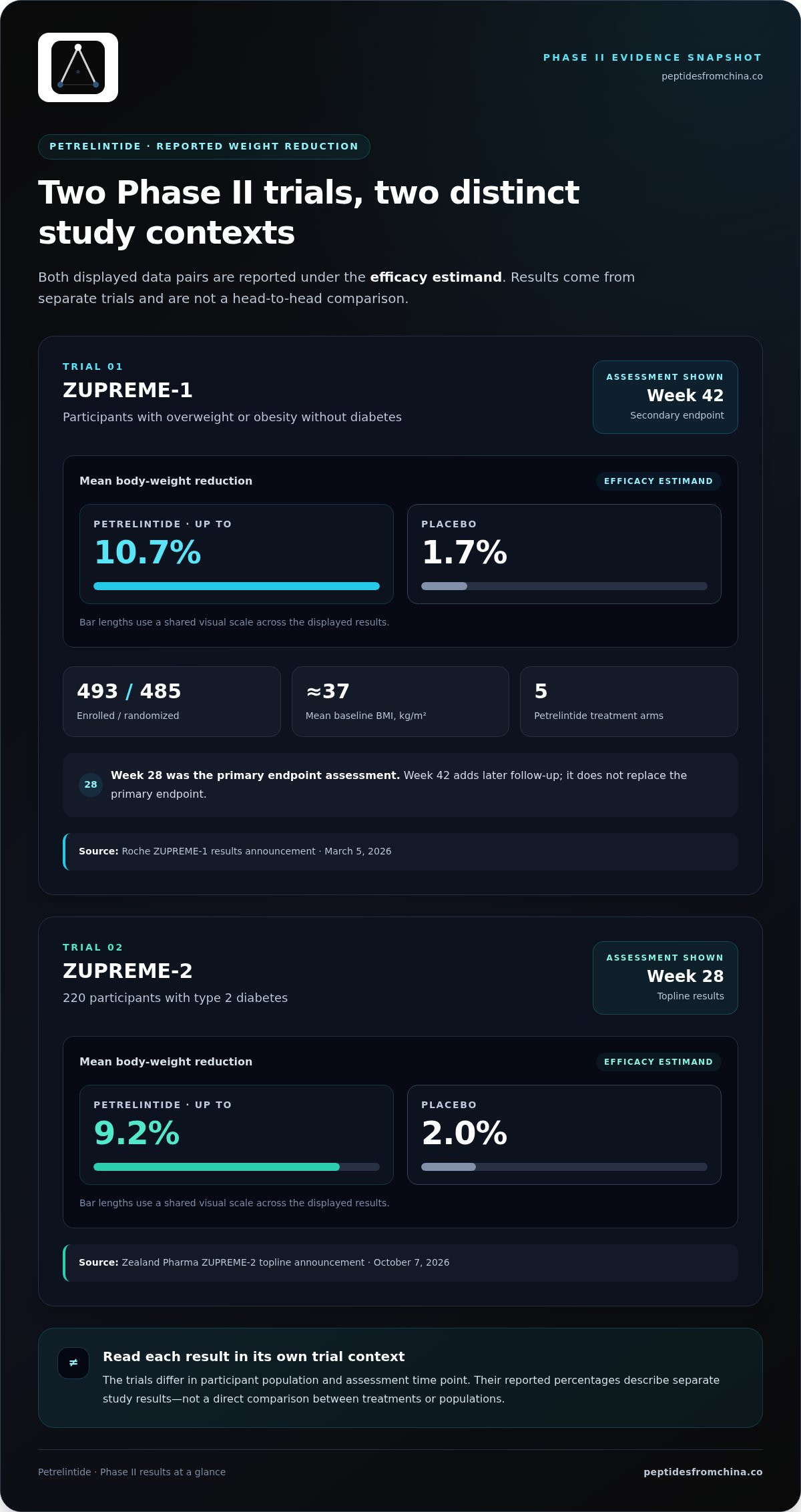
In ZUPREME-1, adults with overweight or obesity without diabetes had up to 10.7% mean body-weight reduction at 42 weeks, compared with 1.7% for placebo, under the efficacy estimand. Zealand Pharma’s October 7, 2026 ZUPREME-2 announcement reported up to 9.2% at 28 weeks versus 2.0% for placebo under the efficacy estimand in 220 participants with type 2 diabetes. The populations and time points differ, so these figures are not a head-to-head comparison.
This update examines the amylin research behind petrelintide, what the Phase II findings show about efficacy and tolerability, and which questions remain open. It distinguishes primary endpoint results from later follow-up and company interpretation, and reviews the next evidence milestones as the program advances to Phase III. The goal is a measured view of the evidence, not a premature verdict.
Key Takeaways
Understand why amylin research has drawn attention and where petrelintide fits within this area of obesity research.
Distinguish a trial’s primary endpoint from results reported at a later follow-up.
Use population, duration, comparator, endpoint, and analysis method to make cross-trial comparisons more meaningful.
Interpret tolerability findings in light of who reported them and which participant group they describe.
Track upcoming evidence milestones, from full trial data and registration details to later studies and regulatory updates.
Table of Contents
Petrelintide and the amylin research landscape: why this candidate matters
What the ZUPREME-1 Phase II results reported, and how to read them
How to compare petrelintide results with other obesity candidates fairly
What the tolerability findings show, and what remains unresolved
What to watch next in petrelintide’s development
Petrelintide and the amylin research landscape: why this candidate matters
Obesity research examines multiple biological pathways. Amylin-related research is one part of that wider effort, and petrelintide is an investigational candidate in the field. In its March 2026 release, Roche described petrelintide as an investigational amylin analog. That description identifies its development category; it does not establish how well it works, what benefits it may offer, or whether its safety profile is favorable.
What does the amylin-analog description mean?
Amylin, also known as islet amyloid polypeptide, is a pancreatic hormone co-secreted with insulin. Research on the hormone and related compounds has examined their potential role in appetite and energy regulation. For foundational molecular context, Cooper and colleagues reported the purification and characterization of human islet amyloid polypeptide in Proceedings of the National Academy of Sciences in 1987. That work helps establish what amylin is, but it does not demonstrate that a particular analog produces a clinical effect.
An “analog” is a molecule developed in relation to a naturally occurring compound. The label alone does not specify a candidate’s detailed pharmacology, prove a particular receptor-level mechanism, or predict outcomes in people. Those claims require molecule-specific evidence. Explanations that assign petrelintide a precise mechanism should be treated as hypotheses unless supported by appropriate primary research.
Where does petrelintide sit in obesity research?
Petrelintide is an investigational long-acting amylin analog developed by Zealand Pharma with Roche. Zealand announced initiation of its registrational Phase III program on September 22, 2026 . The program is under way, rather than merely proposed; the clinical-trial program remains distinct from regulatory approval.
Amylin research matters because it offers a distinct line of investigation in a complex field, where candidates may be assessed for weight-related outcomes and tolerability. That rationale provides context for studying the class, but it cannot establish petrelintide’s clinical value. Judge the evidence from the study methods, participant groups, endpoints, and follow-up, rather than inferring results from amylin biology or another molecule’s findings.
A useful distinction is simple: investigational means a candidate is being evaluated through research, while approved means a relevant regulatory authority has authorized a treatment for specified use. Roche’s March 2026 wording supports the former description. Whether later evidence changes the assessment depends on the published trial record and regulatory updates, not on the class label alone.
What the ZUPREME-1 Phase II results reported, and how to read them
Before interpreting an efficacy figure, establish what the trial set out to measure and which analysis produced the result. Roche reported that ZUPREME-1 enrolled 493 participants, with a mean baseline BMI of 37 kg/m². Its release describes five petrelintide treatment arms compared with placebo at the primary endpoint. These details orient readers, but they do not replace the full protocol or report.
Roche identified week 28 as the primary endpoint assessment and also reported a later assessment at week 42. The first addresses the trial’s stated main efficacy question at its designated time point. The later assessment adds follow-up context. It can provide evidence about outcomes over time, but it does not change which endpoint was primary.
The Roche ZUPREME-1 results announcement is a company-reported topline source. For a fuller interpretation, readers need the complete study report, including arm-level results, the prespecified analysis plan, uncertainty estimates, and the handling of missing data. Without those details, a release can establish what the company reported but cannot answer every methodological question.
What does the headline 10.7% figure represent?
Roche attributes the headline to the highest reported mean result at the later assessment under its efficacy estimand. “Up to” signals that the figure represents the highest reported treatment-arm mean, not an outcome shared by all five arms or all participants. A mean summarizes a group; it does not show the range of individual outcomes or predict what any one participant would experience.
An estimand defines the treatment effect being estimated and the assumptions used to interpret trial data. Readers should consult the full report for its precise definition and analysis population. Those details determine what the reported mean represents and how it should be understood.
Why do the week 28 and week 42 time points both matter?
The primary endpoint provides the trial’s principal planned efficacy assessment. The later assessment adds information about outcomes beyond that measurement. They are complementary, not interchangeable: evaluate the primary analysis at its prespecified time point, and interpret later follow-up in light of who contributed data and how the analysis was conducted.
Keep each result attached to its endpoint, analysis, and time point. This makes topline findings more useful without turning a later observation into the trial’s primary result or treating a group average as an individual forecast.
How to compare petrelintide results with other obesity candidates fairly
A percentage change is interpretable only alongside the study that produced it. Obesity trials can enroll different populations, run for different lengths of time, select different endpoints, and use different statistical methods. A larger number in one announcement therefore does not establish that its candidate is superior to another tested separately.
Before drawing conclusions, use a consistent comparison template. Fill each field from the study report or registry, and mark unavailable information rather than assuming the studies match.
Population: Who was enrolled? Record relevant characteristics and baseline measures, including whether participants had type 2 diabetes.
Study duration: How long was treatment evaluated, and when was the outcome measured?
Endpoint: Was the reported result the primary endpoint, a later assessment, or another outcome?
Comparator: Was the candidate compared with placebo or another intervention, and under what study design?
Analysis method: Which analysis population and estimand produced the figure? Is it a mean change, a subgroup result, or the result from a selected treatment arm?
This framework also applies when reviewing retatrutide and other candidates in obesity research. Keep each candidate’s study details attached to its result. Avoid placing percentages side by side without showing the underlying population, duration, endpoint, comparator, and analysis.
Which study details make comparisons more meaningful?
Start with who took part. Differences in participant characteristics and baseline measures affect how results should be interpreted. Next, check whether the studies measured outcomes at comparable times and used similar comparator designs. Follow-up length matters too: an earlier visit does not answer the same question as a later one.
Then identify exactly what each number represents. A mean change across an analysis population, a selected treatment-arm result, and a subgroup result are not interchangeable. The analysis method also matters, particularly when reports use different approaches to account for missing observations or participants who discontinued. Without these details, a numerical comparison can look more precise than the evidence supports.
Why does a cross-trial ranking remain uncertain?
Separate trials are not controlled comparisons between candidates. Their protocols, populations, endpoints, follow-up, and statistical analyses may differ, so apparent gaps in reported outcomes can reflect study design as well as candidate effects. Even similar-looking figures do not remove those differences.
Keep efficacy, tolerability, and development stage as separate dimensions. Efficacy describes measured outcomes, tolerability concerns reported adverse events and discontinuations, and development stage indicates how far a program has progressed through clinical development. Evidence in one category does not settle the others. A randomized head-to-head trial using a shared protocol and comparator would provide a more direct basis for comparison. Until then, describe what each study observed, note what cannot be aligned, and avoid declaring a cross-trial winner.
What the tolerability findings show, and what remains unresolved
Tolerability is relevant to interpreting a trial, but topline descriptions are not a complete safety assessment. Roche reported that, in the maximally effective dose group in ZUPREME-1, vomiting was not reported and there were no discontinuations due to gastrointestinal adverse events. The scope matters: these observations refer to that specified group, not necessarily every treatment arm or participant in the study.
In brief: Roche reported no vomiting and no discontinuations due to gastrointestinal adverse events in the maximally effective dose group in ZUPREME-1. These trial observations do not establish that petrelintide has no risk or demonstrate long-term safety.
Roche also reported that nausea was the most common gastrointestinal event, occurring in 20% of participants in the maximally effective dose arm versus 6% with placebo, and described most cases as mild and occurring during dose escalation. This adds context to the no-vomiting finding: the absence of one event does not mean gastrointestinal events were absent overall. The announcement’s account is available in Roche’s ZUPREME-1 results.
How should the reported tolerability signal be interpreted?
A favorable topline signal is encouraging as a trial observation, but it is not proof of zero risk. The absence of reported vomiting applies to the maximally effective dose group and should not be generalized to other groups or future populations. Similarly, reported discontinuations concern participants who stopped treatment for the specified gastrointestinal reasons, not every possible adverse event.
To assess event frequency, severity, timing, and differences between arms, readers need the complete adverse-event tables and study methods. A short company summary can identify findings of interest, but may not include enough detail to judge how events were defined, collected, or distributed across participants.
What evidence is still needed?
Longer follow-up can help clarify whether the reported tolerability pattern persists over time and how weight-related outcomes develop with continued observation. Larger evidence sets are also important for characterizing less common events that a Phase II study may not estimate precisely. These are open research questions, not evidence that such events have occurred.
Zealand announced publication of the full ZUPREME-1 results in The Lancet Diabetes & Endocrinology in its September 30, 2026 release , distributed on September 29 in U.S. time. The report gives a fuller account than the March topline summary, including both efficacy and treatment-policy estimands. Use the peer-reviewed methods and adverse-event tables when assessing the complete trial record.
What to watch next in petrelintide’s development
The development program now has a clearer timeline. Zealand announced Phase III initiation on September 22, publication of ZUPREME-1 results at the end of September, and ZUPREME-2 topline results on October 7, 2026. The next step is to follow the larger trials and the full ZUPREME-2 report, rather than treating older statements of intent as the latest status.
The Phase III monotherapy program includes ZUPREME-3 in participants without type 2 diabetes, ZUPREME-4 in participants with type 2 diabetes, and ZUPREME-5 in participants with established cardiovascular disease. Zealand’s October 7 announcement states that the first participants have initiated treatment. A petrelintide–enicepatide combination study is a separate program; the same announcement still describes its initiation as planned for the second half of 2026.
Which upcoming evidence would change the picture?
Start with the complete peer-reviewed results. Review the methods, prespecified endpoints, analysis populations, and statistical results, not just the headline outcome. Then examine registered studies for their design, recruitment status, and updates. A company announcement can describe an intention; a registry entry can help establish whether a study has been submitted, is recruiting, or has changed status.
Later trials can test whether earlier findings are reproduced in broader evidence sets and over longer follow-up. That follow-up may clarify how outcomes develop over time and whether the reported tolerability pattern remains consistent. It can also provide more information about less common events than an earlier-stage trial alone.
How can readers follow the research responsibly?
Use a simple evidence sequence, checking the date and source at each step:
Full results: Compare peer-reviewed publications with company summaries and note which analyses were prespecified.
Study registration: Check the registry record for design details, recruitment status, and updates.
Later trials: Distinguish announced plans from registered studies and studies that have actually begun.
Regulatory updates: Look for communications from relevant regulators before describing any change in status.
Publication dates matter. A release may accurately describe the position when it appeared yet no longer reflect the latest trial status. Prefer current registry records, scientific publications, company communications, and regulator notices, and keep each source’s role clear. This approach separates observed results from sponsor interpretation and an unconfirmed schedule.
Petrelintide now has Phase II evidence in two populations and an initiated Phase III program. Its strongest research story is the combination of observed weight reduction and a tolerability signal worth testing in larger studies. Longer-term outcomes and the comparison with other candidates remain questions for the ongoing evidence program.
Keep the Next Evidence Milestone in View
The broader research question is whether findings from one study can be reproduced across different participant groups and clinical settings. That work will help scientists describe the range of observed responses more precisely, rather than relying on a single average. For petrelintide, continued research matters not only for measuring outcomes but also for establishing how consistently those outcomes appear.
For more context on the amylin class, read our cagrilintide overview . To compare the receptor strategies behind other investigational candidates, see our UBT251 and retatrutide comparison . PFC is a B2B sourcing platform; catalog materials are for laboratory research only, not human or veterinary use, and are not the clinical-trial products discussed here. For an editorial question, contact the team .
Frequently Asked Questions
What does “up to 10.7%” mean in the petrelintide Phase II results?
It identifies the highest reported mean among the treatment arms, not a result that applies uniformly across the study. To understand what the estimate captures, check the full report’s analysis population and definition of the efficacy estimand. Also look for uncertainty intervals: a point estimate alone does not show how precisely the study estimated the group result or how responses varied among participants.
Why did Roche report both week 28 and week 42 results for petrelintide?
The two assessments offer different views of the study record. The primary analysis addresses the trial’s prespecified main question; the later assessment adds follow-up information. When reviewing the full report, check participant flow and the number included in each analysis at each visit. This helps clarify whether the later assessment reflects the same analysis population and how missing follow-up data were handled.
Did all participants in the petrelintide trial lose the same amount of weight?
No. A group average can conceal a wide range of individual outcomes. Roche also reported that female participants lost considerably more weight than male participants, but the announcement does not provide subgroup estimates. To evaluate that observation, look for subgroup sizes, uncertainty intervals, and whether a formal interaction analysis was reported. A difference in observed subgroup averages alone does not establish why responses differed.
Is petrelintide approved for use?
No. The development information for this update describes petrelintide as investigational, not as an approved treatment. A trial’s registration or recruiting status records research activity; it is not authorization from a regulator. Approval is also tied to a specific jurisdiction and indication, so a current status check should rely on communications from the relevant regulatory authority rather than a study listing or older company release.
Does petrelintide’s Phase II result prove it is more effective than retatrutide?
No. A treatment’s result against its own study comparator does not estimate how it would perform against a different candidate. A meaningful direct comparison would require a trial designed to compare the candidates under a shared protocol, with an appropriate statistical plan for the question being tested. Until such evidence is available, describe each study’s finding on its own terms rather than assigning a rank.
Does Roche’s release show that petrelintide has already been tested in combination with another treatment?
No. A rationale for studying a combination is not evidence about how the combination performs. Monotherapy results cannot establish the combined effect or show whether tolerability changes when another treatment is added. Those questions require results from a study that evaluates the combination. Keep statements about potential research separate from findings generated in completed clinical trials.