
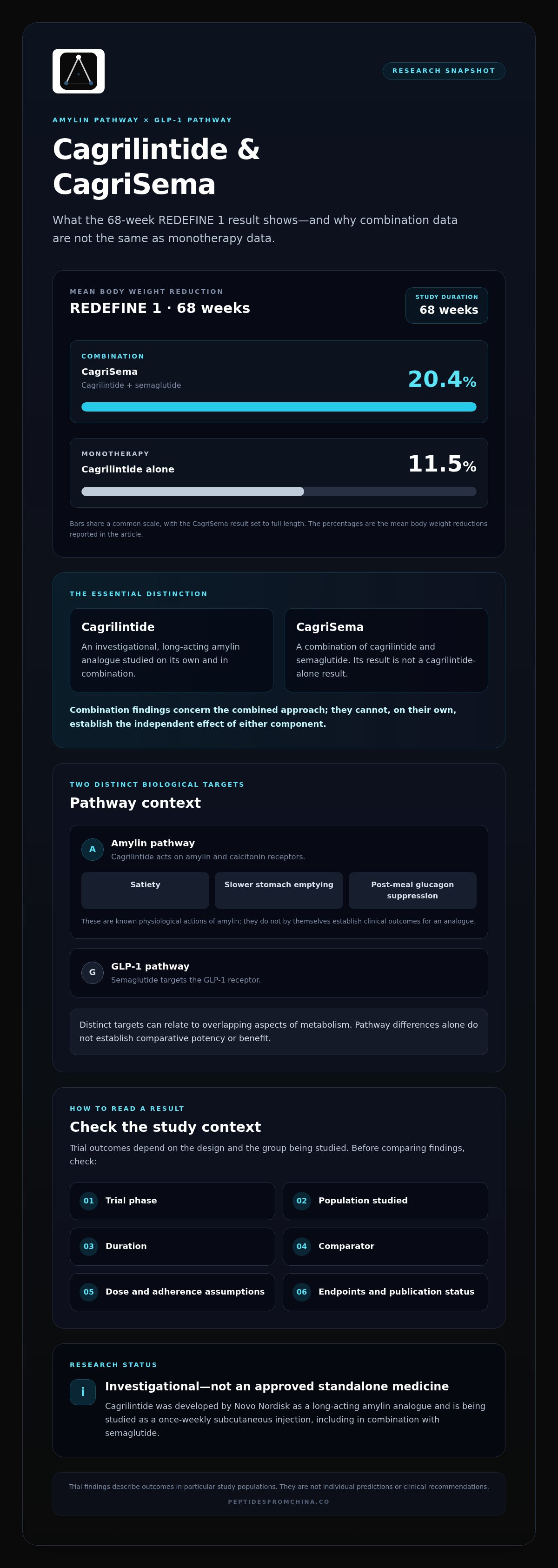
In the 68-week REDEFINE 1 trial, CagriSema reduced mean body weight by 20.4%, compared with 11.5% for cagrilintide alone. The difference highlights a key question in this research area: what does the amylin pathway contribute, and what results from combining it with semaglutide?
A headline about a combination trial can be mistaken for a result from cagrilintide alone. It is not. Cagrilintide is an investigational, long-acting amylin analogue that acts on amylin and calcitonin receptors; semaglutide targets the GLP-1 receptor. The distinct biology makes the combination relevant to research, but each result must be interpreted in light of its trial design and comparison groups.
This guide outlines the biological rationale for cagrilintide, separates monotherapy findings from CagriSema results, and places both in the wider amylin agonist landscape. It also offers practical checkpoints for evaluating evidence, including the population studied, comparator, dose, adherence assumptions, and development status. The goal is to clarify what the data show and what they do not establish.
Key Takeaways
See why researchers study amylin signaling in appetite, satiety, and energy balance, and how it relates to, but differs from, incretin research.
Separate cagrilintide monotherapy findings from CagriSema combination results before drawing conclusions about either approach.
Evaluate each result in context by checking the trial phase, population, duration, comparator, endpoints, and publication status.
Place emerging amylin candidates in the research landscape without treating different targets or study stages as a simple ranking.
Track development updates by distinguishing investigational findings, company disclosures, and regulatory milestones.
Table of Contents
What Is Cagrilintide? The Amylin Research Behind the Candidate
How Cagrilintide’s Amylin Pathway Differs from Incretin Research
Cagrilintide Clinical Research: Separate Standalone Evidence from Combination Data
How Cagrilintide Fits Among Emerging Amylin Research Candidates
What to Watch Next in Cagrilintide Research in 2026
What Is Cagrilintide? The Amylin Research Behind the Candidate
Cagrilintide is an investigational, long-acting analogue of amylin being studied for its effects on appetite and metabolic signaling. It is not an approved standalone medicine. Trial results describe outcomes in particular study populations; they are not individual predictions or clinical recommendations.
Amylin gives researchers a way to examine signals involved in satiety and food intake alongside other metabolic pathways. The hormone is released by pancreatic beta cells with insulin after meals. Studying how amylin-related signaling affects satiety and energy balance lets researchers investigate a biological approach distinct from incretin-focused research. That rationale defines a research question, not proof of benefit outside a trial.
What does amylin do in metabolic research?
Amylin contributes to post-meal signaling. Its known physiological actions include promoting satiety, slowing stomach emptying, and suppressing glucagon release after a meal. These effects help explain why researchers investigate amylin pathways in relation to appetite and glucose regulation. They do not, by themselves, establish what a long-acting analogue will do in a clinical study.
Amylin receptors are receptor complexes that respond to amylin-related signals. Cagrilintide is described as acting at amylin and calcitonin receptors. The terminology can be complex because amylin signaling involves calcitonin-receptor components. The important distinction is that researchers are examining this receptor biology, not simply relabeling the GLP-1 pathway. The pathways have distinct targets but may affect overlapping aspects of metabolism.
How is cagrilintide positioned in the research landscape?
Developed by Novo Nordisk, cagrilintide is designed as a long-acting amylin analogue and is being studied as a once-weekly subcutaneous injection. Its development also includes research in combination with semaglutide, a GLP-1 receptor agonist. Combination findings must be kept separate from monotherapy findings: they concern a combined approach and cannot, on their own, establish the independent effect of either component.
For scientific interpretation, trial design and primary study reports are more useful than a development announcement alone. A company's decision to advance a candidate signals research strategy rather than clinical benefit or approval. Keeping these categories separate makes the evidence that follows easier to read.
How Cagrilintide’s Amylin Pathway Differs from Incretin Research
Amylin and glucagon-like peptide-1 (GLP-1) signaling are distinct research targets, even though both relate to appetite and metabolic regulation. Amylin is released by pancreatic beta cells alongside insulin after meals. Its receptor system includes calcitonin receptors paired with receptor activity-modifying proteins, which help shape receptor responses. GLP-1, by contrast, signals through the GLP-1 receptor. These differences give researchers separate biological questions to investigate, but do not show that one pathway is more effective.
Amylin signaling and the research question
Researchers study whether activating amylin-related receptors can influence satiety, stomach emptying, and post-meal glucagon signaling. Cagrilintide’s activity at amylin and calcitonin receptors provides a rationale for examining those effects. Mechanistic hypotheses and laboratory findings can guide clinical questions, but they are not equivalent to evidence of outcomes in people. Clinical trials must test those questions directly.
How to read the pathway comparison
Research dimensionAmylin pathwayGLP-1 pathwayInterpretation limit Primary targetAmylin-related receptor complexes, including calcitonin-receptor componentsGLP-1 receptorDifferent targets don’t establish comparative potency or benefit. Biological contextPost-meal satiety and related metabolic signalingIncretin signaling, including effects on glucose regulation and appetitePathways can be distinct while affecting overlapping processes. Study contextCandidate tested alone or combined with another agentSemaglutide studied as a GLP-1 receptor agonist or as part of a combinationResults depend on the trial population, design, dose, and comparator.
Different biological targets don’t make trial outcomes directly comparable. Comparisons require aligned study designs, populations, endpoints, and treatment conditions.
Semaglutide is a relevant comparator, not an interchangeable molecule. A cagrilintide monotherapy study asks what the amylin analogue contributes under that trial’s conditions. A CagriSema study asks about the combination; it cannot isolate each component’s contribution unless the design includes suitable comparison groups. The same principle applies to other incretin research: identify the target and treatment arms before interpreting reported outcomes.
When a new result appears, first check the target and whether the candidate was tested alone or in combination. Next, identify the comparator and study design. This keeps mechanistic rationale separate from clinical evidence.
Cagrilintide Clinical Research: Separate Standalone Evidence from Combination Data
The evidence addresses two different questions: what cagrilintide showed as a standalone candidate, and what was observed when it was combined with semaglutide as CagriSema. The findings are not interchangeable. The studies also differ in population, duration, comparator, and reported outcomes, so interpret each percentage within its own trial rather than treating the figures as a single ranking.
What can standalone studies establish?
A 26-week Phase 2 study tested cagrilintide alone, with liraglutide and placebo as comparators. At the highest reported cagrilintide dose, 4.5 mg, mean body-weight reduction was 10.8%, compared with 9.0% for liraglutide 3.0 mg and 3.0% for placebo. This is a finding from that trial and its enrolled population, not a prediction for an individual. Check the study report for publication status and endpoint hierarchy.
What does combination research add?
CagriSema combines the amylin analogue with semaglutide, a GLP-1 receptor agonist. The research tests whether acting on these pathways together changes outcomes relative to the trial’s comparison groups. Combination results describe the combination; they do not isolate the contribution of either component. The table summarizes reported weight and HbA1c results. Consult primary trial reports for the full endpoint hierarchy and publication details.
Source and designReported resultLimitation 26-week Phase 2 cagrilintide monotherapy study; standalone candidate, compared with liraglutide and placeboAt 4.5 mg, mean weight reduction was 10.8%, versus 9.0% and 3.0%, respectively.Different design and duration from Phase 3 programs; check the study report for publication status and endpoint hierarchy. REDEFINE 1, Phase 3; 68 weeks, people with overweight or obesity without diabetes; CagriSema, semaglutide, cagrilintide, and placebo groupsMean weight reduction was 20.4% for CagriSema, 14.9% for semaglutide, 11.5% for cagrilintide, and 3.0% for placebo. The full-adherence estimate for CagriSema was 22.7%.Combination and standalone arms are distinct; the full-adherence estimate uses a different analysis assumption. REIMAGINE 2, Phase 3; 68 weeks, participants with type 2 diabetesCagriSema reduced weight by 14.2% and HbA1c by 1.91 percentage points; semaglutide 2.4 mg reduced weight by 10.2% and HbA1c by 1.75 points.Population and outcomes differ from REDEFINE 1; don’t compare these figures as if the trials were identical. REIMAGINE 3, Phase 3; 40 weeks, participants with type 2 diabetes using basal insulinCagriSema reduced weight by 12.0% and HbA1c by 2.33 points; placebo was associated with a 1.1% weight increase and 0.66-point HbA1c reduction.Different duration, population, and comparator context; check the study report for publication status.
Before interpreting a headline, check who was enrolled, how long the study ran, which comparator was used, and whether the result came from a standalone or combination arm. These differences limit direct comparisons across trials.
How Cagrilintide Fits Among Emerging Amylin Research Candidates
The amylin research field is expanding, but it is better understood as a group of separate development programs than as a leaderboard. Cagrilintide is one example. Other reported programs include eloralintide, developed by Eli Lilly, and petrelintide, developed by Roche and Zealand Pharma. Pfizer and AstraZeneca are also reported to have active amylin-analogue programs. These examples indicate the breadth of research, not equivalent evidence or established clinical effects.
Which comparison criteria help map the field?
Start with four checkpoints: the stated biological target, formulation description, development stage, and type of evidence available. Distinguish laboratory or preclinical findings from early clinical studies and later-stage trials. Then check the original paper, trial registry, or company disclosure to see what was actually studied. Candidate-specific formulation details, precise development stages, and published results may not be available for every program. Keep those gaps visible rather than filling them by inference.
A candidate’s name or pathway label is only a starting point. Look for primary evidence describing the design and results of a specific program, and distinguish those findings from company announcements about development plans.
Why a crowded pipeline doesn’t mean interchangeable evidence
A shared pathway label does not establish that two molecules have the same structure, receptor activity, duration, safety profile, or clinical performance. Those properties require candidate-specific evidence. Likewise, a company’s investment or decision to advance a program signals development interest, not proof of effectiveness.
Separate trials also cannot reliably show which candidate performs better if they differ in participants, dose, duration, comparator, endpoints, or analysis. Even weight-change results may reflect different measurements or study contexts. A suitable head-to-head design is needed for direct comparison; otherwise, apparent differences across programs are hypotheses, not a ranking.
Use this sequence when a new amylin-candidate headline appears:
Confirm the candidate, target description, and whether the evidence is preclinical or clinical.
Check the registry or publication for population, comparator, duration, and endpoints.
Distinguish peer-reviewed findings from company-reported updates, and note what remains unreported.
Avoid cross-trial winner claims unless a direct comparison supports them.
This framework places cagrilintide within a changing research field while keeping pipeline momentum separate from demonstrated results. The most useful comparison is not which name attracts the most attention, but which candidate has evidence that answers a clearly defined question.
What to Watch Next in Cagrilintide Research in 2026
Research updates may appear as registry entries, company announcements, conference reports, or full journal articles, and they do not carry the same evidentiary weight. As of September 2026, cagrilintide remains investigational as a standalone drug. Novo Nordisk’s CagriSema combination has an FDA New Drug Application submitted in December 2025, with a decision anticipated in the fourth quarter of 2026. These status details are time-sensitive and should be rechecked before publication.
A practical checklist for reading new trial reports
Use the same sequence to assess each new claim:
Source: Is the update a peer-reviewed paper, trial-registry record, conference report, or company disclosure? Find the underlying record where possible.
Design: Confirm the trial phase, enrolled population, treatment duration, and whether the result is final, interim, or topline.
Comparator: Identify what the study actually compared, including whether cagrilintide was tested alone or within a combination.
Endpoint: Check the prespecified primary endpoint separately from secondary or exploratory outcomes.
Limitation: Look for missing data, analysis assumptions, adherence, and limitations described by the investigators.
A headline or abstract can help locate a result, but the full report and registry record provide essential context. For example, a weight-change figure may depend on the analysis population or adherence assumptions. Treat safety and efficacy findings as specific to the study population, design, and follow-up period unless broader evidence supports a wider conclusion.
How to interpret announcements without overreading them
Development milestones describe different events. Trial initiation means a study has begun, not that it has produced results. An interim update is not necessarily the final analysis. Topline results are a company-reported summary; a complete publication can provide fuller methods and limitations. A regulatory submission or decision is a separate milestone from clinical evidence.
As of September 2026, REDEFINE 4, a higher-dose CagriSema comparison with tirzepatide, is ongoing. Novo Nordisk also announced topline REIMAGINE 5 results in September 2026 for a lower-dose comparison in adults with type 2 diabetes. Treat that as an announcement and consult the full study details when available before drawing broader conclusions. Pipeline expansion and company strategy indicate research priorities, not demonstrated clinical benefit.
The central checkpoint is simple: keep biological rationale, observed clinical evidence, and future potential separate. Each answers a different question, and none substitutes for the others.
Keep the Evidence in View as Research Advances
Cagrilintide sits at the intersection of amylin biology and a growing set of clinical research questions. Read its standalone findings separately from CagriSema results, which reflect a combination with semaglutide rather than the independent effect of either component.
To assess new claims, check the source, trial design, population, comparator, duration, and prespecified endpoints. A registry entry, company update, completed trial, peer-reviewed publication, and regulatory decision each represent a different kind of evidence. Differences between studies matter too: results from separate trials do not establish a direct winner.
The central distinction is between biological rationale, observed clinical evidence, and future potential. Keeping those categories separate makes emerging findings easier to interpret without overstating what they establish. Follow the underlying reports as they appear, and approach each update with clear questions and measured expectations.
Primary Sources
For the original data, start with these sources:
Frequently Asked Questions
What is cagrilintide?
Cagrilintide is an investigational, long-acting analogue of the hormone amylin, developed by Novo Nordisk. Researchers study it alone and in combination with semaglutide to examine appetite-related and metabolic outcomes. It is not an approved standalone medicine. Trial results describe findings in specific study populations and conditions; they do not predict an individual’s outcome or provide a clinical recommendation.
How does cagrilintide work?
Cagrilintide acts on amylin and calcitonin receptors. Amylin is released by pancreatic beta cells alongside insulin after meals and is associated with satiety, slower stomach emptying, and suppression of post-meal glucagon release. These physiological roles help explain the research rationale, but they do not establish the effects of the analogue in people. Clinical studies must assess outcomes in their enrolled populations.
Is cagrilintide the same as semaglutide?
No. Cagrilintide is an amylin analogue, while semaglutide is a GLP-1 receptor agonist. They act on different primary receptor targets, although both pathways relate to metabolic regulation and appetite. They are not interchangeable, and findings for one compound should not be attributed to the other. A trial that studies them together evaluates the combination under its specific design and does not automatically isolate each compound’s contribution.
What is CagriSema?
CagriSema is Novo Nordisk’s fixed-dose combination of cagrilintide and semaglutide. Researchers study it separately from either component alone, so its results describe the combined approach rather than proving the independent effect of each compound. As of September 2026, Novo Nordisk had submitted a U.S. New Drug Application for CagriSema in December 2025. An FDA decision was anticipated in the fourth quarter of 2026; submission does not mean approval.
What do clinical studies show about cagrilintide?
In a 26-week Phase 2 monotherapy study, the highest reported cagrilintide dose, 4.5 mg, was associated with mean weight reduction of 10.8%, compared with 9.0% for liraglutide and 3.0% for placebo. In the 68-week REDEFINE 1 trial, mean reduction was 11.5% in the cagrilintide-alone group and 20.4% with CagriSema. These results come from distinct treatment groups and study contexts.
Is cagrilintide approved for use?
No. As of September 2026, cagrilintide remains investigational and is not FDA-approved as a standalone therapy; its use is limited to clinical trials. CagriSema is a separate combination candidate, not the same regulatory question. Novo Nordisk submitted a U.S. New Drug Application for CagriSema in December 2025, with a decision anticipated in the fourth quarter of 2026. A regulatory submission is not an approval.
How is cagrilintide different from other amylin agonists?
Cagrilintide is one candidate in a broader amylin research field that includes programs such as eloralintide and petrelintide. A shared pathway label does not establish that candidates have equivalent molecular properties, receptor activity, safety profiles, or clinical outcomes. To assess differences, examine each candidate’s verified mechanism, study stage, population, and published evidence. Results from separate trials cannot establish which candidate performs better without a suitable direct comparison.
For cagrilintide and other metabolic-research compounds, research organizations can browse the product catalog or submit custom sourcing requests for assistance with identifying suitable compounds, specifications, and documentation. Product availability, specifications, and documentation are verified before orders are finalized. Products are for laboratory research use only and are not for human or veterinary use.