
Peptide supply chain transparency means knowing who handles each part of an order, which records support the proposed material, and which questions remain open. This buyer checklist helps you build a procurement record you can compare with the shipment received.
Table of Contents
Defining Peptide Supply Chain Transparency in B2B Procurement
Navigating Sourcing Channels: Sourcing Platforms, Agents, and Resellers
Batch Verification and Quality Control Protocols
Commercial Architecture: Order Minimums, Deposits, and Processing
Inbound Logistics, Neutral Packaging, and Laboratory Quarantine Controls
Platform resources:Catalog · How It Works · Payment · Quality · Contact · COA Guide
Defining Peptide Supply Chain Transparency in B2B Procurement
A clear procurement record makes research sourcing easier to evaluate. Start with the product and chemical form, the supplier’s commercial role, the available specifications, and the identifiers that can connect the proposed material to the order. Record gaps before committing, rather than treating a polished catalog page as evidence.
This guide focuses on the evidence a buyer can request and retain for a specific order. It complements broader supply-chain planning: the question here is not how many intermediaries exist, but whether the information supplied supports the decision your laboratory needs to make.
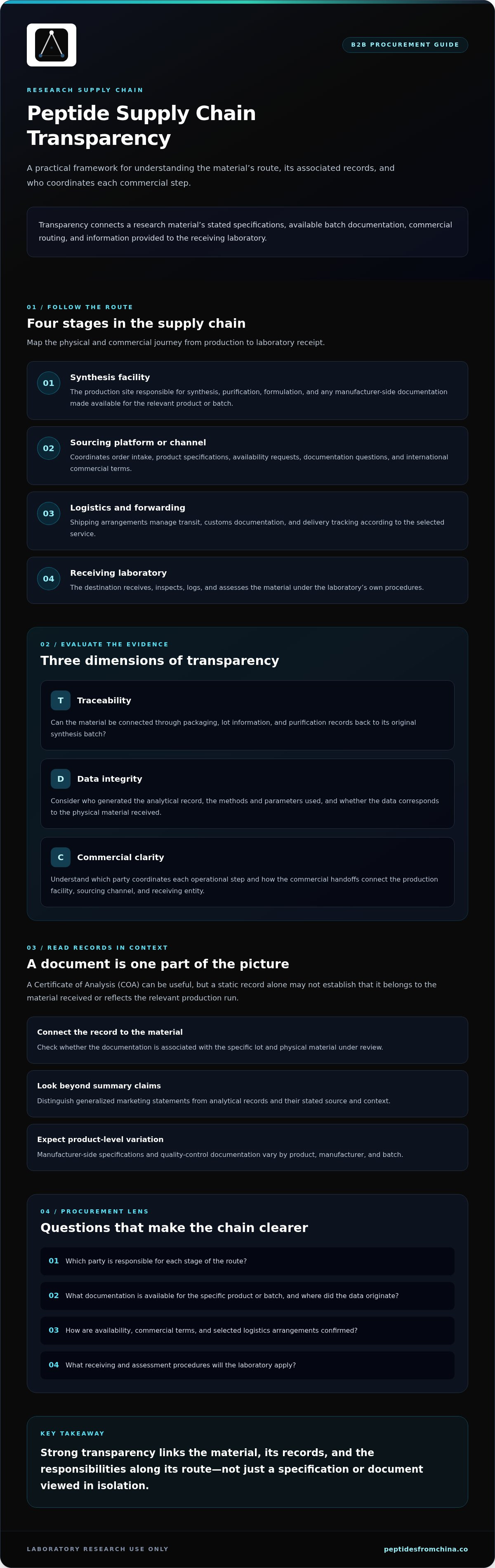
Separate supplier statements from supporting records. A useful order file covers four participants, with each role described accurately:
Synthesis Facility: The production site responsible for synthesis, purification, formulation, and any manufacturer-side documentation made available for the relevant product or batch.
Sourcing Platform or Channel: The commercial entity coordinating order intake, product specifications, availability requests, documentation questions, and international commercial terms.
Logistics and Forwarding: The freight and shipping arrangements managing transit, customs documentation, and delivery tracking according to the selected service.
Receiving Laboratory: The destination where the material is received, inspected, logged, quarantined, and assessed under the laboratory's own procedures.
Record the information available at each stage and the person responsible for answering follow-up questions. Some manufacturing records may not be released to buyers; mark those limits explicitly instead of assuming complete access.
The Components of a Transparent Supply Chain
A rigorous B2B procurement framework evaluates transparency through three structural dimensions: Traceability, Data Integrity, and Commercial Directness.
Traceability: The documented connection among the proposed material, available batch or sample identifiers, order records and received items. Its depth depends on the records available; list any gaps that prevent a link from being established.
Data Integrity: Record who issued an analytical report, which sample was assessed, the method and date, and how its identifiers relate to the proposed material. Keep supplier statements distinct from independent test results.
Commercial Responsibilities: Record who handles sourcing questions, final confirmation, shipping and follow-up. Fewer handoffs do not by themselves prove analytical quality or complete chain of custody.
Why Contemporary Standards Demand More Than a Static COA
A Certificate of Analysis can be useful when its issuer, scope, date and sample or batch identifiers are clear. Read it alongside the order and package identifiers. An analytical result describes the sample and methods assessed; it is not a substitute for the rest of the procurement record.
When documentation is available, ask how it relates to the proposed batch and what the measurements establish. Our COA reading guide explains the difference between chromatographic purity, identity evidence and peptide content.
Navigating Sourcing Channels: Sourcing Platforms, Agents, and Resellers
The peptide distribution landscape encompasses a variety of commercial models, each with distinct operational characteristics, cost structures, and levels of transparency. Understanding the structural differences between these models allows procurement managers to balance budget constraints, lead times, and documentation requirements effectively.
Channel Type Primary Commercial Role Supply Chain Visibility Typical Order Minimums Domestic Reseller Maintains or arranges local fulfillment and offers products through a domestic commercial channel. Varies; documentation and manufacturing-origin information depend on the reseller and product. Often flexible; pricing may reflect local fulfillment and service costs. Independent Sourcing Agent Coordinates buyer requests with one or more suppliers. Variable; depends on the information obtained for the specific order. Flexible and individually negotiated. B2B Sourcing Platform Coordinates buyer requests, sourcing communication, documentation questions, availability checks, and logistics. Depends on the product, manufacturer, batch, and documentation supplied for the order. Set by the actual provider and request. PFC currently has a dated temporary no-minimum-order trial; complete-box quantities still apply.
The Mechanics of Domestic Resellers
A domestic reseller may offer local fulfillment and smaller purchase quantities. Delivery speed and available records depend on the actual stock and service. Evaluate the specific offer rather than assuming that local warehousing proves either better quality or weaker documentation.
Documentation practices differ among domestic resellers. Some may provide local fulfillment and streamlined purchasing, while others may provide more limited manufacturing-origin or batch information. Buyers should ask what product-specific and batch-specific records are available before placing an order.
Domestic warehousing can shorten delivery times, but it also creates a different inventory-management model. Buyers should ask about inventory age, handling, available documentation, and the conditions applicable to the specific product rather than assuming that all domestically held materials have the same history.
The Sourcing Agent Model
Individual sourcing agents can provide flexible access to overseas suppliers, but their documentation, communication practices, and procedures for reviewing nonconforming materials vary. Buyers should establish the available records, commercial responsibilities, and written support process before committing to an order.
The Specialized B2B Sourcing Platform Model
A B2B sourcing platform functions as an organized commercial channel between laboratory procurement departments, wholesale purchasers, and available suppliers. It can coordinate order processing, technical specification alignment, availability requests, documentation questions, and international transit management without being the manufacturing facility or testing laboratory.
A named commercial contact can make sourcing questions easier to manage. Keep manufacturer information, platform coordination and independent laboratory analysis as separate entries in your procurement record. Broader planning considerations are covered in our supply-chain management guide .
Batch Verification and Quality Control Protocols
A transparent supply chain must be supported by an understanding of analytical testing. In peptide synthesis, quality cannot be evaluated by visual inspection alone. Lyophilized powders of identical appearance may vary dramatically in purity, residual moisture, counter-ion content, and isomeric configuration.
Analytical Verification Topics for Synthetic Peptides:
High-Performance Liquid Chromatography (HPLC): May be used to assess chromatographic purity by separating the target peptide from related impurities.
Liquid Chromatography-Mass Spectrometry (LC-MS): May be used to assess molecular identity by comparing observed mass data with the expected peptide.
Net Peptide Content Analysis: May distinguish total lyophilized weight from the amount of target peptide, depending on the method and documentation supplied.
Manufacturer Documentation: Product records may include manufacturer-side analytical information, but the scope and availability vary by product, manufacturer, and batch.
Independent Testing: Buyers may commission external analytical testing when their procurement or research procedures require additional verification.
Manufacturer-Side Quality Control Realities
Manufacturers may apply internal quality-control procedures before releasing a batch, but the scope of those procedures and the records made available to buyers are not uniform. Procurement teams should ask what documentation exists for the specific product and batch rather than assume that a particular test has been performed.
Compare analytical results with the stated specification for the particular material. A headline purity percentage alone does not establish identity, peptide content or suitability for a research project.
Customer-facing documentation is not necessarily issued as a separate, customized analytical report for every standard transaction. Documentation availability varies by product, manufacturer, and batch, so buyers should confirm the applicable records before purchase.
Understanding Chromatographic and Spectrometric Data
Review the report’s method, sample identifier, date and stated result with someone qualified to interpret the analysis. Different measurements answer different questions.
HPLC can report the target peak’s area relative to the peaks measured under a defined method. That result is method-dependent; it is not an absolute measurement of peptide mass in a vial.
Chromatographic purity, peptide content and concentration are separate properties. Ask which one was measured and how the result is expressed.
A chromatogram alone does not identify every impurity or explain its cause. Peak assignments and unexpected results need appropriate analytical interpretation. Avoid deciding that a shoulder proves a particular synthesis defect, or that a single peak proves complete identity.
Mass-spectrometry results can support identity assessment when interpreted against the expected chemical form and method. A matching mass alone does not establish the full sequence, stereochemistry or freedom from all impurities. McCarthy et al. (2023) describe complementary methods for characterizing peptide reference standards, including features that require more than one analytical technique. These pharmaceutical reference-standard examples explain measurement concepts; they are not evidence that PFC products meet those standards.
Independent Testing and Written Support Procedures
Because available manufacturer documentation may not answer every buyer's analytical question, a laboratory or procurement team may commission independent testing as a risk-mitigation or research-control measure. The buyer selects and arranges the testing service and should define the required identity, purity, or content tests in advance.
Retain the report, sample identifiers and relevant receiving records. Send PFC any concern together with the order details so it can coordinate review with the supplier. Independent testing remains a separately arranged buyer service.
Different issues call for different evidence: a missing item, wrong product, analytical discrepancy and transit problem are not the same case. PFC coordinates supplier-side order concerns under the applicable terms. The published FAQ explains the support commitments for fully paid public-catalog orders; an analytical report does not by itself trigger an automatic refund or replacement.
Commercial Architecture: Order Minimums, Deposits, and Processing
A transparent supply chain is also defined by the clarity of its commercial rules. Sourcing platforms geared toward professional researchers and institutional buyers operate differently from retail eCommerce storefronts. Understanding these transactional mechanics prevents operational misunderstandings during procurement.
Order Minimums and Complete-Box Quantities
Check the current request-cart minimum and published announcements before submitting. PFC’s standard USD 600 minimum was temporarily removed in the September 18, 2026 one-month trial . Complete-box ordering remains in place. This dated change should not be mistaken for a permanent minimum policy.
Order value, box quantity and product quality are separate questions. Minimums describe commercial processing conditions, not a purity standard or a promise that a catalog order starts a custom synthesis run.
Standard catalog quantities normally start from one complete 10-vial box per product. Review the package shown for each item rather than assuming that every catalog entry uses the same format. Consult the dated trial announcement and current request cart for the minimum applying to your request.
The Role of the USD 10 Processing Deposit
The PFC sequence is request submission, USD 10 processing deposit, manual availability checks, confirmation of any changes, and final invoicing. The deposit starts processing and is credited in full toward the final invoice. Final payment precedes assembly and shipment. Retain the confirmed item list and invoice with your procurement record.
Initiates Manual Request Processing: The deposit places the customer's compound list into the platform's manual order-handling workflow.
Inventory Reserve Verification: The sourcing desk requests confirmation of current availability or an inventory reserve for the requested products. Availability remains subject to supplier confirmation and the specific order.
Full Invoice Credit: The entire USD 10 deposit is applied as a credit toward the final invoice once the order is confirmed.
The deposit pays for manual request processing and is credited toward the final invoice. Analytical testing is a separate service; documentation availability still depends on the product, manufacturer and batch.
Custom Production versus Standard Catalog Sourcing
Procurement teams should maintain a distinction between standard catalog sourcing and custom synthesis projects. Standard catalog compounds are listed products with defined commercial specifications. Custom projects require separate feasibility review, pricing, minimum quantities, and lead-time assessment.
Requests outside the standard catalog require confirmation of whether the platform can coordinate them and what terms apply. Buyers should obtain written confirmation of specifications, quantities, pricing, documentation, and lead times before proceeding.
Inbound Logistics, Neutral Packaging, and Laboratory Quarantine Controls
The integrity of a peptide supply chain is only as robust as its logistical controls. Even a pure, correctly synthesized peptide can be compromised if subjected to improper environmental conditions, prolonged transit delays, or unmanaged customs processing.
International Logistics Realities
Review the shipping method, cost and destination-specific estimate during order processing. Estimates begin at carrier handover. Keep the confirmed terms in the procurement file so receiving staff know what to expect.
Transit conditions and product handling requirements depend on the specific material, packaging, carrier, route, and applicable manufacturer information. Buyers should not infer storage or stability performance from a general shipping description; receiving laboratories should follow their own approved procedures and the documentation supplied for the relevant product.
Neutral Packaging in Professional Logistics
Neutral packaging describes presentation, not analytical quality or customs clearance. Confirm any special packaging or handling need before ordering. Shipping documents must accurately describe the shipment; packaging should not be treated as a way to avoid applicable requirements.
Receiving Laboratory Protocols: Quarantine and Inspection
Supply chain transparency does not end when the parcel arrives at the facility loading dock. Institutional laboratories should implement formal Standard Operating Procedures (SOPs) for receiving inbound research peptides:
External Visual Inspection: Examine the outer parcel for signs of physical impact, moisture penetration, or seal tampering. Document the parcel condition upon arrival.
Vial Integrity Check: Inspect the primary containers and record any visible damage, leakage, or compromised seals.
Lot Segregation and Quarantine: Hold newly arrived materials according to the laboratory's approved receiving and quarantine procedures until reviewed.
Documentation and Testing Review: Compare the received identifiers with the available order and batch documentation. If additional verification is required, the buyer may commission testing under established sampling and chain-of-custody procedures.
Stock Release: Release the material only after the laboratory's responsible personnel approve the documentation and receiving checks.
Auditing Your Peptide Source: A Procurement Checklist
Build one order file that another colleague can understand without repeating the supplier conversation. Include the requested product and form, proposed specifications, available identifiers and reports, confirmed quantity and price, shipping terms, and the contact handling follow-up. For each entry, record its source, date and status: requested, received, confirmed or unresolved. Update the same file when the invoice, dispatch information and receiving checks arrive.
The Step-by-Step B2B Procurement Audit
Identify the Operational Model: Determine whether the vendor is a domestic reseller, independent sourcing broker, or B2B sourcing platform, and clarify whether it manufactures, stores, or only coordinates products.
Review Commercial Baselines: Record the current request-cart minimum, box quantities, deposit, confirmed invoice and shipping terms.
Clarify Analytical Documentation Policies: Ask what records are available for the specific product and batch. Documentation varies by product, manufacturer, and batch.
Confirm Logistics and Handling Details: Check how shipping lines, transit estimates, packaging, and receiving instructions are confirmed for the destination.
Examine Discrepancy Procedures: Identify the contact for missing items, wrong products, analytical concerns and shipping events, and retain the applicable published support terms.
Audit Communication Channels: Test the responsiveness and technical clarity of the vendor's sourcing team before placing an order.
Identifying Operational Red Flags
When auditing prospective peptide suppliers, procurement professionals should watch for several common warning signs that suggest an opaque or unreliable supply chain:
Universal, Blanket Purity Guarantees: Vendors claiming an identical, absolute purity across all products are presenting a claim that should be tested against product-specific documentation.
Evasive Sourcing Logic: Suppliers who cannot explain their commercial role, documentation process, or inventory-confirmation process may leave buyers without a clear procurement record.
Absence of Written Support Procedures: Buyers should confirm how discrepancies and buyer-commissioned analytical reports are submitted and reviewed.
Non-RUO Positioning: Marketing that promotes administration, therapeutic outcomes, or other uses outside laboratory research is inconsistent with strict Research Use Only (RUO) procurement.
The PFC Sourcing Platform Model
Peptides From China (PFC) is a B2B sourcing platform connecting research buyers, private brands and resellers with manufacturer-side supply. It coordinates requests, availability confirmation, order processing, logistics and delivery support.
PFC provides a commercial contact throughout the order. Manufacturing and analytical testing remain distinct roles, and a sourcing relationship should not be presented as factory ownership or an independent certification. Documentation questions are handled for the relevant product and batch.
Key operational characteristics of the PFC sourcing framework include:
Order Quantities: Use the current request cart and published updates. Standard peptide quantities normally start from one complete 10-vial box; check the package for each listed product.
Manual Request Processing: A USD 10 processing deposit initiates order handling and, if the order proceeds, is applied in full as a credit toward the final invoice.
Inventory Reserve Verification: Availability or an inventory reserve is requested for the specific order and remains subject to supplier confirmation.
Order Support: PFC coordinates supplier-side and delivery concerns under the applicable terms. Submit the order details and relevant evidence when reporting a problem.
Institutional researchers, laboratory procurement managers, and commercial buyers seeking direct commercial routing can review our comprehensive peptide catalog or learn more about our workflow by reviewing the how it works portal.
Frequently Asked Questions
What does peptide supply chain transparency actually mean for a research laboratory?
It means keeping a useful record of the supplier role, proposed product, available specifications and identifiers, confirmed commercial terms and receiving checks. Record information gaps as well as confirmed facts. The depth of traceability depends on the records actually available for the material.
How do I know if a peptide supplier is a reseller or a direct sourcing channel?
Resellers, sourcing agents, and B2B platforms may use different fulfillment and documentation models. Ask whether the channel manufactures, stores, or coordinates the product; what product- and batch-specific records are available; how current availability is confirmed; and what minimum order and support terms apply.
What minimum and package quantities apply to PFC orders?
Use the current request cart and published updates. The September 18, 2026 announcement temporarily removed the standard USD 600 minimum for a one-month trial, while retaining complete-box ordering. Standard peptide boxes normally contain 10 vials; check each product’s listed package.
Does every peptide shipment include a batch-specific HPLC and LC-MS report?
No. Documentation availability varies by product, manufacturer, and batch. Buyers should confirm before ordering whether batch-specific HPLC, LC-MS, or other records are available for the requested material.
What happens if an independent laboratory test shows that a peptide does not meet specifications?
Send PFC the order details, sample identifiers and analytical report so the concern can be reviewed with the supplier under the applicable terms. An analytical discrepancy is distinct from a missing item or shipping event and does not automatically determine a remedy. The FAQ sets out PFC’s published buyer-support commitments .
Why is a deposit required before an order is finalized?
The USD 10 deposit starts manual processing after the request is submitted and is credited in full toward the final invoice. Availability is checked with the relevant facility, confirmed items and any changes are communicated, and the final invoice is issued before final payment and shipment.
Are research peptides intended for uses beyond laboratory research?
Materials discussed in this guide are for laboratory research use only, not human or veterinary use. RUO material, GMP-manufactured API, authorized clinical-trial material and approved finished drugs are distinct categories; one label does not establish another status.
How does neutral packaging impact international peptide shipping?
Packaging and shipping arrangements vary by order, destination, and carrier. Buyers should review the packaging, documentation, and transit information confirmed during order processing, then apply their laboratory's receiving and handling procedures on arrival.