
The standard model of domestic peptide warehousing often creates a veil of opacity that compromises research integrity. Most laboratories realize that relying on local resellers leads to inconsistent batch purity and inflated markups that drain research budgets. Effective peptide supply chain management for labs in 2026 requires a shift away from these opaque middleman structures toward transparent, direct-to-manufacturer sourcing. By establishing a direct link to synthesis facilities, procurement teams can finally eliminate the hidden fees and quality risks associated with unverified domestic stocks.
You've likely experienced the frustration of a study stalled by a lead time delay or a batch that doesn't meet the certificate of analysis (COA) specifications. This guide provides a technical framework for optimizing your procurement process, focusing on the updated ISO 9001:2026 standards and the 2025 EMA guideline requiring impurity reporting above 0.1%. We'll detail how to verify facility standards, manage bulk orders for compounds like Tirzepatide or Retatrutide, and implement robust peptide quality controls. By understanding how it works at the manufacturing level and consulting our faq, you can secure the batch-to-batch consistency and lower milligram costs essential for large-scale research.
Key Takeaways
PFC coordinates manufacturer-side sourcing and international logistics. Products are subject to the manufacturer’s applicable quality-control procedures and product-specific specifications. Manufacturer-side analytical documentation may be available depending on the product and batch, but PFC is not an independent analytical testing laboratory and does not guarantee a universal documentation package. Buyers requiring independent verification may arrange third-party analytical testing.
Table of Contents
The Evolution of Peptide Supply Chain Management in 2026
Direct-to-Manufacturer Sourcing: Eliminating the Opaque Middleman
Critical Verification Protocols for Laboratory Procurement
Logistics and Compliance: Managing the China-to-US Supply Chain
Implementing a Direct Sourcing Strategy with Peptides From China
The Evolution of Peptide Supply Chain Management in 2026
Effective peptide supply chain management for labs encompasses the end-to-end oversight of synthesis, rigorous verification protocols, and international logistics. In 2026, the industry is witnessing a decisive shift toward direct-to-manufacturer models. This transition is largely driven by the unsustainable overhead associated with domestic resellers, who often struggle with rising operation costs and supply volatility. Modern peptide supply chain management for labs prioritizes factual verification over marketing claims, ensuring that research budgets are allocated toward high-purity compounds rather than middleman markups. With the global peptide synthesis market valued at up to $1.9 billion in 2026, the scale of production has reached a point where direct routing is no longer just an option; it's a requirement for competitive research.
For 2026 procurement, research-grade purity of ≥98% is the non-negotiable baseline. Achieving this consistently requires moving away from warehouse-aged stock toward fresh synthesis. This evolution also reflects the adoption of the updated ISO 9001:2026 standards, which emphasize enhanced quality management systems across the global supply chain. Laboratories that fail to adapt to these direct models risk falling behind as competitors secure more reliable, high-purity pipelines.
Identifying Vulnerabilities in Traditional Reseller Models
Anonymous reseller chains can obscure manufacturing provenance and lot continuity. PFC instead coordinates sourcing through a limited network of verified manufacturing facilities together with international logistics. Products are subject to the manufacturer’s applicable quality-control procedures and specifications. Manufacturer-side analytical documentation may be available depending on the product and batch. PeptidesFromChina is not an independent analytical testing laboratory.peptide sourcing platform provides a transparent alternative by connecting labs directly to the manufacturing source. This model ensures every milligram is accounted for from the reactor to the lab bench, eliminating the risks inherent in unverified domestic inventories.
The Economic Logic of Direct-to-Manufacturer Sourcing
Wholesale sourcing can reduce reseller overhead, but price does not itself verify quality. The $600 minimum is an operational minimum for orders placed through PFC and may include multiple catalog products. Buyers requiring independent verification may arrange third-party analytical testing.bulk BPC-157, they secure rates that reflect the actual manufacturing cost-basis. This economic efficiency allows labs to allocate more budget toward independent peptide testing rather than paying for a reseller's marketing overhead. The Custom peptide synthesis process is most cost-effective when conducted at scale, which is why professional procurement focuses on high-volume, COA-verified batches. The $600 minimum is an operational minimum for orders placed through the PFC sourcing platform and may include multiple catalog products. Direct Routing is the strategic elimination of redundant domestic handling to create the most efficient path for bulk research procurement.
Direct-to-Manufacturer Sourcing: Eliminating the Opaque Middleman
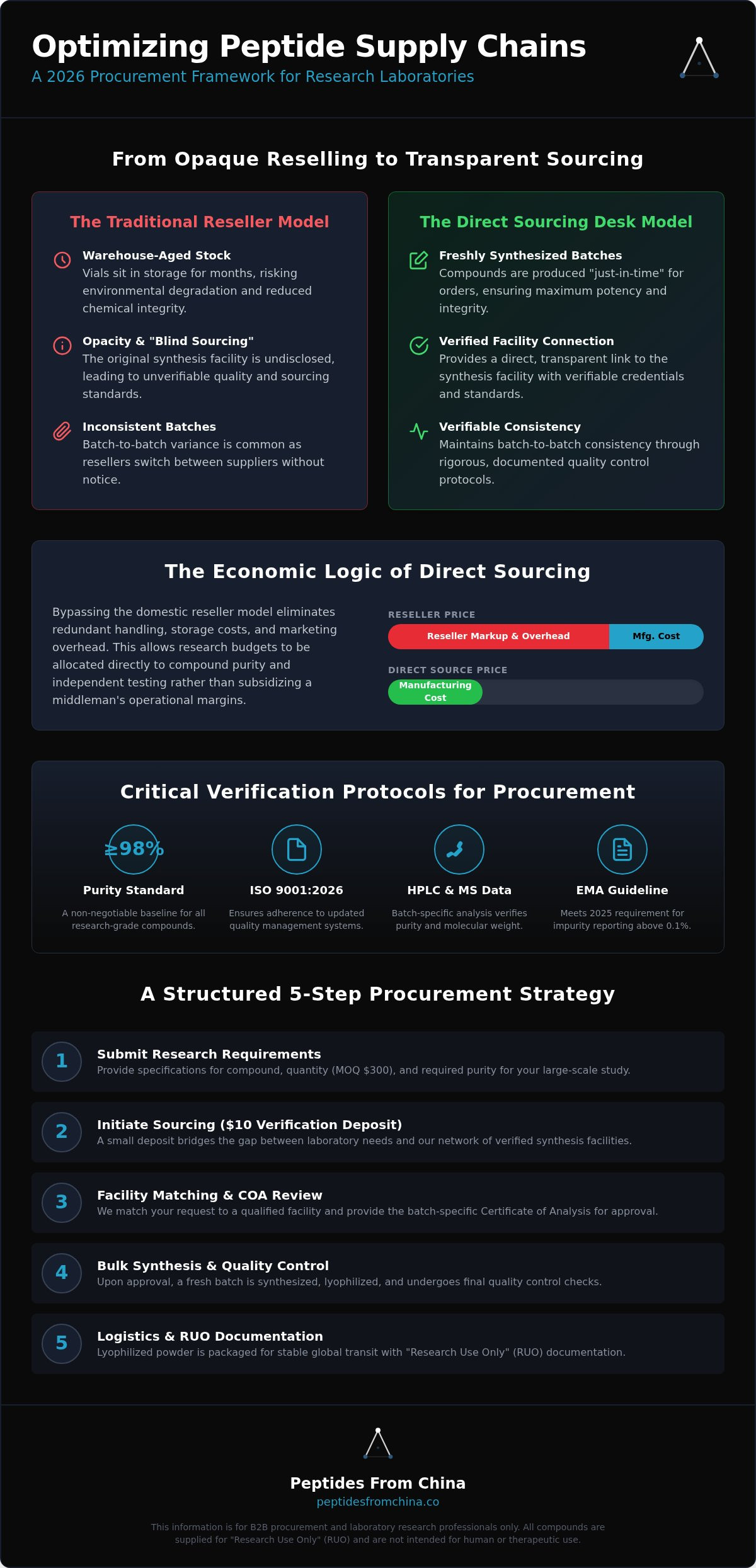
Traditional procurement often relies on domestic resellers who stock vials for months in unverified conditions. A sourcing desk operates on a fundamentally different premise. It functions as a B2B intermediary that verifies manufacturing facilities rather than hoarding inventory. This ensures that every milligram provided is the result of fresh synthesis, which consistently outperforms warehouse-aged vials that may have suffered from temperature fluctuations or chemical degradation over time. Effective peptide supply chain management for labs in 2026 requires this move toward "just-in-time" synthesis to preserve the biological activity of research compounds.
The $600 minimum is an operational minimum for orders placed through the PFC sourcing platform and may include multiple catalog products. Multiple catalog products can be combined to reach the minimum, with orders starting from one 10-vial kit per product.
How Direct Routing Ensures Batch Integrity
Tracing the journey from the synthesis reactor to the laboratory door is the only way to guarantee a secure chain of custody. when you bypass domestic hubs, the material isn't subject to repackaging, relabeling, or dilution by third parties. We utilize neutral packaging and methodical logistics to maintain supply chain stability during international transit. This direct path minimizes the "touch points" where errors or contamination typically occur. You can review the step-by-step routing process on our how it works page to understand how we maintain batch-to-batch consistency.
The Role of Verification Desks in Sourcing Transparency
The "reputable company" myth often relies on domestic branding and slick web design rather than raw analytical data. A verification desk audits synthesis facilities for adherence to ISO and GMP standards based on actual manufacturing performance. The $10 deposit initiates manual request processing and real-time stock verification and is credited toward the final invoice. This serves as a low-risk gateway for labs to access direct facility data and current batch availability. This methodical approach prioritizes factual integrity over marketing flair, treating peptide supply chain management for labs as a technical challenge rather than a retail transaction. If your procurement team has product-specific documentation or independent-testing requirements, include them when requesting a quote.
Critical Verification Protocols for Laboratory Procurement
High-level verification protocols are the primary defense against supply chain volatility. For professional procurement, the hierarchy of verification begins with the Certificate of Analysis (COA), which summarizes the batch's technical profile. However, a COA alone isn't sufficient. You must verify the High-Performance Liquid Chromatography (HPLC) chromatogram for purity and the Mass Spectrometry (MS) analysis for sequence identity. Given the significant dependency on the Chinese pharmaceutical supply chain, laboratories shouldn't rely on trust; they must rely on data-driven verification desks that act as a technical filter.
High-volume compounds, such as bulk BPC-157, require even more rigorous scrutiny. Third-party lab verification is essential because it provides an unbiased confirmation of the manufacturer's internal data. A common red flag in peptide supply chain management for labs is the use of "representative" samples. If a supplier provides an HPLC report that isn't tied to your specific batch number, the data is irrelevant. Forged reports often feature inconsistent fonts, blurred timestamps, or mismatched header information, all of which indicate a compromised supply origin.
Reading and Validating HPLC and MS Reports
HPLC measures purity by calculating the peak area of the target peptide relative to impurities detected by UV analysis. A purity level of 98% or higher is the industry standard for research-grade materials. MS analysis confirms the molecular weight, ensuring the synthesis facility followed the exact amino acid sequence required. A COA without a matching batch number is a significant supply chain risk that often precedes unacceptable batch-to-batch variance in long-term studies.
Batch Consistency and COA Authentication
Maintaining batch consistency requires cross-referencing manufacturer reports with independent third-party testing results. This double-verification method identifies discrepancies before the material enters your laboratory workflow. Products are subject to the manufacturer’s applicable quality-control procedures and specifications. Manufacturer-side analytical documentation may be available depending on the product and batch. PeptidesFromChina is not an independent analytical testing laboratory. This systematic approach ensures that every study is backed by verifiable chemical data rather than reseller promises. For a deeper understanding of our analytical standards, you can review our detailed guide on peptide quality.
Logistics and Compliance: Managing the China-to-US Supply Chain
Lyophilized powder stability allows for efficient international transit without the extreme costs of ultra-cold chain logistics. While some resellers insist on refrigerated shipping for all stages, technical stability data indicates that research peptides in powder form remain structurally sound at ambient temperatures for the duration of standard air freight. For most laboratory applications, the focus should be on moisture control and light protection rather than constant refrigeration during the transit window. Effective peptide supply chain management for labs prioritizes these technical realities to reduce unnecessary logistical overhead while maintaining chemical potency.
PFC coordinates sourcing from established Chinese manufacturing facilities together with international logistics.
Customs Compliance and Packaging Protocols
Products are subject to the manufacturer’s applicable quality-control procedures and specifications. Manufacturer-side analytical documentation may be available depending on the product and batch. PeptidesFromChina is not an independent analytical testing laboratory.
Inventory Management: MOQs and Lead Times
Manufacturer availability and lead times vary by product and current capacity. Shipping options, pricing, and estimated transit times vary by destination and are confirmed during order processing.Semaglutide and Tirzepatide powders, where high demand can influence facility scheduling. By aligning your MOQs with research milestones, you ensure a continuous flow of COA-verified material. If your lab needs to establish a recurring procurement schedule, you can request a logistics consultation to optimize your lead times.
Implementing a Direct Sourcing Strategy with Peptides From China
Transitioning away from domestic reseller dependency isn't just about cost; it's about establishing direct control over your chemical inputs. A robust peptide supply chain management for labs strategy involves five distinct steps. First, audit your current procurement overhead to identify hidden reseller markups. Second, specify your required compounds from our catalog Third, initiate the manufacturer verification process. The $600 minimum is an operational minimum for orders placed through the PFC sourcing platform and may include multiple catalog products. Finally, scale these validated batches into a long-term institutional supply chain. This methodical approach ensures that your laboratory moves from "blind sourcing" to a data-driven procurement model.
The $10 deposit initiates manual request processing and real-time stock verification and is credited toward the final invoice. If you encounter common logistical hurdles during this transition, we recommend reviewing our faq to understand our operational protocols. By prioritizing factual integrity over marketing flair, laboratories can finally secure the batch-to-batch consistency required for high-stakes research.
The Sourcing Desk Workflow: From Deposit to Delivery
Products are subject to the manufacturer’s applicable quality-control procedures and specifications. Manufacturer-side analytical documentation may be available depending on the product and batch. PeptidesFromChina is not an independent analytical testing laboratory.
Scaling Laboratory Research with Bulk Procurement
Scaling from pilot batches to institutional volume significantly reduces the cost per milligram, allowing research budgets to go further. For long-term studies involving compounds like TB-500 or GHK-Cu, the financial impact of direct sourcing is substantial. Establishing a recurring supply schedule ensures that critical reagents are always available, effectively eliminating the downtime caused by domestic supply gaps or reseller stockouts. This level of reliability is the core objective of modern peptide supply chain management for labs. To begin your manufacturer verification and secure your research pipeline, contact our sourcing desk for a formal quote.
Securing Your Research Pipeline for 2026 and Beyond
Transitioning from opaque reseller models to transparent, direct-to-manufacturer relationships is the most effective way to optimize laboratory procurement. By implementing rigorous verification protocols and understanding the logistics of international transit, laboratories can ensure that every milligram used in their studies meets the highest analytical standards. Professional peptide supply chain management for labs requires moving beyond domestic branding to focus on raw data and verifiable synthesis origins. It's a strategic shift that prioritizes study results over marketing flair.
Establishing a manufacturer-side sourcing model can reduce anonymous reseller layers and improve commercial coordination. PFC provides direct-to-manufacturer pricing together with COA-verified batches when manufacturer-side documentation is available for the relevant product and batch. Products are subject to the manufacturer’s applicable quality-control procedures and specifications. Manufacturer-side analytical documentation may be available depending on the product and batch. PeptidesFromChina is not an independent analytical testing laboratory. Our sourcing desk also coordinates international logistics. Contact the team to discuss current requirements.
Request a wholesale quote for your laboratory research today to begin your manufacturer verification. We look forward to supporting your large-scale studies with technical integrity and logistical precision.
Frequently Asked Questions
How does a peptide sourcing platform differ from a retail peptide shop?
A sourcing platform functions as a technical intermediary that verifies synthesis facilities rather than a retail shop that hoards domestic inventory. Retail shops often obscure the origin of their stock, leading to batch-to-batch variance. In contrast, our platform ensures every order is fresh synthesis with a verifiable chain of custody. This model provides superior transparency and lower milligram costs for professional peptide supply chain management for labs without middleman markups.
What is the minimum order quantity (MOQ) for lab-grade research peptides?
The $600 minimum is an operational minimum for orders placed through the PFC sourcing platform and may include multiple catalog products. This MOQ is an operational minimum for orders placed through the PFC sourcing platform and may include multiple catalog products. It ensures that even smaller research projects benefit from wholesale synthesis rates. Large-scale studies often scale beyond this minimum to secure bulk quantities of compounds like Selank or Semax while maintaining consistent batch purity across the entire study duration.
Is it legal for laboratories to import research peptides from China in 2026?
Importing peptides for research purposes remains a standard practice for laboratories in 2026. Compliance depends on using accurate "Research Use Only" (RUO) documentation and adhering to customs regulations for laboratory reagents. We provide the necessary commercial invoices and packing lists to facilitate smooth international transit. It's critical to distinguish these research-grade materials from human-grade pharmaceuticals, as the latter are subject to different regulatory frameworks that don't apply to RUO compounds.
How can I verify the purity of a wholesale peptide batch?
Manufacturer-side analytical documentation may be available depending on the product and batch; buyers requiring independent verification may arrange third-party testing separately. Effective peptide supply chain management for labs involves cross-referencing these manufacturer reports with independent third-party testing. This double-verification method identifies any discrepancies before the material enters your workflow. Always ensure the COA batch number matches the physical vials to prevent the common industry risk of receiving representative rather than batch-specific data.
What are the typical lead times for direct-to-manufacturer peptide synthesis?
Direct synthesis typically requires a lead time of 2 to 3 weeks before the material is ready for international dispatch. This duration accounts for the custom synthesis process, lyophilization, and internal quality control checks at the facility. Laboratories should plan their procurement cycles to account for this window plus international transit time. By maintaining a structured supply schedule, labs avoid research downtime and ensure a continuous pipeline of fresh reagents for their ongoing studies.
The $10 deposit initiates manual request processing and real-time stock verification and is credited toward the final invoice.
The $10 deposit initiates manual request processing and real-time stock verification and is credited toward the final invoice.
Do research peptides require cold-chain shipping during international transit?
Lyophilized research peptides are chemically stable during short-term international transit at ambient temperatures. While long-term laboratory storage requires refrigeration, the environmental stability of the powder form means that ultra-cold chain shipping is often an unnecessary expense. We prioritize moisture control and light-resistant packaging to preserve the structural integrity of the peptides during air freight. This technical approach reduces logistical overhead for compounds like GHK-Cu without compromising the biological activity of the research material.
How do I pay for wholesale peptide orders from international manufacturers?
International wholesale orders are processed through secure B2B payment channels designed for institutional procurement. We provide detailed instructions on the how to pay page to ensure a transparent and efficient transaction process. The $600 minimum is an operational minimum for orders placed through the PFC sourcing platform and may include multiple catalog products. By utilizing professional payment protocols, laboratories can manage their international sourcing budgets with the same level of security as domestic transactions.