Ipamorelin is a synthetic five-amino-acid peptide studied as a growth hormone secretagogue, and GHSR-1a assays can show that it binds and activates the ghrelin receptor and can show the intracellular and hormone responses that follow. They cannot, on their own, establish comparative selectivity, clinical efficacy, safety, or regulatory status. Each level of evidence answers a different question, and this article keeps those levels apart.
Key Takeaways
Receptor activation, intracellular signaling, hormone release, animal findings, and clinical outcomes are separate levels of evidence.
Selectivity depends on the assay, cell type, receptor expression, species, and concentration range tested.
A mechanism at GHSR-1a does not establish clinical benefit, safety, or approval status.
Specific numbers should be checked against the primary paper or trial record before they are relied on.
Table of Contents
What GHSR-1a Assays Measure
GHSR-1a is the ghrelin receptor, a G-protein-coupled receptor. Ghrelin is its principal endogenous ligand. The original pharmacology report on ipamorelin, published in PubMed record 9849822, characterized it as a growth hormone-releasing peptide acting through this receptor system. An agonist is a compound that binds a receptor and activates it.
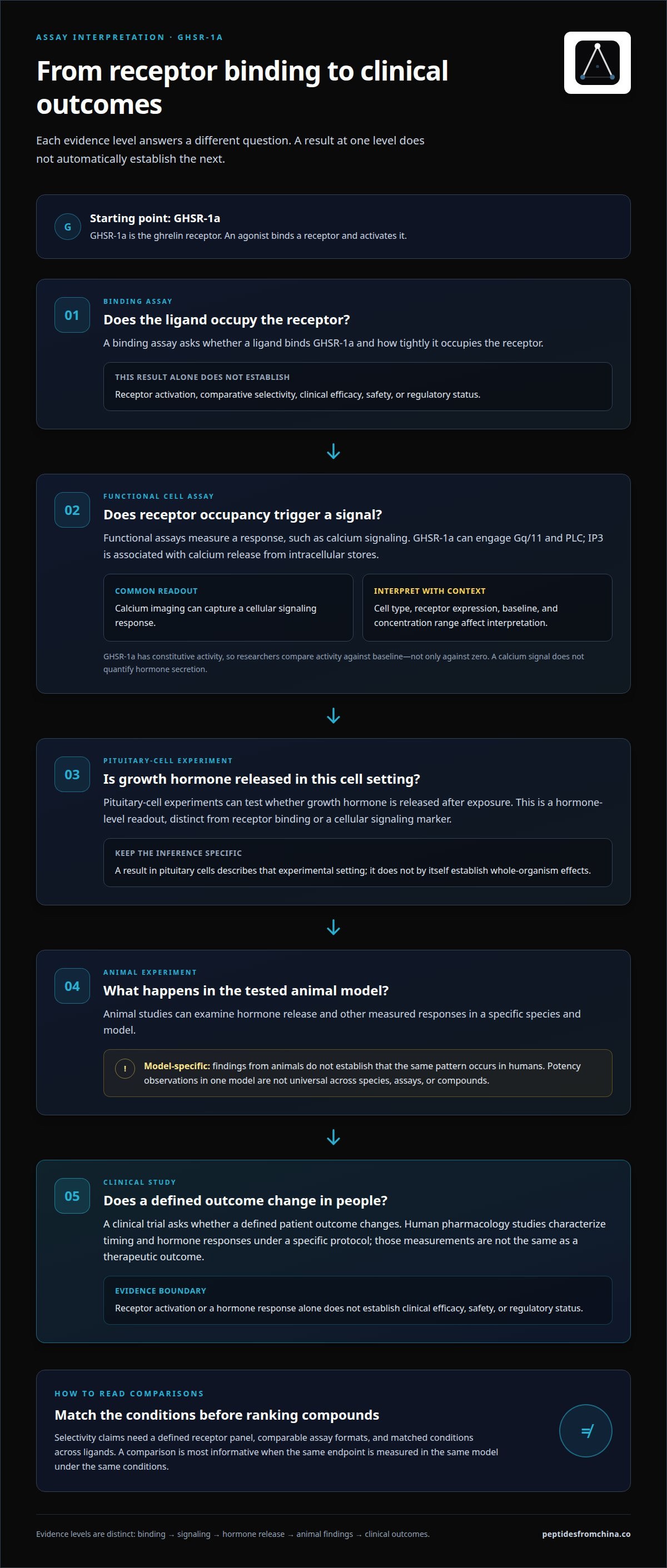
An assay captures one slice of the biology. A binding assay asks whether and how tightly a ligand occupies the receptor. A functional assay asks whether occupancy triggers a signal, such as a calcium response. A pituitary-cell or animal experiment asks whether growth hormone is released. A clinical trial asks whether a defined patient outcome changes. A positive result at one level does not transfer automatically to the next.
The receptor also shows constitutive activity, meaning some signaling occurs without a ligand. Researchers therefore compare activity against baseline, not only against zero. GHSR-1a is distinct from the shorter splice variant GHSR-1b and from the growth hormone-releasing hormone (GHRH) receptor, which carries a separate input to growth hormone regulation.
Intracellular Signaling After Receptor Activation
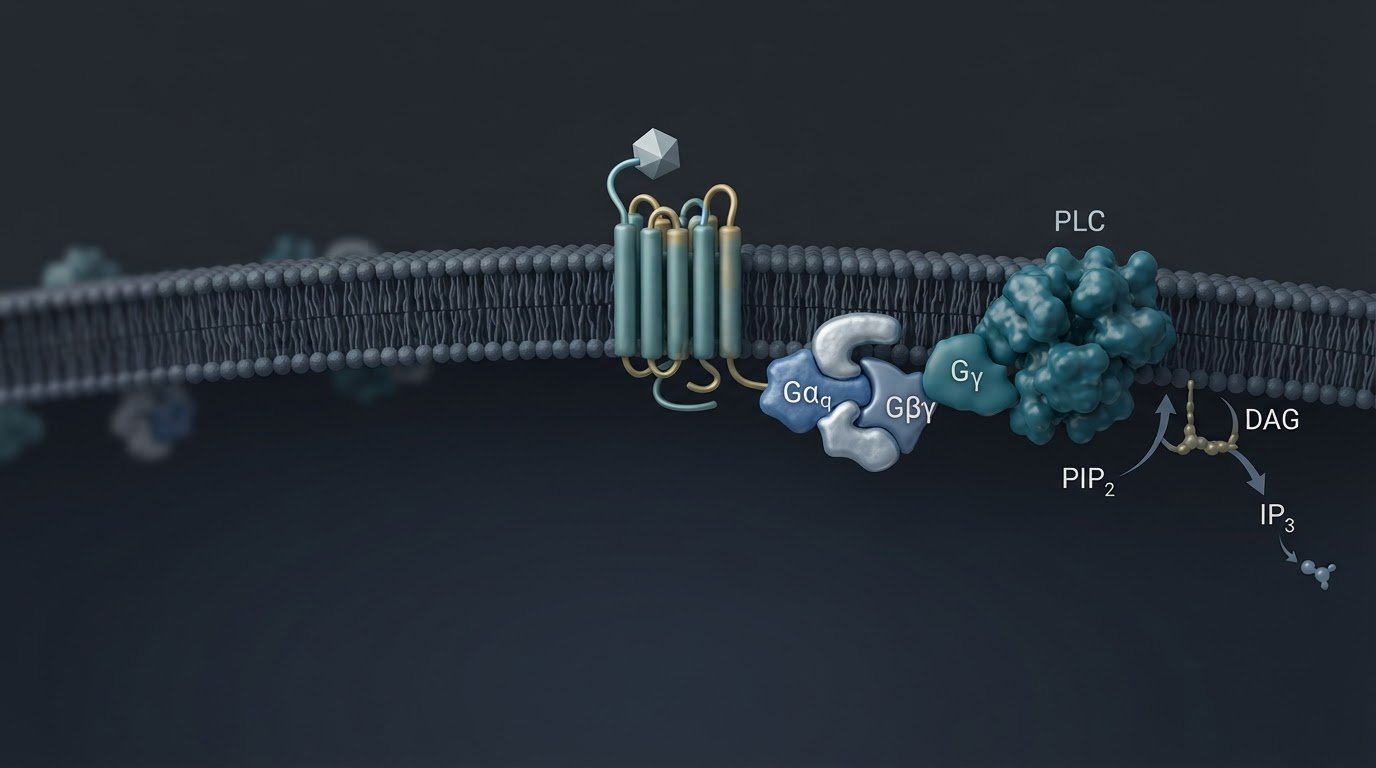
GHSR-1a activation can engage Gq/11 proteins and phospholipase C (PLC). PLC generates IP3 and DAG. IP3 is associated with release of calcium from intracellular stores, while DAG can activate protein kinase C. Calcium imaging is therefore a common readout in cell-based work.
A calcium signal is evidence of a cellular signaling step. It does not quantify hormone secretion, and it says nothing about whole-organism effects. Results also depend on how much receptor the cells express, which cell line is used, and the conditions of the assay. A calcium trace should be reported together with the cell system, the receptor expression level, the baseline used, and the concentration range, so that another group can interpret the result in the same way.
PI3K/Akt and mTOR are linked to cellular growth and nutrient signaling. A Gq/11 and PLC finding does not show that either pathway was activated by ipamorelin. Those pathways must be measured directly before a response is attributed to them.
Binding Affinity and Selectivity: What Can Be Concluded
Describing ipamorelin as a GHSR-1a agonist is a statement about mechanism. It is not a numerical affinity value, and it does not prove selectivity against every other target. Selectivity claims need a defined panel of receptors, comparable assay formats, and matched conditions across ligands.
Ligand bias adds a further layer. Different ligands can produce distinct signaling profiles through the same receptor, so an assay measuring one pathway characterizes that pathway only. The original pharmacology report compared ipamorelin with other secretagogues such as GHRP-6, and such comparisons are most informative when the same endpoint is measured under the same conditions in the same model.
Ghrelin and ipamorelin share a receptor but are not interchangeable. The evidence summarized here supports a mechanistic description, not a ranking of secretagogues. A ranking would require the same readout, the same cell system, and the same concentration series for every compound, measured together rather than assembled from separate papers that used different formats.
Receptor Expression and Regulation
GHSR signaling has been investigated in the hypothalamus, pituitary, central nervous system, gastrointestinal-associated systems, and metabolic tissues. Expression determines which cells can respond, so a finding in pituitary cells describes that setting and not every tissue.
Expression is not fixed. Receptor levels can change in response to other hormonal signals, and reports of this kind depend on the species and model. They should be read in the original paper before being cited as a general rule, and no figure is given here for that reason.
After activation, G-protein-coupled receptors can be phosphorylated, bind arrestins, and be internalized from the cell surface. Some recycle to the membrane. These processes are a framework for explaining why responses can change over repeated or prolonged exposure, but outcomes vary with the cell system. Assay design matters here: the length of exposure, the washout steps, and the time of measurement all influence whether a reduced response reflects desensitization, internalization, or simply a different experimental window.
Hormone Release and Animal Findings
GHSR-1a activity is associated with growth hormone release from pituitary somatotrophs. The preclinical report examined growth hormone release after ipamorelin exposure in animal models and looked at whether other pituitary-related hormones, such as cortisol and ACTH, changed alongside it. It discussed differences from GHRP-6 in these secondary responses.
These are species-specific observations. A dose giving half the maximal effect in one model is not a universal potency measure across species, assays, or compounds. Animal data can support hypotheses about hormonal profile; they do not establish the same pattern in humans.
Because GHSR-1a and the GHRH receptor are separate, the two pathways can in principle interact. Any such interaction must be shown in the specific model and protocol, and it should not be assumed from the receptor biology.
Appetite and Metabolic Signaling
Because ghrelin signals through GHSR-1a and is associated with appetite, the receptor is relevant to energy regulation. Hypothalamic networks integrate signals about energy status, and GHSR activity is one input among many. It is not a stand-alone explanation of feeding behavior.
The same receptor does not guarantee the same effect for every ligand. Appetite-related outcomes must be measured directly, in a model suited to feeding, instead of inferred from receptor activation or growth hormone release. A cell-signaling marker, a change in food intake, and a metabolic endpoint are three different findings. Each needs its own method, its own controls, and its own interpretation.
Human Studies and Clinical Evidence
Human work falls into two groups: pharmacology studies in healthy volunteers and clinical trials in patients. Pharmacology studies characterize timing and hormone responses under a specific protocol. They describe measured pharmacokinetics and pharmacodynamics, not therapeutic effect.
The clinical trial most often cited was a phase 2 study of intravenous ipamorelin in adults recovering from bowel resection. The published report found no statistically significant benefit over placebo on the primary endpoint, and the registry record NCT00672074 lists the design and outcome measures. The trial tested a clinical endpoint in one patient group; it did not test receptor activation alone, and it does not generalize to other conditions.
A separate phase II dose-finding study is registered as NCT01280344. It is a different study with its own design, and its registry entry should be read on its own terms rather than combined with the bowel-resection findings.
The bowel-resection result shows why a clear mechanism is not enough. A compound can activate its receptor and raise a hormone and still fail to change a clinical outcome. The receptor-level and hormone-level findings described above are best read as characterization of mechanism, and the clinical question is answered only by the trial record and the published report.
Regulatory Status and Safety
Receptor studies say nothing about regulatory approval. Ipamorelin is an investigational peptide, and legal status depends on the jurisdiction and the context of use. The FDA has published review material on this subject, available in its official document, and readers needing a definitive position should consult it and the regulator directly.
Safety is likewise a separate question. Preclinical reports of effects on cortisol or prolactin concern specific hormone measurements in specific models. They are not an adverse-effect profile, and they do not establish human safety or long-term effects. Each safety statement needs its own dataset, with defined endpoints, a defined population, and a defined observation period.
Matching Claims to Evidence
ClaimEvidence that can support itEvidence that cannot Ipamorelin activates GHSR-1aBinding and functional receptor assaysA hormone level alone It engages Gq/11 and PLC signalingCalcium or IP3 measurements in cellsAnimal hormone data It releases growth hormonePituitary-cell, animal, or volunteer hormone measurementsReceptor binding alone It is more selective than another secretagogueMatched, multi-target assays under identical conditionsCross-study comparisons It improves a clinical outcomeControlled clinical trialsMechanistic or animal data
Peptides From China: Ipamorelin
Peptides From China is a B2B sourcing platform that coordinates manufacturer sourcing, availability confirmation, specifications, order processing, and international logistics for laboratory buyers. Ipamorelin is listed on the Ipamorelin catalog page. All catalog products are for laboratory research use only, not for human or veterinary use.
Manufacturer-side specifications and quality-control documentation vary by product, manufacturer, and batch. The peptide quality page and the FAQ explain how the process works. For questions about research sourcing, contact Peptides From China.
Conclusion
GHSR-1a assays are well suited to showing receptor engagement and early signaling. They become weaker evidence at each step toward selectivity rankings, clinical effect, safety, and approval. Matching each claim to the level of evidence that can support it, and reading the primary paper or trial record for the numbers, is the most reliable way to approach this literature.
Frequently Asked Questions
What is GHSR-1a?
GHSR-1a is the ghrelin receptor, a G-protein-coupled receptor expressed in the pituitary, hypothalamus, and other tissues. Ghrelin is its principal endogenous ligand.
Which signaling pathway do cell assays measure?
Many assays measure Gq/11 and phospholipase C signaling, usually through calcium or IP3 readouts. These show a cellular signaling step, not hormone secretion or an organism-level effect.
Do the assays prove ipamorelin is selective?
No. Selectivity requires matched assays across a defined receptor panel and comparators under identical conditions. An agonist label or a hormone response cannot establish it.
What do animal studies add?
They report growth hormone release and secondary hormone measurements in specific species. These findings are model-specific and do not predict human outcomes.
Is ipamorelin approved?
Receptor studies do not address approval. Regulatory status should be confirmed with the relevant regulator, starting with the FDA document cited above.