
A blue tint and a downloaded HPLC report don't guarantee your GHK-Cu is authentic. They're merely the baseline entry requirements in a market frequently plagued by batch substitution and reused COAs. If you're sourcing for high-volume research or formulation, finding a reliable GHK-Cu wholesale supplier means looking past the marketing fluff of domestic resellers who often add significant markups to products they never technically verified. You already know that the peptide industry's lack of transparency creates operational risks, from inconsistent synthesis quality to fraudulent analytical data that doesn't match the physical shipment.
This guide provides a professional framework for navigating the direct-to-manufacturer landscape. You'll learn how to evaluate supplier-issued papers as reference material rather than definitive proof, and why independent testing remains a non-negotiable step for any serious buyer. We'll outline the current July 2026 market dynamics, including the 98% purity standards required for professional-grade powder and the logistical realities of international procurement. By focusing on a transparency-first approach, such as the $600 minimum order protocols used by sourcing bridges like Peptides From China (PFC), you can eliminate unnecessary middleman layers and establish a more predictable, data-driven supply chain for your research needs.
Key Takeaways
Market pricing and availability can vary substantially by supplier, product, order size, and current conditions; exact comparisons require current, like-for-like data.
Table of Contents
The GHK-Cu Wholesale Landscape: Understanding the Reseller Problem
Technical Standards for Wholesale GHK-Cu Powder
Evaluating GHK-Cu Wholesale Suppliers: A 2026 Checklist
Managing Bulk Procurement: Minimums and Deposits
Peptides From China: Your Direct GHK-Cu Sourcing Bridge
The GHK-Cu Wholesale Landscape: Understanding the Reseller Problem
The Copper peptide GHK-Cu is a tripeptide with a high affinity for copper ions, widely utilized in research focusing on tissue remodeling, skin regeneration, and anti-inflammatory pathways. In a professional research context, procurement usually involves sourcing high-purity lyophilized powder in bulk. However, the path to obtaining this material is often obscured by a dense layer of domestic resellers who position themselves as primary sources. These entities rarely manufacture the peptides they sell; instead, they operate as logistical intermediaries that buy from large-scale synthesis facilities and repackage the product for retail or small-scale research use.
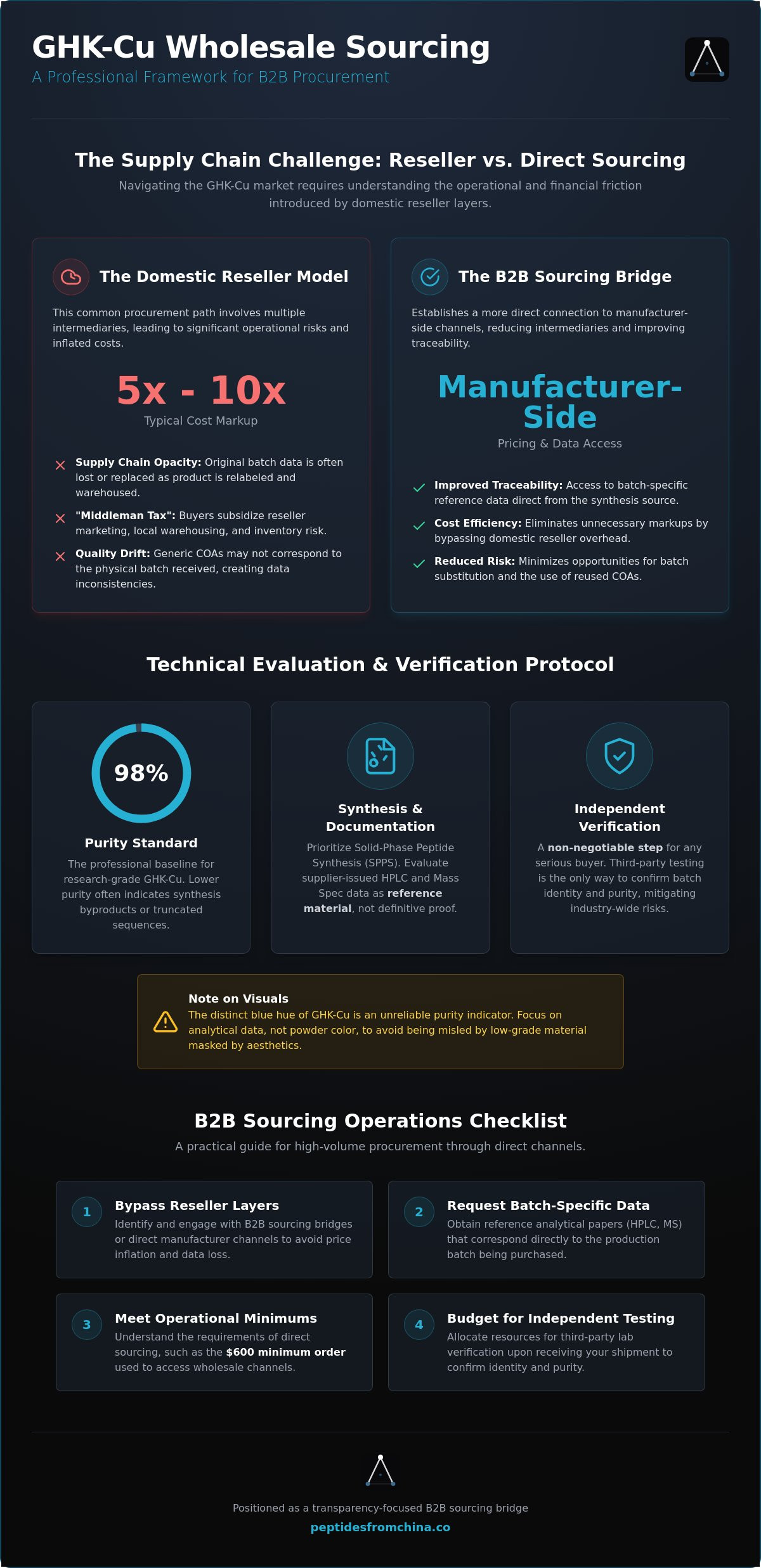
This traditional procurement model introduces significant financial and operational friction. When you engage with a domestic GHK-Cu wholesale supplier that maintains local inventory, you aren't just paying for the peptide. You're subsidizing their marketing budgets, domestic warehousing overhead, and the risk they take on by holding stock. This "middleman tax" frequently inflates the final price by 5x to 10x compared to direct manufacturer rates. For laboratories or commercial formulators requiring kilogram-scale quantities, these markups represent a massive drain on procurement budgets without adding any tangible value to the chemical integrity of the product.
The Economics of Domestic vs. Direct Sourcing
The price discrepancy between domestic retail vials and direct manufacturer powder is stark. In the 2026 market, a single 50mg vial from a domestic reseller can cost as much as a full gram of raw powder sourced closer to the synthesis facility. These resellers often justify high prices by claiming "US-Sourced" status, yet the technical reality is that the vast majority of global peptide synthesis occurs in specialized facilities in China. By bypassing these domestic layers and utilizing a sourcing bridge like Peptides From China (PFC), researchers can access manufacturer-side pricing. This approach requires a professional commitment, such as a $600 minimum order, but it drastically improves the cost-per-gram economics for high-volume operations.
Supply Chain Opacity and Quality Drift
Beyond cost, the reseller model creates a traceability vacuum. When a peptide is re-labeled and moved between multiple warehouses, the original batch-specific analytical data is often lost or replaced with generic, "representative" HPLC reports. This practice leads to quality drift, where the documentation provided doesn't actually correspond to the physical batch in the vial. A "US-Sourced" label frequently just means the product was "US-Warehoused" after being imported in bulk. Establishing a direct link to the synthesis facility helps reduce supply chain uncertainty by ensuring that the reference analytical data, while still requiring independent verification, originates directly from the production source rather than an anonymous reseller's database.
Technical Standards for Wholesale GHK-Cu Powder
High-volume procurement of GHK-Cu requires a shift from visual assessment to rigorous analytical standards. While the market is flooded with varying grades of material, a professional GHK-Cu wholesale supplier should prioritize Solid-Phase Peptide Synthesis (SPPS) for research applications. SPPS allows for the precise assembly of the glycyl-L-histidyl-L-lysine sequence before the copper ion is chelated. This method is generally superior to liquid-phase synthesis for maintaining the 98% purity baseline required in professional research. Lower purity levels often indicate the presence of unreacted reagents or truncated sequences, which can compromise the integrity of a scientific review of GHK peptide pathways or experimental outcomes.
The distinct azure hue of GHK-Cu is a frequent point of discussion among buyers. While pure copper peptides naturally exhibit this blue color due to the chelation of copper ions, color is a subjective metric and an unreliable indicator of actual purity. Some low-grade suppliers may rely on the "blue" aesthetic to mask poor synthesis protocols. Technical buyers should ignore the visual depth of the powder and focus instead on the chelation ratio and the absence of free copper, which can be toxic in sensitive biological models. For those seeking a direct route to verified synthesis facilities, accessing manufacturer-side channels helps ensure that technical specifications take precedence over marketing aesthetics.
Analytical Verification Methods
Every bulk shipment must be accompanied by batch-specific analytical data. High-Performance Liquid Chromatography (HPLC) is utilized to determine the purity percentage by separating the peptide from synthesis byproducts. Mass Spectrometry (MS) then confirms the molecular weight, ensuring the identity of the GHK-Cu molecule. It is a critical industry reality that these documents should be treated as reference analytical data rather than absolute guarantees. Independent third-party testing remains the only way to confirm that the physical powder matches the provided documentation, as reused or edited HPLC reports are common in the reseller market.
Cosmetic vs. Research Grade GHK-Cu
Evaluating GHK-Cu Wholesale Suppliers: A 2026 Checklist
Selecting a GHK-Cu wholesale supplier in 2026 requires a departure from retail-style purchasing. Professional procurement involves a systematic audit of a supplier's operational infrastructure. While many entities claim to be manufacturers, true synthesis facilities are distinguished by their ability to provide batch-specific data and transparent lead times. You must verify that the documentation provided isn't a recycled template from a previous year. Given the scientific review of GHK-Cu's regenerative properties, the stakes for purity are high. Any deviation in synthesis can lead to variable research outcomes and wasted resources.
Vetting the Synthesis Facility
Professional buyers should ask about current batch capacity and lead times for GHK-Cu synthesis in 2026. If a supplier claims immediate availability for multi-kilogram orders without a lead time, it often suggests they're a reseller clearing old stock rather than a manufacturer. Request recent HPLC reports that include a timestamp and batch number. We recommend viewing these as reference material and prioritizing peptide testing by independent third-party laboratories. Utilizing a sourcing deposit model helps align the interests of the buyer and the sourcing bridge during this verification phase, providing a layer of protection before full payment.
Logistics and International Customs
Managing high-volume peptide orders requires realistic international-logistics planning. PeptidesFromChina coordinates manufacturer-side sourcing, while international delivery may involve a forwarder or logistics partner. Its $600 total minimum is an operational order threshold and is not a guarantee of a particular insurance, tracking, or chain-of-custody arrangement. Shipping details are confirmed during order processing.
Managing Bulk Procurement: Minimums and Deposits
Operational efficiency in the peptide market is dictated by volume. When engaging with a GHK-Cu wholesale supplier, the $600 minimum order requirement serves a practical purpose. This threshold ensures that the logistical costs of international shipping and the technical effort of manufacturer coordination are economically viable. For researchers, this minimum represents a shift from reactive, small-scale purchasing to a strategic procurement model that reduces the average cost per gram. By consolidating requirements into larger shipments, you minimize the "middleman tax" discussed earlier and improve the predictability of your supply chain. It's a method that prioritizes long-term research stability over the convenience of retail-style shopping.
Small, frequent orders don't just cost more; they increase your exposure to customs delays and handling errors. Each shipment represents a new point of failure in the logistics chain. By hitting the wholesale minimum, you're able to utilize more robust shipping protocols and neutral packaging that isn't cost-effective for single-vial transactions. This approach aligns with the needs of professional laboratories that value operational consistency and factual integrity over marketing flair. It's about building a reliable bridge to synthesis facilities rather than chasing the lowest price on a single vial.
The Sourcing Deposit Process
We utilize a $10 sourcing deposit to initiate the manufacturer verification phase. This small commitment allows us to verify current stock levels and request batch-specific synthesis papers before you commit to a final invoice. It's a protective measure designed to mitigate the risk of "out of stock" substitutions or delays that often plague the reseller market. Once the documentation is reviewed and the batch is confirmed, the deposit is applied to your total, ensuring a transparent transition from inquiry to fulfillment. This process helps reduce supply chain uncertainty by providing a verification window prior to large-scale capital allocation.
Strategic Wholesale Ordering
Calculating the ROI of bulk GHK-Cu procurement requires looking beyond the unit price. Frequent small orders accumulate significant shipping fees and customs risks over time. Many laboratories optimize their logistics by combining GHK-Cu with other research materials, such as the tb-500 peptide, to meet the $600 threshold while diversifying their inventory. Understanding the wholesale peptides pricing structures is essential for long-term budget planning when selecting a GHK-Cu wholesale supplier for institutional collaboration. Bulk orders support consistent research parameters by ensuring that an entire project utilizes a single synthesis batch, eliminating the variable of batch-to-batch inconsistency. To begin your procurement audit, you can review our wholesale sourcing protocols.
Peptides From China: Your Direct GHK-Cu Sourcing Bridge
Peptides From China (PFC) functions as a strategic B2B sourcing bridge. We don't operate as a manufacturer or a testing lab. Instead, we act as a transparency-focused intermediary that helps researchers identify and access manufacturer-side channels. By selecting PFC as your GHK-Cu wholesale supplier, you're effectively removing the domestic reseller layers that inflate costs and obscure the chain of custody. Our model is built on the reality that while documentation like COAs and HPLC reports are essential, they are reference analytical data that require independent verification by the buyer. This approach helps reduce supply chain uncertainty, allowing you to allocate your research budget toward actual materials rather than middleman markups.
The transition from a sourcing request to lab delivery is handled with technical precision. Once you submit your requirements, we engage with synthesis facilities to confirm batch availability and lead times for 2026. We collect the manufacturer-issued papers for the specific batch in question, providing them to you as a baseline for your own analytical protocols. After the $600 minimum order is met and the logistics are finalized, the product is shipped in neutral packaging to ensure a smooth transition through international customs. This methodical flow ensures that you aren't just buying a product, but are securing a transparent supply route.
Our Operational Protocol
We vet manufacturing partners based on their synthesis capacity and historical consistency. To maintain order integrity, we utilize a $10 processing deposit. This small fee initiates the formal verification of current stock and the collection of batch-specific synthesis papers. It ensures that we're only moving forward with orders that meet your technical requirements. This protocol protects the $600 minimum order threshold, ensuring that every wholesale procurement is grounded in factual verification rather than marketing promises. It's a system designed to help global researchers access consistent compounds without the logistical anxieties of unguided international sourcing.
Why Researchers Choose PFC
Transitioning away from the retail vial experience is a necessary step for institutional and large-scale research. Our peptide sourcing platform provides the infrastructure needed to navigate complex synthesis and logistics. Researchers choose PFC because we prioritize operational realism over sales hype. We don't offer "guaranteed purity"; we offer a transparent pathway to independent verification. Whether you require standard bulk powder or have custom GHK-Cu synthesis requirements, our role is to facilitate a direct, data-driven connection to the production source. This model improves traceability and supports the long-term consistency of your research parameters.
Establishing a Transparent GHK-Cu Supply Chain
Transitioning to a direct-to-manufacturer model is the most effective way to optimize your research budget and improve batch traceability. By moving past the inflated pricing of domestic resellers, you gain access to the raw economics of the global synthesis market. It's essential to remember that while HPLC and MS reports provide necessary reference analytical data, they don't replace the need for independent buyer verification. Success in high-volume procurement depends on methodical vetting and a commitment to operational transparency over marketing flair.
Selecting a reliable GHK-Cu wholesale supplier involves more than just comparing price points; it requires a partner that understands the nuances of international logistics and neutral packaging. Peptides From China facilitates this connection by providing a streamlined B2B bridge that prioritizes factual integrity. With our $600 minimum order protocol and $10 sourcing deposit, we help you navigate the complexities of the Chinese manufacturing landscape with professional precision. We coordinate sourcing from established Chinese manufacturing facilities together with international logistics. Manufacturer-side analytical documentation may be available depending on the product and batch.
Request a GHK-Cu Wholesale Quote with a $10 Sourcing Deposit
Secure your research parameters today with a supply chain built on data and manufacturer-side sourcing access.
Frequently Asked Questions
What is the standard purity for wholesale GHK-Cu powder?
Professional research standards require GHK-Cu powder to have a purity of 98% or higher. This level is verified through High-Performance Liquid Chromatography (HPLC) and Mass Spectrometry to ensure the correct molecular identity. While lower purity grades exist for cosmetic applications, they often contain synthesis byproducts that can interfere with sensitive research models. You should always treat provided documentation as reference analytical data rather than an absolute guarantee of purity.
How much GHK-Cu should I order to qualify for wholesale pricing?
Wholesale pricing is determined by order volume rather than a specific gram amount. To access manufacturer-side rates through our sourcing bridge, your total order must meet the $600 minimum requirement. This threshold allows us to consolidate shipments and provide the logistical infrastructure necessary for high-volume procurement. It's the most efficient way for laboratories and formulators to reduce the high markups typically associated with domestic resellers.
Does Peptides From China provide HPLC reports for GHK-Cu?
Manufacturer-side analytical documentation may be available depending on the product and batch. These documents help improve traceability by showing the synthesis facility's internal results. However, it is an industry reality that reports can be reused or edited by unscrupulous actors. We strongly encourage all buyers to conduct independent third-party testing to verify that the physical product matches the provided analytical data.
What is the minimum order requirement for GHK-Cu wholesale?
The minimum order requirement for wholesale procurement is $600. This amount ensures that the logistical costs of tracked international shipping and the administrative effort of manufacturer vetting are justified. Operating as a GHK-Cu wholesale supplier bridge requires this volume to maintain neutral packaging protocols and ensure a reliable chain of custody. Smaller orders are generally better suited for retail domestic resellers who charge higher per-unit prices.
How is GHK-Cu packaged for international shipping?
GHK-Cu is shipped in neutral, discreet packaging to facilitate smooth transit through international customs. The lyophilized powder is typically contained in vacuum-sealed vials or bulk foil pouches, depending on the total volume ordered. This method protects the peptide from light and moisture during transit. Using neutral labels helps reduce supply chain uncertainty and ensures that the laboratory receives the material without unnecessary delays or handling-related contamination risks.
Can I verify the manufacturer before paying the full invoice?
Yes, our $10 sourcing deposit initiates a formal verification phase before you commit to the full invoice. This process allows us to confirm current batch availability and obtain the latest synthesis papers from the facility. If the manufacturer's documentation doesn't meet your technical standards, the deposit protects you from allocating large-scale capital to an unsuitable batch. It's a transparency-first protocol designed to align the interests of the buyer and the sourcing intermediary.
What is the difference between GHK-Cu powder and GHK-Cu serum?
How long does international shipping take from Chinese facilities?
Shipping options, pricing, and estimated transit times vary by destination and are confirmed during order processing. Any production or availability lead time is separate from transit time.