
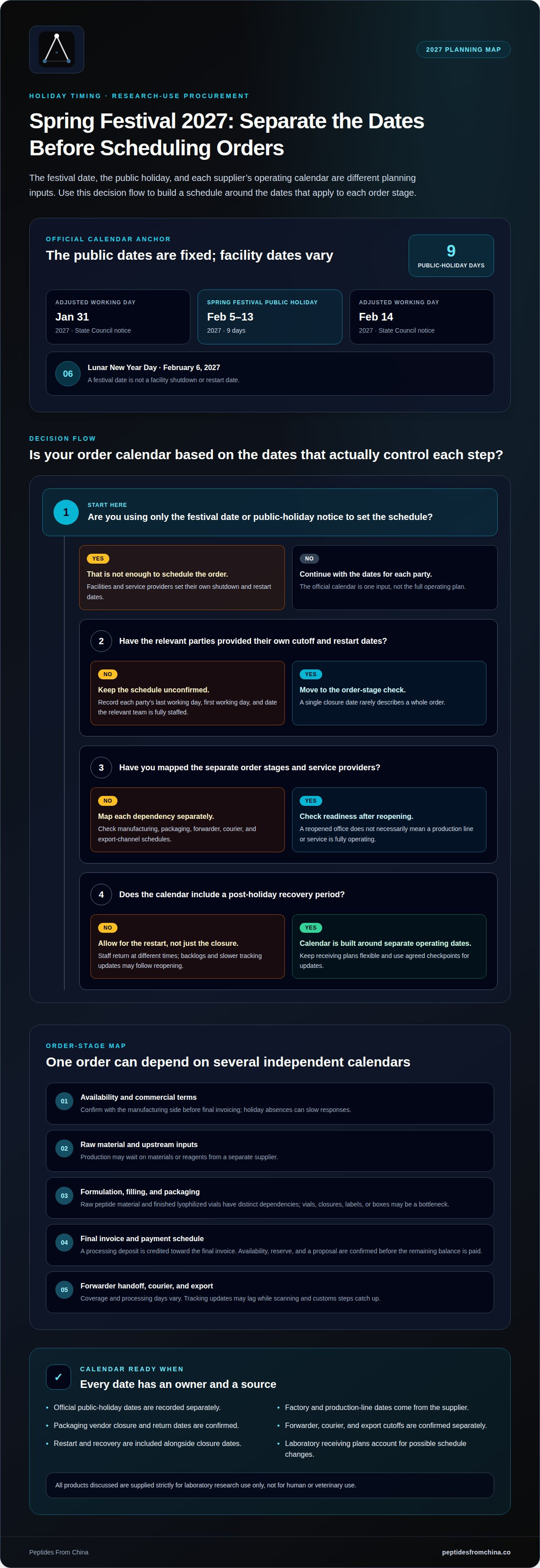
Chinese New Year 2027 falls on February 6, and the festival date is only one part of the planning window. The State Council's official 2027 holiday notice sets the Spring Festival public holiday at February 5–13, 2027 (9 days), with January 31 and February 14 as adjusted working days. Factories, packaging vendors, forwarders, and couriers set their own shutdown and restart dates, which vary by facility and carrier and must be confirmed directly.
This guide separates the three layers of timing, shows how holiday pauses touch each step of a peptide order, and ends with a checklist for the 2027 cycle. All products discussed are supplied for laboratory research use only.
Key Takeaways
Treat the festival date, the official public holiday, and each facility's shutdown as three separate sets of dates.
Factories, packaging vendors, forwarders, domestic couriers, and export channels do not pause or restart together; confirm each one directly.
Map order confirmation, filling, packaging, final invoicing, and forwarder handoff against each party's calendar.
Plan for a recovery period after reopening, including slower tracking updates and delayed responses.
Obtain current cutoffs from the actual parties involved rather than relying on a single published duration.
Table of Contents
Three Layers of Holiday Timing
Chinese New Year is also called Spring Festival in China, and Lunar New Year is the broader label used across several cultures. In supplier conversations, the name matters less than the dates attached to it. Three layers apply.
Festival date: February 6, 2027, Lunar New Year Day.
Official public holiday: February 5–13, 2027 (9 days), with January 31 and February 14, 2027 as adjusted working days, per the State Council notice.
Facility shutdown: the days a specific factory, production line, packaging vendor, forwarder, or courier actually stops work. This may begin before the public holiday and end after it, and it is not set by the notice.
The public holiday is announced by the government and can include adjusted working days around it. A supplier's own calendar is the only source for its closure. Ask for the last production day, the first working day, and the date the relevant team is fully staffed.
Keep these three sets of dates in separate columns of your planning sheet. Mixing them is the most common source of confusion, because a statutory date tells you nothing certain about when a particular line will run. Record the source next to every date, and mark anything a supplier has only said verbally as unconfirmed until it is in writing.
The Supply Chain Does Not Pause Uniformly
A single closure date rarely describes a whole order. Several parties handle a peptide shipment, and each keeps its own schedule:
Manufacturing facilities: synthesis, formulation, and filling teams may stop and restart at different times.
Packaging vendors: vials, labels, and boxes come from separate suppliers with their own closures.
Freight forwarders: handoff and consolidation staff may have limited coverage.
Domestic couriers: pickup within China can be restricted during and after the holiday.
Export channels: customs and carrier processing follow their own operating days.
No single duration applies to all of these. A facility that has reopened may still wait for a packaging component, and a forwarder that is working may be waiting on a courier. Confirm each party's dates directly with the people responsible, and treat any general estimate as a starting question rather than an answer.
It also helps to ask each party what happens to work already in progress. Some teams finish current tasks before stopping, while others pause mid-process. The answer shapes which of your orders are affected, so ask it for each order rather than for the supplier in general. Request the reply in writing and keep it with the order record.
Where Holidays Touch a Peptide Order
Peptide procurement has distinct stages, and a holiday can affect each in a different way. It helps to separate raw peptide material from finished lyophilized vials, since formulation, filling, and packaging are separate dependencies.
Order confirmation and availability
Availability and commercial terms are confirmed with the manufacturing side before final invoicing. During a holiday period, the people who confirm this may be away, so responses can slow. Submit requests early enough that confirmation does not land inside a closure.
Raw material and component availability
Synthesis depends on raw materials and reagents from upstream suppliers. If one of those suppliers is closed, production can wait even when the main facility is open. Ask what inputs an order needs and whether any come from a separate vendor.
Formulation, filling, and packaging
Filling and packaging require vials, closures, labels, and boxes. Each is a potential bottleneck. A finished lot can sit waiting for packaging components, so ask the supplier to name which step is the current constraint rather than accepting a general status.
When several items are on one request, ask whether they depend on the same packaging components or on different ones. Items that share a component can wait on the same vendor, while items with separate components may move on different schedules. Knowing this lets you decide whether to receive items together or in stages.
Final invoice and payment schedule
At Peptides From China, a processing deposit is paid after the request is submitted, and it is credited toward the final invoice. Availability, reserve, and a proposal are confirmed before the remaining balance is paid. Because confirmation depends on the manufacturing side, a holiday can move the date on which the final invoice is ready. Agree internally on who approves the invoice and how quickly, so payment does not become the delay.
Forwarder handoff and tracking
After final payment, orders are processed before hand-over to the carrier. Holiday coverage can affect that handoff, and tracking updates may lag while scanning and customs steps catch up. A quiet tracking page does not always mean a shipment has stopped. Customs handling times are outside anyone's direct control, so keep your own receiving schedule flexible.
Ask the forwarder what it needs from you at handoff, such as consignee details and receiving contacts, and have these ready in advance. Missing paperwork or an unreachable contact can add delay that has nothing to do with the holiday. Confirm cutoffs and handling dates directly with the carrier or forwarder, since they differ by party.
The Recovery Period After Reopening
A reopening date is not the same as normal operations. Employees return at different times, backlogged orders queue up, and suppliers answer messages in the order received. Courier and forwarder volumes can also be elevated as held cargo moves.
Ask suppliers three separate questions: when the office reopens, when the relevant production line restarts, and when it is expected to handle new instructions. Office reopening alone does not show that filling or packaging has resumed.
Build the recovery period into your own schedule. If your laboratory needs material by a fixed date, set an internal buffer that includes the post-holiday restart rather than the holiday date alone. Because suppliers can only estimate their own return to full capacity, ask for updates at agreed checkpoints.
Record each revised date as it arrives and note who gave it. A running log makes it easy to see which party is the current constraint and whom to contact next. Share the log with your receiving team so that storage space and staffing are ready when the shipment arrives.
A 2027 Timeline to Build Your Calendar
Use this structure to build a calendar from official and supplier sources. Dates marked as supplier-provided must come from the parties involved.
MilestoneDate or source Adjusted working dayJanuary 31, 2027 (State Council notice) Spring Festival public holidayFebruary 5–13, 2027 (State Council notice) Lunar New Year DayFebruary 6, 2027 Adjusted working dayFebruary 14, 2027 (State Council notice) Factory and production line shutdown and restartSupplier-provided; varies by facility Packaging vendor closure and returnSupplier-provided Forwarder, courier, and export cutoffsProvided by each party; varies by carrier
Coordinating Research-Compound Sourcing Around Holidays
Peptides From China is a B2B sourcing platform that coordinates manufacturer sourcing, specifications, availability confirmation, order processing, and international logistics support. Using one coordinated request lets a buyer raise timing questions with a single point of contact instead of chasing several parties separately. Products are supplied for laboratory research use only.
The standard minimum order is USD 300 in goods, and a new buyer's first trial order has no minimum requirement. The minimum is a commercial term, not a measure of product quality. Details on process and payment are on the How It Works and How to Pay pages, and the FAQ covers common questions. For a broader view of the process, see the peptide supply chain management guide.
When you submit a request ahead of a holiday, state your required arrival window, and ask which stages are likely to fall inside a closure. You can contact Peptides From China to discuss timing for your request.
Include in your request the delivery address, the receiving contact, and the person who will approve the final invoice. Having these details in one place lets the coordination team raise questions with the relevant parties early, and it keeps the holiday period from adding avoidable back-and-forth.
Operational Checklist
Record the official public holiday (February 5–13, 2027), the adjusted working days (January 31 and February 14), and Lunar New Year Day (February 6).
Define the date your laboratory needs the material and work backward.
Ask each party for its last working day, first working day, and full-staffing date.
Identify raw material, vial, label, and box suppliers and confirm their schedules.
Submit requests early enough that availability confirmation and the proposal land before closures.
Assign an owner to approve the final invoice quickly.
Ask the forwarder and courier about handoff coverage and tracking update timing.
Set an internal buffer that includes the recovery period.
Schedule checkpoint messages after reopening and record every revised date.
Conclusion
Plan 2027 around written dates from each party, not a single holiday label. Start from your required delivery window, confirm every dependency, and leave room for the recovery period. A short calendar with named owners will do more for your schedule than any general estimate.