
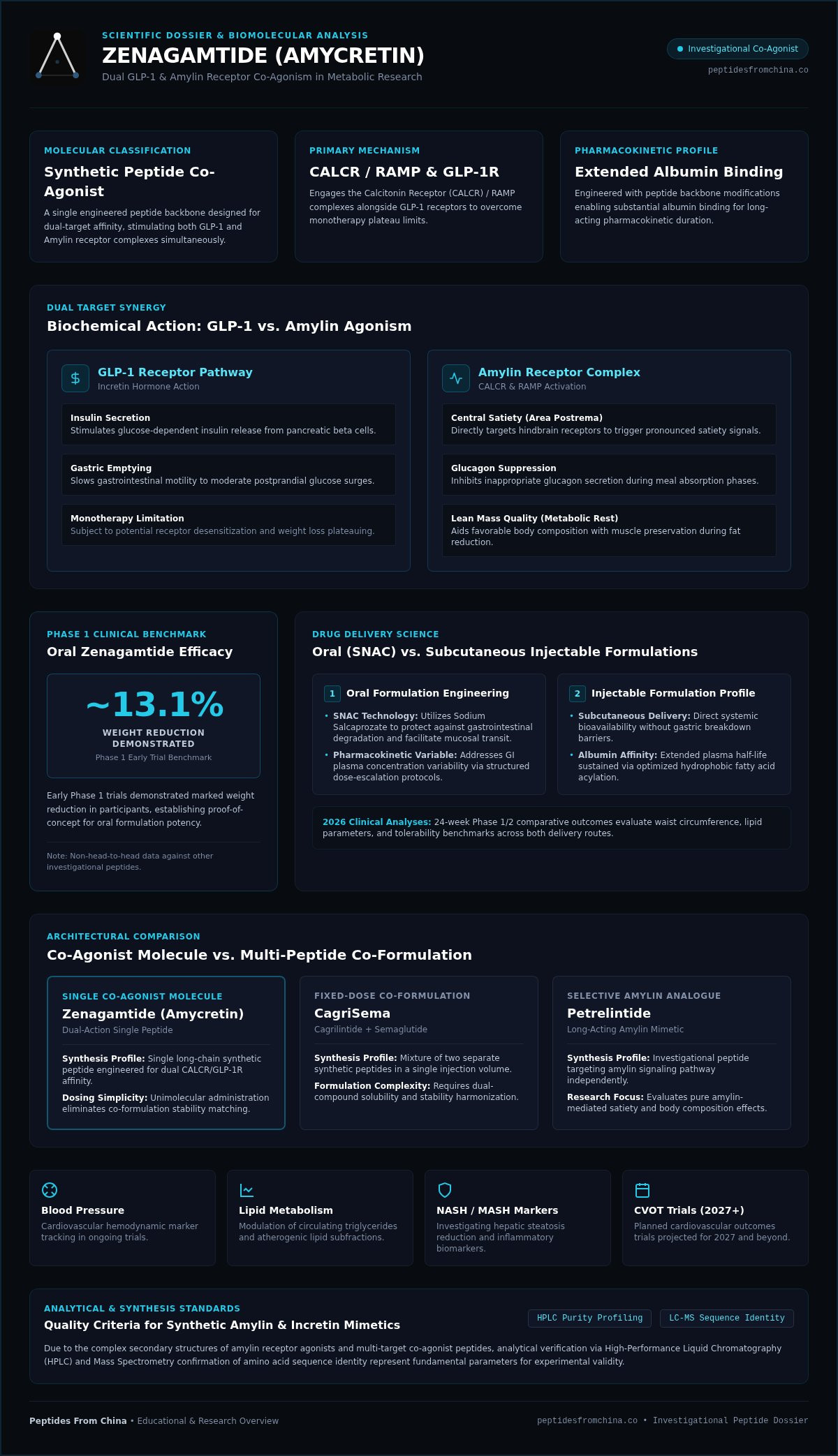
Zenagamtide—previously known as amycretin—is one of Novo Nordisk’s most important next-generation metabolic candidates. Its appeal is easy to understand: one peptide molecule is being developed in both once-weekly injectable and once-daily oral forms, while combining GLP-1 and amylin-pathway activity.
That combination makes zenagamtide scientifically distinct from semaglutide, tirzepatide and retatrutide. It also makes the evidence unusually easy to overstate. The molecule has produced strong early and mid-stage results, but it is still investigational, the oral and injectable datasets come from different trials, and there is no direct evidence that one formulation is universally “better.”
Here is what the published evidence actually shows—and what researchers should watch as Novo Nordisk moves the program into Phase 3.
Zenagamtide at a glance
Developer: Novo Nordisk
Earlier name: amycretin
Development codes: NNC0487-0111; NN9487/NN9490 in Novo Nordisk pipeline materials
Molecule: long-acting unimolecular peptide agonist with GLP-1, amylin and calcitonin-receptor activity
Routes under development: once-weekly subcutaneous injection and once-daily oral administration
Current status: investigational; not FDA-approved
Lead programs: obesity, overweight and type 2 diabetes
Phase 3 program: AMAZE studies began appearing in 2026
What makes zenagamtide different?
Zenagamtide is not a fixed combination of two separate drugs. It is a single engineered peptide designed to engage complementary appetite and metabolic pathways.
GLP-1 receptor activation is associated with glucose-dependent insulin secretion, reduced glucagon signaling, slower gastric emptying and lower energy intake. Amylin signaling also contributes to meal termination and satiety. Novo Nordisk commonly describes zenagamtide as a unimolecular GLP-1 and amylin receptor agonist; published clinical papers also report activity at calcitonin receptors.
That architecture differs from:
Semaglutide, a GLP-1 receptor agonist
Tirzepatide, a GIP/GLP-1 receptor agonist
Retatrutide, a GIP/GLP-1/glucagon receptor agonist
CagriSema, a fixed-dose combination of semaglutide and the amylin analog cagrilintide
The distinction is mechanistic, not proof of clinical superiority. Only controlled comparative trials can establish whether the single-molecule GLP-1/amylin approach delivers a better balance of efficacy, tolerability, convenience or durability.
What the first human studies established
The first-in-human program enrolled adults with overweight or obesity and examined oral and subcutaneous administration across several study parts. The main goals were safety, tolerability and pharmacokinetics rather than a definitive efficacy comparison.
Published Phase 1 results supported continued development and showed that both routes could produce meaningful weight reduction signals. Gastrointestinal events were the most common treatment-emergent adverse events and increased with exposure. The studies were small, relatively short and designed around dose exploration, so their headline percentages should not be treated as a direct oral-versus-injectable contest.
The most useful conclusion from Phase 1 was strategic: Novo Nordisk had evidence that the same molecular program could support two delivery formats.
What the 2026 injectable Phase 2 trial showed
The strongest randomized evidence for subcutaneous zenagamtide comes from a 36-week Phase 2 trial in 262 adults with type 2 diabetes inadequately controlled on metformin, with or without an SGLT2 inhibitor.
Once-weekly zenagamtide produced statistically significant HbA1c reductions across the studied dose range. At the highest investigated dose, the estimated mean HbA1c reduction reached approximately 1.7 percentage points from a baseline near 7.8%.
Body weight also fell in a dose-dependent pattern. The highest-dose group recorded a mean reduction of 14.6% at week 36, compared with 2.1% with placebo. The published report noted that the weight curve had not clearly plateaued at the higher exposures by the end of the trial.
That last observation is interesting, but it is not a prediction of indefinite continued loss. Participants at the highest maintenance levels had limited time at those exposures, and later trials must establish the full time-response curve.
The most common adverse events were gastrointestinal and were generally mild to moderate. This does not support claims that zenagamtide bypasses the tolerability trade-offs seen with incretin- and amylin-based programs.
What the oral Phase 2 trial showed
A separate 36-week randomized Phase 2 trial studied once-daily oral zenagamtide in 186 adults with type 2 diabetes across 83 sites in 11 countries.
All three studied dose groups produced statistically significant HbA1c improvements versus placebo. Estimated mean HbA1c changes ranged from about 0.9 to 1.4 percentage points, with a clear dose-response pattern.
Weight reduction was also reported, with company topline materials describing up to roughly 10% at week 36. The peer-reviewed paper’s primary focus was glycemic efficacy and safety, so comparisons with the injectable program should account for different group sizes, exposures and estimands.
Gastrointestinal events again increased with dose. Serious adverse events occurred in a small number of zenagamtide participants, and no deaths were reported during the trial.
The oral result matters because peptide delivery by mouth is technically difficult. It does not mean an oral peptide behaves like a conventional small-molecule tablet. Formulation, absorption and administration requirements remain central questions for Phase 3.
Oral versus injectable: what can actually be compared?
The two formats answer different practical questions.
Once-weekly subcutaneous zenagamtide
The injectable program has produced the larger weight-reduction signal in the available type 2 diabetes dataset and allows less frequent administration. It also carries the acceptance and access issues associated with an injectable medicine.
Once-daily oral zenagamtide
The oral program offers a needle-free format and could broaden patient choice. Its development challenge is consistent peptide exposure through the gastrointestinal tract, along with any timing or administration requirements ultimately established in Phase 3.
The comparison that does not yet exist
There is no completed head-to-head trial proving that oral or subcutaneous zenagamtide is clinically superior. Cross-trial comparisons can generate hypotheses, but differences in population, dose allocation, exposure, analysis and trial design prevent a clean ranking.
The better formulation may ultimately depend on adherence, tolerability, access, manufacturing economics and individual preference—not only the largest headline percentage.
Does zenagamtide preserve lean mass?
Claims that zenagamtide uniquely protects muscle or selectively removes fat have moved faster than the evidence.
Weight-loss trials increasingly include body-composition substudies, but the currently published zenagamtide evidence does not establish a clinically proven lean-mass advantage over semaglutide, tirzepatide, retatrutide or CagriSema. Mechanistic arguments about amylin are not a substitute for adequately powered imaging and functional outcomes.
This is a major Phase 3 question, not a settled product benefit.
How zenagamtide fits Novo Nordisk’s strategy
Novo Nordisk is developing several ways to combine incretin and amylin biology. CagriSema pairs two separate agents; zenagamtide puts GLP-1 and amylin-pathway activity into one molecule; additional pipeline programs explore other receptor combinations.
That portfolio gives Novo Nordisk multiple routes to compete in a market where convenience and differentiation are becoming as important as headline weight loss. The company’s 2025 annual report says Phase 3 development of zenagamtide is underway, and ClinicalTrials.gov now lists AMAZE studies across obesity, type 2 diabetes and related complications.
The breadth of that program signals confidence, but it should not be confused with regulatory approval or a confirmed launch timeline.
Zenagamtide versus retatrutide
Both are multi-pathway investigational peptides, but their receptor designs are different.
Retatrutide combines GIP, GLP-1 and glucagon receptor agonism. Zenagamtide combines GLP-1 with amylin-pathway activity in a single molecule and is being developed in both oral and injectable forms.
No completed head-to-head trial establishes which approach is more effective or better tolerated. Comparing percentages from separate studies—especially across populations with and without type 2 diabetes—can be misleading. The scientifically useful comparison is between development strategies: glucagon-driven energy expenditure on one side, amylin-linked satiety on the other.
What researchers should watch next
Phase 3 replication. Mid-stage efficacy must hold in larger, more diverse populations.
Formulation-specific adherence. Real-world convenience will depend on the final oral administration requirements and injection experience.
Body composition. Direct measurements are needed before lean-mass claims are credible.
Discontinuation and tolerability. Gastrointestinal events and the ability to remain on an effective exposure matter as much as peak efficacy.
Durability. Longer studies must define whether weight and glycemic effects persist.
Comparative evidence. Head-to-head studies would be more informative than cross-trial leaderboards.
Manufacturing and access. A daily oral peptide and a weekly injectable peptide present different scale, cost and supply challenges.
Research sourcing and identity
Zenagamtide is a complex investigational peptide, and its name does not by itself establish identity, purity, concentration or equivalence to Novo Nordisk’s clinical material.
PFC coordinates research-compound sourcing through manufacturing partners. Researchers should request current availability, specifications and batch-specific documentation for the exact material under consideration through the PFC contact page. Catalog materials are supplied for laboratory research use only and are not substitutes for Novo Nordisk’s investigational products.
The bottom line
Zenagamtide is a credible next-generation program because it brings GLP-1 and amylin biology together in one molecule and supports both oral and injectable development.
The injectable Phase 2 trial produced a strong 36-week weight and glucose signal in adults with type 2 diabetes. The oral trial showed meaningful glycemic efficacy and a viable second delivery route. Those findings justify Phase 3; they do not establish clinical superiority, lean-mass protection or a guaranteed advantage over retatrutide, tirzepatide or CagriSema.
The most compelling story is already enough: one molecule, two delivery formats, a broad Phase 3 program and a serious test of whether amylin can become the next major partner to GLP-1.
Frequently asked questions
What is zenagamtide?
Zenagamtide, formerly called amycretin, is Novo Nordisk’s investigational long-acting unimolecular peptide agonist with GLP-1, amylin and calcitonin-receptor activity.
Is zenagamtide the same as amycretin?
Yes. Zenagamtide is the newer nonproprietary name for the program previously known as amycretin or NNC0487-0111.
Is zenagamtide oral or injectable?
Both formulations are in clinical development: once-daily oral zenagamtide and once-weekly subcutaneous zenagamtide.
Is zenagamtide FDA-approved?
No. Zenagamtide remains investigational as of September 2026.
How much weight loss was reported with injectable zenagamtide?
In a 36-week Phase 2 trial in adults with type 2 diabetes, the highest-dose group recorded mean weight reduction of 14.6%, compared with 2.1% with placebo.
Is zenagamtide better than retatrutide?
There is no completed head-to-head trial. They use different receptor strategies, and results from separate trials cannot establish superiority.
Does zenagamtide preserve muscle?
The published evidence does not establish a unique lean-mass preservation benefit. Body-composition data from larger trials are still needed.
Primary sources
Mora P, et al. Efficacy and safety of once-weekly subcutaneous zenagamtide in adults with type 2 diabetes. The Lancet, 2026. PubMed PMID 42532080
Mora P, et al. Efficacy and safety of once-daily oral zenagamtide in adults with type 2 diabetes. The Lancet, 2026. PubMed PMID 42532079
Dahl K, et al. Amycretin, a novel unimolecular GLP-1 and amylin receptor agonist administered subcutaneously: Phase 1b/2a results. The Lancet, 2025. PubMed PMID 40550231
Gasiorek A, et al. Safety, tolerability, pharmacokinetics and pharmacodynamics of first-in-human oral and subcutaneous amycretin. The Lancet, 2025. PubMed PMID 40550229
Novo Nordisk. Innovation and therapeutic focus, Annual Report 2025. Zenagamtide pipeline overview
ClinicalTrials.gov. First-in-human amycretin study. NCT05369390