Why Validated Synthesis Facilities Matter for Brands

A validated peptide synthesis facility gives brands batch-traceable, analytically verified material that protects reproducibility, regulatory readiness, and supply continuity. Without that foundation, every downstream claim a brand makes about its product, from purity to potency, rests on documentation the brand never actually saw.
For procurement teams, this comes down to three checks before any purchase order goes out:
Request a Certificate of Analysis showing both HPLC purity and mass spectrometry identity confirmation, not a single collapsed number.
Ask for batch traceability records, including lot numbers tied to raw material sourcing and process documentation.
Confirm retention sample availability so disputes over identity or content can be resolved without re-ordering.
Manufacturer-side analytical documentation may be available depending on the product and batch. It is not guaranteed with every order and is not independent verification by PFC. Buyers may arrange third-party analytical testing when required.
Key Takeaways
Validated peptide synthesis facilities matter because they turn purity claims into verifiable data, protecting brands from batch inconsistency, mislabeled content, and reproducibility failures that surface only after a product ships.
Point Details Demand orthogonal identity data Require both RP-HPLC purity and MS identity confirmation, since a single purity number hides content and counterion issues. Treat retention samples as standard Ask for a defined retention-sample period so identity or content disputes can be resolved without reordering. Build audit rights into contracts Include right-to-audit, recall, and holdback clauses so supplier commitments are enforceable, not just verbal. Track supplier performance numerically Monitor batch-acceptance rate and COA turnaround across multiple lots, not just a single purchase. Choose suppliers built for traceability Products are subject to the manufacturer’s applicable quality-control procedures and specifications. Manufacturer-side analytical documentation may be available depending on the product and batch. PeptidesFromChina is not an independent analytical testing laboratory.
Table of Contents
Why Validated Synthesis Facilities Matter for Brands Sourcing Research Peptides
What Goes Wrong When Brands Skip Facility Validation
The Analytical and Process Checklist Brands Should Require
What to Ask Suppliers Before Signing a Contract
How Validation Supports Private-Label Scale-Up
Sourcing Through PeptidesFromChina’s Validated Facility Network
Sources
Why Validated Synthesis Facilities Matter for Brands Sourcing Research Peptides
A validated facility, in the peptide-specific sense procurement teams need, runs reproducible solid-phase peptide synthesis (SPPS) with documented process controls, maintains master batch records for every lot, and preserves chain-of-custody from raw material intake through final vialing. That combination is what separates a manufacturer from a reseller repackaging whatever stock happens to be available that quarter.
A facility worth qualifying should be able to produce, on request:
A COA showing both RP-HPLC purity and MS-confirmed identity.
Executed batch records tied to a specific lot number.
Retention samples held for a defined period after shipment.
Stability data and, for parenteral-intended material, endotoxin testing results.
The EMA’s 2026 guidance on synthetic peptides was written for pharmaceutical development, but its analytical expectations, orthogonal identity confirmation, explicit impurity profiling, documented process controls, work as a benchmarking reference even when the material in question is labeled for research use only. A supplier that voluntarily meets that bar is signaling something a purity number alone cannot.
What Goes Wrong When Brands Skip Facility Validation
Sourcing from unvalidated suppliers introduces risks that rarely show up until a brand has already committed inventory or, worse, published research built on inconsistent material.
Mislabeled purity. Purity claims often represent chromatographic area percent rather than actual peptide content by mass once counterions and residual salts are factored in.
Variable peptide content. Two vials from the same nominal lot can carry meaningfully different amounts of active peptide once salt form and moisture content are accounted for.
Unreported impurities. Peptide-related impurities can sit below a vendor’s detection threshold simply because nobody ran an orthogonal method to look for them.
Batch-to-batch drift. Even competent synthesis operations show lot variation; without retention samples and incoming QC, that drift goes undetected.
A vendor showing strong analytical characterization on one lot offers no guarantee the next lot will match it. Lot-to-lot variability is a known feature of peptide synthesis, not an edge case, which is exactly why incoming verification and retention samples exist.
Downstream, these gaps surface as failed QC on receipt, biological activity that shifts between lots for no obvious reason, or, in published research, results that other labs simply cannot reproduce.
The Analytical and Process Checklist Brands Should Require
Procurement teams and lab managers get the most protection from a short, non-negotiable analytical package attached to every purchase order.
Identity confirmation by mass spectrometry. HPLC alone tells you something eluted at the right retention time, not that it’s the right molecule.
Chromatographic purity via RP-HPLC, ideally referencing a defined method consistent with USP <621> practices so results are comparable across suppliers.
Peptide content or assay data, separate from purity percentage, since content by mass and area percent are different measurements that get conflated constantly in vendor marketing.
Counterion characterization. Acetate, TFA, and other salt forms affect both mass calculations and, in some research contexts, biological response.
Impurity profiling with stated thresholds. The EMA guideline flags peptide-related impurities above 1.0% as requiring identification, using orthogonal methods like mass spec rather than HPLC alone.
Executed batch records, including in-process control logs. Coupling completeness checks (Kaiser, chloranil, or TNBS tests) tell you whether the synthesis itself was monitored, not just the finished product.
Lyophilization and vialing cycle summaries. Freeze-drying parameters affect reconstitution behavior and long-term stability, and a facility that can’t produce cycle data usually can’t explain inconsistent reconstitution complaints either.
Stability data and storage instructions, tied to the specific formulation and vial type shipped.
On-receipt, the minimum defensible workflow is a rapid RP-HPLC area-percent check. If that result looks off-spec, request the vendor’s raw MS spectrum and assay data before accepting or rejecting the lot. Escalate to independent third-party testing only when identity or content disputes persist after that exchange.
Pro Tip: For mechanistic studies where exact concentration matters less than molecular identity, prioritize MS confirmation first. For dose-response work, prioritize the assay/content data first, since a purity percentage tells you almost nothing about the actual mass of active peptide in a vial.

What to Ask Suppliers Before Signing a Contract
The questions procurement asks during qualification determine how much leverage a brand has later, when something goes wrong.
Request full COAs for the last three lots produced, not just the one being offered for sale. This surfaces batch-to-batch consistency issues before you’ve committed to a purchase.
Ask for a description of the SPPS process itself, including resin type, coupling chemistry, and whether in-process monitoring (Kaiser test, coupling equivalence records) is documented.
Confirm change-control policy. If a facility switches raw material suppliers or coupling reagents, does that trigger new validation, or does nobody tell you?
Establish audit availability, even if it’s a documentation review rather than an on-site visit.
Contract language should include a right-to-audit clause, a defined retention-sample period (commonly six months to a year past expiry), recall and holdback terms if a lot fails post-shipment testing, and acceptance sampling windows with clear dispute-resolution timelines. Master batch records, executed batch records, and documented deviation handling are standard asks in industrial peptide manufacturing contexts, and a facility that resists providing them is telling you something about its own internal controls.
Custom peptide batches typically run several weeks from order confirmation to shipment, depending on sequence complexity and batch size, with sample testing windows layered on top before full production release. Track supplier performance with concrete metrics: batch-acceptance rate on incoming QC, COA turnaround time, and deviation frequency across consecutive lots. These numbers, tracked over two or three purchase cycles, tell you more about a supplier than any single COA ever will. For teams building out a formal vendor scorecard, a vendor qualification checklist built around these categories keeps evaluations consistent across suppliers.
How Validation Supports Private-Label Scale-Up
Brands scaling a private-label peptide line depend on predictability more than almost anything else. A validated facility delivers that in a few concrete ways:
Faster scale-up, because process parameters are already documented instead of being reverse-engineered from a single successful lot.
Predictable batch release, since in-process controls catch problems before a batch ships rather than after a customer complains.
Fewer QC rejections at receipt, which reduces the internal lab workload spent re-testing material that should have passed the first time.
Simpler continuity planning, because a facility with documented change control won’t quietly swap raw materials without notice.
A practical sequence looks like this: order an initial validation lot, run full incoming QC against the vendor’s COA, transfer the analytical method to in-house testing once confidence is established, then set retention-sample checkpoints for every subsequent lot. That structure turns supplier qualification into an ongoing verification habit rather than a one-time trust exercise. For teams formalizing this into a repeatable operational process, an operational guide to large-scale synthesis and sourcing walks through the scale-up sequence in more detail.
A procurement-side note on where to spend your time
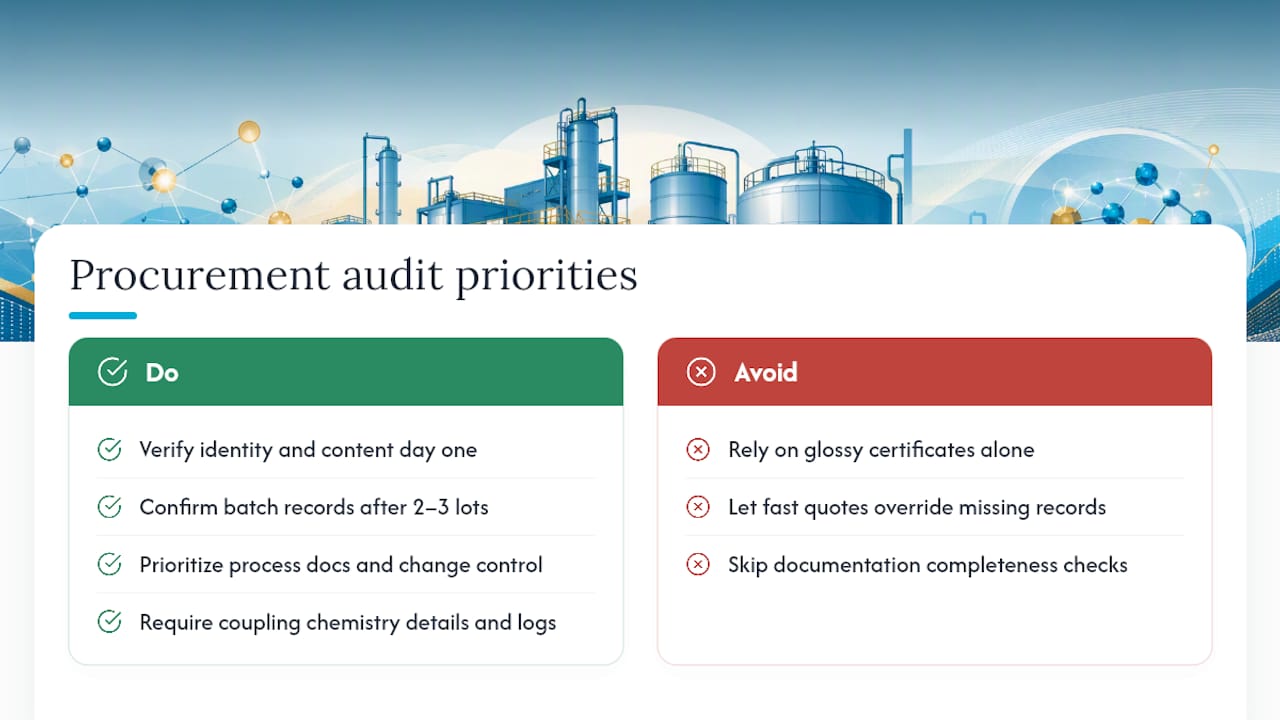
Verify identity and content on day one. That’s non-negotiable. Batch records and retention sample policies can be confirmed slightly later in the relationship, once a supplier has proven the analytical basics hold up across two or three lots. Where I’d tell any procurement lead to spend audit bandwidth: process documentation and change control, not marketing copy. A facility that can explain its coupling chemistry and show you a deviation log is worth more than one with a glossy purity certificate and nothing behind it. Balance cost and lead time against documentation completeness, and never let a fast quote override a supplier’s inability to produce records.
Sourcing Through PeptidesFromChina’s Validated Facility Network
Products are subject to the manufacturer’s applicable quality-control procedures and specifications. Manufacturer-side analytical documentation may be available depending on the product and batch. PeptidesFromChina is not an independent analytical testing laboratory.
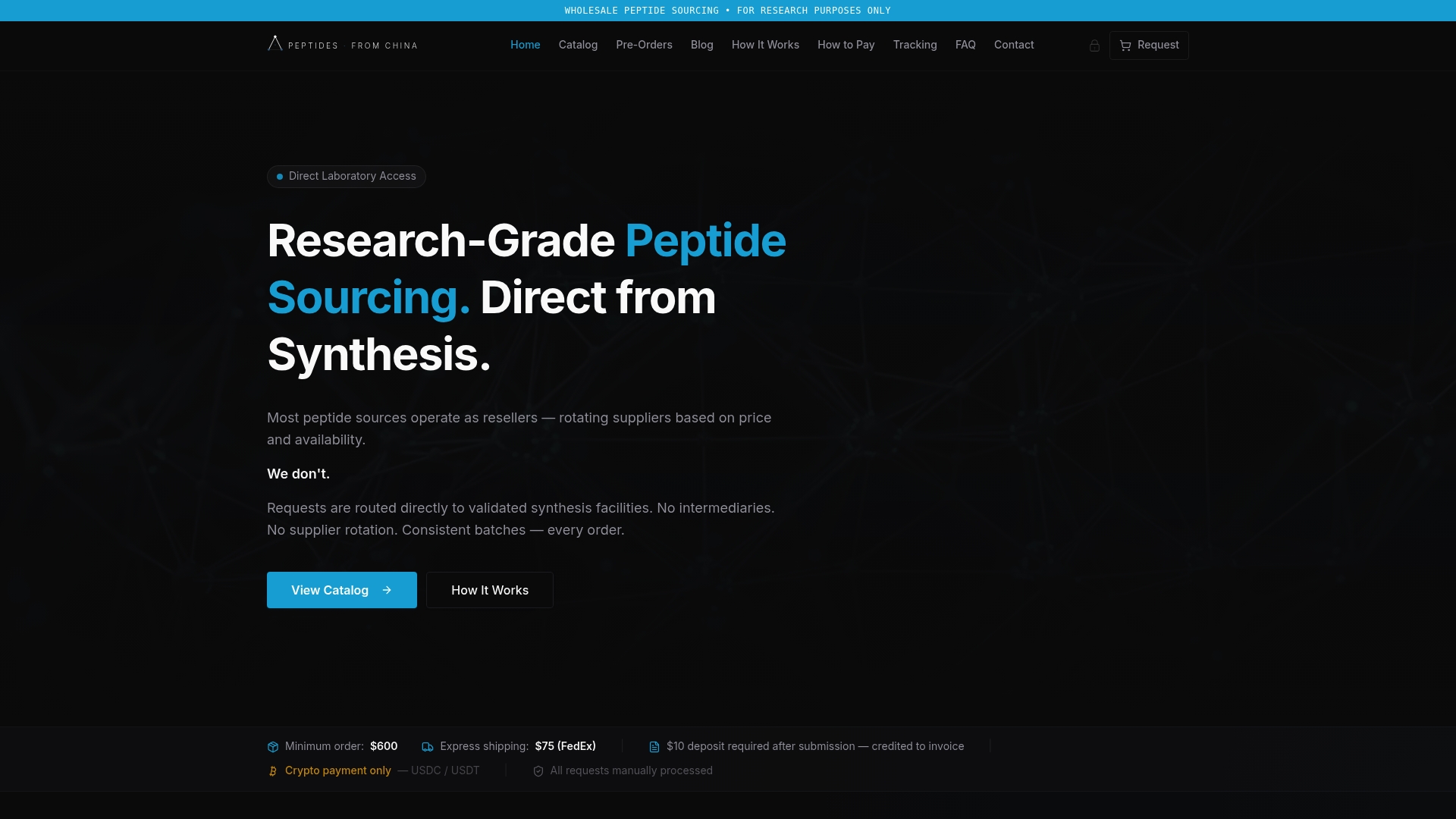
For teams evaluating a first order, the Epithalon product page shows the COA-inclusion approach in practice, and PE-22-28 is a common starting point for procurement teams running an initial validation lot before committing to volume. If you’re building a supplier qualification file, request a COA and batch record sample directly through the product page before placing a full order. That single step will tell you more about a facility than any marketing claim on its site.