Why Source Traceability Matters for Research Reliability

Source traceability matters for research because it makes experimental materials auditable, reproducible, and defensible when something goes wrong. A systematic review of supply chain traceability links visibility and real-time tracking directly to resilience, and the World Economic Forum’s traceability framework treats traceable sourcing as a prerequisite for sustainability claims, not an afterthought. Buyers requiring independent verification may arrange third-party analytical testing.
Two micro-actions get you started today:
Audit your top five reagents or peptides for lot number and certificate of analysis (COA) coverage.
Flag any material with no documented chain of custody for re-verification before your next experiment.
TL;DR:
Verifying lot and COA coverage on your top five reagents helps prevent avoidable failures and ensures reproducibility.
Independent batch verification and detailed chain-of-custody records enable quick identification and containment of problematic materials.
Documenting source details such as supplier traceability, manufacturing site, and storage conditions supports resilience and compliance requirements.
Implementing flexible escalation triggers based on pattern deviations can warn of potential quality issues before they impact experiments.
Focusing traceability efforts on high-risk, critical materials yields significant benefits without overwhelming laboratory resources.
Table of Contents
Why Source Traceability Matters Research Reliability Depends On
What a Traceable Supply Chain Actually Records
Common Barriers That Derail Traceability Projects
What the Research Literature Actually Shows
A Field-Ready Traceability Checklist for Labs and Procurement
Key Takeaways
Sources
Why Source Traceability Matters Research Reliability Depends On
Traceability delivers five concrete gains, and researchers who treat it as a formality usually discover the cost later, during a failed replication or a supplier recall they can’t act on fast enough.
Reproducibility. Connecting a result to an exact supplier lot and COA lets another lab, or your own team six months later, confirm whether a discrepancy came from the material or the method.
Resilience. When a supplier issue surfaces, a documented lot trail lets you isolate the affected batches instead of quarantining an entire inventory.
Sustainability and provenance. Certifications and sustainability reporting increasingly require documented origin data, not a verbal assurance from a distributor.
Operational efficiency. Fewer wasted runs, more precise recalls, and audits that take hours instead of weeks.
Compliance readiness. Regulatory frameworks like FSMA and comparable EU rules are pushing traceability from “nice to have” into a baseline expectation, a trend food-safety researchers have already documented in practice.
The WEF framework frames this as a multiplier effect: traceability doesn’t just reduce risk, it compounds resilience and sustainability outcomes when it’s built into procurement decisions rather than bolted on afterward, according to the same WEF analysis. That distinction separates labs that catch a bad batch in a day from labs that catch it after three failed experiments.
What a Traceable Supply Chain Actually Records
A usable traceability system isn’t complicated in concept, but most labs skip fields until a problem forces the issue. The minimum provenance record for any research material should include:
Supplier identity and manufacturing site (not just a reseller name)
Lot or batch number tied to a specific COA
Manufacture date and, where relevant, expiration or retest date
Chain-of-custody notes covering every hand-off between synthesis and delivery
Storage conditions during transit and at receipt
Identifiers matter as much as the data itself. Lot numbers remain the baseline, but GUIDs, QR codes, and RFID tags are increasingly used to make that identifier machine-readable across a lab’s inventory system. On the technology side, a Laboratory Information Management System (LIMS) or ERP handles the structured recordkeeping, while blockchain-based hashed logs and IoT sensors for cold-chain or humidity monitoring add a layer that’s harder to falsify after the fact. Food-safety guidance from the Global Dialogue on Seafood Traceability calls this the “one step back, one step forward” principle: every actor in the chain should be able to identify who supplied a material and who received it next.
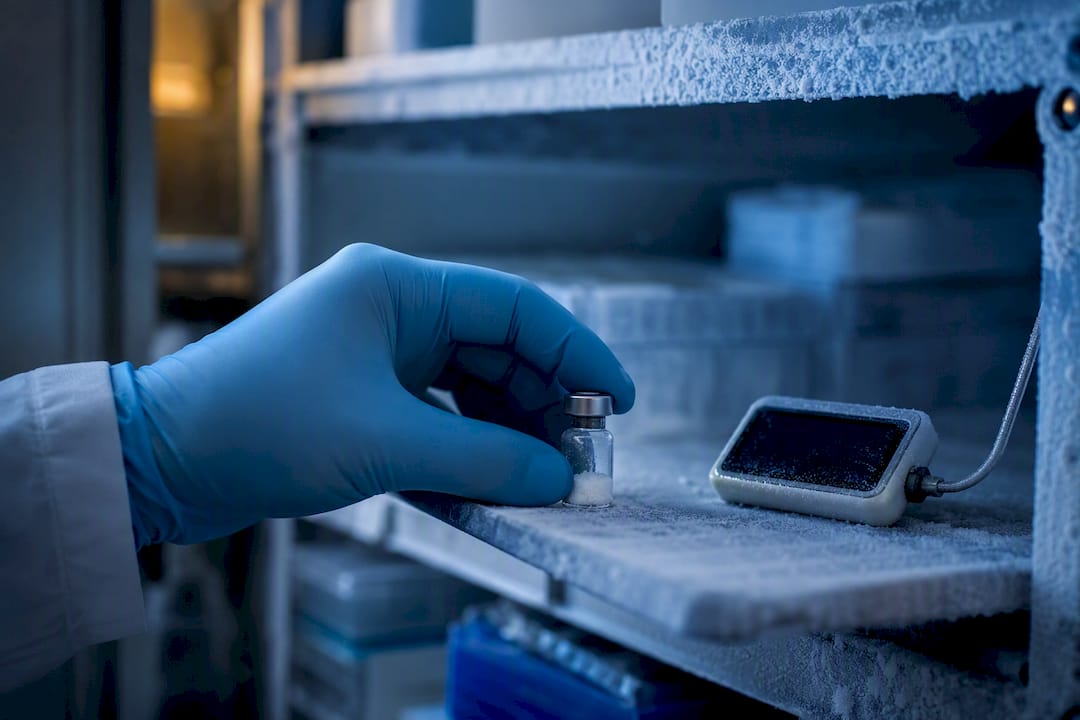
Pro Tip: Combine a static COA record with a real-time sensor log only for high-risk materials, like temperature-sensitive peptides. Applying that overhead across your entire catalog wastes budget on items where nothing ever goes wrong.
Common Barriers That Derail Traceability Projects
Most traceability initiatives stall for predictable reasons, and none of them are technical in the deep sense.
Format mismatch. Suppliers use inconsistent identifiers, spreadsheet layouts, and units, so reconciling data across three or four partners becomes its own project. Industry guidance on traceability challenges calls this the reconciliation problem, and it’s the single most cited failure point in practitioner writeups.
Limited lower-tier visibility. Your direct supplier may track lot data well, but the raw API manufacturer two tiers upstream often shares almost nothing, especially through gray-market resale channels.
Cost asymmetry. Small suppliers can’t always absorb the cost of serialization or LIMS integration, which pushes larger buyers to either subsidize compliance or accept gaps.
Documentation integrity risk. A forged or recycled COA is worse than no COA, because it creates false confidence. Independent verification, not supplier-provided paperwork alone, is what actually closes this gap.
What the Research Literature Actually Shows
Academic and industry evidence on traceability is more consistent than most procurement debates suggest. The WEF framework outlines a four-step approach connecting traceability to sustainability targets, and a tandem systematic review ties traceability deployment to resilience through improved visibility, velocity, and partner collaboration. Neither treats traceability as a compliance checkbox; both frame it as a strategic capability that pays off during disruption, not just during an audit.
Provenance analysis of scientific figures can detect fraudulent manuscripts by tracing reused or manipulated images across publications, showing that material and process provenance both matter for research integrity, not just supply chain accountability.
That finding, from provenance analysis research on paper mills, extends the traceability argument beyond reagents into the analytical record itself. A newer strand of research pushes this further: documentation frameworks for AI-assisted scholarly workflows argue that disclosure alone doesn’t make a workflow traceable. You need a record of which model or process touched the data, not just an acknowledgment that one did.
Practitioner-side controls like independent COA verification and batch-consistency checks, the kind PeptidesFromChina documents in its sourcing guidance, sit at the material end of this same continuum. What the literature still lacks is a solid quantification of ROI on traceability investment and consistent coverage of lower-tier supplier data, both open questions worth watching as more labs digitize procurement.
A Field-Ready Traceability Checklist for Labs and Procurement
Most labs don’t need a full traceability overhaul. They need a short, enforced checklist applied consistently.
Run a quick audit. List your top ten reagents or compounds by usage volume and risk, then check which ones already have lot-linked COAs on file.
Set mandatory provenance fields. Require supplier identity, lot number, COA link, and manufacture date before any material enters inventory. No exceptions for “trusted” suppliers.
Verify independently where it matters. A supplier-issued COA confirms what the supplier claims, not what an independent lab measured. For research-grade peptides and other high-risk categories, cross-check purity claims against third-party testing when possible, as detailed in this guide to reading a peptide COA.
Tag records in your LIMS. Link every experimental record to the specific supplier lot used, not just the product name. This is the single habit that makes retrospective troubleshooting possible.
Set a batch retention policy. Keep reference samples from each lot for a defined period so you can retest if a result looks anomalous months later.
Define an escalation trigger. If a COA looks inconsistent with prior batches from the same supplier, quarantine the material and request a re-verification before it touches active protocols.
Pro Tip: Build your escalation rule around comparison, not absolute thresholds. A COA that’s “fine” on its own but drifts from the same supplier’s last three lots is the earlier warning sign, not the first outright failure. A documentation checklist mapped to lab records makes this comparison easier to run consistently.
The Verdict
Traceability isn’t a paperwork exercise. It’s what lets a lab reproduce results, contain a bad batch fast, and back up sustainability claims with real data.
Audit your five highest-use materials for lot and COA coverage this week.
Pilot full-chain traceability on one high-risk reagent before scaling to your entire inventory.
A Practitioner’s Note on Recurring Sourcing Failures
The failure I see repeated most often isn’t fraud. It’s a COA that’s real but disconnected from the actual lot in hand. Match documentation to physical inventory before you trust either.
— Sam Levin
Where to Find COA Verified Research Peptides
Products are subject to the manufacturer’s applicable quality-control procedures and specifications. Manufacturer-side analytical documentation may be available depending on the product and batch. PeptidesFromChina is not an independent analytical testing laboratory.
That structure matters most for compounds where a documentation gap is expensive to discover late, longevity compounds, signaling peptides, and GLP-1 research materials where batch variability skews results before you even notice it. If you’re building a reproducible protocol around a specific peptide, Epithalon with COA documentation or research-grade KPV are useful starting points to see what a lot-linked verification record actually looks like in practice. Request a documented sample and check the COA against your own verification process before you commit a full order.
Key Takeaways
Traceable sourcing turns experimental materials into auditable, reproducible inputs instead of unverified assumptions about what’s actually in the vial.
Point Details Reproducibility depends on lot data Link every result to a specific supplier lot and COA, not just a product name. Resilience comes from visibility Documented chain-of-custody lets you isolate a bad batch instead of quarantining everything. Start with high-risk materials Pilot full traceability on your riskiest reagents before scaling to the whole inventory. Independent verification beats supplier paperwork alone Cross-check COAs against third-party data when the material carries real experimental risk. PFC coordinates manufacturer-side sourcing and international logistics for eligible research buyers. PFC coordinates manufacturer-side sourcing and international logistics for eligible research buyers.