
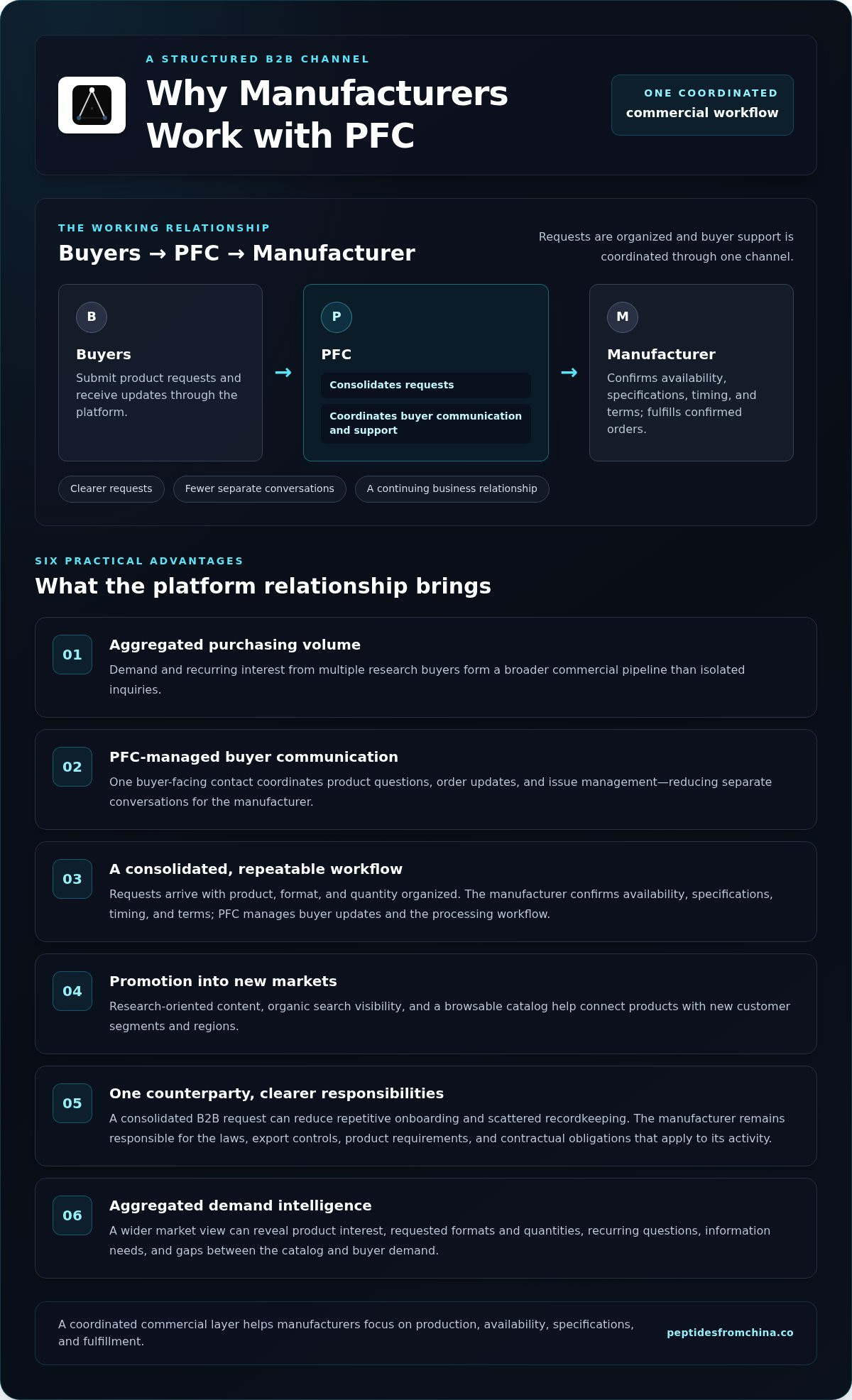
PFC gives peptide manufacturers more than a new sales lead. It provides a structured B2B channel that combines demand, manages buyer communication, and turns fragmented international inquiries into a clear operating workflow.
For a manufacturer, that means more volume with less commercial friction. PFC handles the buyer-facing process while the manufacturer stays focused on production, availability, specifications, and fulfillment.
Why manufacturers choose a platform relationship
A direct relationship with hundreds of small buyers can create more administrative work than commercial value. Every inquiry may arrive in a different format. Buyers ask the same questions repeatedly. Product requests are incomplete. Shipping destinations vary. Some conversations never become orders.
PFC consolidates that activity into one continuing business relationship. The manufacturer works with an organized partner instead of rebuilding the same process for each individual buyer.
The value comes from six practical advantages:
Aggregated purchasing volume across multiple research buyers.
One point of contact for buyer communication and issue management.
A simple, repeatable workflow for requests, availability, terms, and fulfillment.
Market development and promotion across new customer segments and regions.
Reduced fragmented buyer-facing administration and compliance workload.
Consolidated demand intelligence that helps manufacturers understand what the market is requesting.
PFC brings concentrated purchasing volume
Manufacturers benefit from demand that is larger and more predictable than isolated inquiries. PFC combines orders and recurring interest across its customer base, giving manufacturing partners access to a broader commercial pipeline.
This model can improve planning. Instead of reacting to one-off messages, the manufacturer can see patterns across products, quantities, formats, and markets. Repeat volume also makes it easier to justify responsive service and prioritize a durable commercial relationship.
PFC does not promise a fixed purchasing level for every product. The advantage is structural: one platform relationship can represent many buyers, repeated requests, and new-market growth over time.
PFC manages the buyer relationship
Buyer communication takes time. Product questions, order updates, payment steps, delivery expectations, and exception handling can consume a manufacturer’s sales team—especially when international buyers operate across time zones and use different communication styles.
PFC absorbs that workload. Buyers submit requests through the platform, review PFC’s commercial proposal, and return to PFC when they need help. The manufacturer does not need to answer every routine question or manage many separate conversations.
This separation is valuable for both sides. Buyers receive a consistent process and one accountable contact. Manufacturers receive clearer, consolidated requests and spend less time on conversations that have not yet become actionable orders.
A simple workflow for the manufacturer
PFC is designed to keep manufacturer interaction focused. A request should arrive with the information needed to make a decision, not as an open-ended chain of messages.
The typical workflow is:
PFC consolidates the buyer’s request and confirms the required product, format, and quantity.
The manufacturer confirms current availability, applicable specifications, timing, and commercial terms.
PFC communicates with the buyer and manages the processing and invoice workflow.
The manufacturer fulfills the confirmed order and provides the agreed shipment information.
PFC handles buyer updates and raises only the issues that genuinely require manufacturer action.
This approach protects the manufacturer’s managers from unnecessary communication while ensuring that important information is not lost between the buyer and production side.
Market development without building a retail operation
Entering a new market requires more than translating a product list. Buyers need discovery, education, product navigation, commercial support, and a reliable way to submit requests. A manufacturer may have excellent production capabilities without wanting to build an international retail marketing and support organization.
PFC performs that market-facing role. The platform develops organic search visibility, publishes research-oriented educational content, organizes a browsable catalog, and works with emerging product categories and buyer communities. That activity creates demand and brings qualified B2B requests into a shared workflow.
Manufacturers can therefore expand their reach without independently building every marketing channel, support desk, payment process, and buyer relationship. PFC handles the commercial layer; the manufacturer retains responsibility for the products it agrees to supply.
A cleaner B2B counterparty structure
One of the strongest advantages for a manufacturer is having PFC as a single business counterparty rather than dealing separately with a large number of individual buyers.
PFC manages buyer-facing eligibility, research-use positioning, order intake, and commercial communication through its own platform workflow. The manufacturer receives a consolidated B2B request under the commercial relationship with PFC. This reduces repetitive customer onboarding, scattered recordkeeping, and the operational risk created when individual buyers communicate inconsistently.
The structure can also reduce the manufacturer’s exposure to fragmented retail-style interactions. Instead of interpreting the intended context of every informal inquiry, the manufacturer works with PFC under an agreed business process for laboratory research products.
This is an operational and contractual advantage, not a claim that legal responsibility disappears. Each manufacturer remains responsible for the laws, export controls, product requirements, and contractual obligations that apply to its activity. PFC’s value is that it centralizes the buyer-facing workflow and creates a clearer commercial interface.
Demand intelligence from a wider market view
A manufacturer sees its own incoming orders. PFC sees questions, searches, product comparisons, abandoned requests, emerging compounds, repeat purchases, and demand across multiple markets.
That wider view produces useful commercial intelligence. PFC can identify:
Products attracting new research interest.
Formats and quantities buyers request most often.
Recurring questions that create friction before an order.
Documentation or specification information buyers need to make a decision.
Markets where demand is growing but buyer access remains difficult.
Gaps between the current catalog and what research buyers are actively seeking.
Manufacturers can use that feedback to improve product planning, catalog organization, communication, and production priorities. The insight is aggregated and commercial; PFC does not need to expose private customer information to show what the market is asking for.
Better issue resolution protects the partnership
Problems are easier to solve when they enter through one organized channel. If an order is incomplete, a product does not match the confirmed request, or a corrective shipment is needed, PFC gathers the information and communicates the issue clearly.
This prevents the manufacturer from receiving conflicting messages from multiple buyers and gives it a practical opportunity to correct the problem. PFC also maintains the commercial context: a prompt resolution protects not only one order but the broader purchasing relationship.
The relationship is not adversarial. Good manufacturers want accurate requests, prompt communication, and customers who understand the agreed scope. PFC helps create those conditions while representing the buyer when a genuine fulfillment problem needs attention.
Clear quality and documentation communication
PFC does not ask manufacturing partners to support universal claims that are not true across every item. Product specifications and supporting documentation can vary by product, manufacturer, and batch. The platform should communicate the information confirmed for the proposed order rather than presenting one purity figure or document promise across the entire catalog.
That protects the manufacturer from being associated with inaccurate marketing and helps the buyer review the actual proposal. It also creates a cleaner path for discussing buyer-arranged independent analysis when a research project requires it.
All catalog products are positioned strictly for laboratory research use only and are not intended for human or veterinary use.
What PFC expects from a manufacturing partner
The partnership works when the manufacturer provides accurate and timely information. PFC needs dependable confirmation of availability, product scope, specifications where applicable, commercial terms, expected timing, and fulfillment status.
Manufacturers should also respond promptly when an exception requires correction. PFC’s aggregated volume and market development create value for the supplier; reliable performance protects access to that continuing demand.
In return, PFC keeps routine buyer communication away from the manufacturer, consolidates requests, supports market entry, and provides demand feedback that would be difficult to collect from one-to-one transactions.
A scalable route to international B2B demand
The PFC model is designed to make growth simpler on both sides. Buyers receive one organized route to manufacturer-side sourcing. Manufacturers receive volume, a controlled workflow, professional buyer management, market development, and a clearer B2B counterparty relationship.
The result is not merely another listing. It is a commercial operating layer that helps the manufacturer sell into new markets without building a complete international buyer-facing organization.
Manufacturers interested in discussing product fit and partnership structure can contact PFC at https://peptidesfromchina.co/contact/.
Frequently Asked Questions
How does PFC generate value for manufacturers?
PFC aggregates purchasing demand, develops new markets, manages buyer communication, and converts scattered inquiries into structured B2B requests. Manufacturers gain commercial reach without managing every buyer interaction separately.
Does PFC manufacture peptides?
No. PFC is a B2B sourcing platform and international sales channel. Manufacturing remains the responsibility of the relevant production facility.
Does working with PFC remove a manufacturer’s legal obligations?
No. The manufacturer remains responsible for applicable laws, export controls, product requirements, and contractual duties. PFC reduces fragmented buyer-facing administration by providing one organized business counterparty and a consistent research-use workflow.
What buyer communication does PFC handle?
PFC handles request intake, routine product and process questions, proposal communication, payment steps, order updates, and first-line issue management. The manufacturer is contacted when availability, specifications, timing, fulfillment, or a corrective action requires its input.
How does PFC help manufacturers enter new markets?
PFC builds search visibility, publishes research-oriented content, organizes product discovery, supports buyers, and develops demand in markets that may be costly for a manufacturer to serve directly.
What market intelligence can PFC provide?
PFC can share aggregated demand patterns, including growing product interest, requested formats and quantities, recurring buyer questions, and catalog gaps. This helps manufacturers plan products and communication without exposing private buyer information.
How are documentation claims handled?
Specifications and supporting documentation vary by product, manufacturer, and batch. PFC communicates what is available for the proposed order instead of making universal purity or testing promises.