Why Funding Bodies Require Reproducibility Plans for Peptide Sourcing
Funding bodies require reproducibility plans because reviewers need proof that a reagent used in month one of a grant is chemically identical to the reagent used in month twenty-four. That proof depends on lot-specific certificates of analysis, chain-of-custody records, and an agreed verification workflow, not a vendor’s general purity claim. The deliverable procurement teams should produce is a supplier-facing reproducibility appendix: one document naming the reagent, the supplier and contact, expected lot numbers, the COA elements the supplier must provide, numeric acceptance criteria, and the on-receipt verification plan.
That appendix typically covers:
The reagent name, CAS or sequence identifier, and supplier’s direct manufacturing status
Lot number tracking tied to each shipment and each experimental use
Required COA elements: HPLC purity, mass spec identity, content assay, and counterion data
Acceptance thresholds and a defined quarantine step for lots that fail them
Key Takeaways
Reproducibility plans succeed when procurement teams demand lot-specific COAs, mass spec identity confirmation, and documented on-receipt verification instead of accepting a single generic purity claim.
Manufacturer-side analytical documentation may be available depending on the product and batch. It is not guaranteed with every order and is not independent verification by PFC. Buyers may arrange third-party analytical testing when required.
Table of Contents
Why Funding Bodies Require Reproducibility Plans From a Reviewer’s Seat
The Supplier-Facing Reproducibility Checklist to Attach to Your Proposal
What a Reviewer-Grade Certificate of Analysis Actually Needs
Turning the Checklist Into a Working Procurement Process
How PeptidesFromChina Supports Reproducibility-Plan Requirements
What the Checklist Gets Right That Policy Language Doesn’t
Get Lot-Specific Documentation Before You Write the Appendix
Sources
Why Funding Bodies Require Reproducibility Plans From a Reviewer’s Seat
Grant reviewers care about reproducibility because unverified reagents are one of the quieter ways public and institutional funding gets wasted. A study built on a peptide lot that turns out to be 15% counterion by weight instead of active compound produces dosing data that nobody can trust, and nobody can replicate. Reviewers know this, so they look for specific, checkable evidence rather than a promise of quality.
What reviewers typically expect to see in a reproducibility plan includes:
Lot traceability — a documented path from supplier lot number to the specific vial used in a specific experiment.
Analytical verification — both HPLC purity and mass spectrometry identity confirmation, not one or the other.
Method metadata on the COA — enough detail about how the numbers were generated that an outside auditor could judge whether the test was rigorous.
A nonconformance plan — what happens, procedurally, when a lot fails to meet spec after it arrives.
The operational payoff for funders is straightforward. Fewer retraction risks tied to reagent quality, easier replication when a study moves to a second site or a second lab tech, and a cleaner paper trail if an auditor ever asks how grant funds were spent on materials. CMC regulatory guidance for peptide substances reflects the same logic that shows up in grant review criteria: documentation of manufacturing process, impurity profile, and batch consistency is what makes a compound’s data defensible later. A reproducibility plan is really just that CMC discipline translated into procurement language.
The Supplier-Facing Reproducibility Checklist to Attach to Your Proposal
This is the checklist version procurement officers and lab managers can adapt directly into a grant appendix. It is organized the way a reviewer reads it: who supplies it, what they supply, how you’ll know it’s good, and what it costs.
Supplier identification. Name whether the vendor is the manufacturer or a reseller, list a direct point of contact, and state whether the relationship is with the synthesis facility itself or through a validated intermediary.
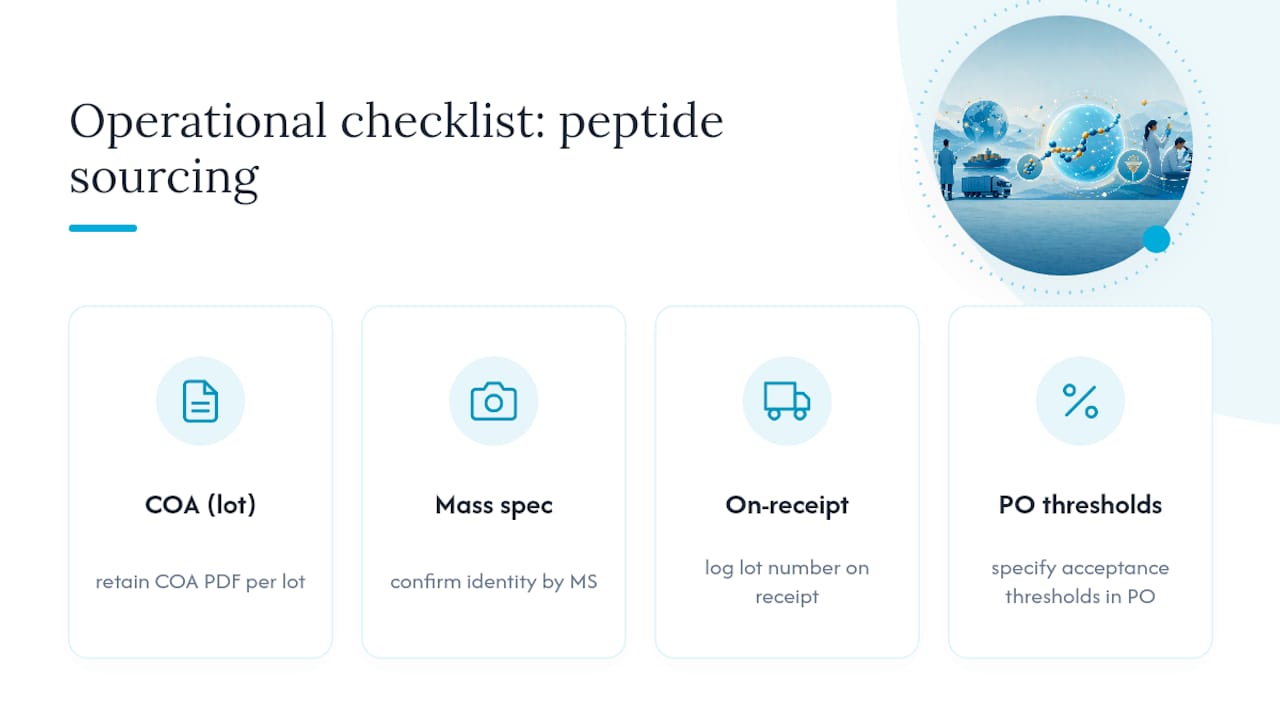
Lot-level deliverables. Require a lot-specific COA including the HPLC chromatogram, method metadata, mass spec identity confirmation, absolute content assay (not just chromatographic purity), and a residual counterion report. Ask for vialing and lyophilization notes and storage conditions on the same document.
Acceptance criteria. Set numeric pass/fail thresholds in advance (for example, minimum 95% HPLC purity plus confirmed MS identity within a defined mass tolerance) and document what triggers a hold or quarantine.
Traceability. Build a chain-of-custody path linking vendor lot number to project code to freezer location, so any sample can be traced backward at audit time.
On-receipt verification. Specify which tests get run when the shipment arrives, at minimum an RP-HPLC purity check, with mass spec identity confirmation recommended for any compound going into quantitative work. Note who runs it and the expected turnaround.
Budget and timeline. Include a per-lot verification cost line and a lead-time buffer in the budget justification, so testing delays don’t become a compliance surprise later.
Pro Tip: Write the acceptance criteria into your purchase order, not just your internal SOP. A supplier who agrees to a numeric threshold in writing is far easier to hold accountable than one who only saw it in your lab’s internal documentation.
What a Reviewer-Grade Certificate of Analysis Actually Needs
A certificate of analysis that reads “98% pure” tells you almost nothing on its own, and a growing body of technical guidance backs that up. HPLC area-percent purity measures the proportion of a compound relative to detected impurities in a chromatogram. It does not measure how much of the vial’s total mass is actual peptide, because it doesn’t account for water content or bound counterions.
That distinction matters more than most procurement checklists acknowledge. Analysis on peptide COAs shows that a compound reported at 98.5% purity by RP-HPLC can contain only 70 to 80% peptide by mass once trifluoroacetic acid (TFA) counterions and residual moisture are factored in, with residual TFA commonly running 10 to 40% by mass in basic peptides. A funder-ready COA needs to close that gap.
What to require on every COA:
Both purity metrics. Chromatographic purity (HPLC area %) and a separate content-determination method, so reviewers know what fraction of the vial’s mass is active compound.
Full method metadata. Column type and dimensions, mobile phase composition, gradient program, detection wavelength, injection mass, and total run time. Without this, nobody can judge whether the purity number reflects a rigorous method or a shortcut.
Mass spec identity confirmation. ESI-MS or MALDI-TOF data showing observed versus theoretical mass, along with the instrument’s stated mass accuracy. Purity numbers without identity confirmation tell you the compound is clean, not that it’s the right compound.
Salt form and residual counterion data. TFA percentage or the specified salt form, because counterion content materially affects usable peptide mass and skips this and your dosing calculations are built on the wrong number.
Lot-specific chromatograms and spectra as PDFs. Not a generic “typical results” sheet. A reviewer or auditor needs to verify that the attached data actually corresponds to the lot shipped.
Vendor-provided data is also, by definition, lot-specific. A supplier who runs a clean analysis on one lot has demonstrated something true about that lot, not a guarantee about the next one. That’s a normal feature of peptide manufacturing, not a red flag, but it’s the reason on-receipt verification belongs in the plan rather than being treated as redundant with the vendor’s own testing.
Turning the Checklist Into a Working Procurement Process
A reproducibility plan only holds up if it survives contact with an actual purchase order and an actual freezer. Here’s how the checklist above maps onto a working procurement workflow.
Pre-award. Write vendor evaluation criteria and sample COA requirements into the grant proposal’s appendix before the award is even decided, so reviewers see the plan is already operational rather than aspirational.
Purchase order terms. Require lot-specific COAs with every shipment and write a contractual right to request full documentation in case of an audit, not just an informal “COA on request” understanding.
Receipt actions. Log the lot number immediately, tie it to the relevant project code, and run the agreed on-receipt verification tests. Record who ran the test, where the results live, and when.
Nonconformance handling. If a lot fails its acceptance criteria, quarantine it, retest if appropriate, notify the supplier, and log a corrective action note. This becomes part of your grant reporting record, not just an internal headache.
Record systems. Keep vendor COAs, chromatograms, mass spectra, and in-house verification results linked to lot numbers in a LIMS or a structured, timestamped file path. This is what supports one-to-one traceability between a method, a specification, and a batch record when an auditor asks for it two years later.
Pro Tip: Set up your lot-tracking spreadsheet or LIMS entry before your first shipment arrives, not after. Retrofitting traceability onto materials you’ve already used is far harder than logging it at the point of receipt.
How PeptidesFromChina Supports Reproducibility-Plan Requirements
PFC coordinates sourcing from established Chinese manufacturing facilities together with international logistics. Products are subject to the manufacturer’s applicable quality-control procedures and specifications. Manufacturer-side analytical documentation may be available depending on the product and batch. PeptidesFromChina is not an independent analytical testing laboratory. That documentation maps directly onto the checklist items above rather than requiring procurement to chase down missing method metadata after the fact.
Two internal resources are built for this purpose:
The research peptide quality standards guide outlines the analytical expectations procurement can cite directly in a proposal appendix.
The lab protocol standardization guide explains how reagent-level controls connect to broader lab SOPs, useful when a reviewer asks how sourcing ties into experimental protocol.
What the Checklist Gets Right That Policy Language Doesn’t
Most reproducibility guidance stays abstract: share your data, describe your methods, preregister your protocol. None of that helps a procurement officer decide whether a specific peptide lot is safe to build a dataset on. The gap in most institutional advice isn’t philosophical, it’s operational. Nobody tells you what to put in the purchase order.
The foundational literature on biomedical research design treats experimental controls as the backbone of replicable work, and that principle applies just as much to reagent sourcing as it does to statistical methodology. A control group means nothing if the compound dosed into it isn’t what the label says it is.
What gets overrated in this conversation is the assumption that a high HPLC purity number is sufficient proof of quality. It isn’t, on its own, and treating it as the finish line is where a lot of otherwise careful labs get caught out during an audit. What gets underrated is the plain administrative work: logging a lot number the day it arrives, keeping the chromatogram PDF instead of a summary line, and writing acceptance thresholds into the PO instead of a lab notebook. That’s unglamorous work, but it’s the difference between a reproducibility plan that reads well and one that survives a program officer’s actual review.
Get Lot-Specific Documentation Before You Write the Appendix
Building a reproducibility appendix around a supplier who won’t commit to lot-specific documentation in writing puts the whole plan on shaky ground. Products are subject to the manufacturer’s applicable quality-control procedures and specifications. Manufacturer-side analytical documentation may be available depending on the product and batch. PeptidesFromChina is not an independent analytical testing laboratory.
Procurement teams preparing a proposal can review KPV research peptide listings or Epithalon peptide documentation, both listed with COA information included, and request a vendor statement or sample lot documentation ahead of submission. If a specific compound isn’t listed yet, reach out directly for a documentation request tied to your project’s reagent list before your deadline forces a rushed decision.
Sources
Procurement officers can cite these directly when justifying COA and testing requirements to reviewers:
Peptide Purification & Impurity Characterization Guide – BiologicsGuide