Consistent Sourcing Is What Makes Peptide Meta-Analysis Valid

Pooling peptide-based experimental results across lots or labs only works when you can prove the input material was consistent. A single Certificate of Analysis tells you about one lot and nothing else. Demonstrating consistency requires comparing COAs and chromatograms across multiple orders, confirming identity by LC-MS, and running periodic third-party checks against the vendor’s own data.
The minimum defensible evidence package looks like this:
Lot-matched COAs from at least three to five consecutive orders, not just the most recent one
Raw chromatogram exports (not screenshots) showing retention time and peak shape
LC-MS identity confirmation per lot, since purity percentage alone can’t distinguish a clean peptide from one riddled with isobaric impurities
Independent lab verification on a recurring subset of orders, not a one-time audit
When these four data points exist and agree with each other across lots, you have grounds to treat the material as a controlled variable in your pooled dataset. When they don’t exist, any statistical comparison across studies is really just measuring supplier noise.
Key Takeaways
Pooling peptide data across lots or labs is only defensible when lot-matched COAs, raw chromatograms, LC-MS identity confirmation, and periodic independent testing all agree with each other.
Point Details One COA proves one lot Consistency requires comparing COAs and chromatograms across multiple orders, not a single certificate. Purity percentage alone is insufficient Two lots at the same purity percentage can have different impurity profiles that shift assay outcomes. Metadata determines comparability Lot number, synthesis date, counterion form, and method IDs must be recorded for every batch. Independent checks catch drift early A recurring spot-check cadence, not a one-time audit, is what reveals supplier drift over time. PeptidesFromChina supports traceable sourcing Manufacturer-side analytical documentation may be available depending on the product and batch, while buyers may arrange independent testing when required.
Table of Contents
Why Consistent Sourcing Enables Meta Analysis Across Peptide Lots
How to Verify Batch Consistency Before You Pool the Data
The Metadata Fields Pooled Analysis Actually Requires
Procurement Checklist: Questions to Ask Before You Order
Balancing Verification Depth With Budget and Speed
Sourcing Peptides With Traceability Built In
Frequently Asked Questions
Sources
Why Consistent Sourcing Enables Meta Analysis Across Peptide Lots
Meta-analysis, in the laboratory sense researchers actually mean when they pool QC and experimental results, depends on one assumption that almost never gets stated out loud: the input material is the same thing every time. Batch consistency isn’t a compliance checkbox. It’s the variable that determines whether your dose-response curve reflects biology or reflects a supply chain hiccup.
Synthesis and purification drift is the usual culprit. Lyophilization technique matters too. A poorly controlled freeze-dry cycle changes residual moisture and reconstitution behavior even when the peptide backbone itself is unchanged. Purity percentage without mass-spec identity confirmation and impurity profiling is not sufficient to say two lots are equivalent.
Here’s a concrete failure mode: Lot A and Lot B both clear 98% HPLC purity. Lot A’s residual 2% is mostly a truncated synthesis byproduct with no receptor activity. Lot B’s residual 2% is a deamidated variant that partially antagonizes the target receptor. Run both lots in a binding assay and you’ll get two different EC50 values that have nothing to do with the biology you’re studying.

Statistically, this shows up as inflated between-study heterogeneity. When researchers pool results assuming uniform input material that wasn’t actually uniform, the variance they attribute to biological effect is partly just supplier variance. That inflates confidence intervals, and in the worst case, it biases the pooled point estimate if the inconsistency correlates with study timing (an early cohort using one lot, a later cohort using a drifted one).
How to Verify Batch Consistency Before You Pool the Data
Treat verification as an ongoing ledger, not a one-time gate. Every order adds a data point, and the pattern across orders is what actually tells you whether a supplier is stable.
Archive every COA the moment it arrives, tagged with lot number, order date, and vendor batch ID. A COA you can’t retrieve six months later is worthless when a reviewer asks how you know your lots were consistent.
Request raw chromatogram and LC-MS export files, not just the summary PDF. Summary sheets round numbers and often crop the baseline, hiding shoulder peaks that matter.
Align retention times across lots using the same column type and gradient method where possible. A retention-time shift of even a few tenths of a minute, with no corresponding change in the method, is worth flagging.
Inspect chromatogram shape, not just the purity number. A widening peak base or a new shoulder near the main peak usually signals an emerging impurity, even if the integrated purity percentage looks stable.
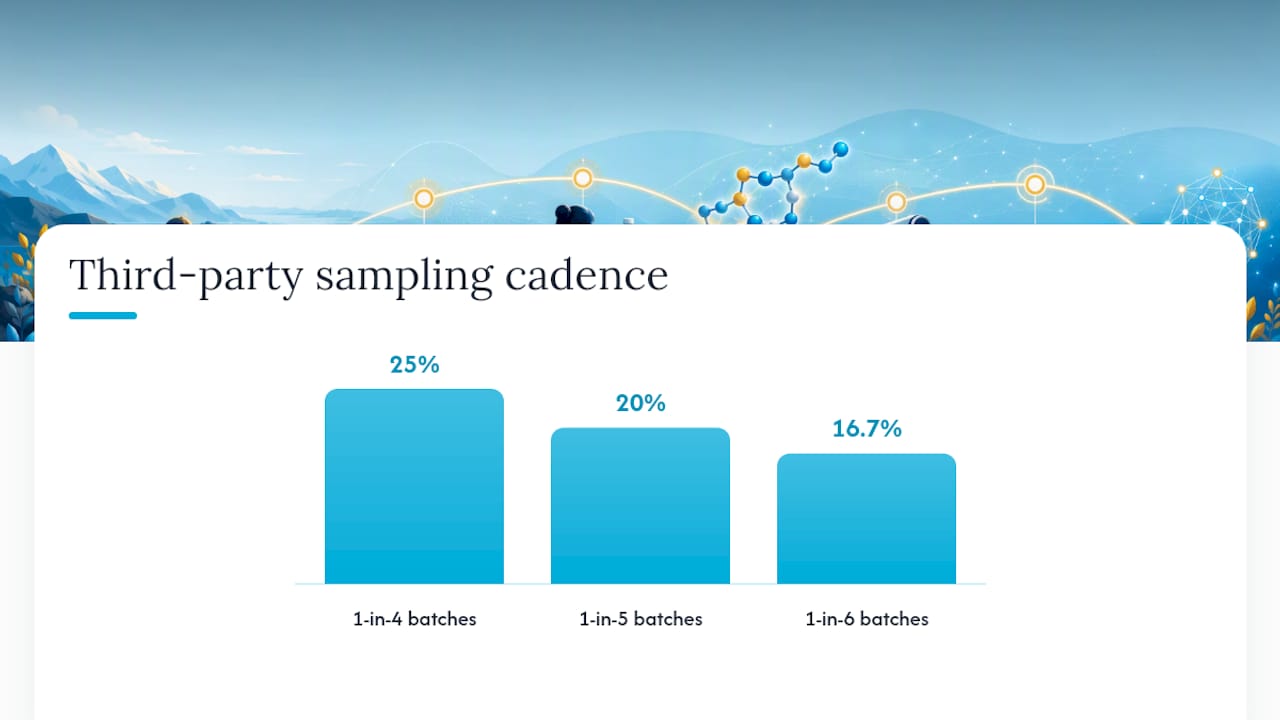
Send a subset to an independent lab periodically. A reasonable cadence is one out of every four to six batches, or a fixed percentage of total order volume, whichever gives you more frequent checks during a new supplier relationship.
Build a drift-response threshold in advance. Decide before you see the data what change in retention time, impurity percentage, or LC-MS signal triggers a hold on using that lot in pooled analysis.
Pro Tip: Keep a running spreadsheet with one row per lot and columns for retention time, purity, top impurity percentage, and LC-MS confirmation status. Trends jump out in a spreadsheet in ways they never do scanning individual PDFs.
Third-party verification matters most in the first several orders with a new vendor, since that’s when you’re establishing whether their process controls are actually reproducible or just lucky once.
The Metadata Fields Pooled Analysis Actually Requires
Chromatograms and COAs are only useful if they’re tagged with enough context to compare apples to apples. Analysts pooling results across lots or labs need a standardized metadata schema attached to every batch, not a folder of loose PDFs.
The minimum set includes vendor name, lot number, synthesis date, purification method (and cut, if the peptide went through more than one purification pass), counterion form, analytical methods used (HPLC column and gradient, LC-MS instrument and ionization mode), and reconstitution or storage conditions at the time of testing. Without these fields, you can’t tell whether a shift in assay results reflects a real batch difference or just a different testing method applied inconsistently.
Metadata Field Why It Matters for Pooling Lot number Anchors every downstream data point to a specific manufacturing run Synthesis/purification date Flags aging or storage-related drift between test and use Counterion form Acetate vs. trifluoroacetate salts affect solubility and bioactivity comparisons Analytical method ID Lets you confirm chromatograms were generated under comparable conditions Storage/reconstitution notes Explains variance that has nothing to do with the peptide itself
Standardizing instrument and method IDs matters more than it sounds. A chromatogram run on a different column chemistry or gradient slope isn’t directly comparable to one from a prior lot, even if both peptides are chemically identical. Retain raw files in original export formats (not converted screenshots) and keep them indefinitely, since pharmacopoeial reference standards shift over time and you may need to re-benchmark old lots against a newer specification. A structured verification workflow built around these fields turns a stack of certificates into an actual dataset.
Procurement Checklist: Questions to Ask Before You Order
Before a supplier earns a repeat order, procurement teams should confirm they can actually produce the documentation trail this whole approach depends on. Most vendors will hand over one COA without hesitation. Fewer will commit to ongoing traceability.
Ask for lot-matched COAs from the last three to five batches, not just a sample certificate from their marketing materials.
Request raw chromatogram and LC-MS files, and see how quickly they can produce them. A vendor who has to “check with the lab” for basic export files probably doesn’t archive this data systematically.
Ask whether they’ll accommodate an independent third-party spot check on an upcoming order. Hesitation here is a bigger red flag than the answer to almost any other question.
Ask about their process controls directly, meaning validated synthesis methods, calibrated instruments, and documented SOPs, rather than accepting a vague assurance of “quality manufacturing.”
Compare their answers against known gray-market patterns. Reporting on the research peptide supply chain has flagged vendors who rotate sourcing without disclosure as a recurring problem; a supplier who can’t explain where a given lot’s API originated is one to scrutinize further. A comparison of direct manufacturers versus resellers is worth reviewing before locking in a new vendor relationship.
Acceptable answers are specific: named lot numbers, dated files, and a described testing cadence. Vague reassurance (“we’re always quality tested”) without documentation is the response pattern that tends to precede batch surprises.
Balancing Verification Depth With Budget and Speed
Full orthogonal characterization on every lot is expensive and often unnecessary once a vendor has a track record. The practical approach is to front-load scrutiny during the first several orders with any new supplier, then shift to a spot-check cadence once chromatograms and LC-MS results have shown consistent agreement across five or six lots.
That phased approach does two things: it builds an empirical baseline for what “normal” variation looks like from that specific supplier, and it lets a procurement team set testing budgets around risk rather than testing everything at maximum depth indefinitely. A vendor relationship that has already demonstrated traceable, batch-matched documentation reduces the friction of this process considerably, since you’re verifying continuity rather than starting from zero each order.
Sourcing Peptides With Traceability Built In
Products are subject to the manufacturer’s applicable quality-control procedures and specifications. Manufacturer-side analytical documentation may be available depending on the product and batch. PeptidesFromChina is not an independent analytical testing laboratory.
That documentation trail is what separates a usable research input from a guess. Instead of piecing together chromatograms from three different email threads, you can pull batch history and analytical files in one place and build the metadata record your pooled analysis actually needs. The peptide catalog lists currently available lots, and product pages like Epithalon and KPV show what a lot-matched analytical disclosure looks like in practice. If your lab or procurement group needs a documented batch history before committing to a bulk order, submitting a sourcing request through the catalog is the fastest way to get that conversation started.
Frequently Asked Questions
Why does consistent sourcing matter more for pooled analysis than for a single experiment? A single experiment only needs the material to be well characterized once. Pooled analysis assumes the material was the same across every study or batch being compared, so any undetected lot variation gets misread as biological signal.
Is a Certificate of Analysis from the manufacturer enough on its own? No. A COA documents one specific lot, not the supplier’s overall consistency. You need matched COAs and chromatograms from multiple orders to establish a pattern.
How often should independent third-party testing happen? A common approach is testing one out of every four to six batches, with more frequent checks during the first several orders from a new supplier and a reduced cadence once a consistency pattern is established.
What’s the biggest documentation gap procurement teams miss? Raw chromatogram and LC-MS export files. Summary PDFs often round numbers and crop details that reveal early-stage impurity drift before it shows up in the headline purity percentage.
Can inconsistent sourcing be fixed after the fact with statistical adjustment? Not reliably. Statistical correction assumes you know the source and magnitude of the variance. Undocumented lot-to-lot drift is exactly the kind of unmeasured confounder that statistical adjustment can’t recover from cleanly.