Sequence Confirmation for Clinical Peptides: Methods and Best Practices

What is sequence confirmation in clinical peptides?
Sequence confirmation is the unambiguous analytical verification of a peptide’s exact amino acid order, establishing identity, structural integrity, and purity for regulatory compliance. For clinical and therapeutic peptides, this is not a formality. A single amino acid substitution, deletion, or stereochemical inversion can alter pharmacokinetics, immunogenicity, or biological activity in ways that standard purity assays will not detect.
The EMA’s guideline on synthetic peptide development and manufacture requires that the primary structure be confirmed by analytical data, and specifies that at least two orthogonal methods be used for identity confirmation at release. Accepted approaches include LC-MS/MS, peptide mapping, amino acid analysis (AAA), NMR, and bioactivity testing. No single technique covers every failure mode, which is precisely why the orthogonal requirement exists.
Sequence confirmation also supports manufacturing control and batch release. When a synthesis facility delivers a new lot, sequence data provides the traceability link between the theoretical structure and the actual API. Without it, batch-to-batch comparisons rely on retention time and mass alone, which is insufficient for detecting sequence variants or truncation products that co-elute with the target peptide.
Key functions sequence confirmation serves in clinical peptide development:
Establishes unambiguous identity beyond molecular weight alone
Detects deletions, insertions, and truncations from chemical synthesis
Identifies stereochemical errors including D-amino acid incorporation
Supports regulatory submissions with theoretical and observed mass tables
Provides the analytical foundation for batch release and comparability studies
Which analytical techniques are used for peptide sequence confirmation?
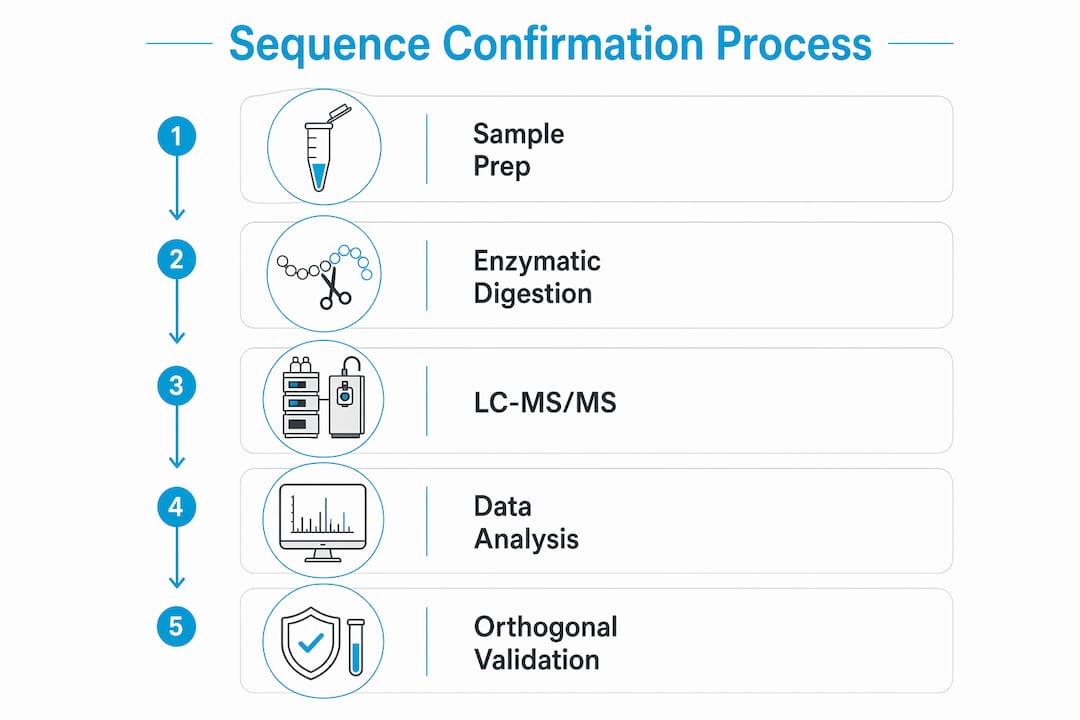
Peptide mapping with LC-MS/MS
Peptide mapping through enzymatic digestion followed by LC-MS/MS is the preferred bottom-up approach for sequence confirmation of therapeutic peptides and recombinant vaccine antigens. The peptide is digested with a site-specific protease such as trypsin or Lys-C, and the resulting fragments are separated by reversed-phase LC before tandem mass spectrometric analysis. Fragment ion series (b-ions and y-ions) are then assigned to reconstruct the original sequence. Coverage of greater than 95% of the primary sequence is typically expected for regulatory submissions.

Intact mass analysis
High-resolution LC-MS on the intact molecule provides a rapid first-pass identity check. Instruments such as Orbitrap or quadrupole time-of-flight (Q-TOF) platforms resolve mass differences at the sub-dalton level, allowing detection of single amino acid substitutions in shorter peptides. Intact mass analysis alone cannot assign sequence position, but it efficiently flags unexpected mass shifts before committing to full peptide mapping.
Edman degradation
Edman degradation is a legacy N-terminal sequencing method that cleaves and identifies one amino acid at a time using phenyl isothiocyanate chemistry. It remains useful for short linear peptides with a free N-terminus, but modern workflows favor high-resolution LC-MS/MS because of its higher sensitivity and throughput. Edman degradation cannot sequence cyclic peptides, N-terminally blocked peptides, or peptides longer than roughly 30 residues without significant signal degradation.
Multiple reaction monitoring for D-amino acid detection
Standard MS fragmentation cannot distinguish D- from L-amino acid stereoisomers because they are isobaric. Detection of D-amino acids in synthetic peptides requires LC-MS analysis of acid-hydrolyzed and derivatized samples using multiple reaction monitoring (MRM). The derivatized amino acids produce diastereomeric products with distinct retention times, making chiral assignment possible. This step is particularly relevant for therapeutic peptides that intentionally incorporate D-amino acids for protease resistance, where the correct stereochemistry must be confirmed, not assumed.
NMR-based sequencing
1H NMR HiFSA sequencing provides identity and purity information simultaneously, independent of instrument software. The HiFSA approach treats peptide spectra as assemblies of individual amino acid spin systems, allowing sequence assignment from 1D 1H NMR data. For pharmaceutical applications, this method can complement or replace MS-based approaches for shorter peptides, and it is particularly valuable when MS fragmentation patterns are ambiguous due to isobaric residues.

Method Primary application Key advantage Key limitation LC-MS/MS (peptide mapping) Full sequence coverage High sensitivity, fragment-level resolution Requires enzymatic digestion; complex data analysis Intact mass LC-MS Identity screening Fast, minimal sample prep Cannot assign sequence position Edman degradation N-terminal sequencing Direct residue identification Limited to short, unblocked peptides MRM (chiral derivatization) D-amino acid detection Only reliable stereoisomer method Requires hydrolysis; destructive NMR (HiFSA) Identity and purity Software-independent; concurrent purity Lower throughput; less sensitive for large peptides
Method pros and cons at a glance:
LC-MS/MS: high throughput and sensitivity, but isobaric residues (Leu/Ile) require orthogonal confirmation
Intact mass: rapid screening tool, not a standalone sequence confirmation method
Edman degradation: direct and interpretable, but practically obsolete for peptides above 30 residues
MRM: definitive for stereochemistry, but the derivatization workflow adds complexity and time
NMR: uniquely capable of simultaneous identity and purity assessment, but throughput is lower than MS
What regulatory guidelines govern peptide sequence confirmation?
The EMA guideline on synthetic peptides, along with ICH Q6b, establishes the core regulatory framework. Both documents require that the applicant demonstrate the proposed identification test or combination of tests is suitable to unambiguously confirm the peptide sequence. The EMA guideline explicitly recommends at least two orthogonal methods for identity confirmation at specification and release.
Sequence confirmation is a risk-based strategy, not a checkbox process. Regulatory submissions require comprehensive correlation between theoretical and observed mass data to differentiate true sequences from impurities with nearly identical mass. The scope of sequence variant analysis should be justified based on the specific product and its synthesis route, not applied uniformly across all peptides.
Industry consensus highlights genuine ambiguity in how sequence confirmation scope is defined during early versus late phase development. Labs are expected to justify their sequence variant analysis (SVA) approaches based on product-specific factors, including synthesis complexity, known impurity profiles, and the clinical risk associated with sequence errors. A short, well-characterized dipeptide requires a different analytical justification than a 40-residue cyclic therapeutic.
Validation of the sequence confirmation method itself is also required. The analytical procedure must demonstrate specificity, accuracy, and reproducibility under the conditions used for batch release. For clinical peptide analysis, this means the method must be capable of distinguishing the target peptide from known process-related impurities and sequence variants at the levels specified in the product’s impurity profile.
Essential regulatory criteria and best practice requirements:
At least two orthogonal analytical methods for identity confirmation
Theoretical and observed mass tables with fragment ion assignments provided in submissions
Sequence variant analysis justified by product-specific risk assessment
Method validation demonstrating specificity for sequence variants and process impurities
Documented batch traceability linking sequence data to each manufactured lot
Consistency between early-phase characterization data and late-phase release specifications
How do data interpretation challenges affect sequence confirmation accuracy?
Automated mass spectrometry software introduces specific failure modes that are not always obvious from summary reports. Software algorithms can misassign nearly isobaric dipeptides such as serine-alanine (SA) versus glycine-threonine (GT), and can misinterpret isotopic peaks as chemical modifications. These errors propagate silently through automated pipelines unless a qualified scientist reviews the raw MS/MS spectra directly.
The leucine/isoleucine problem is a well-known limitation of standard MS fragmentation. Both residues have identical nominal masses, and CID fragmentation does not produce diagnostic ions that distinguish them. Orthogonal confirmation combining LC-MS/MS with NMR or chiral assays is necessary to resolve these stereochemistry and isomer challenges for regulatory submissions.
Manual review by qualified scientists is indispensable for counteracting “black-box” errors from automated sequencing software. Preventing false positives in regulated biopharma settings requires that the reviewer understand both the chemistry of the peptide and the fragmentation behavior of the instrument. Relying solely on software-generated sequence assignments without expert scrutiny is a documented source of regulatory findings during inspections.
Pro Tip: When reviewing MS/MS spectra manually, verify that both b-ion and y-ion series are internally consistent and that the observed mass errors fall within the instrument’s validated tolerance. A sequence assignment supported by only one ion series, or with unexplained gaps in coverage, should be flagged for additional confirmation before inclusion in a regulatory submission.
Common data pitfalls and interpretive strategies:
Isobaric dipeptide misassignment: requires manual spectra review and, where possible, orthogonal NMR or chiral data
Artificial modifications from in-source fragmentation: distinguish by comparing spectra acquired at different collision energies
Isotope misinterpretation: verify monoisotopic mass assignments against theoretical isotope distributions
D/L amino acid confusion: MRM with chiral derivatization is the only reliable resolution method
Incomplete sequence coverage: adjust digestion conditions or use multiple proteases to close gaps
Open-source algorithm limitations: validated commercial software with documented performance in clinical settings is required for regulated submissions
What does an effective sequence confirmation workflow look like?
Sample preparation quality directly determines the reliability of sequence confirmation data. Degradation, oxidation, or incomplete digestion at the sample prep stage introduces artifacts that no amount of analytical sophistication can correct downstream. Peptide samples for LC-MS/MS should be handled under conditions that minimize methionine oxidation and aspartate isomerization, both of which generate mass shifts that complicate sequence assignment.
For peptide mapping workflows, enzymatic digestion conditions require careful optimization. Trypsin is the most commonly used protease, cleaving C-terminal to lysine and arginine residues. Digestion completeness must be verified, as missed cleavages reduce sequence coverage and can obscure truncation variants. Digestion time, enzyme-to-substrate ratio, and buffer composition all affect reproducibility across batches.
Chromatographic separation before MS detection is equally critical. Reversed-phase C18 columns with gradient elution in acidified acetonitrile/water systems remain the standard for peptide fragment separation. Column lot-to-lot variability can shift retention times enough to affect peak assignment, so system suitability testing with reference standards should be performed at the start of each analytical run.
Critical workflow checkpoints and quality control measures:
Sample handling: minimize freeze-thaw cycles; document storage conditions and time from preparation to analysis
Digestion verification: confirm completeness by checking for expected missed cleavage products
System suitability: run reference peptide standards before each batch to verify instrument performance
Sequence coverage calculation: confirm that the sum of confirmed fragment masses accounts for the full theoretical sequence
Batch traceability: link each analytical run to the specific synthesis lot via a documented chain of custody
Workflow stage Key parameter Common failure mode Sample preparation Oxidation control Met oxidation artifacts in MS data Enzymatic digestion Completeness Missed cleavages reducing sequence coverage LC separation Column reproducibility Retention time shifts affecting peak assignment MS data acquisition Mass accuracy Instrument drift causing mass assignment errors Data analysis Manual review Software misassignment of isobaric sequences
How does PeptidesFromChina approach peptide quality and sequence verification?
PeptidesFromChina relies on the manufacturer’s applicable quality-control procedures and product specifications before release. PeptidesFromChina is not an independent analytical testing laboratory and does not represent manufacturer certificates as independent confirmation. Buyers requiring independent verification may arrange third-party analytical testing.
The platform’s verification approach integrates orthogonal analytical techniques consistent with the regulatory framework described above. Peptide testing and analysis at PeptidesFromChina draws on LC-MS/MS for sequence coverage, intact mass confirmation, and where relevant, chiral analysis for peptides containing D-amino acids. NMR data is incorporated when MS fragmentation patterns are insufficient to resolve isobaric residues or confirm structural integrity.
Supply chain transparency is built into the sourcing model. Batch traceability documentation links each lot to its synthesis facility, raw material inputs, and analytical records. Researchers and procurement teams can access this chain of custody rather than relying on summary-level quality claims. This is particularly relevant for longer-term research programs where batch-to-batch comparability is a scientific requirement, not just a procurement preference.
Sequence-confirmation requirements depend on the product and research program. Manufacturer-side analytical documentation may be available depending on the product and batch. Buyers who require independent sequence verification may arrange testing through a recognized third-party laboratory.
Key differentiators of PeptidesFromChina’s verification processes:
Independent batch verification separate from manufacturer-supplied certificates
Orthogonal analytical coverage including LC-MS/MS, intact mass, and chiral analysis where applicable
Documented batch traceability from synthesis facility through to final product
Qualified scientific review of MS/MS spectra, not automated software acceptance alone
Reproducible sourcing from established synthesis facilities with known process histories
Transparent analytical records accessible to research and procurement teams
How does sequence confirmation affect peptide stability and efficacy?
Sequence confirmation data does more than satisfy a regulatory checkbox. The analytical record it generates directly informs stability assessment and efficacy prediction for therapeutic peptides. A confirmed sequence establishes the reference state against which degradation products are measured during forced degradation studies and real-time stability programs.
Sequence errors that escape detection at release can manifest as stability failures. A deamidation-prone asparagine in the wrong position, or a D-amino acid where an L-residue was intended, will alter the peptide’s conformational behavior and susceptibility to proteolytic degradation under physiological conditions. These structural differences affect half-life, receptor binding affinity, and immunogenic potential in ways that are not predictable from molecular weight data alone.
For peptides with defined secondary structure, such as helical or beta-sheet-forming sequences, sequence confirmation also validates the structural prerequisites for biological activity. An amino acid substitution that disrupts a helix-stabilizing interaction may not change the molecular mass detectably but will reduce efficacy in cell-based or in vivo assays. Connecting sequence confirmation data to downstream stability and activity results is therefore a scientific practice, not just a regulatory formality.
Clinical peptidomics research has demonstrated that even minor sequence variants can produce distinct pharmacokinetic profiles in biological matrices. The implication for therapeutic development is that sequence confirmation must be rigorous enough to detect variants at levels that could influence clinical outcomes, not just variants that are analytically convenient to find.
PeptidesFromChina: verified peptides for serious research
Researchers who need confirmed sequence data alongside their peptide supply do not have to treat verification as a separate procurement problem. PeptidesFromChina coordinates sourcing from established Chinese manufacturing facilities together with international logistics. Manufacturer-side analytical documentation may be available depending on the product and batch.
The platform’s sourcing model is built around established synthesis facilities with known process histories, not spot-market resellers. For research programs where batch-to-batch comparability matters, that supply chain stability is a practical requirement. Analytical documentation includes mass confirmation and, for relevant peptides, chiral and structural data that supports downstream stability and efficacy work.
Researchers sourcing peptides such as KPV or Epithalon through PeptidesFromChina receive batch records that reflect the verification standards described throughout this article. Review the current catalog and available analytical documentation at peptidesfromchina.co to assess fit for your specific research requirements.
Key Takeaways
Sequence confirmation for clinical peptides requires at least two orthogonal analytical methods, expert manual data review, and documented batch traceability to meet regulatory standards and support reliable therapeutic development.
Manufacturer-side analytical documentation may be available depending on the product and batch. It is not guaranteed with every order and is not independent verification by PFC. Buyers may arrange third-party analytical testing when required.