Peptide Toxicity Profiling: A Guide for Researchers

Peptide toxicity profiling is the structured set of tests and analyses used to characterize immunogenicity, organ toxicity, genotoxicity when relevant, and safety pharmacology. WuXi AppTec identifies these assessments as foundations of preclinical testing, while FDA and ICH guidance informs their scope. Computational tools such as ToxinPred and ToxiPep can help triage candidates early. For procurement, PeptidesFromChina coordinates manufacturer-side sourcing; manufacturer documentation may be available depending on the product and batch, and buyers may arrange independent testing.
Before commissioning any study, confirm these safeguards are in place:
Independent batch verification: third-party HPLC and MS confirmation of identity and purity
COA with batch-specific HPLC/MS traces, not just a generic certificate
GLP vs. non-GLP designation clearly stated on all study reports
Synthesis transparency: raw API source and lyophilization records available on request
Table of Contents
What does peptide toxicity profiling actually cover?
The four core pillars of a toxicity profile
Which assays belong at each stage of the funnel?
How do you justify species selection for animal studies?
How do you translate profiling results into go/no-go decisions?
What should you demand from peptide suppliers and contract labs?
A practical commissioning workflow with timeline and cost factors
How PeptidesFromChina supports reliable toxicity profiling.
Key Takeaways
The part of toxicity profiling that procurement consistently underestimates
Source your next research batch with verified documentation
Selected resources and references
What does peptide toxicity profiling actually cover?
The scope spans four endpoint categories as outlined by WuXi AppTec: immunogenicity, acute and chronic toxicity, genotoxicity (when relevant), and safety pharmacology. Not every peptide requires all four assessments; PK/ADME and histopathology are standard readouts or supporting studies rather than core pillars. Natural-amino-acid peptides rarely trigger genotoxicity concerns; modified residues or non-natural linkers change that calculus and should prompt genotoxicity evaluation per ICH/FDA-aligned principles.
Who should commission profiling? Principal investigators running preclinical programs, procurement teams buying research-grade peptides in volume, and CRO selection committees all have a stake. The distinction between discovery screening (non-GLP, internal decision-making) and a formal GLP preclinical package matters because it determines which data can support an IND submission and which cannot.
Profiling does not guarantee clinical safety or predict post-marketing behavior. Its role is to generate decision-quality data at the research stage, nothing more.
Pro Tip: When buying peptides for in vivo use, ask the supplier whether their COA was generated by the synthesis facility or by an independent third-party lab. The difference in evidentiary weight is significant.
The four core pillars of a toxicity profile
WuXi AppTec’s preclinical framework organizes peptide safety assessment around four pillars:
Immunogenicity assessment: Anti-drug antibody (ADA) assays and cytokine release panels. Prioritize these for longer peptides, modified sequences, and any peptide intended for repeat dosing. Cytokine storm signals here are a hard stop.
Acute and chronic toxicity: Single-dose and repeat-dose designs with NOAEL endpoints. Clinical pathology markers, including hematology and clinical chemistry panels, are standard readouts. Histopathology of target organs follows.
Genotoxicity screening: Required when the sequence contains non-proteogenic amino acids, chemical linkers, or structural modifications. For natural-amino-acid peptides, regulatory guidance generally de-emphasizes routine genotoxicity testing; immunogenicity and pharmacology endpoints deserve higher priority in most programs.
Safety pharmacology: Functional studies targeting cardiac, respiratory, and CNS endpoints. These run as a separate pillar because organ-level functional changes can appear before histopathology signals, making them an earlier warning system.
Which assays belong at each stage of the funnel?
Peptide safety evaluation follows a staged funnel: computational triage, then in vitro screens, then in vivo confirmation.
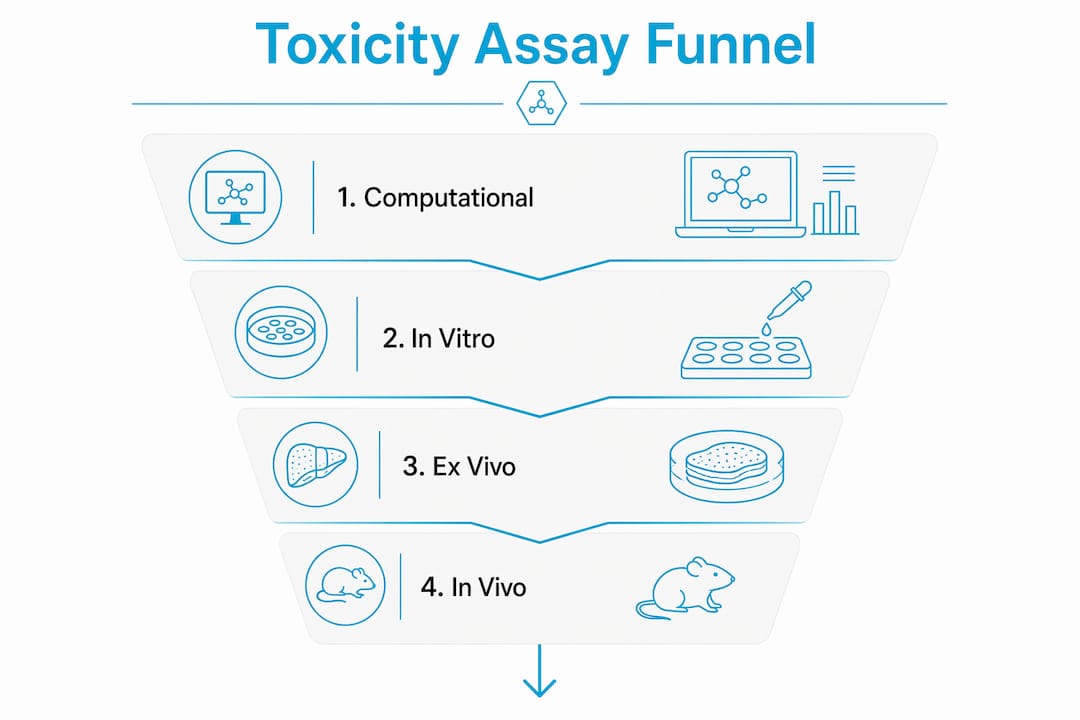
In silico: ToxinPred and ToxiPep are the most widely used sequence-based predictors. ToxiPep integrates context-aware sequence embeddings with atomic-level structural features, outperforming earlier tools on benchmark datasets. Advanced models like ToxMSRC use multi-scale CNN and BiLSTM architectures to identify toxicity-associated residues. These tools triage candidates and flag sequence motifs, but PMC reviews confirm they are not a substitute for wet-lab assays. Use them to shape in vitro panel design, not to skip GLP in vivo testing.
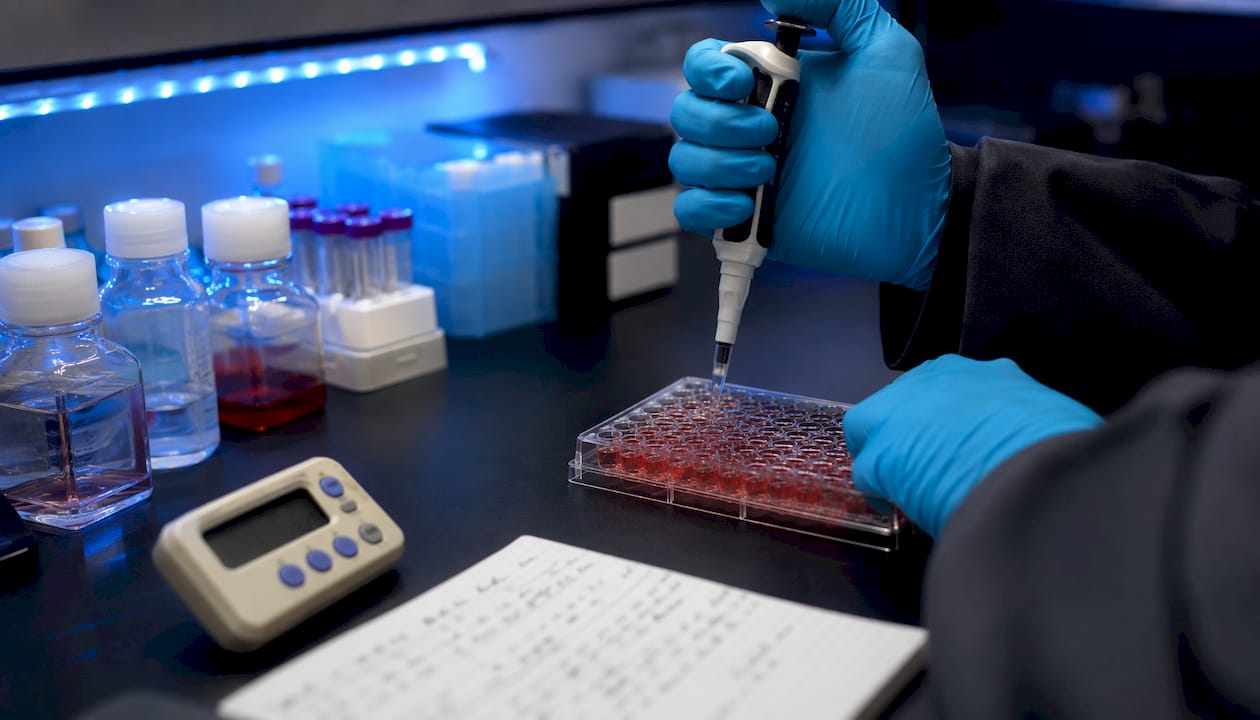
In vitro: The hemolysis assay (RBC lysis, HC50) is the gold-standard early screen. LDH release and MTT cytotoxicity assays measure cell membrane integrity and viability. The selectivity index (SI), calculated as HC50 divided by the therapeutic IC50, gives a two-dimensional view of the safety window. Cytokine release assays complete the basic in vitro panel.
Ex vivo / mechanistic: Receptor cross-reactivity binding assays, metabolic stability, and plasma protein binding studies clarify mechanism and inform species selection.
In vivo: Toxicokinetics (TK), acute and subchronic dosing, histopathology, and clinical pathology panels (WBC, neutrophils, organ weights) confirm what in vitro screens cannot. Route of administration should match intended use: IV, IP, or intranasal, as the research context requires.
Pro Tip: Reserve a confirmation vial from every batch for third-party QC before in vivo dosing begins. Once a study is running, retroactive batch disputes are expensive and often unresolvable.
How do you justify species selection for animal studies?
Species selection failures are a documented cause of invalid toxicology data. If the test animal does not respond via the same metabolic pathway as the human target, histopathology results can be technically clean but scientifically meaningless.
A practical checklist for species justification:
Confirm target expression in the candidate species using binding or functional assays.
Verify metabolic pathway similarity and predicted metabolite profile.
Review historical precedence for structurally similar peptides in that species.
Document ethical and regulatory constraints (IACUC, USDA Animal Welfare Act requirements).
Run cross-reactivity assays before finalizing species when the target is novel, residues are modified, or species-specific receptors are suspected.
Pro Tip: Cross-reactivity work is often treated as optional. For peptides with species-specific receptor variants, running it early costs far less than repeating a GLP study in a second species after a failed primary.
How do you translate profiling results into go/no-go decisions?
Start with exposure confirmation. TK data must show relevant systemic exposure before any adverse finding is attributed to the peptide itself. Without that, histopathology signals are uninterpretable.
Decision triggers that warrant a stop or redesign:
Hemolysis above an acceptable HC50 threshold for the intended route and dose
Cytokine storm signal in the release panel
Organ-specific histopathology not explained by pharmacology
Immunogenicity that reduces intended exposure or causes adverse immune activation
Context rules apply throughout. Weigh the therapeutic index and selectivity index against the intended use: an in vitro tool compound tolerates a different risk profile than an in vivo model probe. Mitigation options, including dose adjustment and formulation change, should be evaluated before a hard stop.
Before releasing any batch for in vivo use, require:
NOAEL from the most relevant toxicity study
TK data confirming exposure at the intended dose
Pathology readouts from target organs
Independent batch verification (HPLC and MS) on the specific lot being used
What should you demand from peptide suppliers and contract labs?
A COA alone is not sufficient. Research confirms that highly pure peptides can remain toxic due to sequence-driven hemolysis or immunogenic motifs. Purity and safety are separate properties.
Supplier deliverables to require on every order:
Sequence confirmation by MS/MS, not just nominal sequence
HPLC purity trace with batch-specific identifier
Synthesis transparency: raw API source, lyophilization records, and moisture content
Stability data under intended shipping and storage conditions
Testing obligations for procurement teams:
Independent third-party HPLC and MS verification of the received lot
Hemolysis assay, basic cytotoxicity panel, and cytokine screen for in vivo-bound batches
GLP labeling on any study report that may support regulatory submissions
Sample PO clauses worth including:
Warranty of identity and purity tied to the specific batch number
Right to retest the batch at an independent laboratory at any time
Hold-back sample policy: supplier retains a portion of the lot for dispute resolution
Defined obligations for cold-chain shipping and storage temperature documentation
QC red flags: a COA without a batch identifier, absence of MS/MS data, inconsistent lyophilization records, or no traceability to the synthesis facility. Any of these should trigger a hold on in vivo use.
Pro Tip: When evaluating a new supplier, request the COA verification documentation for a recently shipped batch before placing a large order. How quickly and completely they respond tells you more than any marketing claim.
A practical commissioning workflow with timeline and cost factors
Stage Activity Typical Lead Time Primary Cost Driver 1. Sequence verification MS/MS identity confirmation, HPLC purity 3–7 days Analytical lab fees 2. In silico triage ToxinPred / ToxiPep screening 1–2 days Minimal (web tools) 3. In vitro panels Hemolysis (HC50), LDH/MTT, SI, cytokine release 1–3 weeks Assay multiplicity 4. Cross-reactivity Binding/functional assays in candidate species 2–4 weeks Species and assay count 5. GLP in vivo bridging Acute/subchronic dosing, TK, histopathology 6–16 weeks GLP compliance, species Expanded GLP toxicology Full repeat-dose, safety pharmacology 3–6 months Multi-species, GLP audit
Stagger spend deliberately. In silico and basic in vitro screens are inexpensive relative to GLP in vivo work. Staging spend this way filters out poor candidates before budget-intensive studies begin. Document decision gates tied to budget approvals so that a failed in vitro screen stops spending automatically.
Operational notes:
Reserve a confirmation vial for third-party QC before dosing begins
Use non-GLP in vitro data for internal go/no-go decisions; switch to GLP for any data intended for regulatory submission
Build analytical re-testing costs into the budget from the start; retroactive testing after a study failure costs more
How PeptidesFromChina supports reliable toxicity profiling.
Products are subject to the manufacturer’s applicable quality-control procedures and specifications. Manufacturer-side analytical documentation may be available depending on the product and batch. PeptidesFromChina is not an independent analytical testing laboratory.
For procurement teams building a toxicity profiling program, PeptidesFromChina can assist with:
Specifying analytical tests appropriate for the peptide class and intended use
Recommending CRO contacts for GLP in vitro and in vivo studies in the U.S.
Providing sample PO language for batch retest rights and hold-back sample policies
Clarifying GLP vs. non-GLP requirements based on downstream research goals
Consistent reagent quality across batches is a prerequisite for reproducible toxicology data, and that starts with traceable sourcing. The platform’s direct manufacturer relationships and batch traceability documentation are designed to meet that standard for research programs operating under U.S. institutional and regulatory expectations.
Key Takeaways
Peptide toxicity profiling requires independent batch verification, staged assay spending, documented species justification, and GLP scope aligned with downstream research goals.
Manufacturer-side analytical documentation may be available depending on the product and batch. It is not guaranteed with every order and is not independent verification by PFC. Buyers may arrange third-party analytical testing when required.
The part of toxicity profiling that procurement consistently underestimates
The procurement conversation around peptide safety almost always centers on HPLC purity. A batch comes in at greater than 98% purity, the COA looks clean, and the assumption is that the safety question is answered. It is not. Sequence-driven hemolysis and immunogenic motifs are structural properties, not contamination problems. A peptide can be analytically pure and still lyse red blood cells at relevant concentrations, or trigger a cytokine response that invalidates the entire study.
The more consequential gap is in species selection. Labs routinely pick rodents by default, run a clean histopathology panel, and treat the data as human-relevant. When the peptide target has a species-specific receptor variant, that data may be technically accurate and scientifically useless at the same time. Cross-reactivity work is the check that closes that gap, and it is consistently treated as optional until a GLP study fails.
The practical implication: the cheapest point in a toxicology program to catch a problem is always earlier than where most teams are currently looking.
Source your next research batch with verified documentation
Research programs benefit from defining verification requirements before a study begins. PeptidesFromChina coordinates sourcing from established Chinese manufacturing facilities and international logistics. Manufacturer-side analytical documentation may be available depending on the product and batch, and buyers requiring independent verification may arrange third-party testing.
Browse the research peptide catalog to review available compounds and submit sourcing requirements. Manufacturer-side analytical documentation may be available depending on the product and batch. Buyers requiring independent verification or specialized study documentation should arrange it with an appropriate third-party laboratory or service provider.
Selected resources and references
Resource What it provides WuXi AppTec: 4 Safety Assessments for Peptide Preclinical Testing Framework for the four core pillars; IND data package guidance PMC: Traditional and Computational Screening of Non-Toxic Peptides In vitro assay methods, HC50, SI calculation, and hemolysis prediction models ToxiPep: Peptide Toxicity Prediction via Dual-Model Framework State-of-the-art computational tool integrating sequence and structural features ToxinPred: Improved Peptide Toxicity Prediction Alignment-based and ML methods for sequence-level toxicity triage PMC: Multi-Scale CNN Model for Peptide Toxicity Prediction Deep-learning architecture for residue-level toxicity feature discovery Peptide Research Standards: 2026 Guide Lab best practices and research standards for peptide programs PeptidesFromChina: How to Choose a High Purity Peptide Supplier Supplier selection criteria and independent verification guidance