Crude vs Purified Peptide: A Lab Researcher’s Guide
Products are subject to the manufacturer’s applicable quality-control procedures and specifications. Manufacturer-side analytical documentation may be available depending on the product and batch. PeptidesFromChina is not an independent analytical testing laboratory.
Table of Contents
What do “crude” and “purified” actually mean on a supplier listing?
How is peptide purity measured and reported on a COA?
How crude peptide gets converted to purified material
When should you use crude versus purified peptide?
What can go wrong when purity is insufficient?
What to specify when placing a peptide order
Reconstitution, storage, and handling in the lab
Supplier verification, batch traceability, and independent testing
Key Takeaways
The case for staged purity decisions
Research-grade peptides with documented purity from PeptidesFromChina
Useful sources
What do “crude” and “purified” actually mean on a supplier listing?
The terminology varies between vendors, which creates real confusion when ordering. Here is how the labels typically map to purity ranges in practice.
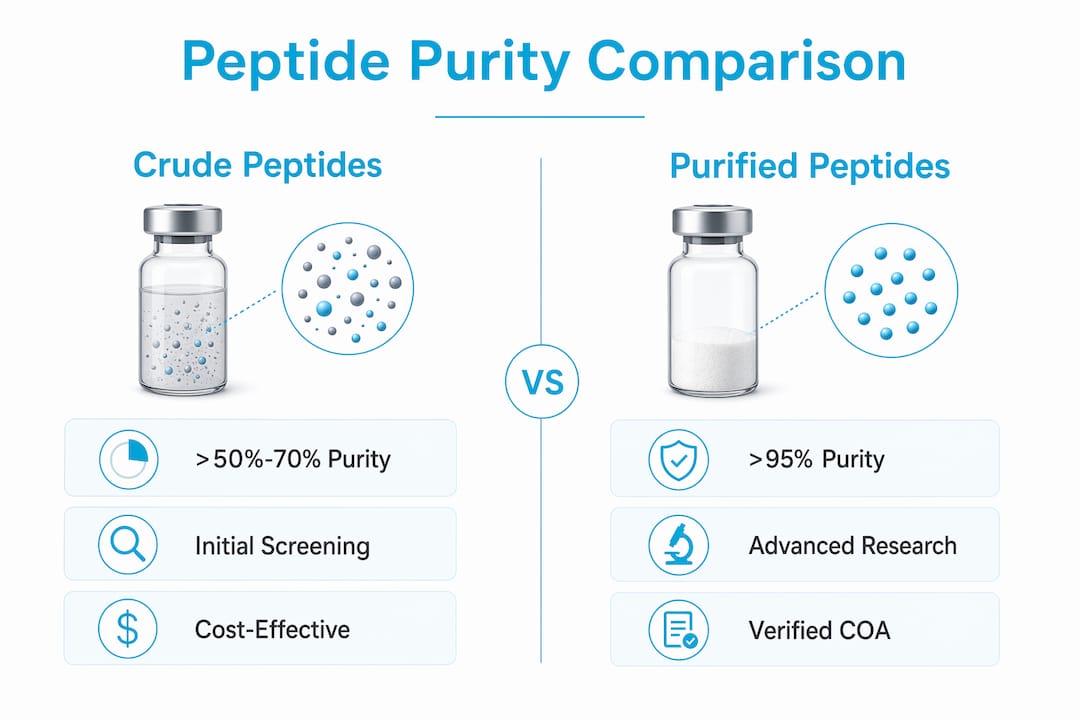
“Crude” or “desalted” material sits in the >50%–70% purity range by RP-HPLC area%. Desalting removes small-molecule reagents and counterions but does not separate sequence-related impurities. Some vendors call this “crude purified,” which is a contradiction in terms — it means the material has been through a simple SPE or desalting step, not a preparative HPLC run. Mid-range material, labeled “partially purified” or simply “>75%” or “>80%”, falls in the 70%–85% band. High-purity material runs from 85%–95%, and analytical or ultrapure grades are specified at >95% to >98%+
One distinction that often gets overlooked: peptide content versus total dry weight. A vial labeled “5 mg” reflects the total mass of the lyophilized powder, which includes the peptide itself plus counterion salts (typically trifluoroacetate, or TFA, from HPLC mobile phases, or acetate after ion-exchange treatment). The actual peptide content can be meaningfully lower. Vendors should report both figures. If a COA lists only dry weight with no peptide content value, the dosing calculations for any quantitative assay will be off.
Purity Band Common Label Typical Research Uses >50%–70% Crude / desalted Initial screening, lead generation, epitope mapping >70%–85% Partially purified Antibody production, ELISA, semi-quantitative assays >85%–95% High purity Enzymology, cell-based assays, structural studies >95%–98%+ Analytical / ultrapure Quantitative binding, in vivo studies, reference standards
How is peptide purity measured and reported on a COA?
RP-HPLC area% is the standard purity metric. The method integrates UV absorbance peaks across the chromatogram and expresses the target peak as a percentage of total peak area. It is a relative measure, not an absolute one — a peptide with no chromophore at 214 nm will be underrepresented, and co-eluting impurities with similar retention times will inflate the apparent purity. LC-MS identity confirmation is the complementary check: it verifies the molecular weight of the target sequence and flags any mass-shifted variants (oxidation, deamidation, incomplete deprotection).
Core QC methods to require on any COA:
RP-HPLC area% with the actual chromatogram (not just a number)
LC-MS spectrum showing the expected [M+H]+ or multiply charged ions
Reported peptide content (not just dry weight) — ideally from amino acid analysis or UV quantification at 280 nm for Trp/Tyr-containing sequences
Counterion notation (TFA or acetate form) and salt form
Lot number, synthesis date, and recommended storage conditions
The counterion matters more than most researchers realize. TFA is the default counterion from RP-HPLC purification and is cytotoxic at concentrations relevant to cell-based assays. If your experiment uses cell culture, request acetate-form peptide or plan for a TFA-removal step. Vendors should state the counterion explicitly on the COA; if they do not, ask before ordering. For a detailed breakdown of what a complete COA should contain, the peptide characterization reporting checklist from PeptidesFromChina covers the documentation expectations in full.
Pro Tip: When reviewing a chromatogram, look for a flat baseline before and after the main peak. A rising baseline, a shoulder on the main peak, or a cluster of small peaks within 0.5 minutes of the target retention time all suggest co-eluting impurities that area% alone will not resolve. Request the raw chromatogram file or a zoomed view if the vendor provides only a thumbnail.
Marketing language is a separate problem. Terms like “purified peptides” in consumer skincare contexts carry no analytical meaning — there is no chromatogram behind them. As Cleveland Clinic’s peptide guidance notes, the consumer use of “purified” does not map to laboratory-grade purification standards. Always validate vendor claims with the actual analytical data, not the product description.

How crude peptide gets converted to purified material
Preparative RP-HPLC is the standard purification method for synthetic peptides. The same column chemistry used for analytical work (typically C18 or C8 reversed-phase) scales to preparative columns with larger internal diameters and higher mass loads. Waters’ practical guidance on peptide isolation describes how preserving gradient slope per column volume — expressed as % change per column volume rather than % per minute — maintains resolution when moving from analytical to preparative scale. This is the detail that separates a supplier who understands prep chromatography from one who simply runs a bigger column.
Common purification approaches and their tradeoffs:
RP-HPLC (preparative): highest resolution, separates sequence-related impurities, scalable from milligrams to grams; reduces yield because overlapping fractions are discarded
SPE / desalting: removes small-molecule reagents and salts but does not resolve deletion peptides or truncated sequences; fast and low-cost, appropriate for crude-grade material
Ion-exchange chromatography: useful for charge-based separations, particularly for basic or acidic peptides where RP-HPLC resolution is limited; often used as an orthogonal step
Size-exclusion chromatography (SEC): separates by molecular weight; practical for removing aggregates or high-molecular-weight impurities, not for resolving closely related sequences
Mass-directed fraction collection adds confidence when the target peak is low-abundance or co-elutes with a closely related impurity. The mass spectrometer triggers fraction collection only when the target m/z is detected, which recovers more of the correct sequence and discards less material to waste. For complex sequences or those with known synthesis challenges (long chains, aggregation-prone motifs), this approach is worth requesting explicitly from the supplier.
Pushing for >99% purity on complex sequences can cause exponential cost increases and yield loss, because closely eluting sequence variants require repeated repurification and discard of overlapping fractions. For most research applications, >95% is the practical ceiling where cost and purity are still in reasonable balance.
When should you use crude versus purified peptide?
The decision comes down to what the experiment actually requires, not what sounds rigorous. Using >95% material for a 384-well primary screen of 200 sequences wastes budget. Using crude material for a receptor binding Kd determination produces unreliable data.
Experiment Type Recommended Purity Key QC Required Primary screening / lead generation >50%–70% (crude/desalted) MS identity, lot number Epitope mapping, antibody generation >70%–85% HPLC chromatogram, MS ELISA, semi-quantitative cell assays >70%–85% HPLC chromatogram, peptide content Enzymology, quantitative cell assays >90%–98% Full COA, peptide content Receptor-ligand binding (Kd), SPR >90%–98% Full COA, TFA-free form In vivo animal studies >90%–98% Full COA, endotoxin testing Reference standards, structural work >90%–98% Full COA, amino acid analysis
Biocompare’s peptide synthesis guidance supports this tiered approach: crude or desalted peptides are cost-effective for initial screens and lead generation, mid-range purities (>70%–85%) are appropriate for antibody production and ELISA work, and purities >90%–98% are recommended for quantitative bioassays, receptor-ligand binding, and in vivo studies.
A practical staging strategy: order crude or desalted material for broad sequence screening, then commission preparative purified batches only for validated leads. This approach balances budget against experimental rigor and avoids paying for high-purity material on sequences that will not advance. For proteomics applications where LC-MS/MS is the readout, purity requirements differ from cell-based work — the peptides in proteomics methods guide covers those specific considerations.
What can go wrong when purity is insufficient?
The risks from using insufficiently purified peptides fall into three categories: assay interference, biological effects, and dosing errors.
Deletion peptides and truncated sequences can have partial agonist or antagonist activity, producing false positives or attenuated signals in activity screens
Residual TFA from RP-HPLC purification is cytotoxic in cell-based assays at concentrations that overlap with typical peptide working concentrations
Incomplete deprotection products (e.g., residual Pbf on Arg, tBu on Ser/Thr) alter the peptide’s charge state and binding properties
Variable peptide content between batches — when only dry weight is reported — leads to inconsistent dosing across experiments
Immunogenic impurities in crude material can trigger inflammatory responses in animal studies, confounding pharmacological readouts
Deletion peptides are among the most insidious impurities because they are structurally similar to the target sequence and can co-elute on a poorly optimized HPLC method. A crude peptide used in a receptor binding screen may show apparent activity that disappears entirely when the same sequence is re-tested at >95% purity — not because the target is inactive, but because a deletion variant was driving the signal. This is a documented source of false positives in early-stage peptide drug discovery and one of the strongest arguments for confirming hits with purified material before committing resources to follow-up work.
Supplier QC can miss these issues when LC methods are not optimized for the specific sequence. A generic gradient run on a C18 column may not resolve a one-residue deletion from the full-length target. Requesting the chromatographic method parameters alongside the chromatogram — column, gradient, temperature, flow rate — lets you assess whether the separation was adequate. For a broader look at how impurities affect peptide selectivity in biological assays, the linked resource covers the mechanistic detail.
What to specify when placing a peptide order
A complete order specification prevents the most common sourcing problems. Vague requests produce variable results; explicit documentation requirements give the supplier no room to substitute lower-grade material.
Ordering checklist:
Sequence (single-letter or three-letter code, with any modifications specified)
Requested purity (%, by RP-HPLC area%)
Scale (mg or g of peptide content, not total dry weight)
Counterion preference (TFA or acetate)
Required COA items: HPLC chromatogram, LC-MS spectrum, peptide content value, lot number, synthesis date, storage conditions
Lyophilized form confirmed (not in solution)
Vial labeling requirements: peptide content per vial, lot number, storage temperature
Any special requirements: endotoxin testing, sterile filtration, mass-directed fraction collection
Higher target purity reduces overall recovery yield and increases cost, so ask the supplier for expected recovery before committing to a large-scale order. A supplier who cannot give a rough yield estimate for a given sequence and purity target is not running a well-characterized process. For new sequences, a pilot run at analytical scale before committing to preparative quantities is standard practice — it surfaces synthesis problems early and gives you a baseline chromatogram for comparison. The high purity peptide supplier guide covers the supplier qualification questions in more detail.
Reconstitution, storage, and handling in the lab
Lyophilized peptides require careful reconstitution to preserve integrity and avoid aggregation artifacts.
Stepwise reconstitution:
Calculate the volume needed from peptide content (not dry weight) to reach your target concentration
For hydrophilic sequences, dissolve in sterile water or aqueous buffer; for hydrophobic sequences, add a small volume of DMSO first (typically 10%–20% of final volume), then dilute with aqueous buffer
Avoid prolonged DMSO contact with assay components — dilute into buffer immediately after dissolution
Aliquot into single-use volumes before freezing to avoid repeated freeze-thaw cycles
Label each aliquot with peptide content, lot number, and date of reconstitution
Storage recommendations depend on planned use timeline. Lyophilized peptides are stable at -20°C for most sequences; -80°C is preferred for long-term storage of oxidation-sensitive sequences (Met, Cys, Trp-containing peptides) or when the material will not be used within six months. Keep lyophilized vials sealed and equilibrate to room temperature before opening to prevent moisture condensation on the powder.
Pro Tip: For hydrophobic or aggregation-prone sequences, brief sonication in a water bath (30–60 seconds) after initial dissolution helps break up aggregates before dilution. A quick UV absorbance check at 280 nm (for Trp/Tyr-containing peptides) or a rapid LC-MS injection after reconstitution confirms that the material dissolved correctly and has not degraded during storage.
Supplier verification, batch traceability, and independent testing
A COA number is not the same as a verified COA. The document needs to contain specific analytical data — not just a purity percentage — to be useful for research documentation and batch acceptance decisions.
Supplier verification checklist:
Lot number that traces back to a specific synthesis batch (not a generic catalog number)
Complete COA with HPLC chromatogram (not just area%), LC-MS spectrum, and explicit peptide content value
Preparative method description: column chemistry, gradient, scale, fraction pooling criteria
Retention sample policy: does the supplier hold a portion of each batch for re-testing if questions arise?
Repurification strategy for side fractions: how are overlapping fractions handled?
The EMA guideline on synthetic peptide development and manufacture treats crude post-cleavage peptide as an intermediate and expects documented criteria for pooling main and side fractions, acceptance criteria for each purification step, and justification for any repurification. While this guidance targets pharmaceutical development, it provides a useful reference framework for what rigorous documentation looks like — and a practical benchmark for what to request from any research-grade supplier.
Independent verification is worth building into the procurement workflow for critical work. A third-party LC-MS check on the first batch from a new supplier, or on any batch where the COA chromatogram looks unusual, costs far less than repeating a failed experiment. PeptidesFromChina provides batch traceability, COA documentation, and independent verification as standard components of its research-grade sourcing process.
Key Takeaways
Crude peptide is a post-synthesis intermediate suitable for screening; purified peptide with a verified COA is required for any quantitative, in vivo, or mechanistically interpretable experiment.
Point Details Crude vs purified defined Crude is a post-cleavage mixture (>50%–70% purity); purified is chromatographically isolated material with a specified purity %. Purity bands and uses Use >70%–85% for antibody work and ELISA; require >90%–98% for receptor binding, in vivo, quantitative assays, and reference standards. COA minimum requirements Always require an HPLC chromatogram, LC-MS spectrum, and explicit peptide content value — not just dry weight. Cost and yield tradeoff Higher target purity reduces recovery yield and increases cost; request expected yield estimates before large-scale orders. PeptidesFromChina sourcing Products are subject to the manufacturer’s applicable quality-control procedures and specifications. Manufacturer-side analytical documentation may be available depending on the product and batch. PeptidesFromChina is not an independent analytical testing laboratory.
The case for staged purity decisions
The most common sourcing mistake is treating purity as a single fixed specification rather than a variable matched to experimental stage. Labs that order >95% material for every sequence in a discovery screen are spending three to five times more than necessary on material that will mostly be discarded. Labs that use crude peptide for quantitative assays are generating data that cannot be reproduced when the sequence advances.
The practical approach is staged: crude or desalted for broad sequence coverage in primary screens, mid-range purity for confirmation and immunological work, and fully characterized high-purity material only for the sequences that earn it. This is not a cost-cutting compromise — it is how rigorous peptide research is actually structured. The verification layer matters at every stage: a lot number, a chromatogram, and a peptide content value are non-negotiable regardless of purity grade. Suppliers who cannot provide those three items for crude material are not running a traceable process, and that is a problem that compounds as the work scales.
Independent batch testing before committing to large preparative orders is underused in research procurement. A single LC-MS check on a pilot sample from a new supplier surfaces synthesis failures, counterion problems, and purity discrepancies before they affect a full experiment series. The cost of that check is trivial relative to the cost of repeating six weeks of assay work.
Research-grade peptides with documented purity from PeptidesFromChina
Products are subject to the manufacturer’s applicable quality-control procedures and specifications. Manufacturer-side analytical documentation may be available depending on the product and batch. PeptidesFromChina is not an independent analytical testing laboratory.
The platform works directly with established synthesis facilities rather than through reseller intermediaries, which means batch-specific documentation is available and retention samples are held for re-testing when needed. The catalog covers research peptides across purity grades, from desalted material for screening applications to high-purity analytical-grade batches for quantitative work. Browse the research-grade catalog or submit a sourcing request to receive a COA sample and pilot batch quote for your specific sequence and purity requirements. Wholesale orders only; all supply is for research purposes.
Useful sources
Source What it covers EMA Guideline on Synthetic Peptides Regulatory expectations for intermediates, purification documentation, and acceptance criteria under ICH Q7 Waters: Peptide Isolation and Purification Practical RP-HPLC method development, prep scaling, and mass-directed fraction collection Biocompare: Peptide Synthesis Purity Guide Purity band definitions, application mapping, and cost considerations for research use Cleveland Clinic: Peptides for Skin Consumer vs. laboratory-grade “purified” terminology — a useful contrast for interpreting vendor claims Harvard Health: Peptides Overview Background biology and safety context for lab-synthesized peptide use