
Quick answer: Thymosin Alpha-1 (TA-1) is a synthetic 28-amino-acid peptide studied in laboratory research on immune signaling. For buyers looking for a Thymosin Alpha-1 wholesale supplier, the practical questions are who is supplying the material, what documentation exists, how orders are processed, and how a buyer can test what arrives. This guide covers those questions in procurement order. All products discussed are for laboratory research use only, not for human or veterinary use.
Thymosin Alpha-1 Wholesale: What Procurement Teams Need to Know in 2026
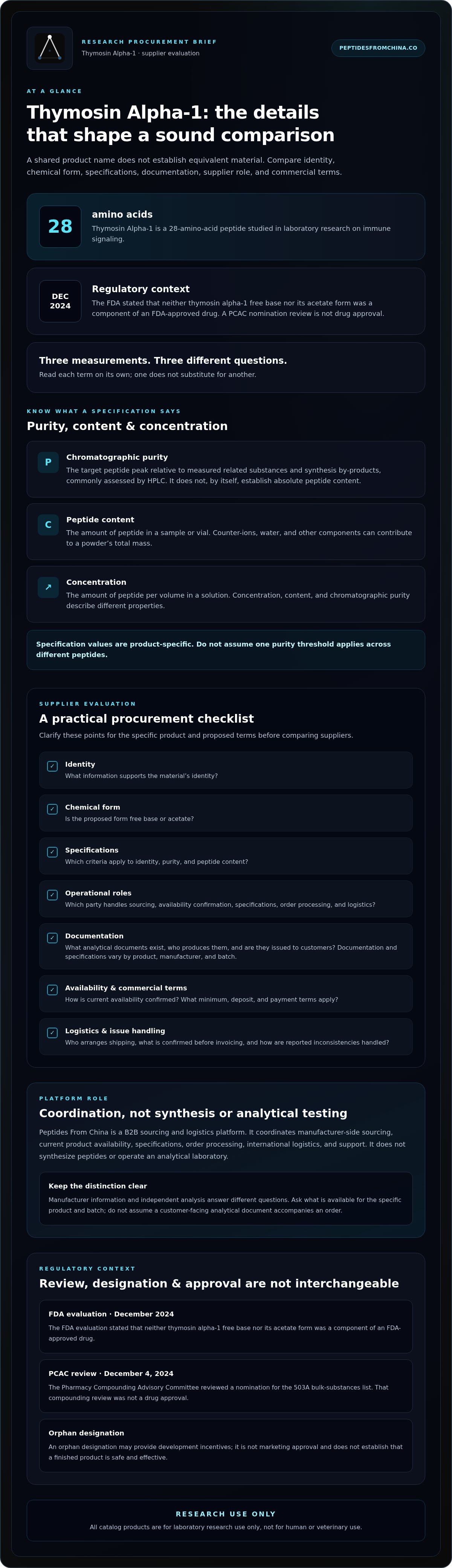
Thymosin Alpha-1 is a 28-amino-acid peptide originally characterized by Goldstein and colleagues (1977) and subsequently made by chemical synthesis. Research literature examines its effects on immune signaling. When comparing research material, confirm identity, chemical form, content and impurity profile as well as supplier roles, documentation and commercial terms. A shared product name does not establish equivalent material.
Laboratories and research buyers generally move to wholesale ordering for two reasons. The first is cost per milligram across larger programs. The second is the ability to plan around a consistent supply over the length of a study. Neither benefit is automatic. Both depend on understanding how a supplier is structured and what is confirmed before an invoice is issued.
The Evolution of Peptide Sourcing
Peptide supply has traditionally run through several layers: a synthesis facility, one or more distributors, and a retail-facing seller. Many research buyers now look for sourcing channels with a shorter commercial path and a clearer description of who does what. A sourcing platform works differently from a retail catalog. It coordinates between the buyer and the manufacturing side rather than holding a shelf of goods for single-vial sales.
Clear supply-chain descriptions matter more in 2026 because buyers increasingly ask for specifics: which party confirms availability, which party issues specifications, and how international delivery is arranged. A good supplier answers these questions plainly.
Defining High-Volume Research Standards
“Research grade” describes intended laboratory use; it is not proof of a particular manufacturing standard. An RUO label does not establish GMP compliance, clinical-trial authorization or approval of a finished drug product. Those are separate questions that require their own evidence. Match the material specification to the planned research with your quality team.
For procurement teams, the useful questions are concrete: which chemical form is proposed, what specifications apply, and which measurements support identity, purity and peptide content? Manufacturer information and independent analysis answer different parts of that assessment.
Regulatory Background: Where Thymosin Alpha-1 Stands
The FDA’s December 2024 evaluation stated that neither thymosin alpha-1 free base nor its acetate form was a component of an FDA-approved drug. On December 4, 2024, the Pharmacy Compounding Advisory Committee reviewed their nomination for the 503A bulk-substances list. That compounding review was not a drug approval. The FDA briefing document and meeting minutes provide the primary record; consult the agency’s current materials for subsequent regulatory changes.
The FDA’s orphan designation guidance makes a separate distinction: designation can provide development incentives for a potential treatment for a rare disease, but it is not marketing approval. It does not establish that a finished product is safe and effective.
Clinical research on thymosin alpha-1 exists, but results vary by study design and population, and this article does not draw therapeutic conclusions from it.
Supplier Disclosure Expectations: What to Ask Before You Order
Before comparing prices, a procurement officer should compare how clearly each supplier describes its own role. A useful disclosure covers the following points.
Role: Is the company the manufacturer, a distributor, or a sourcing platform?
Specifications: Which chemical form, identity, purity and peptide-content criteria apply to the product?
Documentation: What analytical documents exist, who produces them, and are they issued to customers?
Availability: How is current stock or production availability confirmed?
Commercial terms: What are the minimum order, deposit, and payment terms?
Remediation: What happens if independent testing indicates a problem?
Logistics: Who arranges shipping, and what is confirmed before the invoice?
Suppliers that answer these questions in specific terms make evaluation simpler. Claims such as a blanket 99% purity across a whole catalog deserve scrutiny, because acceptable values depend on the individual product and its specification.
Synthesis and Quality Control: General Background
This section is general scientific background and is not a description of PFC’s own procedures.
Thymosin Alpha-1 can be made by solid-phase peptide synthesis, followed by purification and analysis. Lyophilization means freeze-drying; it does not by itself establish shipping stability or shelf life. Storage and handling conditions depend on the material, formulation and supporting stability information. This scientific background describes peptide production in general, not PFC manufacturing or testing.
Purity, Peptide Content and Concentration
These two terms are often confused, and the difference matters when reading any analytical document.
Chromatographic purity describes the target peptide peak relative to measured related substances and synthesis by-products, commonly assessed by HPLC. It does not, by itself, establish absolute peptide content.
Peptide content is the amount of peptide in a sample or vial; concentration is amount per volume in a solution. Neither is interchangeable with chromatographic purity. Counter-ions, water and other components can contribute to a powder’s total mass.
Acceptable purity values vary by product and are defined by the manufacturer in the applicable specification. For that reason, no single percentage should be applied across every peptide.
Manufacturer-Side Quality Control
Documentation and specifications vary by product, manufacturer, and batch. Buyers should not assume that a customer-facing analytical document, such as a COA, HPLC report, or LC-MS report, accompanies every order, and should ask what is available for the specific product and batch.
Seller-provided records and independent testing serve different purposes. For help interpreting the figures and checking what a report actually measures, see the guide to reading a peptide COA .
Peptides From China: A Sourcing and Logistics Platform
Peptides From China (PFC) is a B2B sourcing platform that coordinates manufacturer-side sourcing, availability, specifications, order processing, international logistics, and support. PFC does not synthesize peptides and does not operate an analytical laboratory.
What PFC coordinates:
manufacturer-side sourcing;
current product availability;
product specifications;
order processing;
international logistics;
customer support.
Who Buys Through the Platform
The standard catalog serves buyers purchasing for research use, including private research buyers, research groups, laboratories, and resellers. All catalog products are for laboratory research use only.
Procurement Checklist for Evaluating a Wholesale Supplier
The following sequence works for any supplier, including PFC.
Confirm the supplier’s role. Ask whether it manufactures, distributes, or coordinates sourcing, and how it relates to the manufacturing side.
Review order structure. Confirm the current minimum and unit of sale. PFC announced a temporary no-minimum-order trial on September 18, 2026, while retaining complete-box ordering. Check the current terms when submitting a request rather than relying on an older article.
Ask what documentation exists. Clarify whether analytical documents are available for the product and batch, who produced them, and whether they are customer-facing.
Plan your own verification. Decide whether you will arrange independent testing on receipt and which laboratory you will use.
Understand remediation. Know in advance what the supplier does if an independent result indicates a possible nonconformity.
Confirm logistics. Shipping methods, pricing, and estimated transit times vary by destination and are confirmed during order processing.
Ordering terms can change independently of product specifications. PFC’s September 18 no-minimum-order announcement describes the temporary trial and complete-box requirement; check the latest update before assembling your request.
Ordering Workflow Through PFC
The process is manual and sequential, which is why it can confirm current details before an invoice is finalized.
Build a request. Select Thymosin Alpha-1 and any other research products from the PFC catalog in the offered complete-box units. Confirm the current ordering terms with your request.
Pay the USD 10 deposit. The deposit initiates manual request processing and places the request into the processing workflow. It is credited toward the final invoice.
Availability and terms are confirmed. Availability and commercial terms are confirmed before final invoicing.
Invoice and payment. Payment options are described on the how to pay page, and the overall process is outlined on the how it works page.
Shipping. Shipping methods, pricing, and estimated transit times vary by destination and are confirmed during order processing.
What the Deposit Covers
The USD 10 deposit starts manual request processing and is credited to the final invoice. During processing, PFC confirms availability and commercial terms. Analytical testing is a separate service, and any available documentation depends on the product, manufacturer and batch.
Documentation and Testing Options
Because documentation varies by product, manufacturer, and batch, buyers who need analytical evidence for a specific lot can arrange independent testing through a qualified laboratory. Independent testing is initiated by the buyer and is not included in the deposit or the order.
If an independent result raises a concern, send PFC the relevant order details and test records for review. The response should follow the confirmed issue and applicable order terms.
When commissioning a test, agree with the laboratory which measurements will address your research needs, preserve the sample’s chain of custody, and retain lot identifiers. PFC’s peptide quality page explains the platform’s documentation and quality position.
Logistics Considerations for International Orders
International peptide logistics involves more variables than domestic purchasing. Shipping methods, available carriers, parcel structure, and transit times differ by destination and product. For that reason, PFC confirms these details during order processing rather than publishing a single universal figure.
Practical steps for procurement teams include confirming the delivery address and contact details before invoicing and asking about tracking.
Frequently Asked Questions
What is Thymosin Alpha-1?
Thymosin Alpha-1 is a synthetic 28-amino-acid peptide used in laboratory research on immune modulation. Products sold through PFC are for research use only.
Is Thymosin Alpha-1 FDA-approved in the United States?
The FDA’s December 2024 evaluation stated that thymosin alpha-1 free base and acetate were not components of an FDA-approved drug. The December 4, 2024 compounding committee review was not a marketing approval. Check the current FDA record for subsequent changes; orphan designation is also separate from approval.
How does sourcing through PFC work?
Buyers build a request from the catalog and pay a USD 10 deposit to start manual processing. Availability and commercial terms are confirmed before final invoicing, and the deposit is credited toward the final invoice. Shipping methods, pricing, and estimated transit times vary by destination and are confirmed during order processing.
What is the minimum order?
PFC announced a one-month no-minimum-order trial on September 18, 2026, retaining complete-box ordering. The announcement says the policy will be reviewed after the trial. Consult the current ordering terms and latest announcement before submitting your request.
Is PFC the manufacturer?
No. PFC is a B2B sourcing platform that coordinates manufacturer-side sourcing, availability, commercial terms, request processing, and international logistics.
Does every order include a COA?
Not as a standing policy. Documentation and specifications vary by product, manufacturer, and batch, so ask what is available for your product and batch.
Can I test the product myself?
Yes. Buyers may arrange independent testing through a qualified laboratory. Share relevant test records with PFC if the results raise a concern, so the issue can be reviewed against the applicable order terms.
What does the USD 10 deposit cover?
It initiates manual request processing and is credited toward the final invoice. It does not purchase analytical documents or testing.
Next Steps
Buyers ready to review options can open the Thymosin Alpha-1 catalog page or browse the full catalog to assemble a request. Questions about process or terms can be sent through the contact page , and general answers are collected on the FAQ page .
All products referenced are supplied for laboratory research use only and are not intended for human or veterinary use.