10 mM HCl: Proven TFA Removal for Assay Ready Peptides
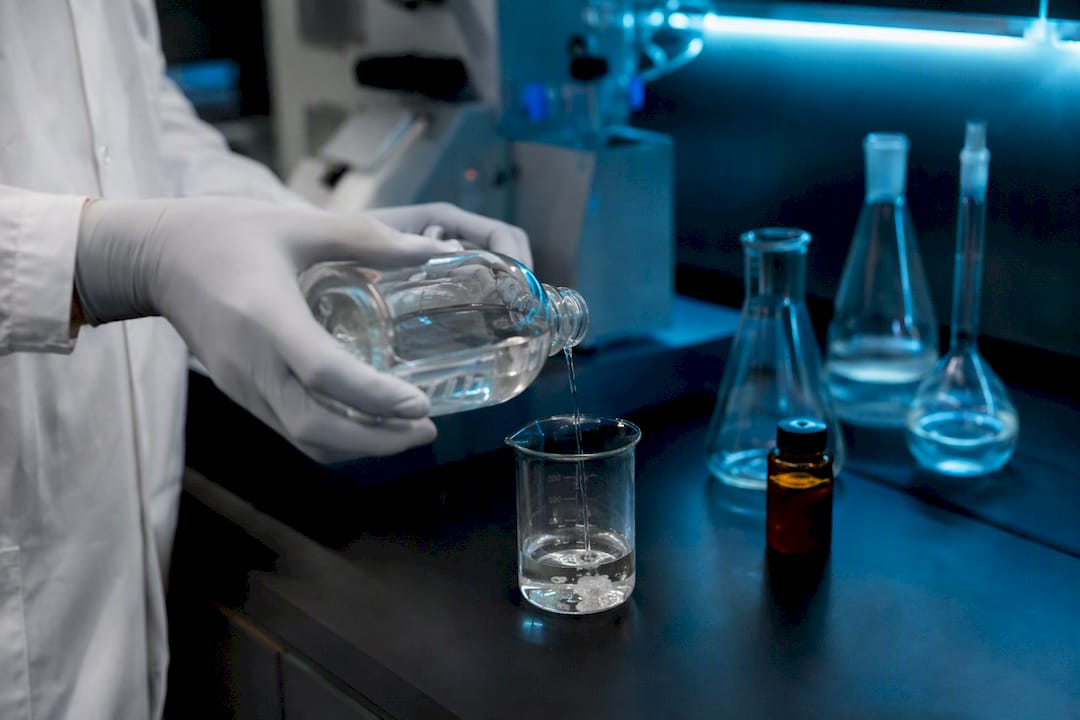
TFA removal is required before sensitive biological assays, in vivo studies, and most API-development work. The baseline method is straightforward: exchange trifluoroacetate for chloride using controlled HCl treatment, with 10 mM HCl as the frequently optimal concentration, followed by lyophilization. Verify the outcome with 19F-NMR or HPLC-ELSD before any assay work begins, since residual TFA below detection is not the same as residual TFA below your assay’s tolerance.
TL;DR:
Peptides with high basic amino acid content often require multiple TFA exchange cycles to achieve residual levels below assay detection limits.
Ion-exchange chromatography or HPLC with volatile buffers are better suited for large batches or cationic sequences than simple HCl cycles.
Confirm residual TFA removal with sensitive analytical methods like 19F-NMR or HPLC-ELSD, not just visual inspection or odor.
PeptidesFromChina provides peptides with specified salt form and verified residual TFA levels on certificates of analysis for better batch-to-batch consistency.
Skipping proper verification can lead to residual TFA confounding in vitro or in vivo results, especially in high-sensitivity biological studies.
Table of Contents
When Does Residual TFA Actually Affect Your Experiments?
How Do You Actually Remove TFA from a Peptide?
How Do You Detect and Quantify Residual TFA?
Which TFA Removal Method Should You Choose?
What Do You Do When TFA Removal Fails?
How Reproducible Counterion Handling Fits into Peptide Sourcing
The Real Gap in TFA Removal Advice
Where to Source Assay-Ready Peptides with Verified Salt Form
Sources
When Does Residual TFA Actually Affect Your Experiments?
Trifluoroacetate is not an inert bystander. It associates with peptides through ionic interactions with basic residues, and that association carries real consequences once the peptide moves from a synthesis vial into a biological system. Residual TFA has been linked to altered peptide conformation, changes in membrane permeability, and cytotoxic effects that can confound in vitro readouts entirely independent of the peptide’s actual pharmacology. A systematic study on TFA counterion exchange found that these effects are significant enough that counterion identity should be reported alongside purity data, not treated as an afterthought.
The practical risk criteria are straightforward to apply:
Target residual TFA below your assay’s limit of quantification, not just below visual detection on a chromatogram.
Report the salt form explicitly on the certificate of analysis rather than assuming acetate or TFA by default.
Flag cationic, hydrophilic sequences for more aggressive exchange protocols, since these bind TFA more tightly than neutral or hydrophobic peptides.
Sequence composition drives most of the variability here. Peptides rich in arginine, lysine, or histidine associate with more TFA molecules per chain, and that stoichiometry has been directly correlated with the number of positively charged residues in peer-reviewed exchange studies. A neutral, hydrophobic 8-mer and a cationic 20-mer with four basic residues do not behave the same way under identical exchange conditions, and treating them identically is a common source of incomplete removal.
How Do You Actually Remove TFA from a Peptide?
Removing TFA is less about picking one magic method and more about matching the technique to your peptide’s charge profile, your batch size, and how clean the material needs to be for downstream work. Five approaches cover nearly every scenario a research lab encounters.
HCl (chloride) exchange. Dissolve the lyophilized peptide in dilute HCl, typically in the 5 to 20 mM range, with 10 mM identified as an optimal starting point in controlled studies. Freeze the solution and lyophilize. A single cycle often suffices, though sequences rich in basic residues may require additional cycles for effective TFA removal. This is the most common baseline for research-scale desalting because it requires no specialized chromatography equipment.
Acetate exchange. Dilute acetic acid substitutes for HCl when a chloride counterion is undesirable for the downstream assay or formulation. The workflow mirrors the HCl protocol: dissolve, freeze, lyophilize, repeat as needed. Acetate salts also tend to be more soluble in aqueous buffers than TFA salts, which helps with reconstitution later.
Ion-exchange chromatography. For larger batches or peptides where repeated freeze-dry cycles risk degradation, ion-exchange offers a single-pass alternative. Volatile buffers are essential here, since nonvolatile salts left behind after chromatography defeat the purpose of the exchange. This approach scales better than manual HCl cycling once you’re working past gram quantities.
RP-HPLC desalting with volatile buffers. Reversed-phase HPLC remains the standard isolation method in peptide labs, and running it with ammonium formate instead of TFA-containing mobile phases lets lyophilization remove the buffer salts afterward, according to practical isolation guidance from Waters. Supercritical fluid chromatography is a specialized option worth knowing about too. It reduces organic solvent consumption for preparative peptide separation, though most research labs won’t have the equipment on hand.
Cold ether wash and lyophilization. For crude peptide directly off the cleavage cocktail, three to four cold ether washes remove unbound TFA and cleavage byproducts before the material ever reaches a purification column, based on standard post-cleavage purification protocols. This step alone won’t eliminate ionically bound TFA, but it clears the bulk of free acid before more targeted exchange work.
A few cautions apply across all five methods. Repeated freeze-thaw cycling stresses peptide integrity, so track how many cycles a batch has been through and watch for oxidation at methionine, cysteine, or tryptophan residues during extended processing. Use glass or peptide-grade polypropylene containers rather than standard plasticware, and avoid prolonged exposure to room temperature during the dissolve-freeze steps. Reference the specifics of a proven lyophilization cycle before scaling any of these protocols past a few milligrams.
Pro Tip: Run your first HCl exchange cycle at 10 mM and check TFA content by 19F-NMR before assuming you need a second cycle. Overcycling costs peptide yield without necessarily improving removal efficiency for neutral or mildly cationic sequences.
How Do You Detect and Quantify Residual TFA?
Four analytical methods dominate residual TFA testing, and they are not interchangeable in terms of sensitivity or practicality.
19F-NMR detects fluorine directly and offers strong quantitative accuracy, making it the reference method when precision matters, though it requires access to NMR instrumentation many smaller labs don’t have in-house.
HPLC-ELSD (evaporative light scattering detection) works well for routine quality control because it doesn’t require a chromophore and integrates into existing HPLC workflows.
ATR-FTIR offers a fast, low-cost screening option, useful for confirming gross TFA reduction but generally less precise at low concentrations than NMR or ELSD.
Ion chromatography quantifies the exchanged counterion (chloride, acetate) directly, confirming not just that TFA left but that the intended replacement ion took its place.
A systematic evaluation of these methods validated 19F-NMR, FT-IR, and HPLC-ELSD against ICH-aligned criteria and found that a single 10 mM HCl exchange cycle reduced TFA below the limit of quantification for several tested peptides, a useful benchmark when setting internal acceptance criteria.
For in vitro screening, HPLC-ELSD or FTIR screening is often sufficient. In vivo studies and API-track material warrant the added rigor of 19F-NMR paired with an orthogonal technique like ion chromatography, since the two methods together confirm both TFA departure and correct ion replacement. Certificates of analysis should report TFA content as molecules per peptide chain, state the LoQ of the method used, and name the exchanged counterion explicitly rather than leaving salt form unspecified.
Which TFA Removal Method Should You Choose?
The right method depends on four variables: peptide sequence, assay sensitivity, batch scale, and what equipment you actually have access to.
Sequence composition. Neutral or mildly hydrophobic peptides usually clear TFA in a single HCl exchange cycle. Cationic, arginine-rich sequences often need two to three cycles or a switch to ion-exchange cleanup.
Assay sensitivity. In vitro screening with tolerant readouts can often proceed after one HCl cycle verified by HPLC-ELSD. In vivo and clinical-adjacent work demands 19F-NMR confirmation below LoQ before you touch an animal model.
Batch scale. Milligram-scale research batches favor manual HCl or acetate exchange. Gram-scale or repeat-production batches justify the setup cost of ion-exchange chromatography or RP-HPLC with volatile buffers.
Equipment access. No chromatography system on hand means HCl exchange and cold ether washing are your realistic starting point; escalate to a contract lab or specialist service only when in-house lyophilization cycles fail to clear TFA after two attempts.
When escalating to a specialist provider, request the exchanged ion identity, the analytical method used to confirm it, and the reported LoQ in writing before accepting delivery.
What Do You Do When TFA Removal Fails?
Incomplete exchange is common enough that it deserves a standard troubleshooting sequence rather than guesswork.
Run an additional HCl or acetate exchange cycle, particularly for sequences with three or more basic residues that resisted a single pass.
If repeated cycling stalls, switch counterions entirely (acetate instead of chloride, or vice versa) or move to ion-exchange chromatography for a cleaner single-pass result.
Check for solubility loss or aggregation with analytical HPLC and mass spectrometry after each cycle. This is more common in hydrophobic sequences than most labs expect.
Confirm purity hasn’t degraded relative to the pre-exchange batch. TFA exchange should not measurably change your HPLC purity percentage.
Sign off only after both residual TFA and counterion identity are confirmed analytically, not by visual inspection or odor.
Solubility problems after exchange often trace back to counterion mismatch rather than the peptide itself. Consult solubility troubleshooting guidance before assuming a batch is compromised.
How Reproducible Counterion Handling Fits into Peptide Sourcing
Products are subject to the manufacturer’s applicable quality-control procedures and specifications. Manufacturer-side analytical documentation may be available depending on the product and batch. PeptidesFromChina is not an independent analytical testing laboratory. Buyers should confirm salt-form and counterion documentation needs during order processing. When placing a purchase order, researchers can request the exchanged-ion identity, analytical method, and reported limit of quantification described in the counterion stability guide.
The Real Gap in TFA Removal Advice
Most guidance on TFA removal treats it as a checkbox: run one exchange cycle, call it done. The peer-reviewed data doesn’t support that shortcut. A 10 mM HCl cycle clears TFA below quantification for many neutral peptides, but cationic, arginine-heavy sequences routinely need a second pass or a different counterion strategy entirely. Treating every sequence identically is where most labs waste material and still end up with assay interference they can’t explain.
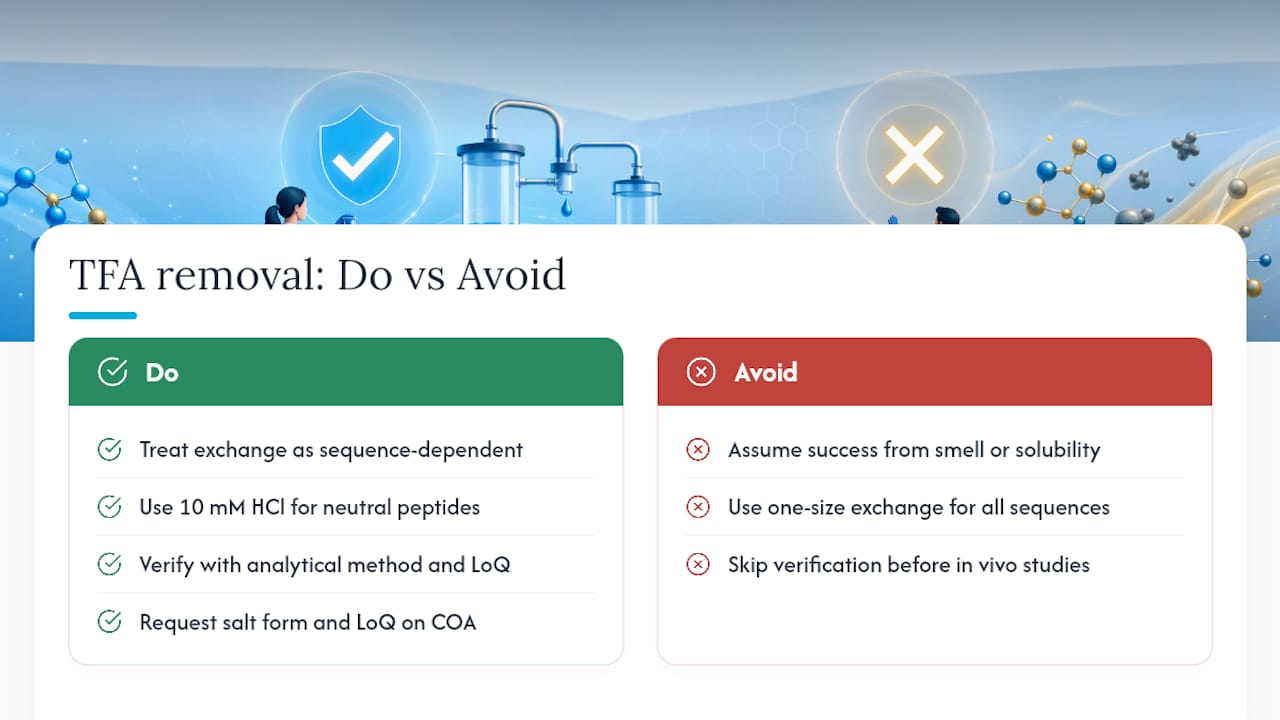
The bigger blind spot is verification. Plenty of labs run an exchange step and assume it worked because the peptide dissolved cleanly or the ether smell faded. That is not evidence. Only an analytical method with a stated limit of quantification, 19F-NMR or HPLC-ELSD, confirms removal. Skipping that step and moving straight to an in vivo study is where residual TFA quietly confounds results that get published as clean data.
What should change first: stop treating counterion exchange as a one-size protocol and start treating it as sequence-dependent chemistry. Request salt form and LoQ on every COA, whether you’re synthesizing in-house or sourcing from a supplier. That single habit closes more gaps than any exotic purification technique.
— Sam Levin
Where to Source Assay-Ready Peptides with Verified Salt Form
Products are subject to the manufacturer’s applicable quality-control procedures and specifications. Manufacturer-side analytical documentation may be available depending on the product and batch. PeptidesFromChina is not an independent analytical testing laboratory.
When ordering, request the following on your COA: exchanged counterion identity, the analytical method used (19F-NMR, HPLC-ELSD, or both), and the stated limit of quantification for residual TFA. This gives you a documented starting point instead of guessing whether a batch needs pretreatment before it goes into an assay. Reconstitution and storage handling matter just as much after exchange, and the reconstitution guide for researchers covers the practical steps for getting a counterion-exchanged batch back into solution without introducing new variability.
For researchers building out a signaling peptide or longevity compound panel, the PE-22-28 catalog listing and the Epithalon product page both include COA documentation with salt form specified. Check current batch specs before placing a wholesale order.