Switch Peptide Suppliers in 2026 Without Reformulation

Switching peptide suppliers without triggering reformulation is achievable when the transition is built on matched specifications, not assumptions. The critical parameters to align between your current and incoming supplier are molecular weight distribution, amino acid composition, net peptide content, and counter-ion type. Industry standards confirm that mismatches in any of these properties can force downstream reformulation even when reported purity percentages look identical. Batch-specific Certificates of Analysis (COAs) must be verified against these parameters before any material enters your workflow.
Key steps to protect formulation integrity during a supplier switch:
Confirm molecular weight, amino acid sequence, and counter-ion identity (TFA vs. acetate) match your existing specification sheet.
Request manufacturer-side analytical documentation, not category-level certificates, and cross-reference lot numbers before accepting delivery.
Order a pilot batch and run solubility and bioassay tests before committing to full-scale replacement.
Use a phased transition: pilot order, verification, limited protocol use, then full adoption.
Watch for lyophilization residual solvents. Minor variations in the lyophilization process can shift solubility and stability in ways that purity percentages alone will not reveal.
How do you vet a new peptide supplier effectively?
Supplier vetting starts with documentation, not pricing. The two non-negotiable signals are manufacturer-side analytical documentation and independent third-party testing from a verifiable accredited laboratory. A COA tied to a specific lot number, produced by a lab you can look up and confirm online, is the baseline for any supplier worth considering.
Practical vetting criteria:
Verify the testing lab named on the COA has a real website, published accreditation, and is not exclusively referenced on vendor marketing pages.
Confirm the COA includes purity percentage with HPLC methodology, mass spectrometry identity confirmation, and endotoxin data where relevant.
Check for consistent batch numbering across documentation. Generic or undated certificates not tied to a production run are a red flag.
Assess customer support responsiveness before placing an order. A supplier that takes more than 48 hours to answer a documentation request will not improve once you are a paying customer.
Verify the supplier’s business presence: domain age, community mentions in research forums, and a physical or verifiable contact address.
Red flags that should end the evaluation: refusal to name the testing lab, purity claims that are statistically unrealistic for most peptides, and pricing significantly below established market rates.
Pro Tip: Request identical synthesis and purification methods, not just a purity percentage. Two suppliers can both report 98% purity using different HPLC methods and different impurity thresholds. The chromatogram tells you what the number does not.
Transparent communication is itself a vetting tool. A supplier willing to discuss counter-ion specifications, residual solvent panels, and synthesis route details before the order is placed is demonstrating the kind of supply chain transparency that protects your research downstream.
Comparing trusted US peptide suppliers for research-grade sourcing
The US research peptide market includes well-documented suppliers with strong batch traceability alongside a fragile middle tier with inconsistent documentation practices. For labs switching sources without reformulation, the comparison below covers the suppliers most relevant to that decision.
Supplier Quality Verification COA Availability Batch Traceability Compound Range Shipping Reliability Support Responsiveness Best For Lone Star Peptide Co. Independent third-party testing Batch-specific, transparent Strong Extensive catalog Reliable US domestic Responsive Researchers needing traceable COAs PeptidesFromChina Independent verification, raw data access Batch-specific with raw chromatograms Detailed batch records Broad, including GLP-1 and longevity compounds Documented cold-chain Technical support available Labs requiring reproducible batch consistency Freedom Diagnostics Third-party purity verification Transparent, compliance-aligned Verified Focused research range North American Responsive Regulatory-aligned research facilities Peptide Sciences Internal COA (historical) On request (legacy) Batch-matched historically — US domestic (defunct) — Legacy reference only; not currently active PSPeptides Formal verification documentation COA with batch traceability Formal batch records Pharma-adjacent range Documented Available Researchers needing pharma-adjacent traceability Pepta Labs Independent lab testing, every batch Downloadable, batch-specific Full batch records 34+ compounds, custom synthesis Free shipping all orders Technical consultation available Teams needing custom synthesis or formulation support
Lone Star Peptide Co. stands out for researchers whose primary concern is COA transparency and compound traceability. The independent testing model and extensive catalog make it a practical first-choice for labs replacing a defunct supplier.
Pepta Labs has positioned itself directly as a migration destination for former Peptide Sciences customers. Every batch goes through independent lab testing with HPLC purity analysis and mass spectrometry verification, and COAs are downloadable before purchase. The catalog covers 34+ compounds with custom synthesis options, which matters for teams that need formulation consultation alongside standard supply.
Freedom Diagnostics suits facilities where regulatory alignment is a procurement requirement. The emphasis on transparent manufacturing sourcing and third-party purity verification fits labs that need audit-ready documentation.
Peptide Sciences is listed here for historical context only. The company has voluntarily discontinued operations, and its COAs should not be used as active reference documentation without replacement records from a current supplier.
PeptidesFromChina is the strongest option for labs where batch-to-batch reproducibility is the primary constraint. The platform provides raw chromatogram data alongside manufacturer-side analytical documentation, which allows procurement teams to conduct the kind of impurity profile comparison that a summary purity figure cannot support. For labs switching sources on GLP-1 agonists, longevity compounds, or signaling peptides where formulation sensitivity is high, that level of documentation depth is directly relevant.
PSPeptides covers the pharma-adjacent tier, with formal batch traceability and verification documentation suited to researchers who need a quality profile closer to regulated manufacturing but without the overhead of a compounding pharmacy.
What does a safe, step-by-step supplier transition look like?
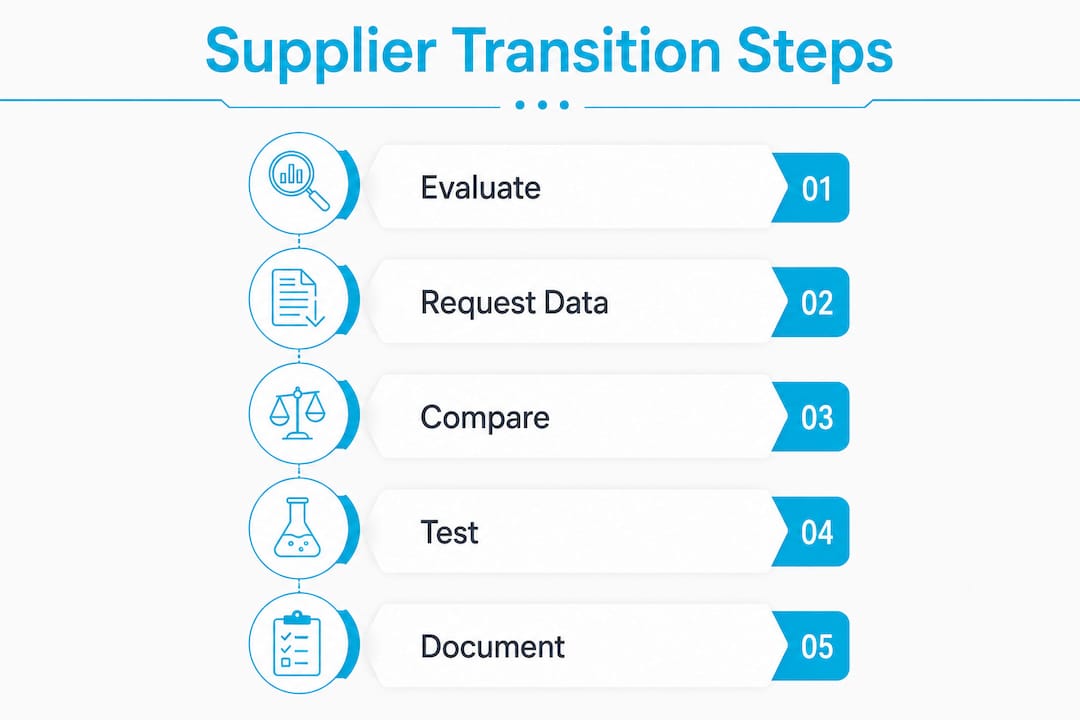
A phased transition is the standard approach for switching peptide sources without disrupting active protocols. The sequence below reflects current best practice for research labs managing this process in 2026.
Order a single pilot batch of your highest-use compound from the new supplier before committing to a full catalog switch.
Verify the manufacturer-side analytical documentation against your existing specification: molecular weight, purity, counter-ion, and impurity profile. Request the raw HPLC chromatogram, not just the summary certificate.
Run solubility tests using your standard reconstitution protocol. Differences in lyophilization residual solvents can affect how a peptide dissolves even when the sequence is identical.
Conduct a small-scale bioassay or functional assay before scaling. Pilot assay confirmation before full adoption prevents costly reformulation caused by unexpected bioactivity shifts.
Communicate your formulation requirements explicitly to the new supplier: target counter-ion, purity threshold, synthesis route, and any terminal modifications your protocol depends on.
Set milestone checkpoints: receipt and inspection, analytical verification, pilot assay results, and a go/no-go decision before full transition.
Document every step. If a batch fails at any checkpoint, the documentation trail tells you exactly where the discrepancy originated, which is far more useful than discovering a problem mid-protocol.
What do industry experts say about maintaining formulation consistency?
The most common mistake labs make when switching peptide sources is treating purity percentage as a proxy for performance equivalence. Minor changes in synthesis and purification methods introduce impurities that affect assay performance even when two suppliers both report comparable purity figures. The impurity profile, not the headline number, determines whether a new batch behaves identically in your assay system.
Counter-ion content is a specific area where this plays out. TFA vs. acetate counter-ions affect solubility, stability, and in some assay systems, bioactivity. A supplier switch that changes the counter-ion without flagging it can produce batch drift that looks like a formulation problem when the root cause is a sourcing variable.
Pro Tip: Request raw chromatograms from the new supplier for the specific lot you are receiving. Comparing chromatograms between your current and incoming supplier reveals impurity peaks that a purity percentage summary will not capture.
The table below summarizes the key formulation consistency parameters to verify during any supplier transition.
Parameter Why It Matters Verification Method Molecular weight Confirms correct sequence and no truncation LC-MS identity confirmation Amino acid composition Detects deletion sequences or substitutions Amino acid analysis Net peptide content Affects accurate dosing in assays Karl Fischer water content + TFA quantification Counter-ion type Impacts solubility and assay sensitivity Counter-ion characterization panel Residual solvents Lyophilization variation causes batch drift Residual solvent panel Impurity profile Determines actual functional purity Full HPLC chromatogram review
Procurement teams that request identical synthesis routes and purification methods for repeat orders, rather than accepting any batch that meets a purity threshold, maintain the assay consistency that makes research reproducible.
How to manage risk when switching suppliers without reformulation
Risk in a supplier transition concentrates at two points: the first batch received and the first time that batch enters an active protocol. Managing both requires parallel sourcing during the transition period. Keep enough inventory from the current supplier to cover at least one full experimental cycle while the new supplier’s material is being validated. This prevents a failed pilot batch from halting active research.

Supplier diversification is a secondary risk control. Relying on a single source, even a well-documented one, creates exposure to supply disruptions. The 2025–2026 period saw multiple established US suppliers exit the market with little notice, leaving labs scrambling for replacement documentation. Maintaining a qualified secondary supplier with verified COAs reduces that exposure significantly.
Incoming inspection SOPs formalize the risk controls that experienced labs apply informally. Define acceptance criteria before the first shipment arrives: minimum purity, identity confirmation method, water content limits, and COA batch number matching. A batch that fails any criterion goes back before it enters the lab, not after a failed experiment.
How to conduct comparative stability testing without reformulation
Comparative stability testing between suppliers does not require reformulation. The goal is to confirm that the new supplier’s material behaves identically to the existing batch under your storage and use conditions, using the same protocol on both samples in parallel.
Run accelerated stability comparisons by storing aliquots from both the current and incoming supplier under identical conditions (temperature, humidity, light exposure, and container type) and testing at defined intervals. Measure purity by HPLC and confirm identity by LC-MS at each timepoint. Divergence in the degradation profile between the two samples indicates a manufacturing difference worth investigating before full adoption.
For peptides sensitive to oxidation (methionine or cysteine-containing sequences), include a redox stability check. Lyophilized aliquots under argon headspace from both suppliers, tested after controlled stress exposure, will reveal whether the new supplier’s lyophilization process provides equivalent protection. This approach generates comparative data without altering the formulation itself.
What timeline should labs expect for a supplier transition?
A realistic supplier transition for a research lab runs four to eight weeks from initial contact to full adoption, depending on the complexity of the compounds involved and the depth of verification required. The timeline below reflects a standard transition for a single compound.
Weeks one and two cover supplier qualification: reviewing documentation, requesting sample COAs, confirming the testing lab’s accreditation, and placing a pilot order. Week three is typically receipt and incoming inspection. Weeks three and four cover analytical verification, including HPLC comparison and LC-MS identity confirmation. Weeks four through six cover pilot assay work. Full transition follows a go decision at the end of the pilot phase.
Custom synthesis compounds require additional lead time, typically two to four weeks beyond the standard timeline, because the synthesis route must be confirmed and the first batch validated before any assay work begins. Labs managing multiple compound transitions simultaneously should stagger the pilot phases to avoid bottlenecks in the analytical verification step.
PeptidesFromChina: batch-verified sourcing for labs that cannot afford variability
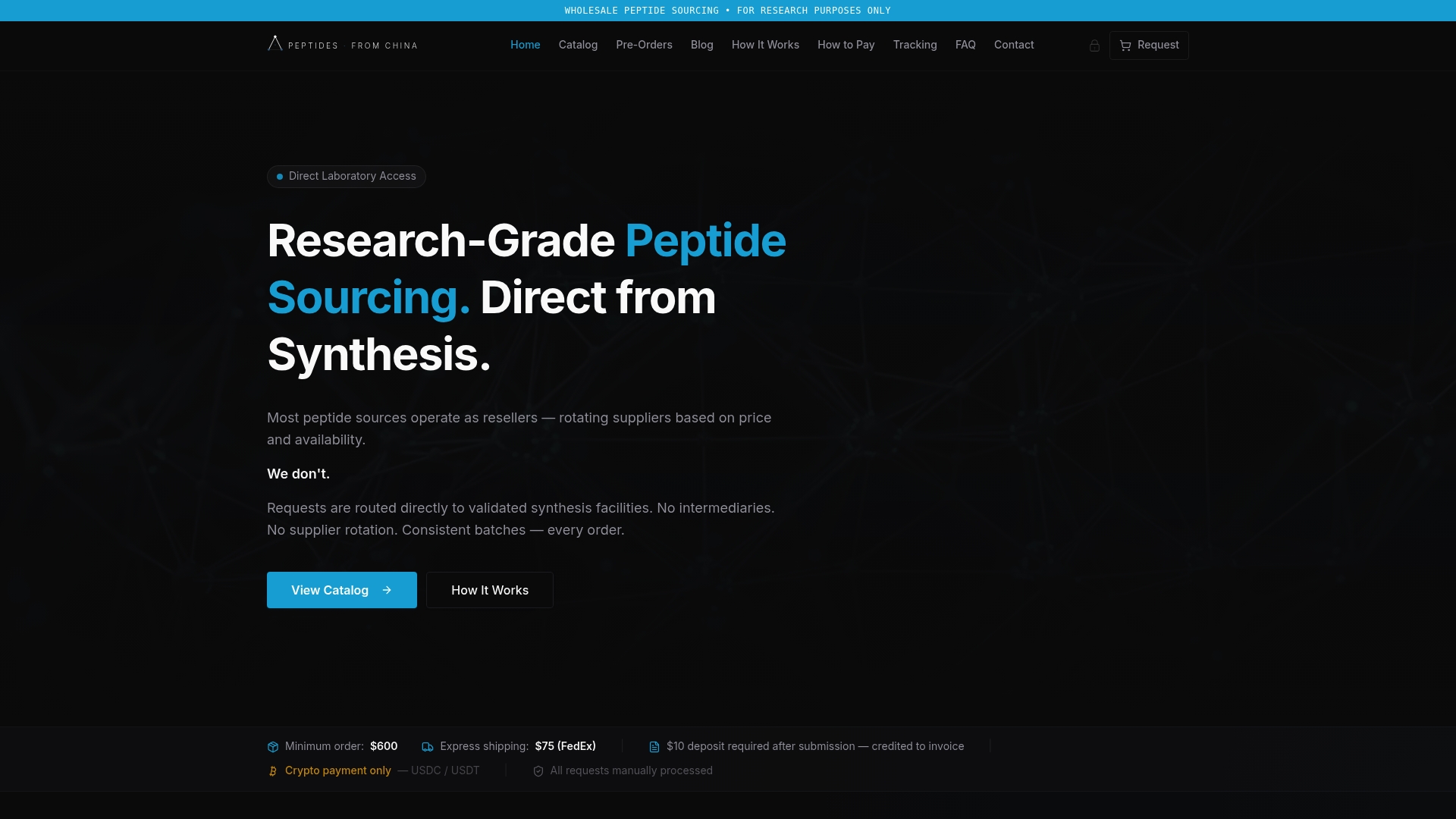
For labs where batch reproducibility is not negotiable, PeptidesFromChina offers a sourcing model built around the documentation depth that supplier transitions require. The platform coordinates sourcing from established Chinese manufacturing facilities together with international logistics. Manufacturer-side analytical documentation may be available depending on the product and batch. Researchers switching sources on GLP-1 agonists, longevity compounds, or signaling peptides can access research-grade verified peptides with the formulation detail needed to confirm equivalency without reformulation. The focus is reproducible sourcing, not volume throughput, which makes it a practical fit for procurement teams that need to verify, not assume, batch consistency.
Key Takeaways
Switching peptide suppliers without reformulation depends on matched specifications, verified documentation, and staged validation before full adoption.
Point Details Match specifications first Molecular weight, amino acid composition, counter-ion type, and net peptide content must align before any material enters your protocol. COAs must be batch-specific Generic or undated certificates provide no real quality assurance; always request lot-matched documentation from an independently verifiable lab. Pilot before scaling Run solubility and bioassay tests on the first batch from any new supplier before committing to full protocol adoption. Stability testing confirms equivalency Parallel accelerated stability runs on current and incoming supplier material reveal manufacturing differences without requiring reformulation. PeptidesFromChina for reproducibility Manufacturer-side analytical documentation may be available depending on the product and batch.