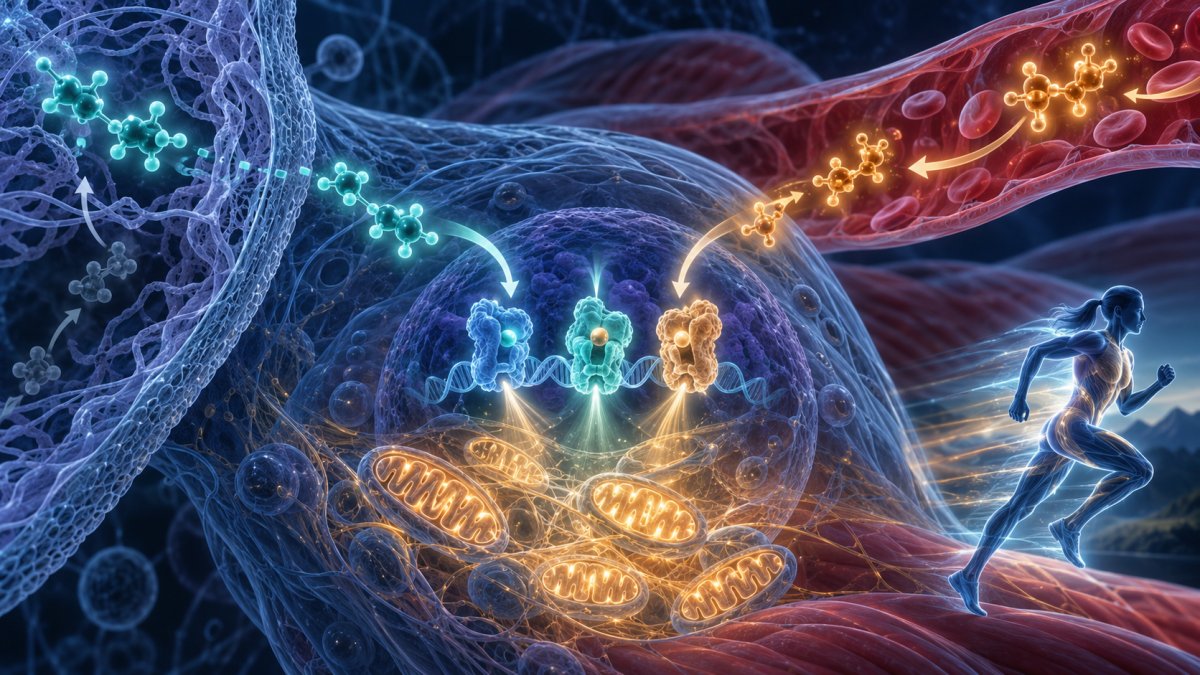
SLU-PP-332 became famous as an “exercise-in-a-pill” compound. That label was always too simple, but it captured the central idea: activate the same transcriptional machinery that helps skeletal muscle adapt to aerobic exercise.
SLU-PP-915 is the next important step in that research story. It activates the same family of estrogen-related receptors, yet it is not merely a stronger dose, a renamed version, or a minor reformulation of SLU-PP-332. It is a chemically distinct molecule designed to solve a practical problem that limited the earlier research tool: SLU-PP-332 lacks useful oral bioavailability, while SLU-PP-915 produced systemic exposure and exercise-like effects after oral administration in mice.
That difference makes 915 more drug-like. It does not make it a proven human performance compound. As of September 2026, the published evidence for both molecules remains preclinical.
First, ERR does not mean estrogen
Both compounds activate estrogen receptor-related receptors: ERRα, ERRβ and ERRγ. The name causes predictable confusion, but ERRs are not the classical estrogen receptors targeted by estradiol, tamoxifen or standard hormone therapies.
ERRs are orphan nuclear receptors. They act as transcriptional regulators inside cells and help coordinate genes involved in:
mitochondrial biogenesis;
oxidative phosphorylation;
fatty-acid oxidation;
the Krebs cycle;
skeletal-muscle energy demand;
adaptation to aerobic exercise.
These receptors work closely with metabolic coactivators such as PGC-1α. During endurance training, that network helps muscle build greater oxidative capacity. The goal of an ERR agonist is not to reproduce every benefit of exercise. It is to pharmacologically activate part of the molecular program that exercise normally recruits.
That is why “exercise mimetic” is useful shorthand but an incomplete description. Running changes blood flow, mechanical loading, neural coordination, glucose handling, connective tissue, bone and hundreds of signaling pathways. An ERR agonist targets one influential control system within that larger response.
What SLU-PP-332 established
SLU-PP-332 was the proof-of-concept molecule. It is a synthetic pan-ERR agonist with its highest reported potency at ERRα.
In mouse studies, the compound activated an ERRα-dependent acute aerobic-exercise program, increased expression of exercise-responsive genes and improved running capacity. Additional experiments expanded the story beyond endurance.
In diet-induced and genetically obese mice, SLU-PP-332 increased energy expenditure and fatty-acid oxidation, reduced fat accumulation and improved features of metabolic syndrome. In aging-kidney models, ERR agonism improved mitochondrial function and inflammatory signaling. In pressure-overload heart-failure models, SLU-PP-332 and SLU-PP-915 both improved ejection fraction, reduced fibrosis and increased survival.
This is a surprisingly broad preclinical package for a research compound. It supports the biological importance of ERR signaling across muscle, adipose tissue, kidney and heart.
But SLU-PP-332 has a major translational weakness: it is not orally bioavailable. Most of its headline results came from intraperitoneal administration in animals. Selling it in a tablet does not change that pharmacokinetic fact.
Researchers can study an orally supplied material in laboratory systems, but an oral dosage form should never be confused with demonstrated oral exposure in a living organism.
What SLU-PP-915 changed
The 2026 paper from Cyrielle Billon and colleagues describes SLU-PP-915 as a chemically distinct, orally active pan-ERR agonist.
When administered intraperitoneally in mice, 915 improved running distance and duration to a similar extent as 332. More importantly, it retained comparable exercise-mimetic activity after oral administration when the researchers adjusted exposure appropriately.
Both molecules strongly increased Ddit4, an exercise-responsive gene induced by an acute bout of aerobic activity. Depending on the muscle examined, the response matched or exceeded treadmill running. SLU-PP-915 also worked alongside exercise training, producing additional changes in Ddit4 and mitochondrial gene expression.
This is the real reason 915 matters. It did not replace the mechanism. It made the mechanism accessible through an oral route in an animal model.
SLU-PP-915 vs SLU-PP-332 at a glance
Molecular relationship
SLU-PP-332: the original pan-ERR research agonist.
SLU-PP-915: a chemically distinct pan-ERR agonist, not a reformulation of 332.
Receptor targets
SLU-PP-332: ERRα, ERRβ and ERRγ, with its strongest reported activity at ERRα.
SLU-PP-915: ERRα, ERRβ and ERRγ.
Oral activity
SLU-PP-332: poor or absent oral bioavailability in the published animal work.
SLU-PP-915: demonstrated oral activity and systemic exposure in mice.
Exercise-capacity evidence
SLU-PP-332: improved aerobic performance in mice after intraperitoneal administration.
SLU-PP-915: produced a similar improvement by injection and preserved activity after oral administration.
Breadth of evidence
SLU-PP-332: the larger body of metabolic, kidney, muscle and cardiac research.
SLU-PP-915: the newer molecule; exercise and cardiac data are currently its strongest direct evidence.
Neither molecule has an approved medical use or published human efficacy trial.
The comparison is therefore not “weak versus strong.” A better framing is established tool compound versus orally active next-generation tool compound.
Is SLU-PP-915 more potent?
Not in the simple way online comparisons often claim.
Potency can mean receptor activity in a cell assay, exposure in blood, activation of target genes in tissue or a whole-animal effect. Those are different measurements. A molecule can be less potent at an isolated receptor yet more useful in vivo because it is absorbed, remains stable and reaches the relevant tissue.
The published 915 study emphasizes comparable biological activity after accounting for exposure, not a universal claim that 915 is categorically stronger. Its advantage is pharmacokinetic: oral administration became experimentally viable.
That distinction also explains why comparing milligrams between the two compounds is scientifically weak. Different structures, absorption and exposure prevent a simple dose-for-dose conversion.
What the heart-failure study adds
The strongest head-to-head disease-model evidence predates the dedicated oral-exercise paper.
In a pressure-overload mouse model, both SLU-PP-332 and SLU-PP-915 improved cardiac function. The researchers reported better ejection fraction, less fibrosis and improved survival, linked to restored fatty-acid metabolism and mitochondrial function.
This matters because a failing heart often loses metabolic flexibility. Rather than efficiently oxidizing fatty acids, it undergoes energetic remodeling and mitochondrial dysfunction. Pan-ERR activation appeared to push the model back toward a more oxidative cardiac program.
It is compelling mechanistic evidence, not clinical evidence. The study does not establish that either compound treats human heart failure, and it does not define a human safety window.
Why anti-doping researchers are already interested
A 2026 analytical study did not test performance. It addressed a different question: if these compounds appeared in sports, could laboratories identify them and their metabolites?
Using high-resolution mass spectrometry and human liver preparations, researchers characterized both molecules and mapped nine in-vitro metabolites for SLU-PP-332 and seven for SLU-PP-915. The work provides potential analytical targets for future doping-control methods.
That attention is revealing. Neither compound is an approved medicine, yet the combination of endurance-related animal data and a plausible performance-enhancing mechanism has already made the class relevant to sports testing.
It does not prove athletes are using either molecule. It shows that anti-doping science is preparing for the possibility.
What has not been established
The excitement around 915 is understandable, but several essential questions remain open:
No published human trial has established safety, tolerability or efficacy.
No validated human dose or exposure target exists.
Long-term pan-ERR activation has not been adequately characterized in people.
Animal improvements in running or metabolic markers do not show that the compounds reproduce the full health effects of exercise.
Oral activity in mice does not guarantee predictable oral pharmacokinetics in humans.
ERR signaling influences multiple high-energy tissues. That breadth creates therapeutic potential, but it also makes chronic safety work especially important. A pathway that changes mitochondrial and oxidative programs across muscle, heart, liver and kidney requires careful tissue-level evaluation.
Which compound is more important for research?
That depends on the question.
SLU-PP-332 remains the better-established reference compound. It has been used across a wider collection of animal models and offers a clearer link to the original ERR exercise-mimetic literature. For mechanistic comparison, it is still highly valuable.
SLU-PP-915 is the more practical translational candidate because oral exposure changes what chronic studies can look like. Repeated oral administration is easier to standardize in many animal models and is more relevant to eventual drug development than repeated intraperitoneal dosing.
The two compounds are therefore complementary rather than interchangeable. Researchers can use 332 as the established benchmark and 915 to explore whether an orally active ERR agonist preserves the same biology over longer experiments.
PFC currently lists both SLU-PP-332 oral research material and SLU-PP-915 research tablets for qualified laboratory procurement. Product format should be evaluated separately from published pharmacokinetic evidence.
The bottom line
SLU-PP-915 is a meaningful advance, but the advance is specific.
SLU-PP-332 showed that pharmacological pan-ERR activation can reproduce selected aerobic-exercise signals and improve metabolic, renal and cardiac outcomes in animal models. SLU-PP-915 retained that core biology while solving a central formulation problem in mice: it worked by mouth.
That makes 915 more drug-like, not clinically proven. The next decisive step is no longer another dramatic mouse headline. It is a rigorous package of chronic toxicology, pharmacokinetics and ultimately controlled human trials.
Until then, the scientifically accurate description is also the most interesting one: SLU-PP-915 is the first orally active successor that makes the ERR exercise-mimetic concept look more like a development program and less like a laboratory curiosity.
Frequently asked questions
Is SLU-PP-915 a peptide?
No. SLU-PP-915 and SLU-PP-332 are synthetic small molecules. Their names are often discussed in peptide communities, but neither is a peptide.
Is SLU-PP-915 simply a stronger version of SLU-PP-332?
No. It is a chemically distinct pan-ERR agonist. Its clearest demonstrated advantage is oral bioavailability in mice, not a universal claim of greater receptor potency.
Do the compounds activate estrogen receptors?
They target estrogen receptor-related receptors, or ERRs. ERRα, ERRβ and ERRγ are metabolically important nuclear receptors but are distinct from classical estrogen receptors.
Can either compound replace exercise?
No evidence supports that conclusion. They reproduce selected transcriptional and metabolic features of aerobic exercise in animal models, not the complete physiological effects of training.
Has SLU-PP-915 been studied in humans?
No published human clinical trial was identified as of September 2026. The key efficacy findings come from mice and laboratory systems.
Why is oral bioavailability important?
Oral exposure makes repeated and chronic animal studies more practical and gives a development program a route that is more relevant to a potential future medicine. It does not by itself establish human effectiveness.
Which compound has more evidence?
SLU-PP-332 currently has the broader published preclinical record. SLU-PP-915 is newer and has the more favorable demonstrated oral profile.
Primary sources
Billon C, Appourchaux K, Côté I, Burris TP. An orally active estrogen receptor-related receptor agonist, SLU-PP-915, enhances aerobic exercise capacity. Journal of Pharmacology and Experimental Therapeutics. 2026;393(1):103787. DOI: 10.1016/j.jpet.2025.103787. https://pubmed.ncbi.nlm.nih.gov/41421047/
Billon C et al. Synthetic ERRα/β/γ Agonist Induces an ERRα-Dependent Acute Aerobic Exercise Response and Enhances Exercise Capacity. ACS Chemical Biology. 2023.
Billon C et al. A Synthetic ERR Agonist Alleviates Metabolic Syndrome. Journal of Pharmacology and Experimental Therapeutics. 2024.
Xu W et al. Novel Pan-ERR Agonists Ameliorate Heart Failure Through Enhancing Cardiac Fatty Acid Metabolism and Mitochondrial Function. Circulation. 2024. https://pubmed.ncbi.nlm.nih.gov/37961903/
Möller T, Krug O, Thevis M. In Vitro Metabolism and Analytical Characterization of SLU-PP-332 and SLU-PP-915: Novel Pan-ERR Agonists With Doping Potential. Rapid Communications in Mass Spectrometry. 2026;40(8):e70039. DOI: 10.1002/rcm.70039. https://pubmed.ncbi.nlm.nih.gov/41588687/