
Most "direct" factory links in the peptide industry are actually multi-layered chains of domestic resellers and relabeling operations that obscure the true origin of your material. If you've spent any time in peptide procurement, you already know that a glossy website and a recycled HPLC report don't guarantee batch consistency. Finding a legitimate semaglutide wholesale supplier requires looking past the "guaranteed purity" marketing and understanding the technical reality of synthetic solid-phase peptide synthesis.
Since the FDA officially resolved the semaglutide shortage in February 2026 and effectively ended the 503B compounding loophole, the market has become increasingly opaque. This guide provides an insider's framework for bypassing intermediaries and establishing direct-to-manufacturer routing. You'll learn how to audit supply chain documentation, why independent third-party testing is your only real safeguard, and the operational steps for professional-grade procurement. The $600 minimum is an operational minimum for orders placed through the PFC sourcing platform and may include multiple catalog products. We will examine how to reduce supply chain uncertainty by prioritizing transparency over the typical reseller promises that dominate the current landscape.
Key Takeaways
Identify the structural flaws in the reseller model and how bypassing domestic warehouses helps eliminate the risks of batch substitution and relabeling.
Navigate the technical complexities of bulk synthesis, focusing on Solid-Phase Peptide Synthesis (SPPS) standards and the necessity of proper salt conversion.
Evaluate any potential semaglutide wholesale supplier by treating manufacturer-issued HPLC and Mass Spectrometry reports as baseline technical references rather than absolute guarantees.
The $600 minimum is an operational minimum for orders placed through the PFC sourcing platform and may include multiple catalog products.
Prioritize independent laboratory testing as the final step in establishing batch traceability and reducing inherent supply chain uncertainty.
Table of Contents
The Semaglutide Supply Chain: Why the Reseller Model is Failing Labs
Technical Standards for Bulk Semaglutide Synthesis
Direct-to-Manufacturer Sourcing vs. Domestic Warehousing
Verification Protocols: HPLC, MS, and Independent Testing
The PFC Model: Streamlining Semaglutide Wholesale Procurement
The Semaglutide Supply Chain: Why the Reseller Model is Failing Labs
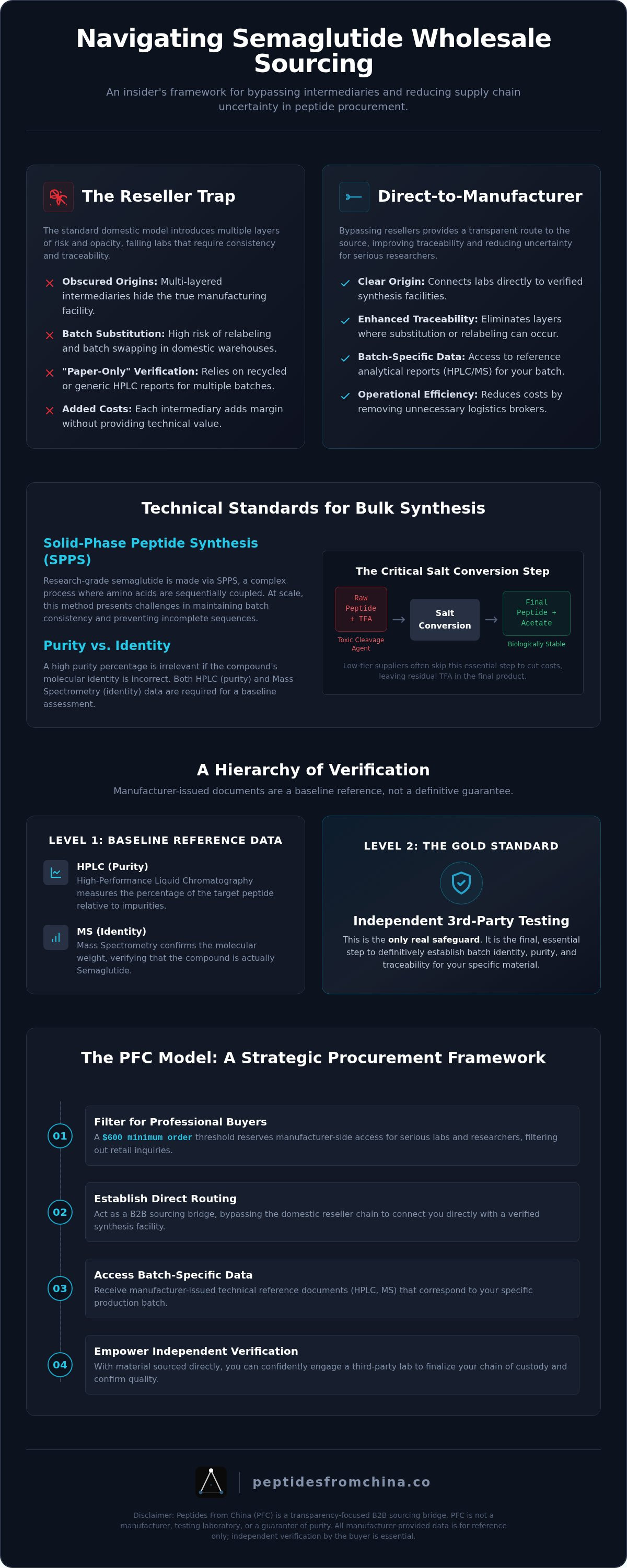
The surge in global demand for Semaglutide has created a "wild west" atmosphere within the research peptide market. While the official FDA shortage was declared resolved on February 21, 2026, the fallout has left a fragmented supply chain. Most researchers searching for a semaglutide wholesale supplier find themselves trapped in a cycle of domestic resellers who offer convenience at the expense of traceability. This reseller model is failing labs because it introduces unnecessary layers of risk, such as batch substitution and relabeling, which often occur in domestic warehouses far removed from the original synthesis site.
Identifying the 'Reseller Trap' in Peptide Procurement
A common sign of a reseller is a lack of factory-level technical data. These intermediaries often provide "paper-only" verification, where a single HPLC report is reused across multiple batches or even years of sales. Intermediaries add significant cost without adding any technical value to the compound; they aren't chemists or manufacturers, they're logistics brokers. Relying on these local distributors increases supply chain opacity, as they rarely disclose the specific synthesis facility or the batch-specific purity logs. This makes it impossible for a researcher to establish a true chain of custody. When evaluating a potential semaglutide wholesale supplier, it's vital to distinguish between a company that stocks material and one that facilitates a direct link to the production line.
The Reality of Global Semaglutide Shortages in 2026
Although the official shortage has ended, localized supply gaps persist because Novo Nordisk's main patents don't expire until 2032. Chinese synthesis facilities remain the primary source for research-grade material, yet many buyers struggle to access these channels directly. Direct-to-manufacturer routing helps reduce supply chain uncertainty by bypassing the reseller trap entirely. For serious laboratory procurement, Peptides From China (PFC) acts as a transparency-focused B2B sourcing bridge. The $600 minimum is an operational minimum for orders placed through the PFC sourcing platform and may include multiple catalog products. By connecting labs to verified synthesis facilities, researchers can improve traceability and access reference analytical data that domestic resellers simply cannot provide.
Technical Standards for Bulk Semaglutide Synthesis
Semaglutide synthesis isn't a simple chemical reaction; it's a multi-stage sequence requiring high-precision execution. While pharmaceutical giants use recombinant DNA technology, a research-grade semaglutide wholesale supplier typically utilizes chemical synthesis. Specifically, they manufacture semaglutide active ingredient through Solid-Phase Peptide Synthesis (SPPS). This method allows for high-throughput production but introduces specific technical hurdles, particularly regarding trifluoroacetic acid (TFA) removal. TFA is often used as a cleavage reagent, but its presence in the final product can be toxic to certain biological systems. Professional synthesis facilities must perform a salt conversion process to replace TFA with more stable acetate salts, a step that is often skipped by low-tier manufacturers to reduce costs.
Solid-Phase Peptide Synthesis (SPPS) Explained
High-precision automated synthesizers are required to achieve 98% or higher purity levels. During the synthesis of GLP-1 agonists like Semaglutide, manufacturers must monitor for deletion sequences and truncated peptides that occur when amino acids fail to couple correctly. Manufacturing scale significantly impacts molecular integrity; larger batches often face challenges with heat dissipation and solvent penetration. If these variables aren't strictly controlled, the final compound may suffer from batch-to-batch inconsistency, which is the primary challenge for wholesale suppliers operating at scale.
Purity vs. Identity: What Researchers Must Differentiate
A 99% purity claim on an HPLC report is functionally meaningless without Mass Spectrometry (MS) confirmation of the molecular weight. HPLC measures the relative amount of the target substance, but MS proves the substance is actually Semaglutide. Beyond identity, researchers must account for residual solvents and moisture, which can skew experimental data. Net peptide content is the actual weight of the peptide excluding salts and residual water. Many wholesale suppliers quote "gross weight," which includes the weight of the acetate or TFA salts used during purification. This distinction is critical for accurate dosing in a laboratory setting.
Establishing batch traceability requires looking past the "guaranteed purity" marketing often found in retail environments. At Peptides From China (PFC), we act as a transparency-focused B2B sourcing bridge to help researchers navigate these technical nuances. We facilitate access to manufacturer-side channels that provide the necessary reference analytical data for serious research. The $600 minimum is an operational minimum for orders placed through the PFC sourcing platform and may include multiple catalog products.
Direct-to-Manufacturer Sourcing vs. Domestic Warehousing
Choosing a semaglutide wholesale supplier often involves a trade-off between the perceived speed of domestic warehousing and the transparency of direct manufacturer routing. Domestic distributors market themselves as a safer choice because their stock is already "in-country," but this convenience often hides a significant lack of batch traceability. When a reseller stocks material in a local warehouse, they effectively create a "black box" where the original synthesis facility and production date are obscured. This fragmentation makes it nearly impossible for a buyer to verify if the compound has been stored under proper temperature controls or if it has been relabeled to move older inventory.
Direct sourcing helps reduce supply chain uncertainty for long-term projects by ensuring that every batch comes from the same production line. This consistency is vital for longitudinal research where even minor variations in synthesis quality can compromise data. While a local reseller might offer single vials, a professional sourcing bridge provides access to the raw manufacturer-side channels required for bulk procurement. This method prioritizes logistical integrity over retail convenience, ensuring that the material hasn't passed through multiple unverified hands before reaching your lab.
The Hidden Costs of Domestic Peptide Distributors
The most obvious drawback of local distributors is the substantial markup. These resellers aren't just charging for shipping; they're pricing in their own overhead and profit margins, which often results in a massive price gap compared to factory-direct rates. Beyond the cost, the primary issue is that domestic sellers rarely have a direct relationship with the synthesis facility. They often purchase from secondary brokers, further diluting the chain of custody. For a deeper analysis of these dynamics, researchers should review this wholesale peptides guide for B2B sourcing in 2026.
International Logistics and Customs Navigation
Navigating international logistics requires destination-specific planning. Peptides From China acts as a sourcing bridge and coordinates with established manufacturing facilities and logistics partners rather than operating as the manufacturer. Shipping options, pricing, and estimated transit times vary by destination and are confirmed during order processing. The $600 minimum is an operational minimum for orders placed through the PFC sourcing platform and may include multiple catalog products.
Verification Protocols: HPLC, MS, and Independent Testing
Relying on a semaglutide wholesale supplier requires a shift from blind trust to methodical verification. In an industry where batch substitution and reused COAs are common, documentation must be treated as baseline technical reference material rather than definitive proof of quality. Establishing a professional standard of procedure (SOP) involves a multi-step approach that starts at the synthesis facility and ends with independent laboratory analysis.
Step 1: Request manufacturer-issued HPLC and Mass Spectrometry reports specifically for the current batch number.
Step 2: Cross-reference these batch numbers with synthesis logs to ensure the material was produced during the stated window.
Step 3: Submit a random sample for independent third-party testing at specialized facilities like MZ Biolabs or Janoshik.
Step 4: Compare the resulting analytical data against established baseline reference standards for GLP-1 agonists.
Reading a Certificate of Analysis (COA) for Semaglutide
A legitimate COA provides critical data points such as retention time, peak area, and molecular weight. Retention time on an HPLC chromatogram helps confirm the peptide's identity relative to a standard, while the peak area determines the purity percentage. Researchers should look for red flags like digital artifacts, inconsistent fonts, or missing timestamps, which often indicate forged or digitally altered reports. For a technical deep dive into these metrics, consult this professional guide on peptide testing.
The Necessity of Independent Laboratory Verification
When selecting a semaglutide wholesale supplier, internal factory testing is only the first step in a professional procurement SOP. While manufacturer reports provide necessary reference analytical data, they represent the facility's own assessment. Selecting a qualified third-party lab for GLP-1 peptide analysis is essential to confirm that the material meets the required purity and identity benchmarks. Independent testing is the buyer's ultimate responsibility in the research sector. This practice helps reduce supply chain uncertainty and ensures that your data remains reproducible. To begin a professional sourcing engagement that prioritizes this level of transparency, you can access our manufacturer-side channels The $600 minimum is an operational minimum for orders placed through the PFC sourcing platform and may include multiple catalog products.
The PFC Model: Streamlining Semaglutide Wholesale Procurement
Peptides From China (PFC) operates as a dedicated B2B sourcing bridge, specifically designed to help laboratories bypass the fragmented reseller market. PFC coordinates sourcing from established Chinese manufacturing facilities together with international logistics. This model isn't about retail convenience; it's about providing a structured, transparent pathway for professional procurement. Acting as a semaglutide wholesale supplier bridge, we prioritize factual accuracy and logistical integrity over the typical marketing hype found in the retail sector.
The Step-by-Step PFC Sourcing Process
The $10 deposit initiates manual request processing and real-time stock verification and is credited toward the final invoice. This isn't a fee, but a filter to ensure we're allocating resources to serious research institutions and procurement professionals who understand the complexities of international sourcing. Once the deposit is placed, we initiate manufacturer verification for the specific batch you require. This step ensures that the manufacturer has the current synthesis logs and reference analytical data available for your review before you commit to a bulk purchase.
Initial request for specific compound specifications and quantity.
Manufacturer verification and retrieval of batch-specific HPLC and MS reports.
Client review and approval of the provided technical documentation.
The $10 deposit initiates manual request processing and real-time stock verification and is credited toward the final invoice.
Neutral international transit with end-to-end tracking to your facility.
Positioning Your Lab for Consistent Supply
Large-scale longitudinal studies require more than just a one-off purchase; they need a reliable semaglutide wholesale supplier that can facilitate recurring bulk orders without the risk of batch substitution. Establishing a direct manufacturer relationship through a sourcing platform like PFC helps reduce supply chain uncertainty. The $600 minimum is an operational minimum for orders placed through the PFC sourcing platform and may include multiple catalog products.
This focus on wholesale efficiency allows labs to maintain batch consistency over months or years of research, avoiding the volatility of the secondary market. By minimizing intermediaries, we help ensure that your laboratory maintains a direct line to the production facility, which is essential for maintaining operational consistency. Ready to eliminate the middleman? View our Semaglutide sourcing protocols to begin the verification process for your next research project.
Securing Batch Traceability in a Fragmented GLP-1 Market
Navigating the global peptide market in 2026 requires a shift from convenience-based purchasing to methodical, technical verification. The era of relying on domestic resellers with opaque supply chains has passed; it's now critical to prioritize direct-to-manufacturer routing to reduce supply chain uncertainty. By moving beyond "paper-only" verification and implementing independent laboratory testing, you ensure your research isn't compromised by batch substitution or synthesis inconsistencies.
Establishing a relationship with a reliable semaglutide wholesale supplier means looking for a partner that functions as a transparency-focused bridge rather than a simple warehouse. PFC coordinates sourcing from established Chinese manufacturing facilities together with international logistics. Products are subject to the manufacturer’s applicable quality-control procedures and specifications. Manufacturer-side analytical documentation may be available depending on the product and batch. PeptidesFromChina is not an independent analytical testing laboratory. The $600 minimum is an operational minimum for orders placed through the PFC sourcing platform and may include multiple catalog products.
The $10 deposit initiates manual request processing and real-time stock verification and is credited toward the final invoice. to begin verifying your next batch. Taking control of your procurement process is the most effective way to protect your laboratory's operational consistency and data integrity.
Identity and intended-use boundary
For sourcing records, identify the specific material and its intended research use from product-specific documentation. A shared semaglutide name does not by itself establish equivalence to an approved medicine or support human use; this article concerns laboratory research procurement.
Frequently Asked Questions
Is it legal to buy Semaglutide from a wholesale supplier for research?
Sourcing semaglutide from a wholesale supplier is legal when the material is strictly intended for laboratory research and development. It is not legal to purchase these compounds for human consumption or unauthorized medical use. Compliance with the Federal Food, Drug, and Cosmetic Act is mandatory. Researchers must ensure their procurement aligns with institutional biosafety protocols and local regulatory requirements for handling non-clinical chemical compounds.
How do I verify if a Semaglutide wholesale supplier is a real manufacturer?
Genuine manufacturers provide batch-specific synthesis logs and raw analytical data that corresponds to current production runs. Most resellers only offer generic or reused COAs that lack specific timestamps. A real semaglutide wholesale supplier usually operates with significant production minimums and doesn't maintain domestic retail stock. Requesting an audit of the facility's quality control procedures or asking for reference analytical data for a specific lot number is a standard verification step.
What is the typical minimum order quantity (MOQ) for wholesale Semaglutide powder?
Typical MOQs for bulk powder vary depending on the synthesis facility's capacity and the specific grade of the compound. The $600 minimum is an operational minimum for orders placed through the PFC sourcing platform and may include multiple catalog products. This threshold is necessary to bypass the fragmented retail reseller market and establish direct-to-manufacturer routing. Orders below this amount are generally handled by resellers who add significant markups and reduce supply chain transparency.
How long does shipping take when sourcing Semaglutide direct from China?
Fulfillment and shipping routes vary by product, manufacturer, destination, and current logistics availability. International delivery may involve logistics partners; shipping options and estimates are confirmed during order processing.
Can I trust the HPLC reports provided by Chinese peptide labs?
Manufacturer-issued HPLC reports should be viewed as baseline technical reference material rather than definitive proof of identity or purity. While these reports provide necessary data points like retention time and peak area, the industry suffers from reused or digitally altered documentation. Independent third-party testing is the only way to verify the accuracy of factory-provided data. Researchers should always conduct their own analysis to reduce supply chain uncertainty and confirm batch consistency.
What happens if a batch fails independent laboratory testing?
If a batch fails independent verification, the buyer must have a clear recourse protocol established with their sourcing partner. This is why the PFC model emphasizes manufacturer verification and batch approval before final invoicing. Establishing a direct link to the synthesis facility makes it easier to address technical discrepancies. Researchers should always reserve a portion of the batch for re-testing if initial results don't align with the reference analytical data provided.
The $600 minimum is an operational minimum for orders placed through the PFC sourcing platform and may include multiple catalog products.
The $600 minimum is an operational minimum for orders placed through the PFC sourcing platform and may include multiple catalog products. By maintaining this minimum, PFC can provide genuine wholesale pricing and access to manufacturer-side channels that are generally unavailable to buyers seeking single vials or low-volume quantities.
How do I pay a wholesale supplier for bulk peptide orders securely?
The $10 deposit initiates manual request processing and real-time stock verification and is credited toward the final invoice. Most wholesale suppliers utilize bank transfers or secure digital payment platforms that offer a clear paper trail for institutional accounting. This structured invoicing process helps improve traceability and ensures that all financial transactions are documented for auditing purposes.