Safety Stock in Peptide Procurement: A Research Guide

Safety stock for research-grade peptides is a targeted inventory buffer that prevents experiment-stopping stock-outs while preserving scientific integrity. The role of safety stock in peptide procurement goes beyond simple quantity management: it functions simultaneously as a continuity control and a quality control gate. A buffer that sits in an unmonitored freezer, lacks a current certificate of analysis, or cannot be traced to a specific lot number is not usable safety stock. It is a liability.
Procurement teams should adopt this baseline policy stance: size safety stock from measurable inputs (demand variability, lead-time variability, average lead time, and service-level target), then pair every unit held with validated cold-chain storage, independent batch verification, and lot traceability before drawing from it.
Minimum policy requirements before any safety stock draw:
Current COA on file, reviewed against specification limits
Independent purity test result for high-value or critical-tier SKUs
Continuous temperature log showing no excursions since receipt
Lot number and manufacturing record confirmed in the inventory system
Expiry date and stability data reviewed against planned use window
Table of Contents
Why peptides need a different safety-stock approach than commodity reagents
How do you calculate safety stock for research-grade peptides?
What QC gates make safety stock actually usable?
Supplier and lead-time strategies that reduce required safety stock
What KPIs should procurement track for peptide safety stock?
How do you balance holding cost against the cost of a peptide stock-out?
What are the contingency options when safety stock runs out?
One-page SOP template for peptide safety-stock policy
Key Takeaways
The gap between buffer size and buffer quality
How PeptidesFromChina supports your safety-stock strategy
Useful sources
Why peptides need a different safety-stock approach than commodity reagents
Most lab reagents tolerate ambient storage, ship at room temperature, and carry expiry windows measured in years. Peptides do not behave that way.

Characteristic Commodity reagent Research-grade peptide Storage temperature Ambient or 2–8°C Often −20°C to −80°C Expiry window 2 years typical 12–24 months common Batch-to-batch variability Low for established chemicals Meaningful; sequence-dependent Cost per vial Low to moderate Moderate to very high Cold-chain sensitivity Low High; excursions degrade activity Traceability requirement Standard lot tracking Lot + synthesis batch + COA
Those differences change the calculus in two directions. First, holding cost per unit is higher, which pushes toward leaner buffers. Second, the cost of a stock-out is also higher: a failed synthesis run, a delayed clinical timeline, or a compromised assay batch can cost far more than the carrying cost of a few extra vials. Safety stock for peptides is therefore both a financial and a scientific decision.
Key structural differences that drive peptide-specific safety-stock thinking:
Stability and expiry risk mean that excess stock can expire before use, making over-buffering genuinely wasteful
Batch-to-batch variability means that a replacement lot may require re-qualification, adding effective lead time beyond the supplier’s stated window
Cold-chain sensitivity means that physical presence does not equal usability without verified storage history
How do you calculate safety stock for research-grade peptides?
The standard safety-stock formula that accounts for both demand and lead-time variability is:
SS = Z × √(LT × σD² + D² × σLT²)
Where:
Z = service-level z-score (e.g., 1.65 for 95%, 2.33 for 99%)
LT = average lead time in weeks
σD = standard deviation of weekly demand
D = average weekly demand
σLT = standard deviation of lead time in weeks
Required inputs and where to find them:
Consumption logs from your LIMS or inventory system (last 12–24 months minimum)
Supplier lead-time history, pulled from purchase orders and confirmed delivery dates
On-time delivery (OTD) rate from your supplier scorecard
Chosen service level, set by SKU tier (see Section 7)
Worked example for a mid-priced peptide SKU:
Average weekly demand (D): 4 vials
σD: 1.5 vials
Average lead time (LT): 6 weeks
σLT: 1.2 weeks
Service level: 95% → Z = 1.65
SS = 1.65 × √(6 × 1.5² + 4² × 1.2²) = 1.65 × √(13.5 + 23.04) = 1.65 × √36.54 ≈ 1.65 × 6.04 ≈ 10 vials
At 99% service level (Z = 2.33), the same inputs yield approximately 14 vials. Moving from 95% to 99% can increase required safety stock by over 40%, so service-level selection has a direct budget impact. Reserve 99% targets for critical clinical materials; 95% is defensible for most research compounds.
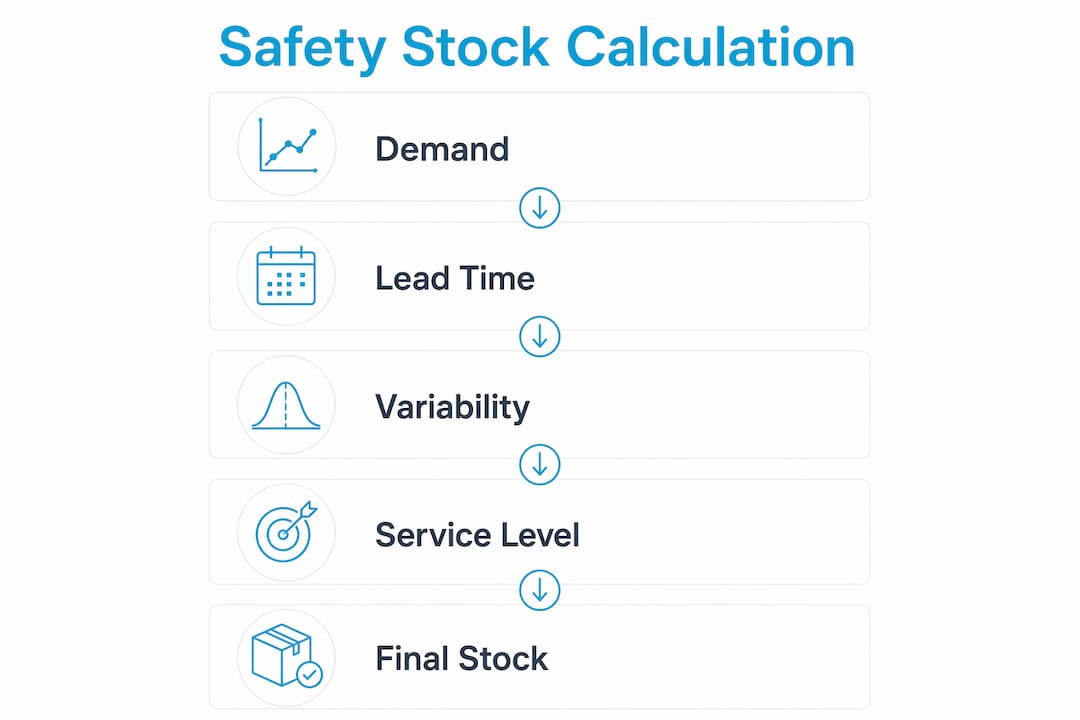
Pro Tip: Lead-time variability (σLT) typically drives more safety-stock requirement than demand variability. Reducing σLT through supplier SLAs often lowers your buffer more efficiently than improving demand forecasting alone.
What QC gates make safety stock actually usable?
Physical presence in a freezer is not the same as scientific usability. Continuous temperature monitoring and validated storage protocols are necessary conditions for safety stock to function as intended.
Minimum QC gate checklist before drawing from safety stock:
COA review: confirm purity, identity, and specification compliance for the specific lot
Independent test result: required for critical-tier SKUs; recommended after any storage anomaly
Visual inspection: check for discoloration, aggregation, or container integrity issues
Temperature log review: confirm no excursions since receipt; flag any alarm events for investigation
Expiry and stability check: confirm the lot remains within its validated use window
Lot traceability: verify lot number links to synthesis batch and manufacturing records in your system
For COA interpretation and acceptance criteria, procurement teams should define pass/fail thresholds in their SOP before a stock-out event forces a rushed decision.
Storage requirements by peptide class:
Refrigerated (2–8°C): short-term working stocks, typically less than 30 days
Frozen (−20°C): standard lyophilized peptides; validated for most research applications
Ultra-cold (−80°C): sensitive sequences, reconstituted stocks, or extended storage beyond 12 months
Temperature excursions are the most common reason safety stock fails at the point of use. A single unmonitored thaw cycle can degrade peptide activity without any visible change to the vial. Continuous logging with automated alarms, combined with periodic audit sampling, costs a fraction of what a ruined study run costs to repeat.
Pro Tip: Periodic audit sampling of safety-stock lots (e.g., one vial per quarter per critical SKU) gives early warning of storage drift before a full batch is compromised.
Supplier and lead-time strategies that reduce required safety stock
Reducing σLT at the source is the most direct way to lower required buffer levels without cutting service targets. Procurement tactics that accomplish this:
Qualify at least two backup suppliers for every critical SKU; run small qualification batches annually to keep alternatives audit-ready and lead times current
Request historical OTD data and lead-time windows from primary suppliers before finalizing SLAs
Negotiate prioritized production slots for mission-critical compounds, particularly for custom sequences with long synthesis cycles
Pre-qualify expedited air-freight lanes for frozen transport; confirm cold-chain validation with the logistics partner before a disruption occurs
Explore vendor-managed inventory (VMI) or consignment arrangements for high-volume, stable-demand SKUs
Contract terms worth requesting:
Lead-time reporting: supplier provides actual vs. committed lead time monthly
Remediation clauses for missed SLAs, including expedited re-synthesis at no additional cost
Small-batch flexibility: ability to order partial quantities without minimum-order penalties
Annual qualification run rights for backup suppliers
For detailed contract negotiation tactics specific to peptide sourcing, procurement teams should build SLA language around measurable lead-time windows rather than vague “best efforts” commitments.
What KPIs should procurement track for peptide safety stock?
Effective inventory management in peptides requires a defined monitoring cadence, not ad hoc reviews.
KPI Target / Threshold Review Cadence Supplier OTD ≥95% for critical SKUs Monthly Lead-time variability (σLT) Trend review; escalate if rising Monthly Forecast accuracy (MAPE) Track trend; use to recalibrate SS Monthly Stock-out frequency Zero for critical tier Weekly Inventory days of supply (DOS) Within defined min/max band Weekly Temperature excursion rate Zero tolerance; investigate all events Daily alerts Lots with independent verification 99% for critical tier Per receipt
Escalation triggers: if OTD falls below 90% for two consecutive months, or if σLT increases by more than 20% from baseline, escalate to procurement leadership and activate contingency sourcing. For procurement KPI frameworks tailored to peptide supply chains, tracking these metrics in a centralized system reduces the lag between a supplier performance shift and a policy response.
How do you balance holding cost against the cost of a peptide stock-out?
Inventory carrying costs commonly run at approximately 20% or more of inventory value annually, covering storage, capital cost, and obsolescence risk. The cost of a stock-out on the same compound, if it halts a multi-week study, can exceed that figure in a single event.
SKU segmentation framework:
Critical clinical materials: hold 4–6 weeks of safety stock; target 99% service level; require independent verification on every lot
High-impact research peptides: hold 2–4 weeks; target 95–97% service level; COA review required, independent test on first lot from each batch
Low-impact exploration compounds: hold 1–2 weeks or rely on lean buffer plus expedited logistics; 90–95% service level acceptable
For expensive discovery peptides where holding cost is prohibitive, a lean on-site buffer combined with pre-qualified expedited synthesis and air freight is often more cost-effective than a large static inventory. Reshoring trends and BIOSECURE Act considerations are also reshaping lead-time assumptions for API-sourced compounds, which procurement teams should factor into longer-term safety-stock policy reviews.
What are the contingency options when safety stock runs out?
Pre-planned contingency options, in priority order:
Expedited synthesis: contact primary supplier for emergency production slot; confirm cold-chain validated air freight is pre-arranged
Secondary supplier activation: draw on the pre-qualified backup; release only after COA review and, for critical SKUs, independent test
Consignment or VMI draw: if a consignment agreement is in place, request immediate release of held inventory
Third-party cold-storage reserve: if a validated reserve lot is held at an external cold-storage provider, initiate release with full temperature-log documentation
Controlled protocol pause: document the freeze point, preserve all in-progress samples per validated hold procedures, and record the deviation
Emergency checklist:
Identify who authorizes emergency purchase (procurement lead + PI sign-off for critical SKUs)
Confirm QC release criteria before emergency lot enters use
Document all deviations and lot substitutions in the study record
Verify that the emergency lot’s COA meets original specification limits
Pre-approved contingency contracts and an identified emergency logistics partner reduce decision friction when time pressure is highest.
One-page SOP template for peptide safety-stock policy
Tier definitions and service-level targets:
Critical tier: clinical-stage materials, irreplaceable reference standards; 99% service level; 4–6 weeks safety stock
Priority tier: active research compounds with no near-term substitute; 95–97% service level; 2–4 weeks safety stock
Routine tier: exploration compounds with available alternatives; 90–95% service level; 1–2 weeks safety stock
Reorder point calculation: ROP = (D × LT) + SS, where D is average weekly demand and LT is average lead time in weeks.
QC gates before stock draw (all tiers):
COA on file and reviewed
Temperature log verified, no unresolved excursions
Expiry confirmed within planned use window
Lot number recorded in inventory system
Additional gates for critical and priority tiers:
Independent test result on file for the specific lot
Batch traceability confirmed to synthesis records
Responsibility matrix:
Procurement: safety-stock calculation, reorder execution, supplier SLA monitoring
Lab manager: consumption reporting, storage monitoring, draw authorization
QC: COA review, independent test coordination, lot release sign-off
Logistics: cold-chain validation, temperature log custody, carrier qualification
Escalation: stock-out or OTD breach triggers immediate notification to procurement lead and PI; contingency workflow activates within 24 hours.
Review cadence: critical-SKU safety stock reviewed monthly; policy refreshed quarterly or after any supply disruption.
Pro Tip: Build the SOP review into the quarterly supplier performance meeting. If σLT has shifted, recalculate safety stock for critical SKUs before the next procurement cycle, not after a stock-out.
For a procurement checklist that maps directly to these SOP gates, procurement teams can use it as an acceptance-testing companion document.
Key Takeaways
Safety stock in peptide procurement is only effective when sized from measurable inputs and backed by validated cold-chain storage, COA verification, and lot traceability at every draw.
Point Details Size from measurable inputs Use Z, σD, σLT, and LT in the standard formula; recalculate when lead-time variability shifts. Tier SKUs by criticality Critical materials warrant 99% service level and 4–6 weeks of buffer; routine compounds can hold less. Cold chain is a prerequisite Continuous temperature monitoring and alarm verification are required before safety stock is scientifically usable. Reduce σLT at the source Qualifying backup suppliers and negotiating lead-time SLAs lowers required buffer without cutting service levels. PeptidesFromChina Supports safety-stock strategies through transparent lead-time reporting, batch traceability, COA sharing, and VMI options.
The gap between buffer size and buffer quality
The most persistent mistake in peptide procurement is treating safety stock as a quantity problem rather than a quality problem. Teams spend time debating whether to hold four weeks or six weeks of a critical compound, then store it in a freezer with no continuous monitoring and draw from it without reviewing the temperature log. The buffer is physically present. It may not be scientifically usable.
The second common misstep is over-relying on large static buffers as a substitute for supplier qualification work. A 12-week safety stock of a critical peptide does not fix a supplier whose lead-time variability is unpredictable. It delays the reckoning. The correct sequence is to reduce σLT first through SLAs and backup qualification, then right-size the buffer to what the math actually requires.
One practical step that most procurement teams skip: run a small annual qualification batch from each backup supplier, even when the primary supplier is performing well. It keeps the backup’s lead-time data current, confirms the synthesis facility is still operational, and gives QC a recent lot to verify against specification. When a disruption occurs, that preparation is the difference between a 48-hour contingency activation and a six-week delay.
How PeptidesFromChina supports your safety-stock strategy
Supplier transparency can improve safety-stock planning. PeptidesFromChina can confirm current availability through its manual request process, while shipping methods and estimated transit times are confirmed during order processing. Manufacturer-side analytical documentation may be available depending on the product and batch, and independent testing is arranged by buyers who require it.
For teams evaluating backup sourcing or running a first qualification batch, PeptidesFromChina offers small-batch qualification runs and VMI or consignment arrangements for stable-demand compounds. The research peptide catalog includes COA documentation and batch traceability details at the SKU level, so procurement teams can inspect the verification standard before committing to a pilot. To discuss a specific SKU evaluation or a supply-risk review for your critical compounds, contact PeptidesFromChina directly through the catalog page.
Useful sources
ASCM: Safety Stock as a Contingency Plan — the primary reference for service-level z-scores, combined demand/lead-time formulas, and CSL vs. fill-rate distinctions; directly applicable to U.S. research procurement
NetSuite: Safety Stock Calculation Guide — covers standard formula inputs and carrying-cost benchmarks; useful for teams building spreadsheet-based models
Sophus: Safety Stock Optimization — explains the nonlinear relationship between service level and buffer size; relevant for teams choosing between 95% and 99% targets
MIT: Safety Stock Economics (King) — lean buffer plus expedited logistics framework for high-cost perishables; directly applicable to expensive peptide SKUs
Peptide supply risk report — cold-chain and storage validation requirements for research-grade peptides; U.S.-relevant for lab storage SOP development
PeptideStaff: Peptide API Manufacturing Reshoring — BIOSECURE Act context and reshoring trends affecting U.S. procurement lead times; relevant for longer-term safety-stock policy reviews
MDPI: Enhancing Inventory Management through Safety-Stock Strategies — comparative analysis of safety-stock methodologies including service-level and ABC-XYZ hybrid approaches; applicable to SKU segmentation decisions