Role of Counterions in Peptide Stability: A Researcher’s Guide

Counterions (TFA−, AcO−, Cl−, and related anions) are not passive spectators in peptide chemistry. They directly modulate peptide stability through charge screening, specific ion-pairing, and Hofmeister-type hydration effects, and the wrong counterion can corrupt structural data, suppress biological activity, or destabilize a lyophilized formulation before an experiment even begins. The practical consequence: verify salt form and quantify counterion content by ion chromatography or capillary electrophoresis before any structural or biological assay.
Key points to act on immediately:
TFA− persists in synthetic peptides after RP-HPLC and interferes with IR, MS, and biological assays
Acetate and chloride are the preferred alternatives for most biological work, and the majority of approved peptide pharmaceuticals are acetate salts
Counterion identity and molar ratio should appear on every certificate of analysis (CoA) and in every published methods section
Ion chromatography and capillary electrophoresis are the validated quantitative methods; 19F-NMR is uniquely specific for TFA−
Pro Tip: Before running any CD, MS, or cell-based assay, request the counterion assay data from your supplier. If it is not on the CoA, treat the salt form as unknown and verify independently.
Table of Contents
This article explains how counterions affect peptide stability, formulation, analysis, and reporting. Manufacturer-side counterion or analytical documentation may be available depending on the product and batch; buyers should independently verify data required for their protocols.
Why peptides exist as salts and what a counterion actually is
Peptides with basic residues (Lys, Arg, His) or a free N-terminus carry net positive charges at physiological pH. In solution and during processing, these cationic sites associate with anions to form electroneutral ion pairs. The anion in that pair is the counterion, and the resulting solid is a peptide salt.
The counterion identity is largely determined by the manufacturing workflow:
TFA−: introduced during solid-phase peptide synthesis (SPPS) cleavage (trifluoroacetic acid is the standard cleavage cocktail) and carried through RP-HPLC when TFA-containing mobile phases are used
AcO− (acetate): introduced by lyophilization from dilute acetic acid solution or by ion-exchange steps; the most common counterion among approved peptide pharmaceuticals
Cl− (chloride): introduced by HCl treatment or anion-exchange chromatography; physiologically compatible and analytically clean
Hydrophobic anions (docusate, dodecylsulfate, oleate): deliberately introduced for hydrophobic ion pairing (HIP) in specialized formulations
Protonation state matters here. The number of positive charges on a peptide at a given pH determines how many counterion equivalents associate stoichiometrically. A peptide with three basic residues can carry up to three TFA− ions per molecule, and that stoichiometry has direct functional consequences. Lyophilization fixes the salt form in the solid state, but it does not guarantee a defined or pure counterion composition unless the pre-lyophilization solution chemistry was deliberately controlled.
Always request counterion identity and a quantitative assay on the CoA when sourcing peptides. Assuming the salt form from the synthesis route alone is a reproducibility risk.
How counterions alter peptide structure and stability: four mechanisms

Electrostatic screening and secondary structure induction
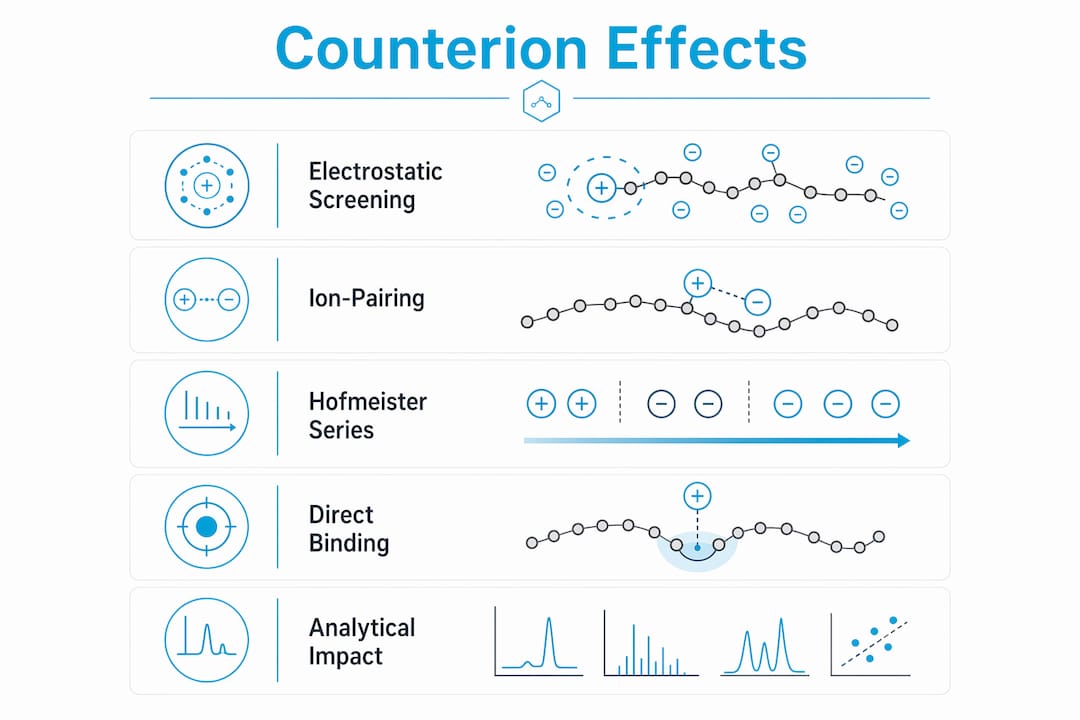
Cationic peptides in water experience intramolecular charge repulsion between basic residues. Anions screen those charges, reducing repulsion and allowing the backbone to adopt lower-energy conformations. For helical peptides, sufficient screening can tip the equilibrium toward α-helix formation. The effect is anion-dependent: divalent anions (SO4²−) screen more efficiently per ion than monovalent ones, and chaotropic anions (SCN−, I−) interact with the peptide surface differently than kosmotropes (SO4²−, F−).
Ion-pair formation and hydrophobic ion pairing
When the counterion is hydrophobic (docusate, oleate, or similar bulky anions), it forms a tight ion pair with the cationic residue and buries the charge. The resulting complex is effectively neutral and substantially more lipophilic than the parent peptide salt. This is the basis of HIP formulation strategies. Leuprolide, insulin, and desmopressin have all been studied in HIP formulations, where exchange to hydrophobic anions improved encapsulation into lipid-based delivery systems and, in some cases, enhanced enzymatic stability. The tradeoff is that HIP complexes require careful optimization of molar ratios and lipophilicity matching per peptide.
Hofmeister and specific-ion effects
The Hofmeister series ranks anions by their ability to stabilize or destabilize protein/peptide hydration shells. Kosmotropes (SO4²−, AcO−) tend to promote compact, folded states and reduce aggregation by strengthening hydrophobic interactions. Chaotropes (SCN−, ClO4−, I−) do the opposite, disrupting hydration and increasing aggregation propensity. Chloride sits near the middle of the series, which partly explains its utility as a physiologically compatible counterion with moderate effects on peptide conformation.
Direct binding and hydrogen bond competition
Some anions make specific contacts with peptide backbone or side-chain groups rather than acting purely through diffuse electrostatics. TFA−, iodide, and thiocyanate can compete with backbone amide hydrogen bonds or bind near charged side chains in ways that perturb secondary structure. A neutral peptide-counterion complex may even be the dominant permeant species in membrane permeation assays, meaning the counterion travels with the peptide across the membrane rather than dissociating at the interface. That finding has direct implications for interpreting in vitro permeability data.
Practical biophysical signatures of counterion effects include: CD spectral shifts (altered helix/sheet ratio), anomalous RP-HPLC retention times (TFA as ion-pairing agent increases retention), suppressed MS signal intensity, and 19F NMR peaks diagnostic for TFA−.
What the experimental literature shows: case studies
The overall pattern from published work is that counterion effects on peptide conformation and activity are real but peptide-dependent. No single anion is universally destabilizing or stabilizing. Recurring trends do emerge: TFA− frequently distorts structural analysis and can suppress biological activity, while acetate and chloride are generally cleaner alternatives for biological work.
Case / Peptide Counterions Tested Observed Outcome Source LL-37 (antimicrobial) SO4²−, HCO3−, CF3CO2− (TFA−) α-helical conformation induced by specific anions; antimicrobial activity correlated with helical content PubMed 41301485 Synthetic AMPs (antistaphylococcal) TFA− vs. Cl− Residual TFA− ranged 150–320 µg per mg peptide; activity and cytotoxicity differed between salt forms Springer Leuprolide, insulin, desmopressin Hydrophobic anions (docusate, oleate) HIP improved encapsulation efficiency and enzymatic stability in lipid-based systems PMC7761850 Synthetic peptides (TFA exchange study) TFA− → Cl− (10 mM HCl) 10 mM HCl exchange reduced TFA− below LOQ; verified by FT-IR, 19F-NMR, HPLC-ELSD Pharmaceutics
The LL-37 data is particularly instructive. The same peptide sequence adopts different secondary structures depending on which anion is present, and that structural difference translates directly into measurable differences in antimicrobial potency. That is not a subtle analytical artifact; it is a biologically meaningful outcome driven entirely by the counterion.
Key patterns from the literature:
TFA− at levels of 150–320 µg per mg peptide is common in synthetic peptide batches and is not removed by standard lyophilization
Acetate and chloride produce more reproducible biological assay results than TFA− salts in most published comparisons, and the majority of approved peptide pharmaceuticals are acetate salts
HIP formulations require case-by-case optimization; molar ratios and pKa matching are critical variables
Counterion effects on aggregation are especially pronounced for amphipathic helical peptides and those with high net charge
How counterions distort analytical readouts and what to do about it
Counterions commonly distort analytical readouts in ways that are easy to misattribute to peptide degradation or sequence error. Knowing which method is affected and why is the first step to clean data.
Specific analytical interferences from TFA−:
FT-IR and IR: TFA− absorbs near 1,670 cm−1, overlapping directly with the amide I band used to assign secondary structure. TFA interference with the amide I band is well-documented and can produce false helix or sheet assignments.
19F-NMR: TFA− gives a sharp, characteristic 19F signal. This is actually useful for detection and quantification, but the signal must be accounted for in any 19F-NMR experiment on fluorinated peptides.
RP-HPLC: TFA acts as an ion-pairing reagent, increasing peptide retention time. Switching mobile phase additives changes retention, complicating method transfer between labs.
MS: TFA suppresses ionization and reduces signal intensity, particularly in ESI-MS. Desalting or counterion exchange before MS is standard practice for this reason.
Stepwise TFA-to-chloride or acetate exchange protocol
Dissolve the lyophilized TFA salt in water or dilute aqueous solution.
Pass through an anion-exchange resin (Cl− or AcO− form) or treat with 10 mM HCl for Cl− exchange.
Lyophilize the resulting solution.
Repeat dissolution and lyophilization at least twice; single-cycle exchange is rarely complete.
Verify by ion chromatography (quantitative for Cl−, AcO−, TFA−), capillary electrophoresis (sensitive for low-level anions), or 19F-NMR (specific for TFA−).
Verification method selection depends on the analytical need. Ion chromatography and capillary electrophoresis are quantitative for most anions and appropriate for routine QC. 19F-NMR is uniquely specific for TFA− and useful when the matrix is complex or when IC results are ambiguous. Mixed-mode HPLC-ELSD provides an orthogonal check and is useful for hydrophobic ion pairs that may not elute cleanly on standard IC columns.
Pro Tip: Desalt peptide samples before ESI-MS using C18 ZipTips or equivalent solid-phase extraction. Report both the counterion identity and the molar ratio of counterion to peptide in your methods section. Reviewers and collaborators cannot reproduce your results without that information.
Formulation, lyophilization, and storage: what salt form changes in practice
The salt form materially changes formulation behavior. Solubility, glass transition temperature during lyophilization, aggregation on reconstitution, and pH drift are all counterion-dependent variables that affect shelf life and batch-to-batch reproducibility.
Lyophilization is the standard route to fix salt form, but it is not inherently quantitative as an exchange method. Achieving near-complete TFA-to-acetate or TFA-to-chloride exchange typically requires multiple dissolution and freeze-dry cycles, and the completeness must be confirmed analytically rather than assumed. A single lyophilization from acetic acid solution will reduce TFA− content but rarely eliminates it below detection limits in one pass.
Practical formulation considerations by salt class:
TFA salts: avoid for biological assays and in vivo studies without prior exchange and verification; acceptable for initial analytical characterization where TFA interference is accounted for
Acetate salts: preferred for most biological work; mild exchange conditions; most approved peptide pharmaceuticals are acetate salts; compatible with standard lyophilization excipients (mannitol, sucrose)
Chloride salts: physiologically compatible; produced by HCl treatment; analytically clean for MS and CD; appropriate for in vivo and cell-based work
Hydrophobic ion pairs (docusate, oleate): increase lipophilicity and encapsulation efficiency; require optimization of molar ratios; not appropriate for aqueous biological assays without prior dissociation
On reconstitution, counterion-driven pH drift is a real concern. Acetate buffers weakly, and reconstituting an acetate salt into water without pH control can shift the solution pH enough to affect peptide solubility or aggregation. Chloride salts are generally pH-neutral on reconstitution. For lyophilized peptide storage, moisture content control is critical regardless of salt form; residual moisture accelerates hydrolysis and aggregation in the solid state.
Researcher checklist: choosing, exchanging, verifying, and reporting counterions
Verify and report counterion identity and quantity before any structural or biological experiment. That single practice eliminates the most common source of irreproducible peptide data.
Request counterion identity and quantitative assay on the CoA from your supplier. Ask specifically for anion stoichiometry per peptide charge, not just a qualitative statement of salt form. Independent IC results from the manufacturer are preferable to self-reported data.
If the counterion is unsuitable, perform exchange. Start with 10 mM HCl for TFA-to-Cl− exchange (validated in published methods work). For acetate, lyophilize from dilute acetic acid. Perform a minimum of two dissolution-lyophilization cycles.
Verify exchange completeness analytically. Use ion chromatography for quantitative anion measurement, capillary electrophoresis for low-level anion detection, or 19F-NMR for TFA− confirmation. Do not proceed to biological assays on unverified material.
Desalt appropriately before MS or functional assays. C18 solid-phase extraction or equivalent removes residual salts that suppress ionization or interfere with activity measurements.
Report salt form and measured residuals in your methods section. Include counterion identity, quantitative level (µg per mg or molar ratio), and the analytical method used to verify. This is the minimum information needed for reproducibility.
For formulation development, screen multiple salt forms. Test aggregation propensity, solubility, and potency across at least TFA−, AcO−, and Cl− forms before committing to a formulation. For lipid-based delivery, evaluate HIP with docusate or oleate.
Verification assay selection guide:
Ion chromatography: first choice for routine quantitative anion profiling; works for TFA−, AcO−, Cl−, and most common anions
Capillary electrophoresis: preferred for low-level anion detection and complex matrices; orthogonal to IC
19F-NMR: uniquely specific for TFA−; use when IC results are ambiguous or when a fluorinated peptide matrix complicates IC
Pro Tip: When interrogating a supplier, ask for the anion stoichiometry per peptide charge (e.g., moles TFA− per mole of positive charge) and request the raw IC chromatogram, not just the reported value. Retain batch traceability records including lot number, exchange procedure, and verification assay results. These records are the foundation of reproducible peptide research.
Counterions are formulation components, not residues
The practical conclusion is direct: counterions must be treated as active formulation components, not inert manufacturing residues. Salt form affects secondary structure, aggregation, solubility, membrane permeability, and analytical readouts in ways that are large enough to change experimental outcomes and invalidate cross-study comparisons.
Three immediate steps for any peptide research workflow:
Verify salt form quantitatively (ion chromatography or capillary electrophoresis) before structural or biological assays; never assume the counterion from the synthesis route alone
Prefer physiologically compatible anions (Cl−, AcO−) for biological work unless HIP is a deliberate formulation strategy
Document salt form, counterion level, and verification method in every methods section and CoA
Reproducibility in peptide research depends on treating the counterion as a defined variable, not an afterthought. The field’s reporting standards are still inconsistent, and that inconsistency is a direct source of irreproducible results across labs.
Key Takeaways
Counterion identity is a primary variable in peptide stability, analytical accuracy, and formulation performance. Researchers who treat it as such produce more reproducible data and avoid the most common sources of assay failure.
Point Details Counterions are active variables TFA−, AcO−, and Cl− each alter peptide secondary structure, aggregation, and analytical readouts differently. TFA− is the most problematic default Residual TFA− at 150–320 µg per mg peptide is common and interferes with IR, MS, and biological assays. Preferred alternatives for biological work Acetate and chloride salts are analytically cleaner and the majority of approved peptide pharmaceuticals are acetate salts. Validated verification assays Ion chromatography and capillary electrophoresis quantify anions; 19F-NMR confirms TFA− specifically. PeptidesFromChina sourcing standard Products are subject to the manufacturer’s applicable quality-control procedures and specifications. Manufacturer-side analytical documentation may be available depending on the product and batch. PeptidesFromChina is not an independent analytical testing laboratory.
A procurement note on what CoAs actually show in practice
Counterion reporting on supplier CoAs is inconsistent in ways that create real problems for researchers. The majority of CoAs from standard peptide manufacturers list purity by RP-HPLC and molecular weight by MS, but say nothing about counterion identity or quantity. A peptide listed as “>95% purity” may carry TFA− at levels that materially affect its behavior in a biological assay, and that information simply does not appear on the document.
The corrective action is straightforward but requires deliberate supplier interrogation. Ask for the anion assay data, not just the purity figure. Suppliers who perform ion chromatography as a routine QC step will have this data. Those who do not will either be unable to provide it or will offer a qualitative statement (“acetate salt”) based on the synthesis route rather than measured data. That distinction matters for reproducibility.
A common misconception in procurement is that lyophilization equals exchange. It does not. A peptide lyophilized from a TFA-containing RP-HPLC fraction still carries TFA− unless an active exchange step was performed and verified. Assuming otherwise is one of the most frequent sources of counterion-related assay variability seen in real-world batches. When sourcing from any supplier, including those operating through established synthesis facilities, always ask specifically whether an exchange procedure was performed, what conditions were used, and whether the result was verified analytically. Batch traceability records should include that information.
Relying on default TFA salts for biological assays without prior verification is a reproducibility risk that is straightforward to eliminate. The analytical methods exist, the exchange protocols are validated, and the cost of verification is small relative to the cost of a failed or irreproducible experiment. For guidance on evaluating peptide suppliers against these criteria, the checklist approach outlined in this article applies directly to the procurement conversation.
Manufacturer Documentation and Buyer Verification of Counterion Data
Products are subject to the manufacturer’s applicable quality-control procedures and specifications. Manufacturer-side analytical documentation may be available depending on the product and batch. PeptidesFromChina is not an independent analytical testing laboratory.
For research workflows where counterion control is a defined experimental variable, the practical next step is to request a CoA with ion assay data before committing to a batch. PeptidesFromChina’s research peptide catalog lists available compounds with verification documentation, and the QC team can confirm salt form options and exchange procedures for specific peptides on request. That level of documentation is what separates a reproducible sourcing workflow from one that introduces uncontrolled variables at the starting material stage.
Useful sources
Core peer-reviewed references for mechanisms, methods, and case studies:
The Role of Counter-Ions in Peptides: An Overview — PMC review covering prevalence of acetate salts, HIP formulation examples, exchange methods, and reporting standards. Best for mechanistic background and formulation guidance.
The Effects of Counter-Ions on Peptide Structure, Activity, and Applications — MDPI review covering TFA persistence, structural interference, and case studies including LL-37. Best for experimental examples and analytical pitfalls.
Towards a Consensus for the Analysis and Exchange of TFA as a Counterion in Synthetic Peptides and Its Influence on Membrane Permeation — Pharmaceutics methods paper validating FT-IR, 19F-NMR, and HPLC-ELSD for TFA− detection; reports 10 mM HCl as an effective exchange condition. Best for analytical protocols and exchange procedures.
Counter-ion effect on antistaphylococcal activity and cytotoxicity of selected antimicrobial peptides — Experimental study reporting TFA− levels of 150–320 µg per mg peptide and activity differences between salt forms. Best for case study data and quantitative context.
The Effects of Counter-Ions on Peptide Structure, Activity, and Applications (PubMed) — PubMed entry for the MDPI review; includes LL-37 anion-dependent conformation data. Best for cross-referencing experimental cases.