
Retatrutide sourcing from China is not simply a search for the lowest price. For a research buyer, it is a process of defining the requested material, confirming what is actually available, understanding which documents apply to the proposed batch, and deciding what the receiving laboratory will verify independently.
This guide explains that process for research-use-only procurement. It also separates the current scientific status of retatrutide from the commercial questions a buyer should resolve before placing an order.
Retatrutide’s research status in 2026
Retatrutide, also known as LY3437943, is Eli Lilly’s investigational agonist of the GIP, GLP-1, and glucagon receptors. The discovery and early clinical rationale were described by Coskun and colleagues in Cell Metabolism in 2022 (PubMed PMID 35985340).
Its development program has advanced considerably since then:
On December 11, 2025, Lilly announced positive topline results from the Phase 3 TRIUMPH-4 trial.
On March 19, 2026, Lilly announced positive Phase 3 results from TRANSCEND-T2D-1.
On May 21, 2026, Lilly announced positive topline results from the Phase 3 TRIUMPH-1 obesity trial.
These are important development milestones, but they do not change the central procurement fact: retatrutide remains investigational. A research-use material is not an FDA-approved drug and should not be presented as an alternative to a regulated medicine.
Primary sources:
What “sourcing from China” actually means
A buyer rarely deals with one simple entity called “the supplier.” The practical chain normally includes several roles:
A manufacturer or source responsible for producing or supplying the requested material.
A sourcing platform that coordinates the request, checks availability, confirms commercial terms, and communicates with the manufacturing side.
Logistics providers that move the shipment along the agreed route.
The receiving laboratory, which records the delivered material and applies its own acceptance procedure.
Peptides From China operates in the second role. PFC is a B2B sourcing platform. It coordinates manufacturer sourcing, availability confirmation, requested specifications, order processing, and international logistics and support. It is not the manufacturer, factory owner, or analytical laboratory.
That distinction is useful, not defensive. It tells the buyer which questions PFC can coordinate and which conclusions require manufacturer documentation or independent analysis.
Seven questions to settle before ordering
A strong procurement request is specific enough to produce a useful answer. Before paying a final invoice, record the following in writing.
1. What material is being requested?
Use the exact product name and requested form. If your laboratory has specification requirements, state them before availability is checked. Do not assume that two listings with the same common name are identical in form, counterion, content, packaging, or documentation.
2. What quantity is needed?
PFC’s standard catalog minimum order is USD 600. Different standard catalog items may be combined to reach that total, and orders normally begin with one 10-vial kit per product. For the current listing, review the Retatrutide research catalog page.
3. Is the requested material currently available?
Availability should be confirmed for the actual request rather than inferred from a generic page. PFC checks physical availability and reserve status during manual processing before the final invoice is issued.
4. What documentation is available for the proposed batch?
Documentation varies by product, manufacturer, and batch. Ask what exists for the material being proposed instead of assuming that every shipment includes a COA, HPLC chromatogram, LC-MS result, or a universal purity statement.
A document is most useful when the buyer can connect it to the proposed or delivered material through relevant identifiers. A polished PDF without a meaningful batch relationship is not a substitute for traceability.
5. What will the receiving laboratory verify?
Manufacturer-side documentation and buyer-side testing answer different questions. A laboratory may choose to arrange independent analysis under its own protocol after receiving the material. The scope, acceptance criteria, sample handling, and release decision belong to the buyer’s quality system.
For a practical overview of analytical evidence, see Peptide Testing and Analysis and PFC’s current Peptide Quality information.
6. What are the logistics and commercial terms?
Confirm the shipping method, destination-specific price, expected dispatch and transit window, and any information the receiving party needs before shipment. These details can vary by destination and available route, so they should be confirmed for the order rather than copied from a general estimate.
7. What happens if the proposal does not match the request?
Resolve specification questions before the final invoice. If something delivered appears inconsistent with the written order, preserve packaging and identifiers, document the issue promptly, and follow the current quality or support process. Avoid relying on promises that are not part of the written commercial terms.
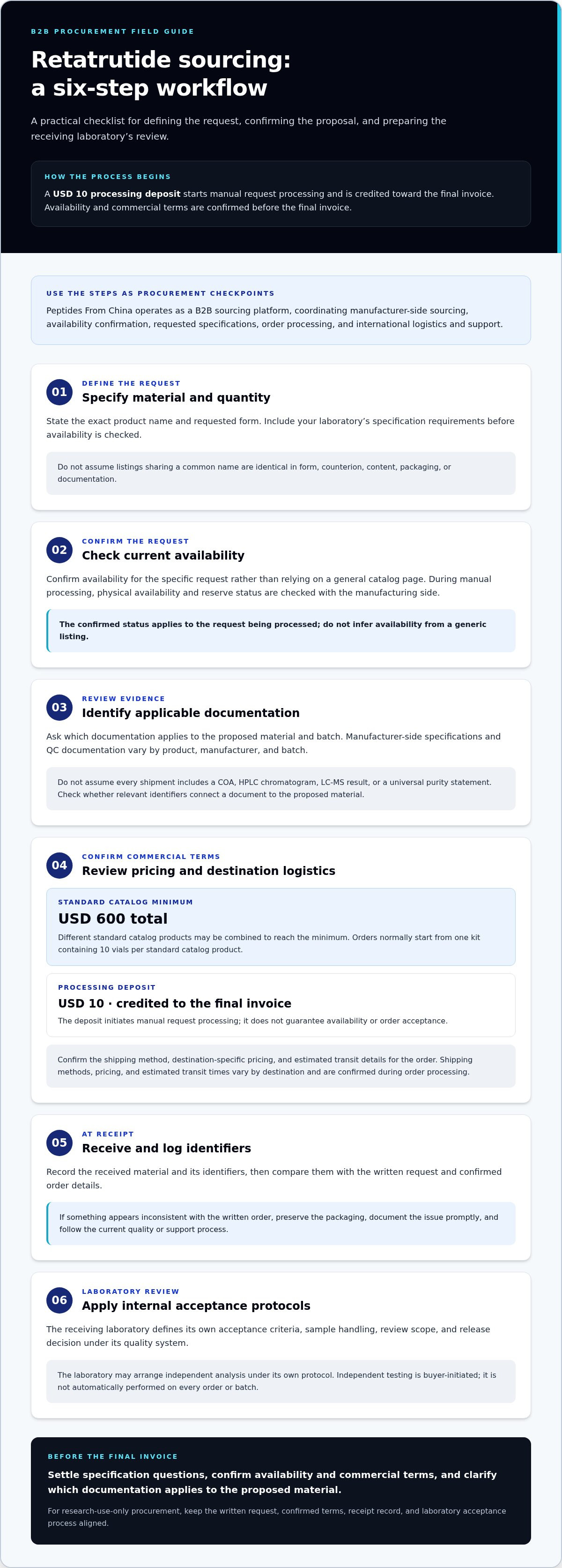
PFC’s order workflow
The PFC process is designed around manual confirmation rather than pretending that every catalog item is sitting in a universal inventory pool.
Build the request. Select retatrutide and any other standard catalog products needed for the project.
Submit the USD 10 processing deposit. This starts manual request processing and is credited to the final invoice.
Confirm availability and specifications. PFC checks the request with the manufacturing side, including physical availability or reserve status and the requested commercial details.
Review the final terms. The buyer receives the confirmed price, logistics information, and any available product or batch documentation relevant to the proposal.
Approve and complete the order. After the buyer accepts the terms and pays the remaining invoice, fulfillment proceeds through the confirmed route.
The full sequence is explained on How It Works and How to Pay.
How to evaluate quality claims without overreading them
Research procurement improves when every claim is tied to a specific question.
Identity: Does the evidence support that the material is the requested compound?
Chromatographic purity: What method and integration support the reported relative purity?
Content: How much target material is present in the supplied unit?
Form: Which salt, counterion, or other material form is being supplied?
Batch relationship: Can the document be connected to the proposed or received material?
Additional attributes: Does the intended research require water content, residual solvent, bioburden, endotoxin, stability, or other tests?
HPLC, mass spectrometry, content assays, and other methods provide different pieces of evidence. No single percentage answers every quality question. The appropriate test panel depends on the material and the receiving laboratory’s intended research.
That is also why PFC does not need to fill an article with a universal “99%+” promise. A better conversation is: what specification is requested, what evidence is available for the proposed material, and what will the buyer independently confirm?
A practical procurement checklist
Use this checklist when comparing any retatrutide sourcing proposal:
Exact product and requested material form recorded
Research-use purpose defined internally
Quantity and packaging requirements stated
Current availability or reserve status confirmed
Manufacturer/source disclosed when commercially available
Available documents listed for the proposed batch
Document identifiers checked against the proposal or delivery
Final price and USD 600 order minimum understood
USD 10 deposit correctly credited to the final invoice
Shipping method and destination-specific estimate confirmed
Receiving, recordkeeping, and independent-testing plan prepared
Current support and quality terms reviewed in writing
A supplier does not become credible because it uses technical language. Credibility comes from answering these questions clearly and avoiding claims it cannot support.
Why the China sourcing route can be useful
China is an important center for peptide synthesis and related supply-chain capacity. For a B2B buyer, working through a China-focused sourcing platform can make manufacturer communication, catalog consolidation, order coordination, and international logistics easier to manage.
The value is not a claim that every Chinese source is equivalent or that direct sourcing removes all risk. The value is a more explicit process: define the requirement, check the actual proposal, document what is available, and keep the receiving laboratory in control of acceptance.
PFC helps coordinate that process without pretending to be the factory or the laboratory. This creates a clearer commercial relationship and gives buyers one place to manage the request from availability check through fulfillment.
Frequently asked questions
What role does Peptides From China play?
PFC is a B2B sourcing platform. It coordinates manufacturer sourcing, availability confirmation, requested specifications, order processing, and international logistics and support. It does not manufacture retatrutide or perform independent laboratory testing.
What is the minimum order?
The standard catalog minimum is USD 600. Multiple standard catalog products may be combined to reach that total, with orders normally starting from one 10-vial kit per product.
How does the USD 10 deposit work?
The deposit starts manual request processing and is credited to the final invoice. It allows PFC to confirm availability, reserve status, specifications, and commercial terms before the buyer commits the remaining balance.
Does every order include a COA or HPLC report?
Documentation varies by product, manufacturer, and batch. Buyers should ask what is available for the specific material being proposed rather than assuming that the same document set accompanies every order.
Can a buyer arrange independent testing?
Yes. Independent testing is buyer-initiated and should follow the receiving laboratory’s own sampling, chain-of-custody, methods, and acceptance criteria.
What is retatrutide’s current status?
Retatrutide is Lilly’s investigational GIP, GLP-1, and glucagon receptor agonist. Lilly has reported positive Phase 3 topline results, but retatrutide remains investigational and research-use material is not an approved medicine.
Start a retatrutide sourcing request
If the PFC catalog structure fits your research procurement needs, review the Retatrutide listing, read How It Works, or contact the PFC team with the requested quantity, specification questions, and destination. The clearer the request, the faster the team can confirm a workable proposal.