Prevent Months of Rework: GMP vs Research Grade Peptides for Labs

Use research-grade peptides for in-vitro assays, biochemical screening, and other nonclinical lab work; require GMP-grade material the moment a peptide touches a human body, whether through a clinical trial, compounding, or any administered protocol. The distinction is not primarily about purity certifications. GMP is a documentation and traceability system built around validated methods and batch records, and that audit trail is what regulated work actually depends on.
TL;DR:
Research-grade peptides are suitable for in-vitro studies but lack endotoxin, sterility, and batch traceability necessary for regulated or clinical applications.
GMP certification ensures validated methods, environmental controls, and comprehensive batch records critical for human trials and compounding, significantly increasing costs and lead times.
Transitioning from research to GMP should be planned early, including verifying supplier facilities, requesting expanded CoA items, and retaining samples for quality comparison.
Most sourcing issues arise from untraceable reseller chains and delayed awareness of regulatory needs, not from the peptides’ chemical quality alone.
Establishing supplier relationships with direct, transparent manufacturing facilities and requesting batch records from the start saves months and reduces compliance risks.
Table of Contents
Research Grade vs. GMP Peptides: What “Research Grade” Actually Covers
What Does GMP Add Beyond a Purity Number?
When Do You Actually Need to Switch to GMP?
How Do You Avoid Rework When Scaling From Research to Regulated Use?
PeptidesFromChina’s Approach to Batch Verification and Transition Support
The Real Failure Point Isn’t Grade Choice. It’s Timing.
Sourcing Research-Grade Peptides With a Clear Path Forward
Sources
Research Grade vs. GMP Peptides: What “Research Grade” Actually Covers
A research-use-only (RUO) peptide typically ships with a certificate of analysis showing HPLC purity and mass spectrometry identity confirmation. Those two data points answer a narrow question: does the vial contain the intended sequence, and how much of it is that sequence versus impurities or truncated byproducts. They say nothing about whether the material is sterile, whether it carries bacterial endotoxin, or how much residual solvent survived the synthesis and purification process.
That gap trips up a lot of buyers. Independent industry analysis of GMP versus non-GMP peptide manufacturing consistently flags this as the most common misunderstanding among first-time procurement teams.
Standard RUO CoAs tend to leave out:
Endotoxin testing (LAL or recombinant Factor C)
Sterility confirmation
Residual solvent quantification beyond a pass/fail note
Batch-to-batch traceability back to a specific synthesis run
Validated method documentation with system suitability data
Research grade is genuinely sufficient for in-vitro receptor binding studies, biochemical screening, and early discovery work where the peptide never contacts living tissue in a regulated context. For procurement, the practical move is to request a lot-specific CoA (not a generic template), ask whether retention samples exist for that lot, and, when budget allows, run independent third-party verification on a sample before committing to volume. Reading a peptide CoA correctly is a skill procurement teams underinvest in, and it shows up as rework later.
What Does GMP Add Beyond a Purity Number?
Good manufacturing practice is a quality system, not a test result. It covers validated analytical methods, environmental monitoring in the production space, calibrated equipment, formal change control, and complete batch records that tie every lot back to its raw materials and process parameters. The FDA’s cGMP regulations under 21 CFR Part 211 codify exactly what that documentation and control need to look like for finished pharmaceuticals, and they’re the baseline an FDA inspector will check a facility against.
Release testing expands accordingly. A clinical-grade peptide batch typically carries:
Validated HPLC with documented system suitability, not a one-off run
Mass spectrometry identity confirmation
Endotoxin testing by LAL or recombinant Factor C assay
Sterility testing for anything intended for injection
Residual solvent quantification against defined limits
Water content and, where relevant, ICH-aligned stability data
Statistic Callout: ICH-compliant stability programs alone can run into tens of thousands of dollars per peptide and add weeks to months before a batch is release-ready, which is a large share of why GMP material costs more and ships slower than RUO stock.
The documentation matters more than any single test result once you’re dealing with compounding pharmacies, clinical supply chains, or an FDA inspection. A regulator or auditor doesn’t just want to know the peptide passed; they want to trace exactly which raw material lot, which synthesis run, and which analyst signed off on it. Technical guides on GMP versus research-grade peptides make the point plainly: a research-grade peptide can match or even exceed GMP-grade purity by HPLC and still be unusable for regulated work, because the audit trail simply doesn’t exist.
When Do You Actually Need to Switch to GMP?
Mapping the decision to your specific use case avoids both overspending on documentation you don’t need and underbuying on documentation you legally can’t skip.
In-vitro assays and biochemical screening. Research grade is appropriate. Request lot-specific CoAs and keep retention samples.
Animal studies (non-GLP). Research grade generally holds, though sourcing consistency matters more here because study reproducibility depends on batch stability.
GLP preclinical studies. This is a gray zone. Some programs require validated methods and tighter documentation even before human exposure; check your study protocol and sponsor requirements.
Human clinical trials. GMP is required. Endotoxin and sterility data are non-negotiable for anything injectable, and the API needs traceability back to a registered manufacturer.
Compounding for human use. GMP-sourced API from a listed, traceable supplier is a legal requirement, not a best practice. Legal analyses of bulk substance sourcing are explicit that RUO-labeled material cannot legally enter a compounded human drug product.
Budget-wise, expect GMP material to run at a meaningful multiple over RUO pricing, with lead times stretched by stability studies and validation work rather than by the synthesis itself. Document the use case, the CoA items reviewed, and the rationale for the grade chosen in your procurement file. That record is what protects you when an auditor or reviewer later asks why a given material was acceptable for a given stage.
Pro Tip: Keep a one-page decision memo per project stage that states the intended use, the grade purchased, and the specific CoA fields reviewed. It takes ten minutes to write and saves days when a regulatory reviewer or internal QA team asks for justification months later.
How Do You Avoid Rework When Scaling From Research to Regulated Use?
Most costly rework traces back to a decision made months earlier, when a team sourced research-grade material without asking whether the project might eventually go clinical. Verify supplier fundamentals before you scale, not after: confirm the API’s country and facility of origin, check whether the manufacturer is registered with a relevant regulatory body, and ask for audit evidence rather than a marketing claim about facility standards.
Request expanded CoA items, or fund independent testing for endotoxin, sterility, and residual solvents, before committing to volume purchasing.
Retain research lots and run side-by-side analytics against candidate GMP batches; this is a practical way to catch discrepancies before they become a program-wide problem.
Build stability bridging into your timeline rather than treating it as an afterthought once a clinical pathway is confirmed.
Write batch-record access, change-notification rights, and audit access directly into purchase order language, not as a verbal understanding with the supplier.
Laboratory verification guides that walk through supplier due diligence step by step are worth building into a formal intake process rather than improvising each time.
Pro Tip: Ask any prospective GMP supplier for a redacted batch record from a comparable peptide before you place an order. A supplier that can’t produce one, or resists the request, is telling you something about their actual documentation practices regardless of what their marketing materials claim.

PeptidesFromChina’s Approach to Batch Verification and Transition Support
A certificate of analysis is a starting disclosure, not independent proof. Products are subject to the manufacturer’s applicable quality-control procedures and specifications. Manufacturer-side analytical documentation may be available depending on the product and batch. PeptidesFromChina is not an independent analytical testing laboratory.
Sourcing direct from established synthesis facilities, rather than through layered reseller chains, shortens the traceability gap that trips up teams later when they need to move a peptide toward GMP-grade supply. Knowing which facility actually ran the synthesis, and having a real point of contact there, makes it possible to request batch records or validation summaries with a real chance of getting them.
Author credentials, independent third-party certification data, and documented customer case studies for specific transition projects will be added to this resource as they become available.
The Real Failure Point Isn’t Grade Choice. It’s Timing.
Most of the damage in this space happens quietly, months before anyone notices. A team buys research-grade peptide for early discovery work, the project shows promise, and somewhere between “this looks interesting” and “we’re planning a trial,” nobody stops to ask whether the sourcing chain can support what comes next. By the time someone does ask, the answer is often a partial rebuild: new supplier, new documentation, new stability data, and a multi-month delay nobody budgeted for.
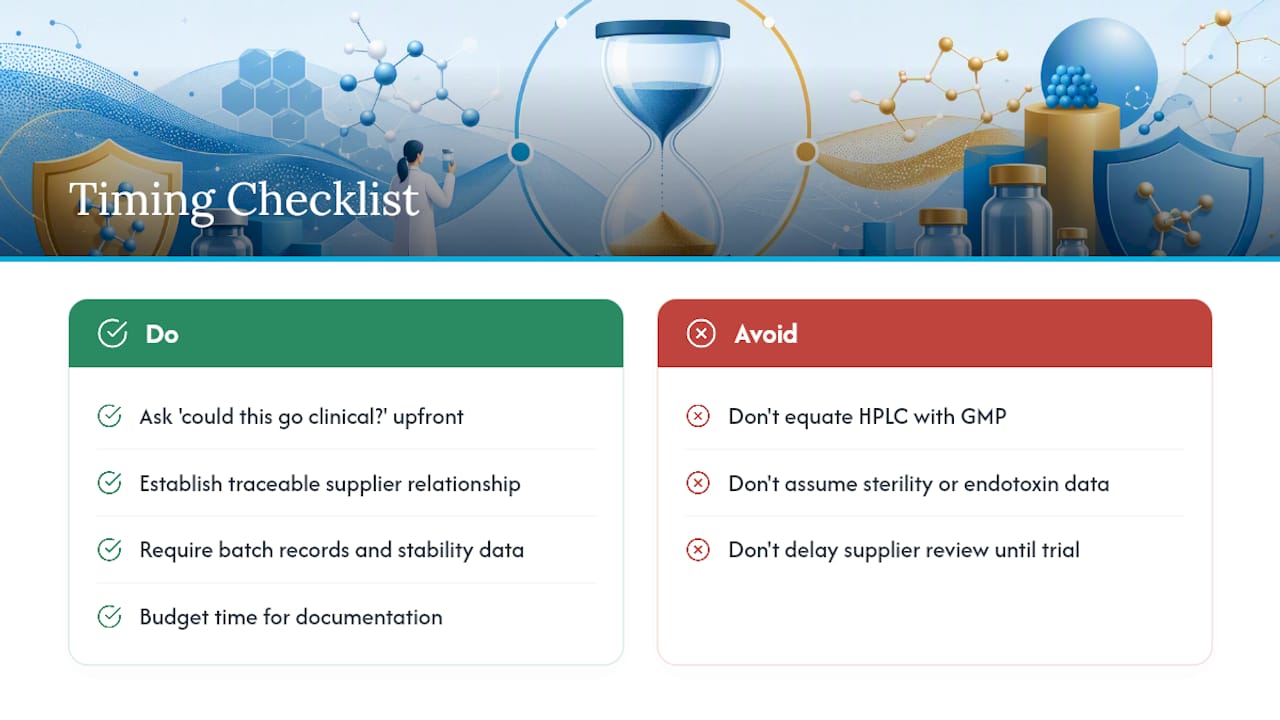
The conventional advice treats this as a purity problem, and that framing is what leads teams astray. Chasing a higher HPLC number on an RUO peptide doesn’t get you closer to GMP. It gets you a cleaner-looking CoA on a product that still lacks endotoxin data, sterility testing, and a traceable batch record. Those are different problems entirely, and no amount of chromatography resolves them.
If there’s one thing worth prioritizing, it’s asking the “could this go clinical?” question at the start of a project, not the middle. A supplier relationship built on real traceability, one where you can ask for a batch record and expect a real answer, costs you almost nothing to establish early and saves you months if the project’s scope changes.
— Sam Levin
Sourcing Research-Grade Peptides With a Clear Path Forward
Teams can reduce transition risk by defining specifications, lot-consistency needs, documentation requirements, and an independent testing plan before ordering. PFC works directly with a limited network of verified manufacturing facilities as a specialized sales and sourcing channel. Products are subject to the manufacturer’s applicable quality-control procedures and specifications. Manufacturer-side analytical documentation may be available depending on the product and batch. PeptidesFromChina is not an independent analytical testing laboratory.
That transparency matters most when a research program starts moving toward regulated use. If your current sourcing can’t answer basic questions about API origin or batch history, that’s worth resolving before scaling, not after. Procurement teams can start by requesting a quote and lot-specific CoA on catalog items like KPV or Epithalon, both of which ship with documentation buyers can actually verify rather than take on faith. Ask for sample testing before committing to volume, and treat the CoA conversation as the first real test of whether a supplier can support you if your work eventually requires more than research grade.