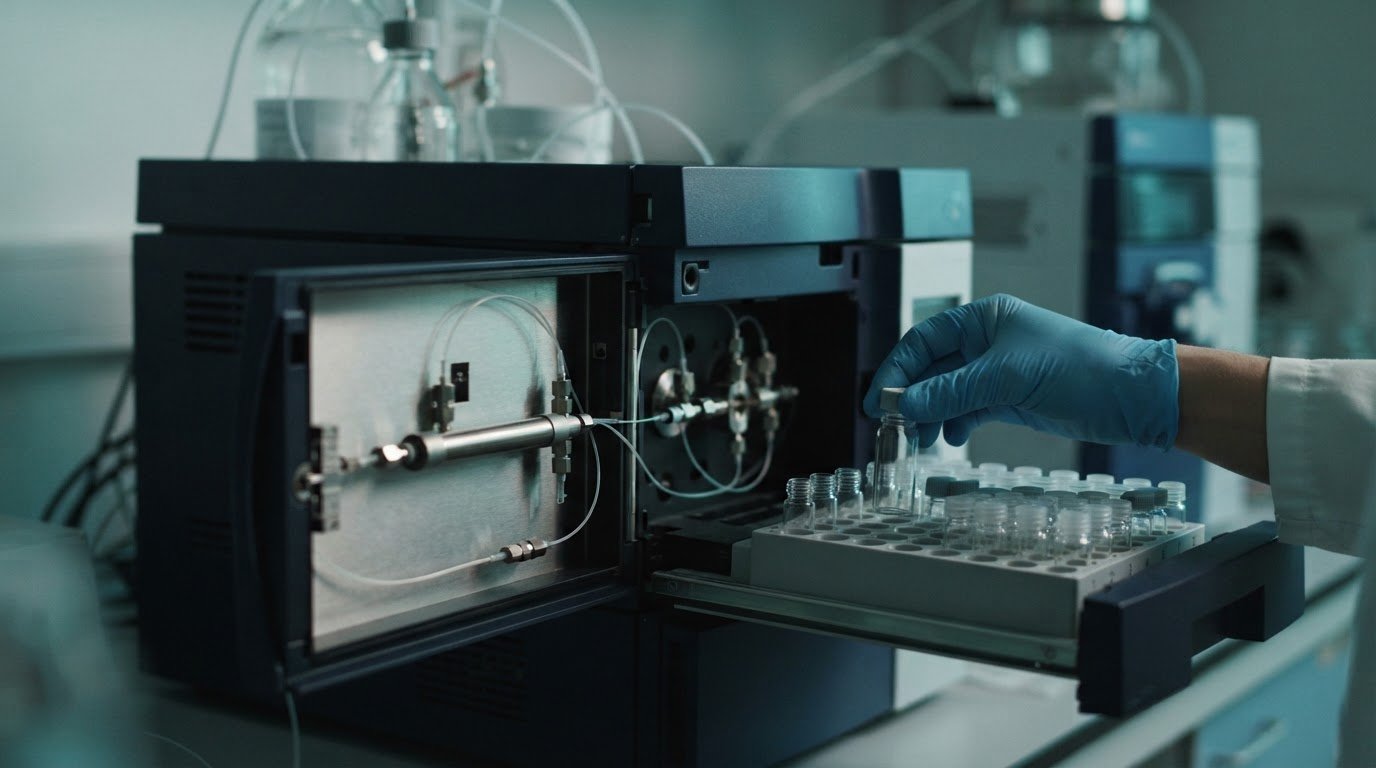
A tirzepatide chromatogram is evidence about one separation, run under one set of analytical conditions. It shows how components of a sample behaved on a specific column, mobile phase and detector. It does not give a complete inventory of every compound present, and it cannot establish identity on its own. This guide is for research use only and explains how to read a trace without over-reading it.
Key Takeaways
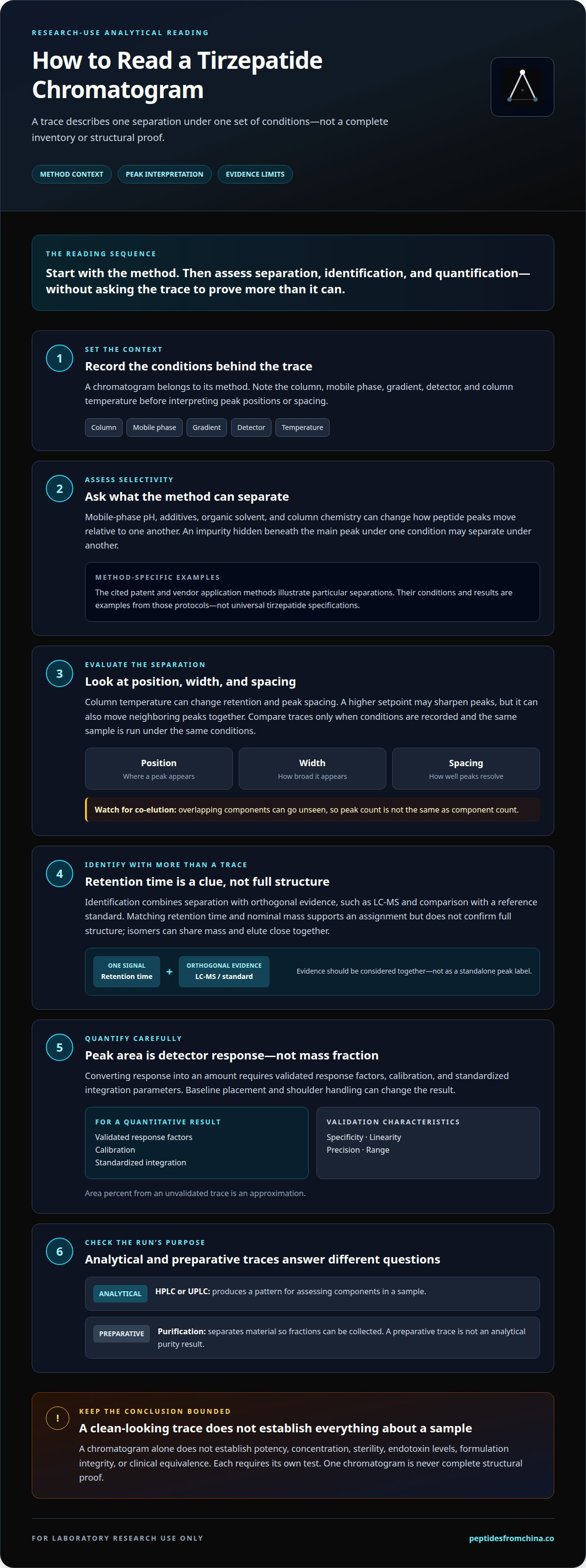
Every peak pattern belongs to its method: column, mobile phase, gradient and detector all shape what is visible.
Peak area is detector response. A mass fraction needs validated response factors, calibration and standardized integration.
Retention time and nominal mass do not prove full structure; reference standards and orthogonal evidence are needed.
Values from a patent or a vendor application note are examples from those protocols, not universal tirzepatide specifications.
A clean-looking trace does not establish potency, concentration, sterility, endotoxin levels, formulation integrity or clinical equivalence.
Table of Contents
Mobile-phase composition and peptide selectivity
In reversed-phase separations of GLP-1 peptides, the mobile phase and the column work together to set which impurities resolve from the main peak. Published methods differ widely, so the chromatogram reflects the method as much as the sample.
Mobile-Phase pH and Organic Modifier Screening
Mobile-phase screening means testing different pH values, additives and organic solvents to see how peptide peaks move relative to each other. It matters because an impurity hidden under the main peak with one mobile phase may separate with another. Defined UPLC impurity methods, and the formulation-specific impurity results obtained with them, are described in patent EP4656183A1. Treat those conditions as an example from that patent's protocol, not as a required setting for every sample.
Reversed-Phase Column Chemistry
Reversed-phase column chemistry is the stationary phase that retains peptides by hydrophobic and other interactions. It matters because the same sample can give different peak spacing on different phases. Merck's technical article on separating tirzepatide from Des-Ile(12)-tirzepatide shows one vendor method for a specific impurity pair. Waters describes a different approach, a phenyl-hexyl column with LC-MS, in its application note on low-abundance impurities in a GLP-1 therapeutic. Together they show that method choice changes what a trace reveals.
Column temperature and impurity resolution
Column temperature changes retention and peak spacing. A higher setpoint can sharpen peaks, but it can also move neighboring peaks together. Compare traces only when the temperature is recorded and the same sample is run under the same conditions. Look at peak position, width and separation rather than the apparent number of peaks.
Impurity thresholds are a separate question from separation. ICH Q3A(R2) sets reporting, identification and qualification thresholds for new drug substances, and those thresholds depend on scope and maximum daily dose. The guideline does not set an automatic or universal 0.10% impurity threshold for tirzepatide. Before citing a threshold, confirm that the guideline applies to the material and context at hand. Whether a peak matters to any threshold also depends on whether the method resolves and measures it reliably.
Forced-degradation studies ask whether degradation products can be distinguished from the parent compound. A stability-indicating method is designed to demonstrate that separation. Even then, the chromatogram alone does not assign each peak a chemical structure.
Compound-specific impurity separation
A method should be judged against the impurities relevant to the specific peptide, not only against its main peak. A platform method for GLP-1 peptides is a starting point, and compound-specific optimization may still be needed. Impurity profiles can also differ between formulations, as the results reported in the EP4656183A1 patent illustrate for its own compositions.
Degradation Products Under Stress
Degradation products are species that form when a peptide is exposed to stress such as heat, light or pH extremes. A peak that appears under stress is a signal for further characterization, not something to label from retention time alone. The patent and vendor documents above describe impurities in their own contexts. Do not carry their findings over to a different sample or method without confirming them.
Impurity Identification and Quantification
Identification combines separation with orthogonal evidence such as LC-MS and comparison with a reference standard. The Waters note describes how low-abundance impurity standards and the method itself influence what can be detected. A matching retention time and nominal mass supports an assignment but does not confirm full structure, because isomers can share mass and elute close together. Whether a standard is available or certified should be checked with the supplier of that standard.
Peak area is detector response. It is not a mass fraction or a concentration. Converting it to an amount requires validated response factors, calibration, and standardized integration parameters, since baseline placement and shoulder handling change the result. Validation characteristics such as specificity, linearity, precision and range show whether the numbers can be trusted. Area percent from an unvalidated trace is an approximation.
Co-Elution and Incomplete Detection Risks
Co-elution occurs when components overlap, so an impurity under the main peak or another impurity can go unseen. The peak count may therefore differ from the number of components. Specificity has to be demonstrated, for example with peak-purity assessment, a second selectivity condition and LC-MS. One chromatogram is never complete structural proof.
C18 and C8 column chemistry
C18 and C8 columns differ in the length of the alkyl chain bonded to the silica. C18 is generally more retentive. Other column features also vary between products, including particle size, pore size, dimensions and bonding. A change in retention between two columns therefore cannot be assigned to ligand chemistry alone. Record the full column designation and dimensions alongside any chromatogram.
Analytical HPLC or UPLC and preparative chromatography have different goals. An analytical run produces a pattern for assessing the components of a sample. Preparative purification separates material so that fractions can be collected. A preparative trace should not be read as an analytical purity result, and a column used for one purpose should not be compared with a column used for the other as though only the phase differed.
What impurities have been identified in tirzepatide drug substance?
One named example is Des-Ile(12)-tirzepatide, the impurity that the Merck technical article separates from tirzepatide on its vendor column. The Waters application note addresses low-abundance impurities more broadly. These are examples from those protocols, not a complete inventory of what any sample contains.
An apparently clean chromatogram does not establish potency, concentration, sterility, endotoxin levels, formulation integrity or clinical equivalence. Each requires its own test. Keep three kinds of evidence separate: chromatographic behavior, measured purity, and structural identification. A result in one category does not establish the others.
Buyer's checklist for a batch-linked chromatogram or COA
When you receive a chromatogram or Certificate of Analysis, check these points before relying on it:
Analytical method: Is it stated as HPLC or UPLC, and is it analytical rather than preparative? Is the method referenced or described?
Column chemistry: Is the stationary phase named, with dimensions and particle size, so the run can be reproduced?
Detector type: Is it UV or MS, and at what wavelength? Peak area depends on the detector.
Reference standards: Is a standard named, and is its source stated?
Integration parameters: Are baseline and threshold rules given? Is the figure reported as area percent, and is any response-factor correction described?
Sample and batch linkage: Does the document carry a batch or lot identifier that matches the material you hold?
Orthogonal identity data: Is there mass spectrometry or another identity method alongside the chromatogram?
Analysis date: Is the date stated, and does it fit the batch history?
If an item is missing, ask for it. Buyers can also commission independent testing through a qualified laboratory under their own protocol.
Peptides From China: Tirzepatide for research use
Peptides From China is a B2B sourcing platform that coordinates manufacturer sourcing, availability confirmation, specifications, order processing and international logistics support. The tirzepatide catalog page gives product context, the peptide quality overview explains how quality documentation is approached, and the How It Works page describes the ordering process. All catalog products are for laboratory research use only, not for human or veterinary use. For questions, contact Peptides From China.
Summary
Read a tirzepatide chromatogram as a method-dependent observation. To confirm a suspected impurity, seek orthogonal identity evidence and a reference standard. To compare samples, keep conditions and integration criteria identical, so a change in peak shape is not mistaken for a change in composition.
Frequently Asked Questions
Which variable most affects GLP-1 peptide impurity separation?
Mobile-phase composition, column chemistry and temperature all contribute, and their effects interact. Change one variable at a time and check whether neighboring peaks stay distinct.
Is 0.10% the impurity limit for tirzepatide?
No. ICH Q3A(R2) thresholds depend on scope and maximum daily dose, and the guideline does not set an automatic universal limit.
Does peak area equal the amount of an impurity?
No. It is detector response. Quantification needs validated response factors, calibration and defined integration.
Do matching retention time and mass confirm an impurity?
They support an assignment but do not prove structure. Isomers and co-elution are possible, so use orthogonal LC-MS evidence and a reference standard.
Does a clean chromatogram show product quality?
It shows separation under one method. It does not establish potency, concentration, sterility, endotoxin levels, formulation integrity or clinical equivalence.