The Peptide Reconstitution Materials Checklist Researchers Trust
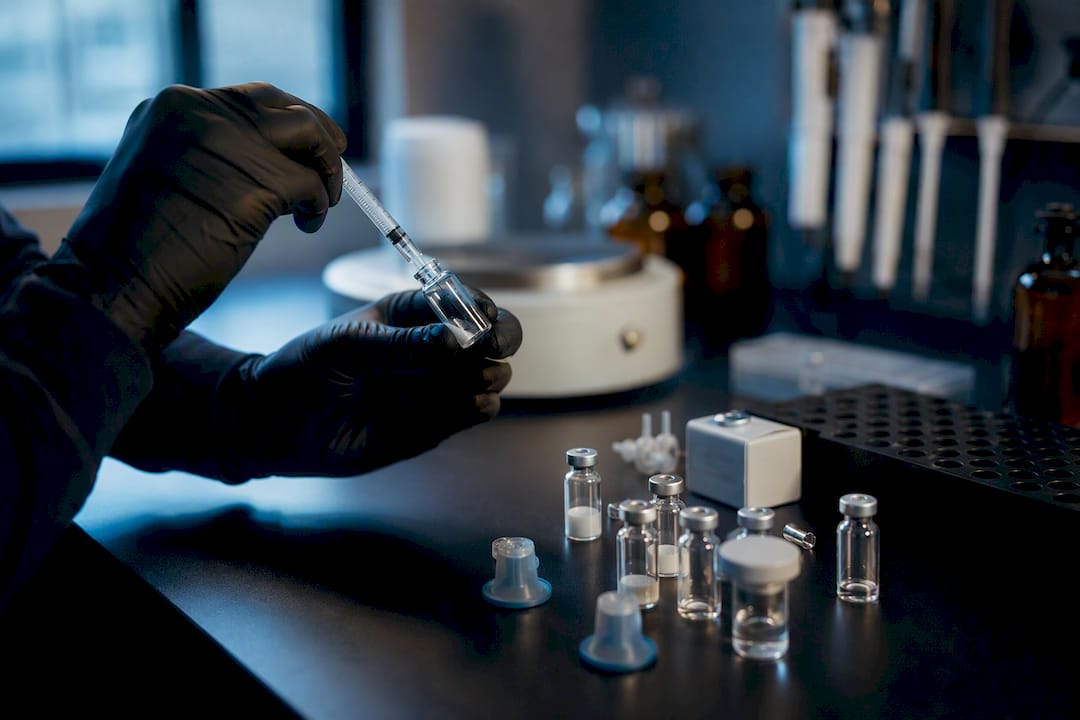
Reconstituting a lyophilized peptide requires seven items: the peptide vial itself, a diluent (typically USP-grade bacteriostatic water), a sterile transfer syringe for adding solvent, an insulin dosing syringe for measurement, alcohol swabs, gloves, and a sharps container for disposal. Bacteriostatic water is the default solvent for multi-dose vials unless your supplier’s label or protocol specifies otherwise. For single-use vials or peptides sensitive to benzyl alcohol, sterile water for injection takes its place.
The concentration math follows one formula: peptide mass (mcg) ÷ solvent volume (mL) = concentration (mcg/mL). Get this wrong and every downstream dose is wrong too.
Lyophilized peptide vial (check label for “For injection, USP” or a supplier COA)
Bacteriostatic water or sterile water for injection
Sterile transfer syringe (3 mL, 21-25 gauge)
Insulin syringe for dosing (U-100, 29-31 gauge)
Alcohol swabs and disposable gloves
Puncture-resistant sharps container
Quick math: A 5 mg vial reconstituted with 2 mL of bacteriostatic water yields 2,500 mcg/mL. PeptidesFromChina’s reconstitution calculator converts vial mass and solvent volume into mcg/mL and syringe units instantly, which removes the arithmetic step where most dosing errors originate.
Key Takeaways
Accurate peptide reconstitution depends on verified materials, correct solvent choice, precise concentration math, and supplier documentation working together, not any single step in isolation.
Point Details Default solvent Bacteriostatic water suits multi-dose vials; use sterile water only when the label specifies it. Concentration math Divide peptide mass in mcg by solvent volume in mL to get mcg/mL, then convert to syringe units. Storage window Refrigerate reconstituted vials and discard bacteriostatic-water preparations around 28 days post-puncture. Discard triggers Cloudiness, particulates, unusual odor, or exceeding the supplier’s beyond-use date mean discard, not guesswork. Verify before mixing Manufacturer-side analytical documentation may be available depending on the product and batch; PeptidesFromChina also provides a reconstitution calculator for reference.
Table of Contents
What Materials Do You Need for Peptide Reconstitution?
Bacteriostatic Water vs Sterile Water: Which Should You Use?
How Do You Calculate Peptide Reconstitution Concentration?
What Is the Correct Reconstitution Procedure?
How Long Do Reconstituted Peptides Last in Storage?
Why Is My Reconstituted Peptide Cloudy or Not Dissolving?
What Tools Help Verify Reconstitution Accuracy?
Why Precision Beats Convention in Peptide Reconstitution
Where PeptidesFromChina Fits Into Your Reconstitution Workflow
Sources
What Materials Do You Need for Peptide Reconstitution?
A procurement-ready checklist looks different from a “nice to have” list. Every item below has a minimum acceptable specification, and skipping any of them introduces variability you can’t trace back later.
Diluent: USP-grade bacteriostatic water (0.9% benzyl alcohol) or sterile water for injection. Reagent-grade or “research-grade” water that isn’t labeled sterile and pyrogen-free is not acceptable for reconstitution, regardless of purity claims on the bottle.
Transfer syringe: 1-3 mL sterile syringe, 21-25 gauge needle, for adding solvent to the vial.
Dosing syringe: U-100 insulin syringe with a fine 29-31 gauge needle for accurate subcutaneous measurement.
Alcohol swabs: Individually wrapped, 70% isopropyl alcohol, used on every stopper puncture.
Gloves and sharps container: Nitrile gloves and a rigid, puncture-resistant sharps disposal unit.
Before you reconstitute anything, verify the product itself. Check the vial label for “For injection, USP” or equivalent wording, confirm the seal is intact, check the expiration date, and cross-reference the lot number against the supplier’s certificate of analysis. Product labeling and manufacturer instructions are catalogued on DailyMed, which remains the primary reference point when you need to verify diluent type, volume, or route for a specific product.
Pro Tip: Log the lot number and COA reference in your lab notebook at the moment of reconstitution, not after. If a batch later shows a solubility or potency issue, that log is the only way to trace it back to a specific supply run.
Bacteriostatic Water vs Sterile Water: Which Should You Use?
Bacteriostatic water is sterile water with 0.9% benzyl alcohol added as a preservative, and that preservative is the entire reason it exists as a separate product category. The benzyl alcohol inhibits bacterial growth across repeated punctures, which is why bacteriostatic water for peptides is the standard choice for multi-dose vials that get drawn from over days or weeks. Its typical multi-use window runs about 28 days once refrigerated after first puncture.
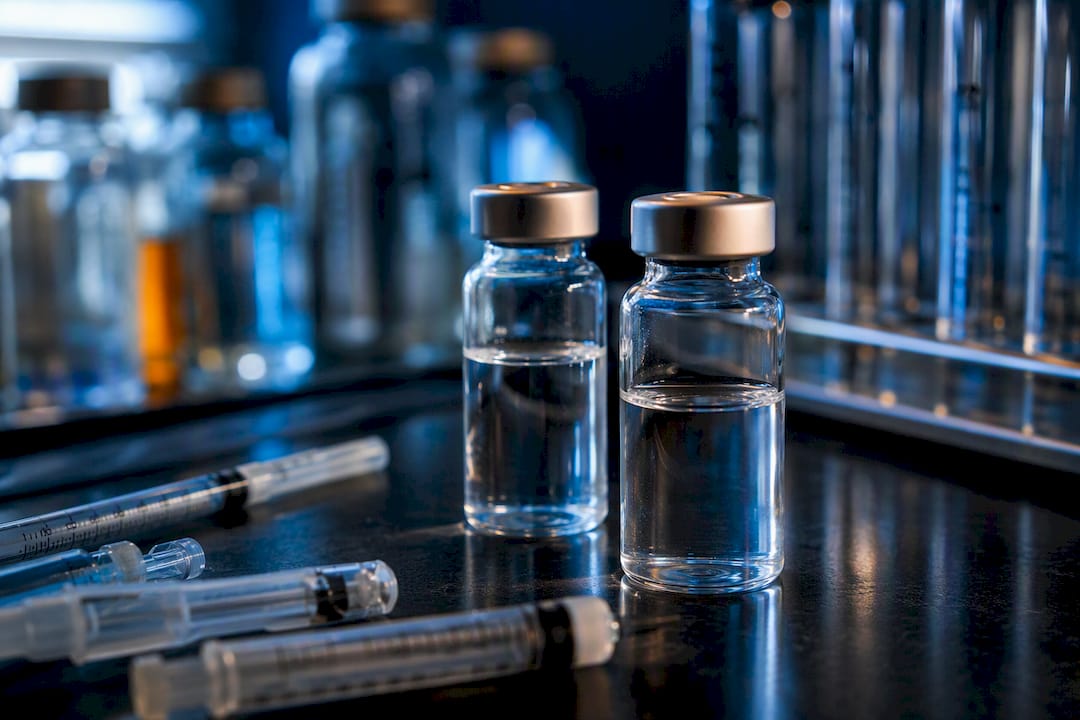
Sterile water for injection contains no preservative. That makes it single-use only, since a punctured vial without benzyl alcohol can’t reliably suppress microbial growth after the first draw. Sterile water becomes the correct choice when a supplier’s label specifies it directly, when the peptide itself is documented as benzyl-alcohol-sensitive, or in analytical contexts where a preservative would interfere with results.
A handful of peptides call for special solvents like DMSO or dilute acetic acid, but these are exceptions, not defaults. They require protocol-level validation and should only be used when supplier documentation explicitly indicates them. Benzyl alcohol is also contraindicated in specific populations and incompatible with certain peptides, so when in doubt, defer to the label rather than habit.
How Do You Calculate Peptide Reconstitution Concentration?
The formula stays constant regardless of vial size: peptide mass (mcg) ÷ solvent volume (mL) = concentration (mcg/mL). Since vials are typically labeled in milligrams, convert first (1 mg = 1,000 mcg), then divide by however many milliliters of solvent you add.
Convert vial mass from mg to mcg (multiply by 1,000).
Choose a solvent volume based on supplier guidance or desired dose granularity.
Divide mcg by mL to get concentration.
Convert concentration to insulin-syringe units (100 units = 1 mL on a U-100 syringe).
Notice the 5 mg example: 2 mL of solvent produces a concentration where common doses land close to whole syringe units. Choosing a solvent volume that yields round insulin-syringe units is standard practice for a reason. It reduces dosing errors compared to concentrations that force you to eyeball fractional units. Subcutaneous injection volume also has a practical ceiling. Most researchers keep single-site injections under 1 mL for comfort, so don’t oversize your solvent volume just to get round numbers if it pushes individual doses past that threshold.
What Is the Correct Reconstitution Procedure?
Technique matters as much as materials. A correct solvent choice paired with sloppy handling still introduces contamination or degrades the peptide before you get a usable sample.
Prepare your workspace. Clean a flat surface, gather all materials, and let refrigerated vials reach room temperature before puncturing.
Swab both stoppers. Alcohol-swab the peptide vial and diluent vial tops, and let them air-dry fully.
Draw the diluent. Insert the transfer syringe needle into the solvent vial at an angle, invert, and draw the calculated volume while clearing air bubbles.
Add solvent slowly. Insert the needle through the peptide vial stopper and let the solvent run down the interior glass wall rather than streaming directly onto the lyophilized cake. A direct stream creates foam and can denature protein at the air-liquid interface.
Dissolve gently. Roll the vial between your palms or swirl it gently. Rolling minimizes shear forces compared to shaking, which can damage peptide structure. Never vortex.
Confirm and label. Check for a clear solution with no particulates, then label the vial with concentration, reconstitution date, and lot number.
Pro Tip: If a peptide seems slow to dissolve, give it a few minutes of gentle rolling before assuming there’s a problem. Some lyophilized cakes, especially larger-mass peptides, take longer to fully clear than a quick swirl allows for.
How Long Do Reconstituted Peptides Last in Storage?
Store reconstituted vials at 2 to 8°C, protected from light, standing upright, and never frozen. Freezing a reconstituted peptide risks structural damage from ice crystal formation that a lyophilized (unmixed) vial doesn’t face.
Bacteriostatic-water vials: typically safe for about 28 days after first puncture, based on microbial risk from repeated stopper access.
Peptide-specific chemical stability can differ from that window. Some peptides remain chemically stable for 3 to 6 weeks, others degrade faster. Supplier documentation and the COA take precedence over generic timelines.
Discard immediately if you see cloudiness, visible particulates, an unusual odor, or if you’ve passed the supplier-stated beyond-use date, even if the solution still looks clear.
Why Is My Reconstituted Peptide Cloudy or Not Dissolving?
Cloudiness after reconstitution is not a “wait and see” situation. Confirm the COA and lot number first, then inspect the vial under good light. Visible particulates or persistent cloudiness after several minutes of gentle rolling means the vial should be discarded rather than used, since you can’t reliably distinguish incomplete dissolution from contamination or degradation by eye alone.
Partial dissolution: allow additional gentle rolling time before concluding there’s a problem; avoid heating the vial unless your protocol explicitly permits it.
Measurement mistakes: recheck your math against the golden formula, or better, run it through a reconstitution calculator rather than adjusting a dose by guesswork.
Contamination signs (unexpected odor, discoloration, floating debris): stop use immediately, document the lot number, contact the supplier, and follow your institution’s incident reporting process if applicable.
For persistent solubility issues across multiple vials from the same batch, a structured troubleshooting approach helps isolate whether the problem is solvent choice, technique, or the batch itself.
What Tools Help Verify Reconstitution Accuracy?
Manual arithmetic is where most dosing errors originate, not technique. Running your vial mass and target solvent volume through the PeptidesFromChina reconstitution calculator removes that failure point and helps you land on a solvent volume that produces whole insulin-syringe units.
Use the calculator before you draw any solvent, not after, to confirm your target concentration matches your dosing plan.
Request supplier COA access for every batch. Purity percentage, residual solvent content, and water content all affect actual peptide mass in the vial, which shifts your real concentration even when the label mass is correct.
Log lot numbers at the point of reconstitution so a solubility or potency problem can be traced to a specific manufacturing run instead of guessed at retroactively.
Batch traceability isn’t a bureaucratic formality. When two vials from the same product line behave differently under identical reconstitution technique, the COA and lot log are usually the only way to figure out whether the batch, the storage chain, or your own process is the variable that changed.
Why Precision Beats Convention in Peptide Reconstitution
The conventional advice on this topic treats reconstitution like a recipe: add water, swirl, inject. That framing undersells how much variability sits upstream of the vial you’re holding. Two vials labeled identically can carry different actual peptide mass if residual moisture content differs between batches, and no amount of careful technique at reconstitution corrects for that.
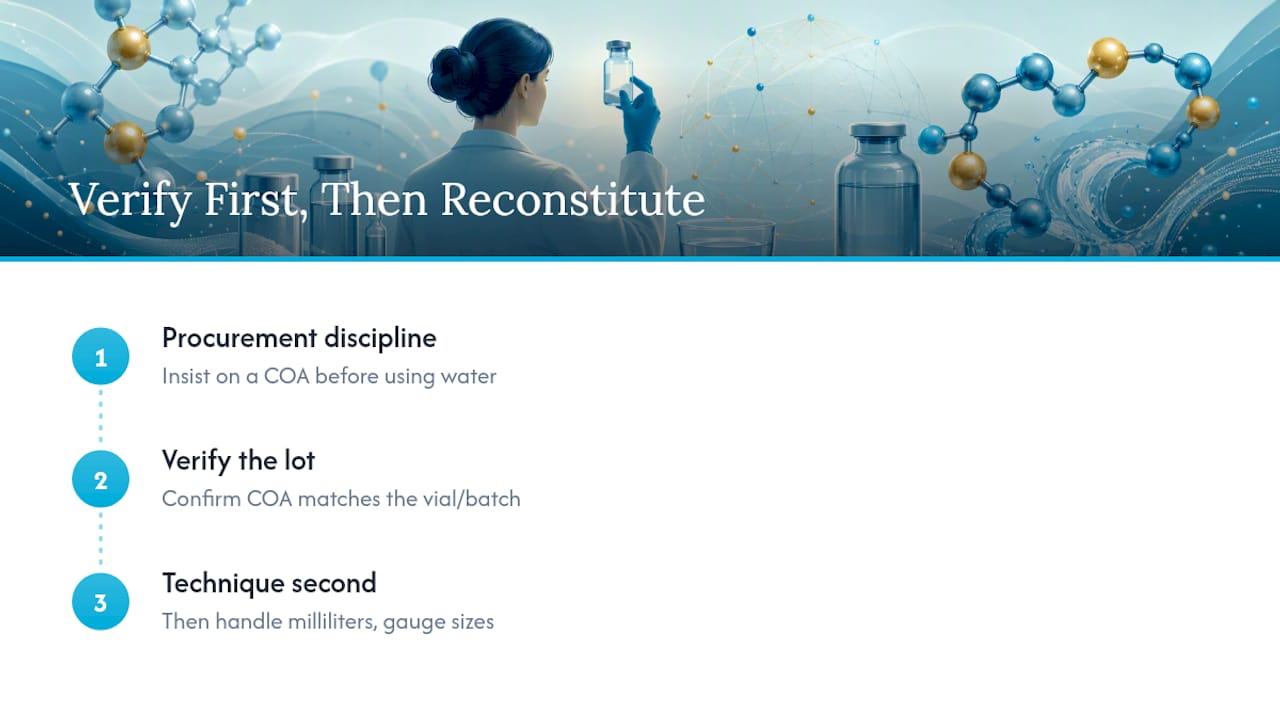
What the research on this topic actually supports is a shift in priority. Technique matters, but it’s the second problem to solve. The first is knowing what’s actually in the vial, which means insisting on a COA before you ever reach for bacteriostatic water. Most guidance treats the COA as optional paperwork. It isn’t. It’s the only record that tells you whether a solubility problem originates from your process or from the batch itself.
The reader’s actual first move should be procurement discipline, not syringe technique. Get the COA, verify the lot, then worry about milliliters and gauge sizes. A perfectly executed reconstitution of a poorly verified peptide is still an unreliable result.
— Sam Levin
Where PeptidesFromChina Fits Into Your Reconstitution Workflow
Getting reconstitution math and technique right only matters if the material is suitable for the planned research. Products are subject to the manufacturer’s applicable quality-control procedures and specifications. Manufacturer-side analytical documentation may be available depending on the product and batch. PeptidesFromChina is not an independent analytical testing laboratory. Buyers requiring independent verification may arrange third-party analytical testing.
The platform’s reconstitution calculator pairs directly with that documentation. You get the actual peptide mass and purity data from the COA, then run it through the calculator to confirm your solvent volume and dosing units before you ever draw a syringe. For researchers working with signaling peptides or longevity compounds like Epithalon, that COA is included with the batch rather than requested after the fact.
If your current sourcing channel doesn’t hand you a certificate of analysis alongside the vial, that’s a gap worth closing before your next order. Browse research-grade KPV and other catalog listings to see what batch documentation looks like when it’s built into the procurement process from the start.
Sources
Bacteriostatic water for peptides: How much to use — Rite Aid
Bacteriostatic water for peptides: A practical guide — DoneDose
This article is general information, not a substitute for advice from a qualified doctor. Consult a qualified healthcare professional about your own circumstances before acting on anything here.